

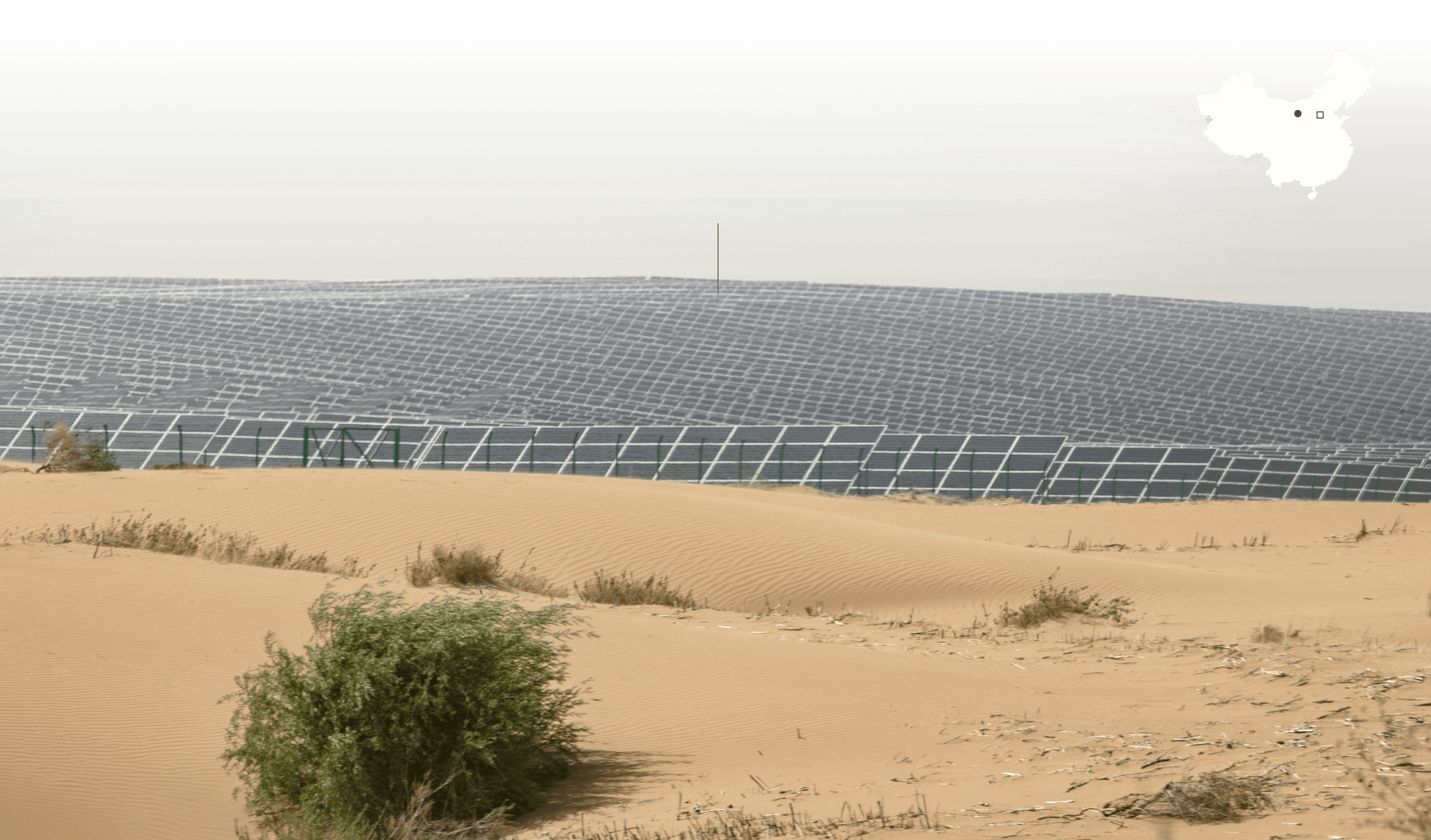
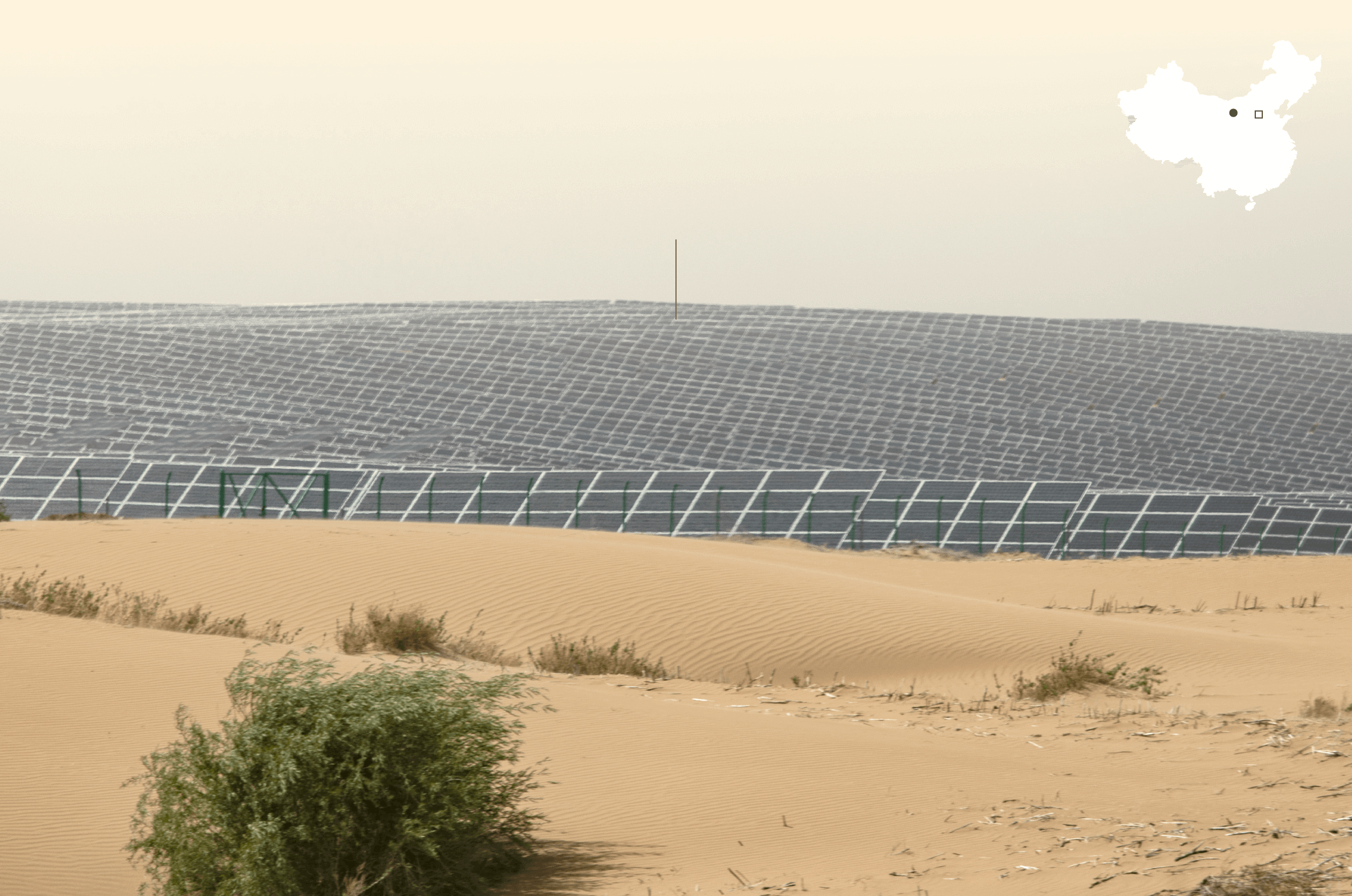
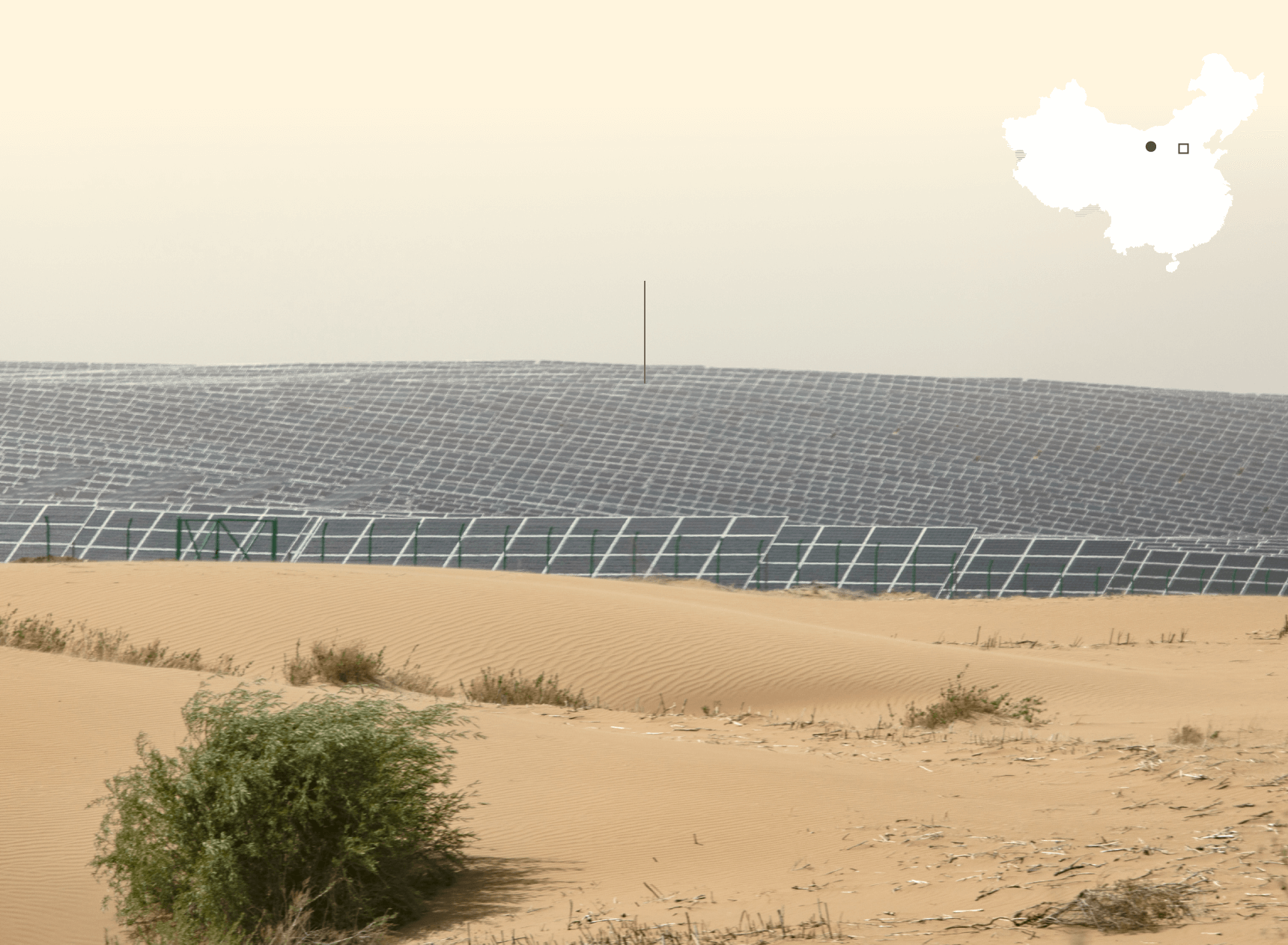
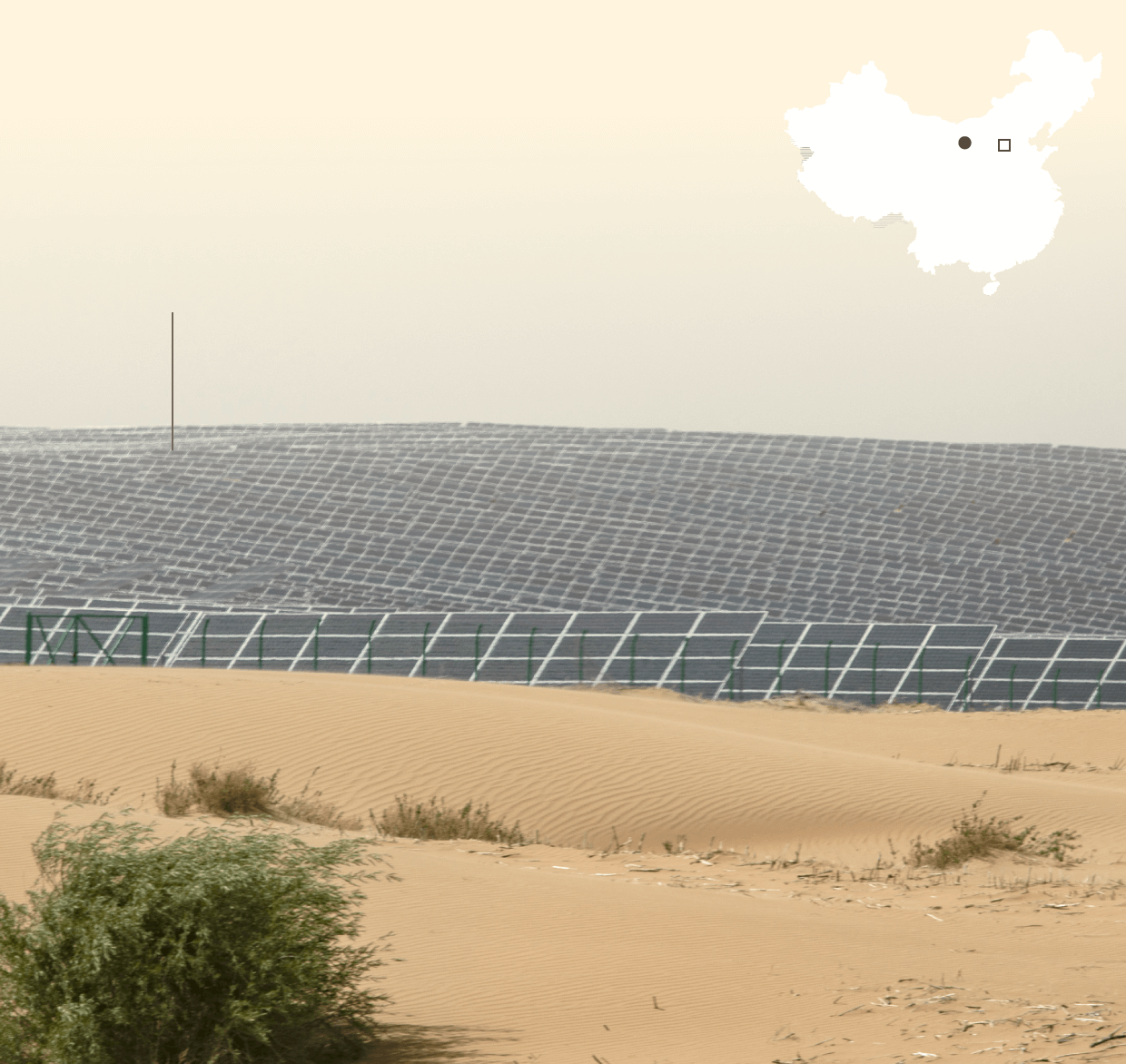
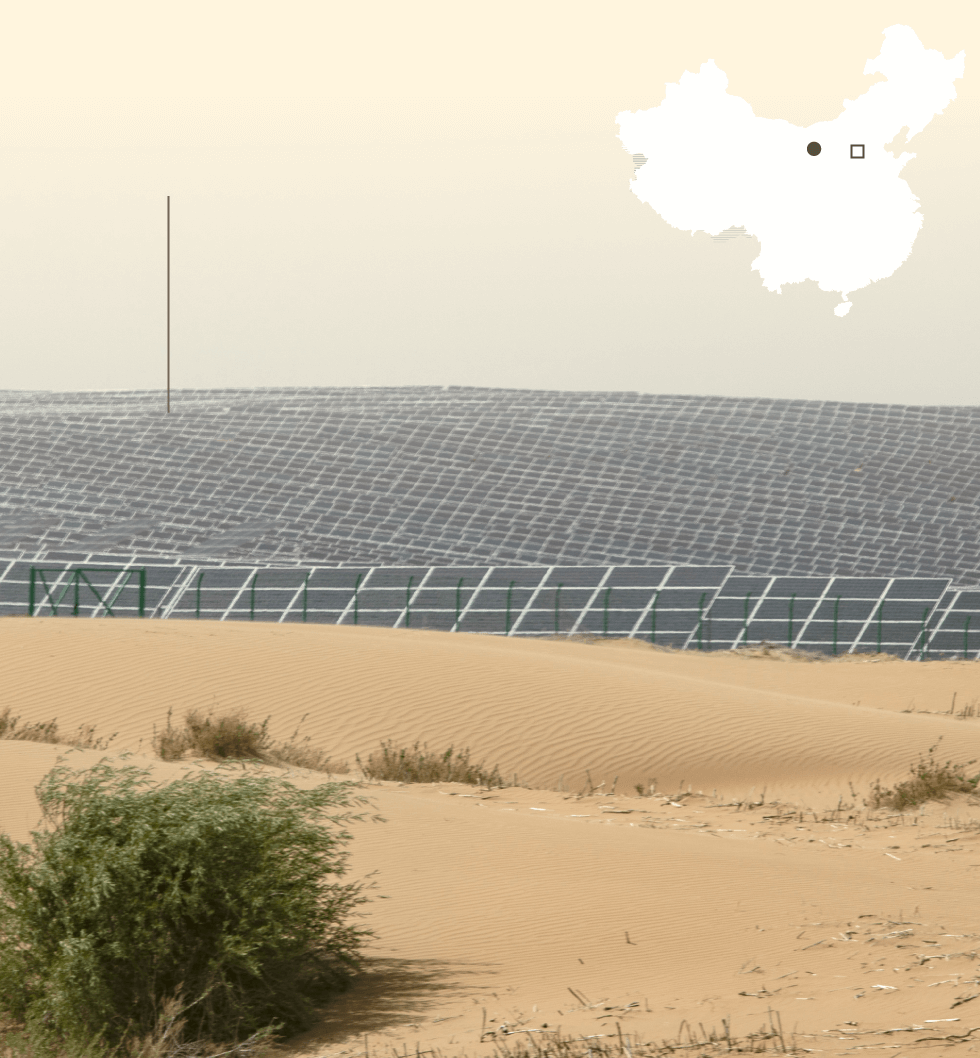
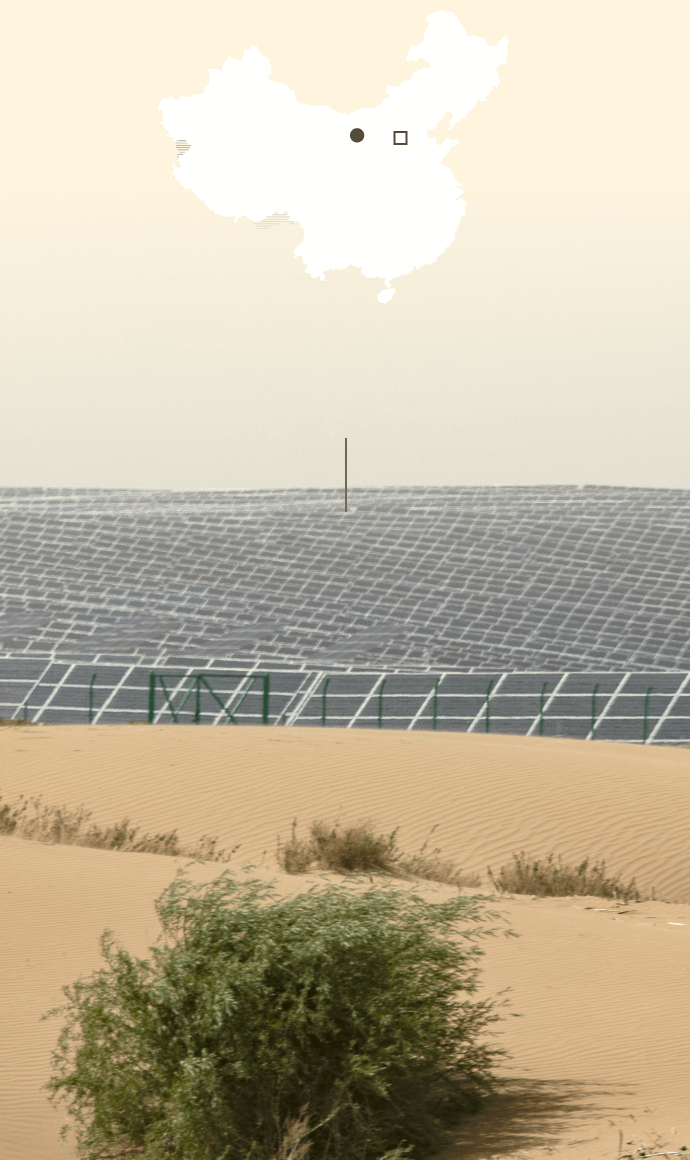
Out of the rolling yellow dunes of the Kubuqi desert arises what appears to be an oasis, shimmering blue beneath the northern China sky.
Row after row of hundreds of solar panels cover this otherwise barren stretch of Inner Mongolia, about 500 kilometers (311 miles) inland from Beijing. They’re the centerpiece of a clean energy project the size of 20 Central Parks that provides enough electricity for 1.1 million homes.
The mammoth site is just one small piece of President Xi Jinping’s plan to deliver the largest ever deployment of man-made power capacity. By the end of this decade, China aims to build the equivalent of 225 more of these massive renewables bases across vast swathes of the country’s interior.
Kubuqi Desert
Beijing
MAINLAND
CHINA
Solar panels in a Kubuqi Desert project which will help generate enough electricity to power more than 1 million homes
Kubuqi Desert
Kubuqi Desert
Beijing
MAINLAND
CHINA
Solar panels in a Kubuqi Desert project which will help generate enough electricity to power more than 1 million homes
Kubuqi Desert
Kubuqi Desert
Beijing
MAINLAND
CHINA
Solar panels in a Kubuqi Desert project which will help generate enough electricity to power more than 1 million homes
Kubuqi Desert
Kubuqi Desert
Beijing
MAINLAND
CHINA
Solar panels in a Kubuqi Desert project which will help generate enough electricity to power more than 1 million homes
Kubuqi Desert
Solar panels in a Kubuqi Desert project which will help generate enough electricity to power more than 1 million homes
Kubuqi Desert
Beijing
MAINLAND
CHINA
Kubuqi Desert
Kubuqi Desert
Beijing
MAINLAND
CHINA
Solar panels in a Kubuqi Desert project which will help generate enough electricity to power more than 1 million homes
Kubuqi Desert
It’s a campaign that promises an upheaval across the energy sector: curbing China’s demand for fossil fuels, trimming its reliance on energy imports and steering the world’s biggest polluter toward a feasible path to zero out its greenhouse gas emissions.
Once complete, the renewables bases will total 455 gigawatts of wind turbines and solar panels. That’s more clean energy generation capacity than is currently available in any nation outside China, and almost the size of the entire power network — including coal plants and nuclear reactors — in India, the world’s third-largest system.
“It’s mind-blowing,” said Cosimo Ries, a Shanghai-based energy analyst with Trivium China. “There’s nothing in history you can benchmark this against.”
Few details on China’s desert developments have been disclosed since Xi outlined his vision for the strategy in a 2021 speech. Now, work by Bloomberg News and analysts at BloombergNEF to visit sites, interview those involved and review thousands of pages of government documents and industry databases is offering the first major assessment of progress.
The analysis reveals a rollout of solar and wind that’s put China on track to reach records this year that far exceed its already world-beating adoption of green energy. So much clean power is coming online that the country could reach peak emissions well ahead of its 2030 deadline, giving the planet a better chance of keeping global temperatures in check.
It’s also a crucial example as COP28 President Sultan Al Jaber pushes more than 200 countries to use the United Nations climate summit opening in Dubai this week to commit to a tripling of renewable power generation this decade. Achieving the target is probably the most important action the world can take to hit net zero, according to the International Energy Agency.
China will lift renewables capacity to about 3.9 terawatts by 2030, more than three times the amount in 2022, BNEF said in a report last week. Al Jaber is urging attending nations in the UAE to aim to lift the global total to 11 terawatts.
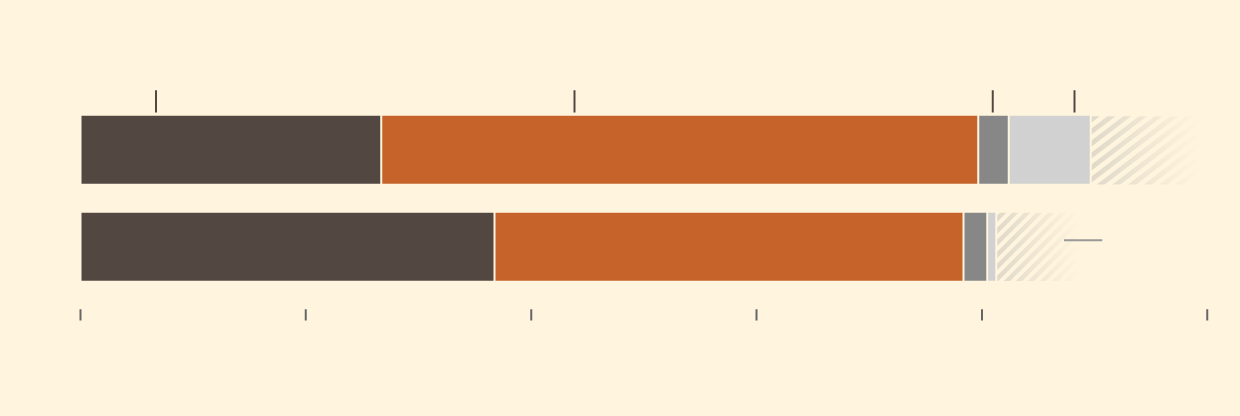
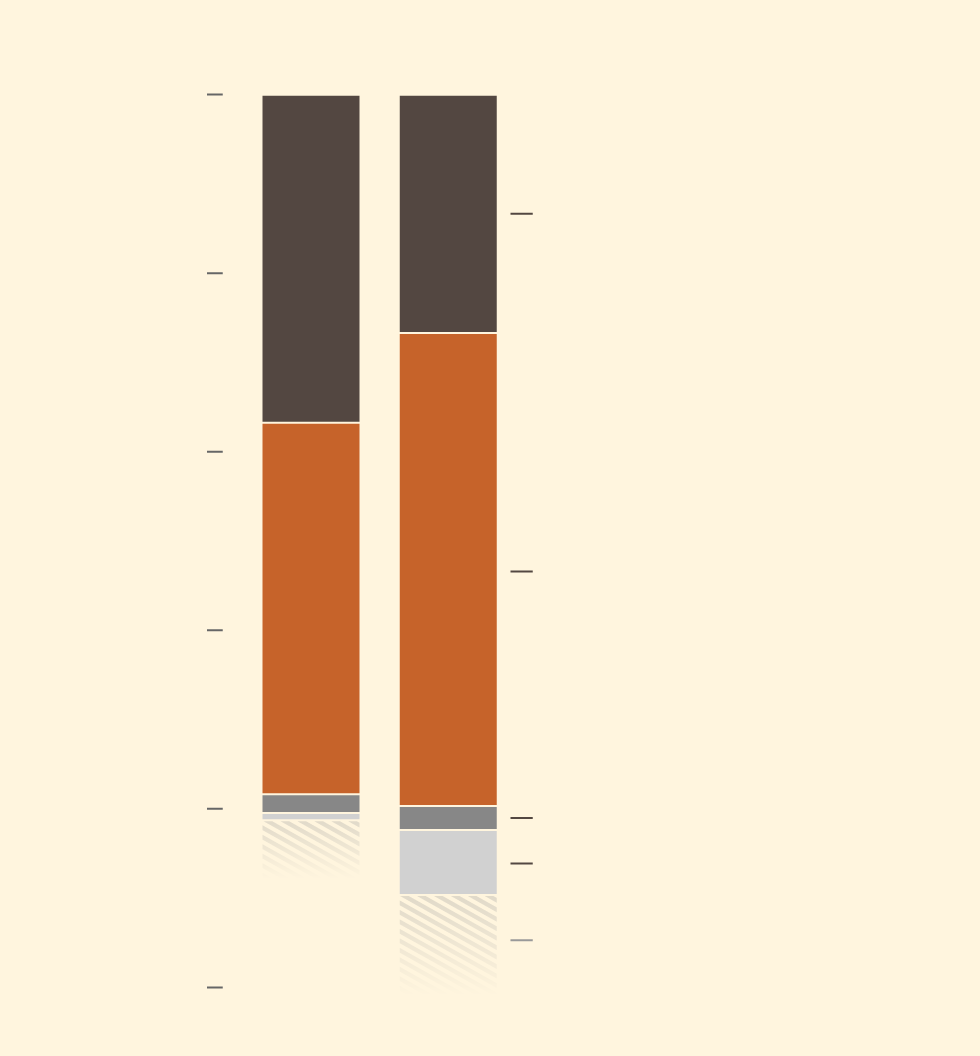
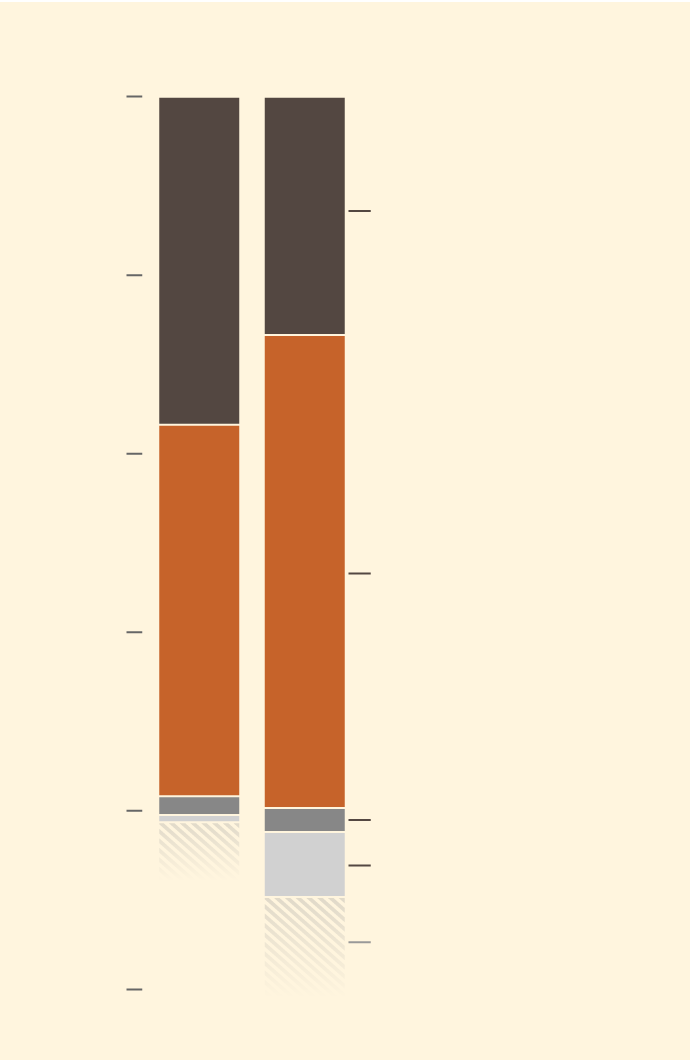
Efforts to assess the desert strategy uncovered details of about 90 gigawatts of the planned 97 gigawatts being added in a first batch of projects, all of which are intended to be installed by the end of this year.
Deployments On Track
Operating
Financing secured/under construction
Approved
Announced
Solar
Unknown
status
Wind
0
10
20
30
40
50GW
capacity
Installed
capacity
Wind
Solar
0
Operating
10GW
20
Financing secured/
under construction
30
40
Approved
Announced
Unknown status
50
Installed
capacity
Wind
Solar
0
Operating
10GW
20
Financing secured/
under construction
30
40
Approved
Announced
Unknown status
50
As of early this month, about a third of capacity was completed and a further half was being built. The nation’s developers are known for end-of-year rushes to meet construction deadlines. One gigawatt is about the equivalent of capacity at a typical nuclear reactor.
For a small volume of capacity, there’s still no clear sign that work has begun, according to BNEF. Some projects that were rushed into planning after Xi’s announcement are now being challenged by local land use or environmental authorities, including a development in Inner Mongolia that’s been accused of damaging forests.
The speed at which projects are being deployed has already led several forecasters to upgrade their estimates for renewables adoption this year. China will install more than 300 gigawatts of solar and wind capacity in 2023, almost double the volume a year earlier, according to BNEF forecasts. The entire global total in 2022 was 338 gigawatts.
“China is relying on these large wind and solar bases to play a key role in its new energy system,” said Michal Meidan, head of China energy research at the Oxford Institute for Energy Studies.
The initial batch of projects focuses heavily on China’s deserts, including the Gobi in the north and the Takla Makan in the west. Both have played a key role in the nation’s development, providing natural boundaries that protected the country from outside invaders and limited the landward expansion of its historical empires.
They also offer benefits for renewable energy: wide skies and open plains with China’s most consistent sunshine and steady winds. They’re sparsely populated too, making it far easier to construct large-scale projects.
And there’s an economic advantage. Land is cheap because there’s little competition for space with major agriculture or real estate development, and the vast scale of many developments can help lower costs. Those factors mean the desert bases will likely be among the cheapest sources of power in the world, according to Ries.
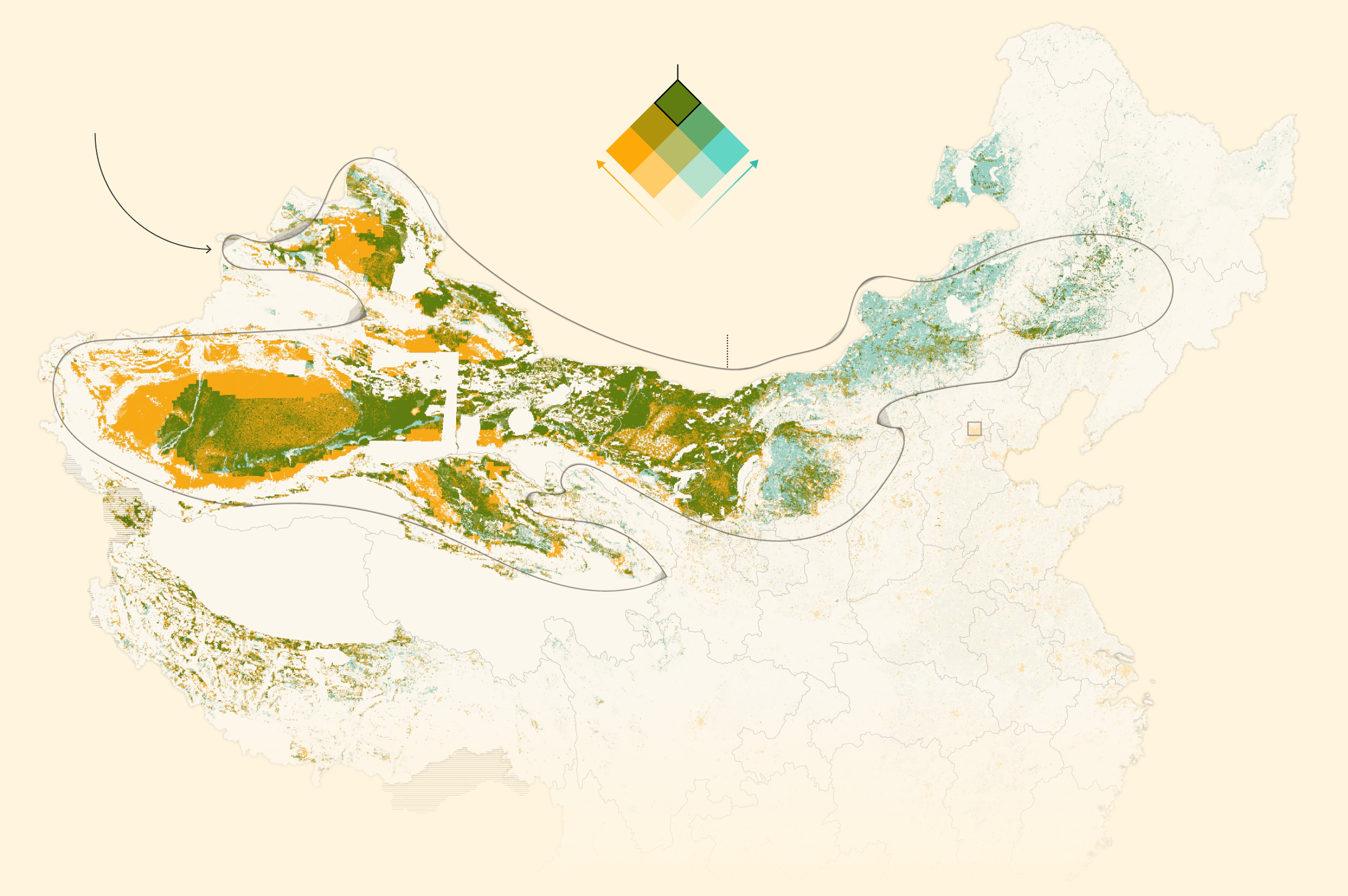
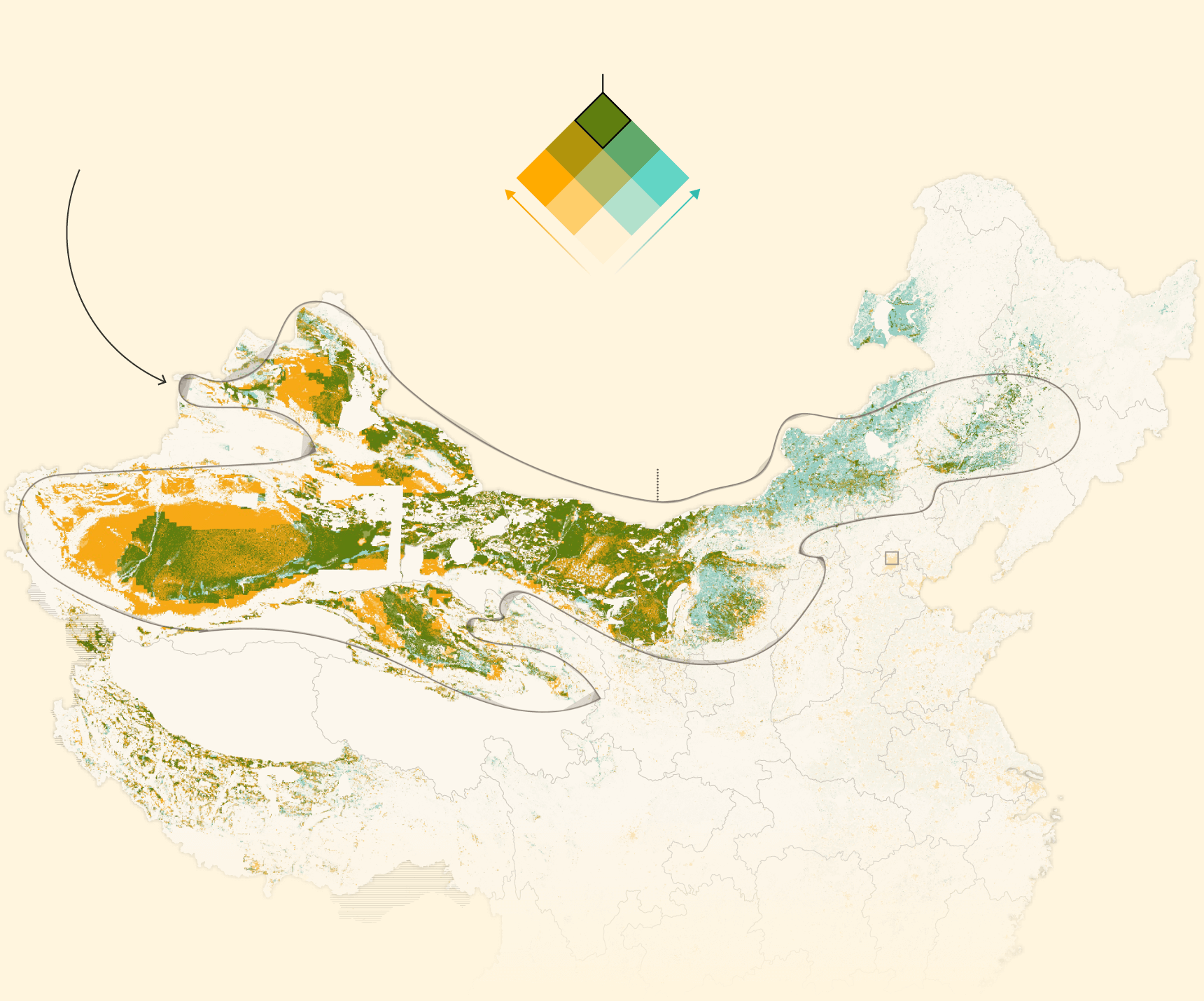
According to a study from the China Meteorological Administration, desert areas are some of the most ideal locations for clean energy, given the amount of sunshine, wind speed and land availability
Areas ideal for both
solar and wind power projects
Heilongjiang
More suitable for building solar power projects
More suitable for building wind power projects
Jilin
Desert areas
Xinjiang
Gansu
Beijing
Inner Mongolia
Qinghai
Protected natural reserves
Shanghai
MAINLAND CHINA
Tibet
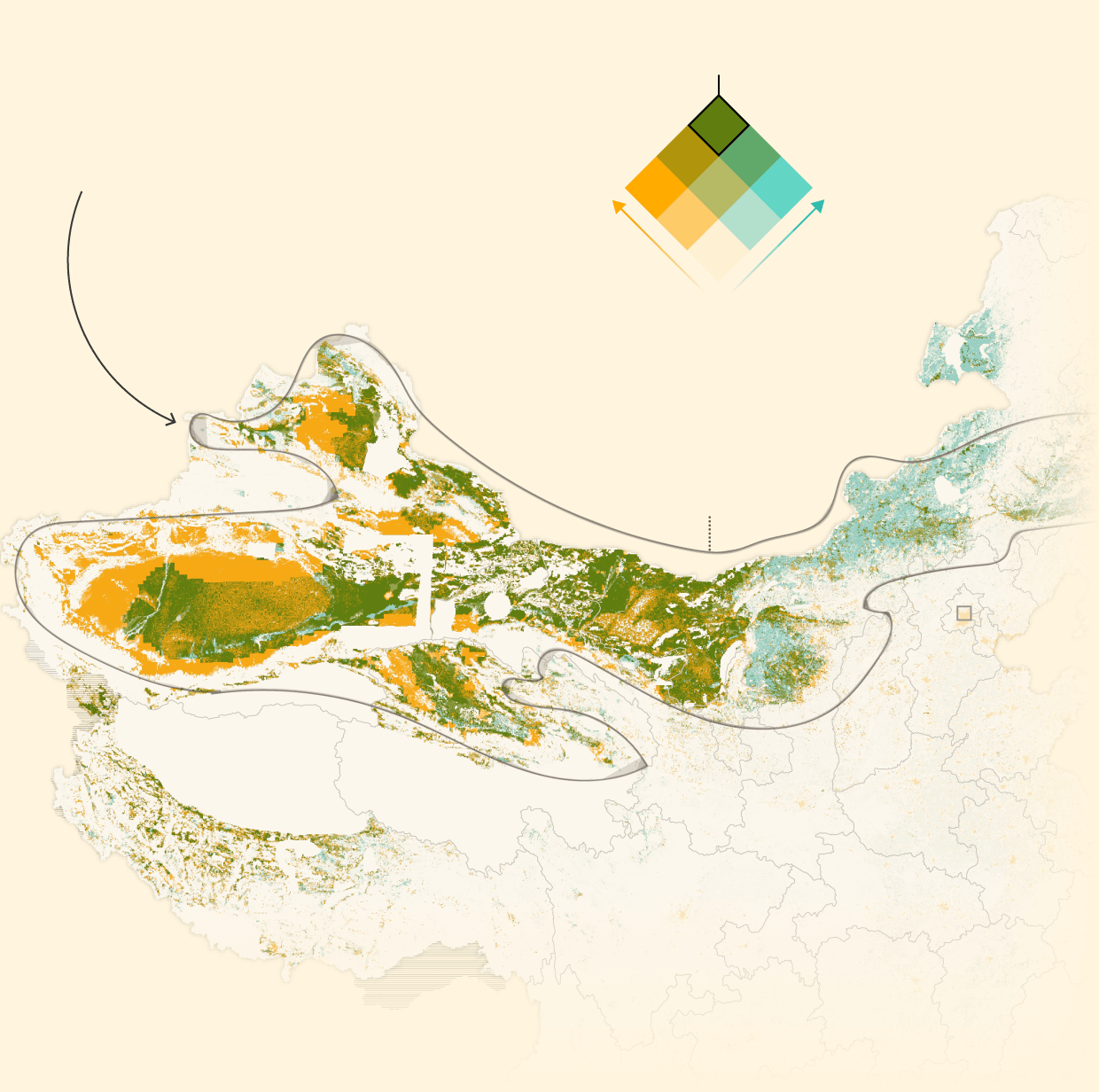
According to a study from the China Meteorological Administration, desert areas are some of the most ideal locations for clean energy, given the amount of sunshine, wind speed and land availability
Areas ideal for both
solar and wind power projects
More suitable for building solar power projects
More suitable for building wind power projects
Heilongjiang
Jilin
Desert areas
Xinjiang
Gansu
Beijing
Inner Mongolia
Qinghai
Protected natural reserves
Shanghai
MAINLAND CHINA
Tibet
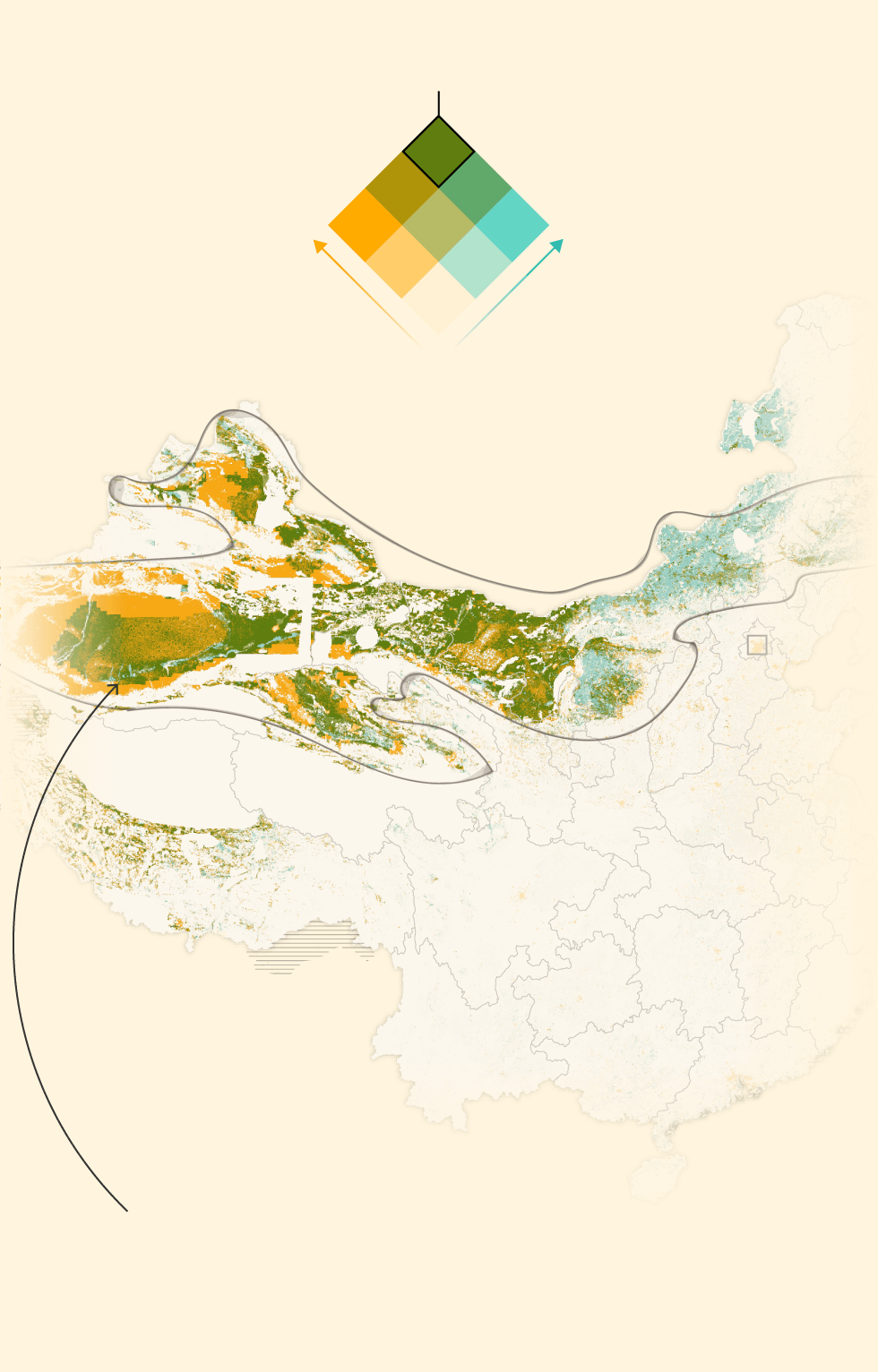
According to a study from the China Meteorological Administration, desert areas are some of the most ideal locations for clean energy, given the amount of sunshine, wind speed and land availability
Areas ideal for both
solar and wind power projects
More suitable for building wind power projects
More suitable for building solar power projects
Desert areas
Xinjiang
Gansu
Beijing
Inner Mongolia
Qinghai
Protected natural reserves
MAINLAND CHINA
Tibet
BORDER FIX HERE
Areas ideal for both
solar and wind power projects
More suitable for building solar power projects
More suitable for building wind power projects
Inner Mongolia
Gansu
Xinjiang
Beijing
Qinghai
Protected natural reserves
MAINLAND
CHINA
Tibet
According to a study from the China Meteorological Administration, desert areas are some of the most ideal locations for clean energy, given the amount of sunshine, wind speed and land availability
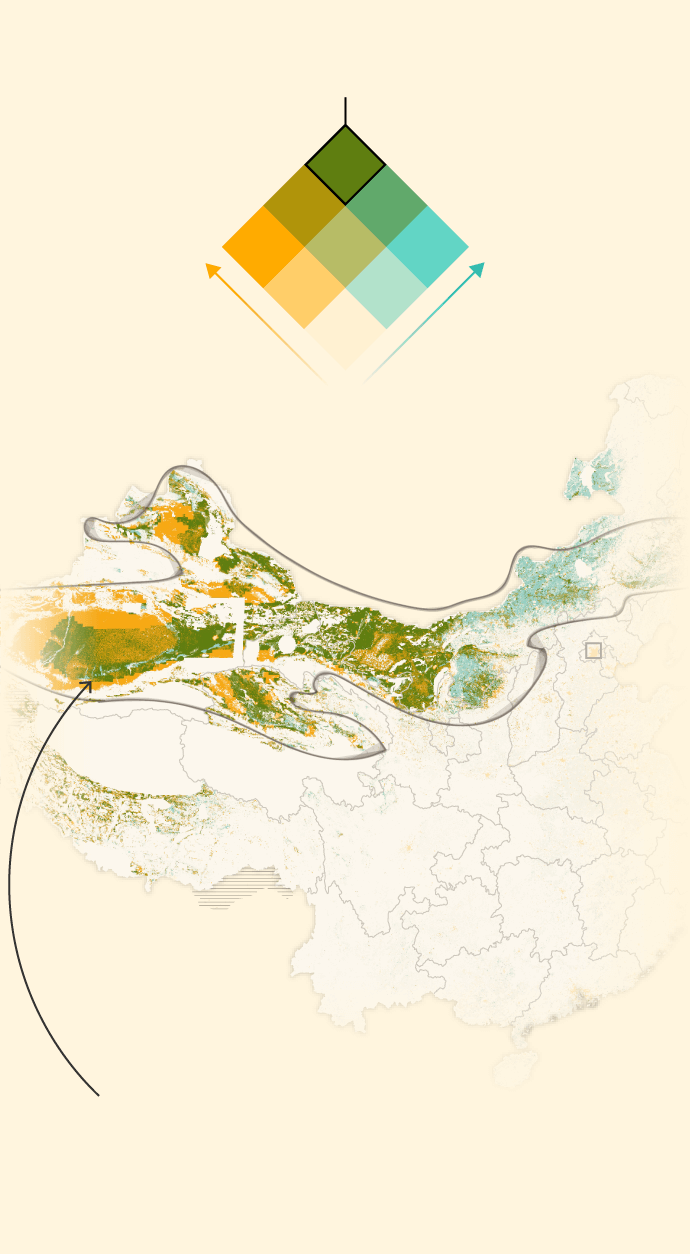
Areas ideal for both
solar and wind power projects
More suitable for building solar power projects
More suitable for building wind power projects
Inner Mongolia
Gansu
Xinjiang
Beijing
Qinghai
Protected natural reserves
Tibet
MAINLAND
CHINA
According to a study from the China Meteorological Administration, desert areas are some of the most ideal locations for clean energy, given the amount of sunshine, wind speed and land availability
That’s potentially crucial at a time when the world’s clean energy sector is coming under its most severe financial pressure in years, even as installations boom and with an estimated $1 billion a day being invested in solar alone.
Companies are being squeezed by volatile costs, high interest rates, and — particularly in China — fierce competition that’s driven down prices of clean energy technologies by almost 80% since 2010.
Constructing large-scale energy bases can help take advantage of China’s now mature clean energy industries, according to Liu Hanyuan, the billionaire founder of Tongwei Group, which owns one of the world’s largest solar firms. “They can support the country to accelerate its energy transition,” Liu said at a Chengdu conference this month. China “can even complete the process ahead of Western countries.”
Hundreds more gigawatts of capacity is planned, and some projects in the program’s second batch are already underway
Among beneficiaries from the roll-out are China’s massive state-owned utilities. China Energy Investment Corp., China Three Gorges Corp., China Datang Corp., China Huaneng Group Co. and State Power Investment Corp., have all had involvement in projects so far.
The desert power bases will also help shore up domestic demand for Chinese suppliers of renewable energy equipment, which have aggressively added capacity and face trade curbs or increased scrutiny in export markets including the US and European Union.
Three further batches of projects under Xi’s strategy will add another 358 gigawatts of solar and wind energy capacity by the end of the decade.
Future phases could prove more difficult to progress as they’ll be reliant on China’s efforts to extend its network of ultra-high voltage power lines, which can transmit electricity across thousands of kilometers.
The ability to link far-flung power generation hubs to urban demand centers has stymied development of massive clean power projects in places like the windswept plains of the central US, or the sun-soaked deserts of northern Australia.
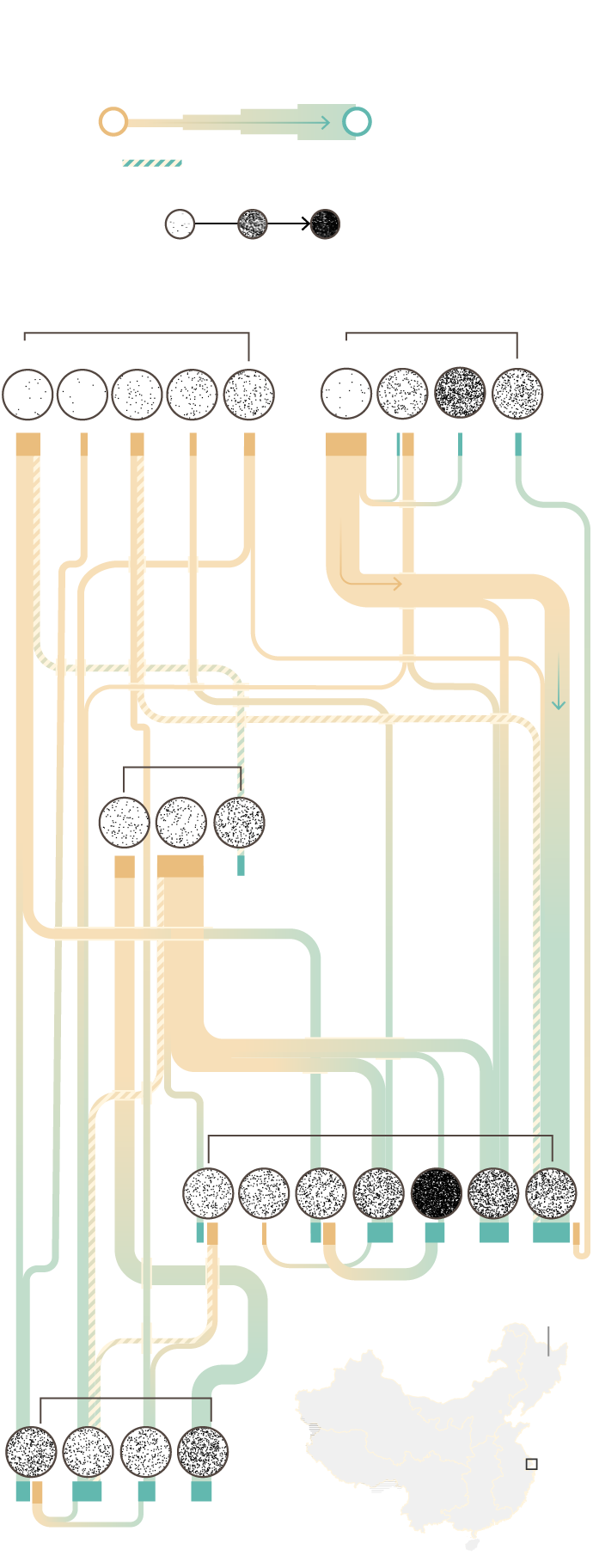
China’s solution is a national network of new power lines that could take decades and cost as much as $300 billion to install. It’s already built more than 30 such conduits, while the rest of the world has only a handful.
Transmitting Power
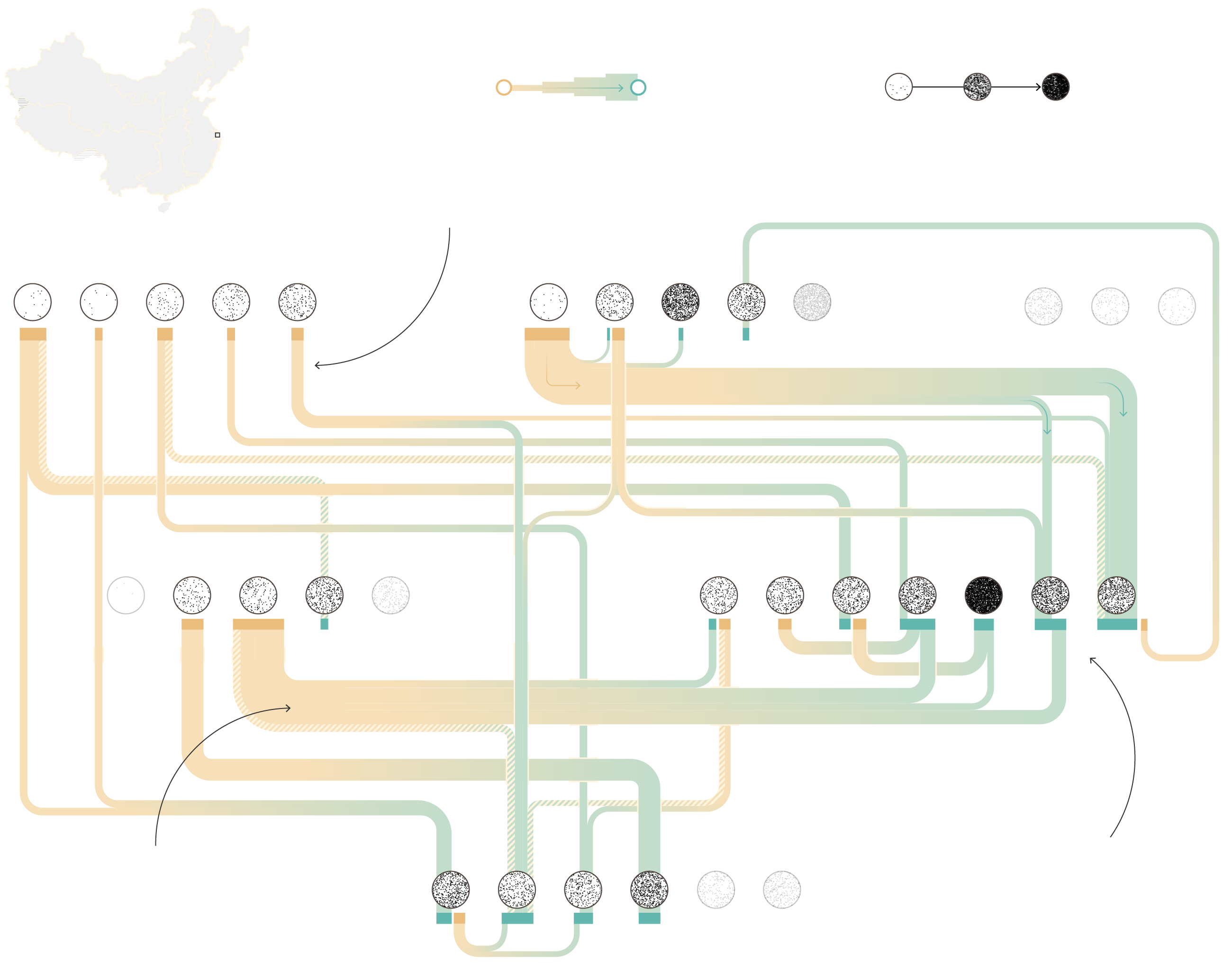
Line width represents delivery capacity of the UHV power line
Northeast
Population density
North
Northwest
Source province
Higher
Destination
Lower
Shanghai
West
East
Allows less-populated areas rich in sunlight, wind and coal to build more power generation than they can use themselves
South
Northwest China
North
Northeast
Inner
Mongolia
Xinjiang
Qinghai
Gansu
Ningxia
Shaanxi
Shanxi
Tianjin
Hebei
Beijing
Liaoning
Jilin
Heilongjiang
No UHV lines
Bring energy from Inner Mongolia to provinces like Shandong and Jiangsu
Under construction/approved
Southwest
East
Chongqing
Yunnan
Sichuan
Tibet
Guizhou
Jiangxi
Fujian
Anhui
Zhejiang
Shanghai
Jiangsu
Shandong
South
UHV lines exporting power from mega-dams contributed to power shortages in Southwest China last year
Helps densely populated mega-cities meet their rapidly growing demand for electricity
Henan
Hubei
Hunan
Guangdong
Guangxi
Hainan
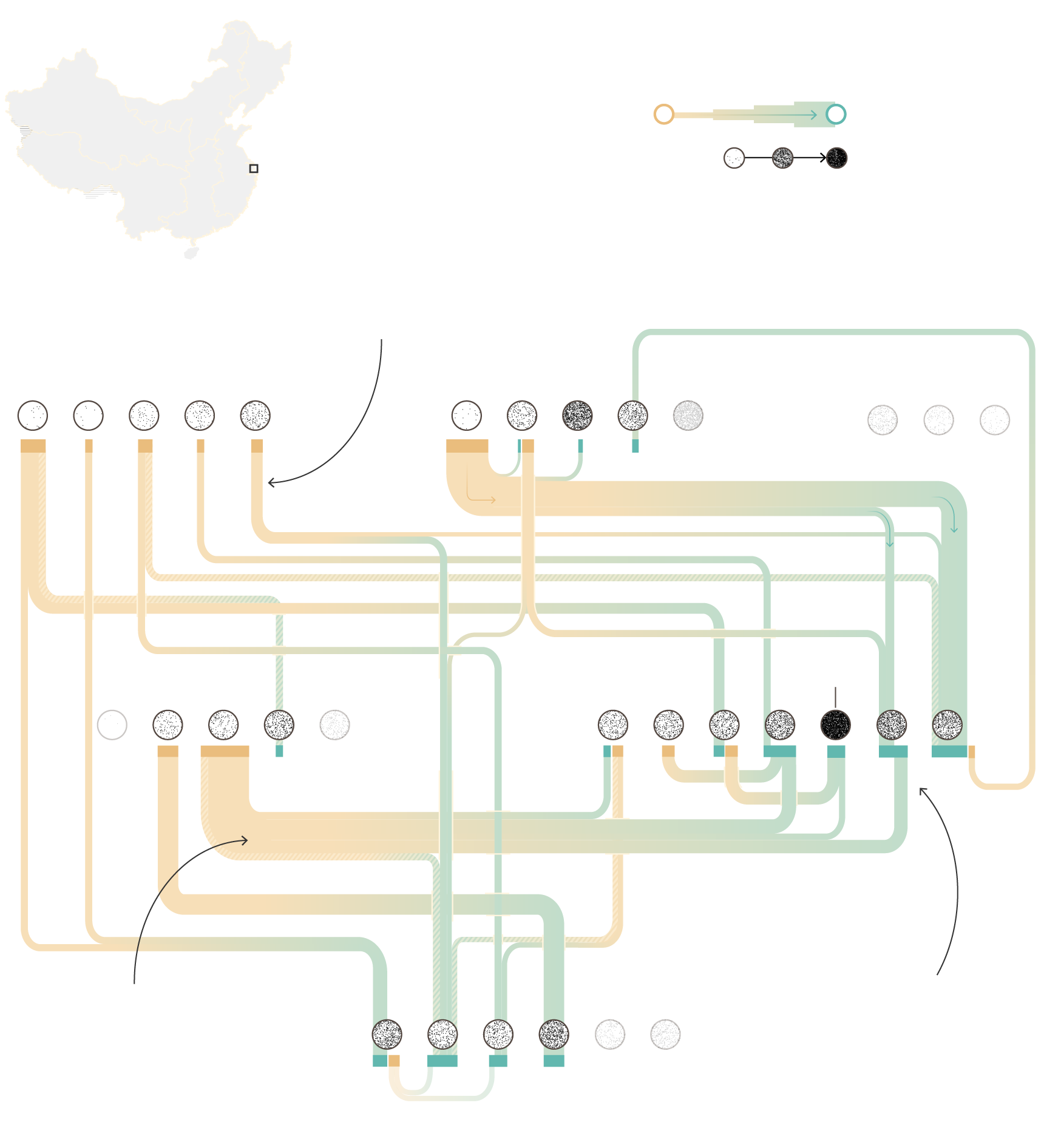
Line width represents delivery capacity of the ultra-high voltage power line
Northeast
North
Northwest
Source province
Destination
Higher
Lower population density
Shanghai
West
East
South
Allows less-populated areas rich in sunlight, wind and coal to build more power generation than they can use themselves
Northwest China
North
Northeast
Inner
Mongolia
Xinjiang
Qinghai
Gansu
Ningxia
Shaanxi
Shanxi
Tianjin
Hebei
Beijing
Liaoning
Jilin
Heilongjiang
No UHV lines
Bring energy from Inner Mongolia to provinces
like Shandong and Jiangsu
Under construction/approved
Southwest
East
Shanghai
Jiangxi
Fujian
Anhui
Zhejiang
Jiangsu
Shandong
Chongqing
Yunnan
Sichuan
Tibet
Guizhou
South
UHV lines exporting power from mega-dams contributed to power shortages in Southwest China last year
Helps densely populated mega-cities meet their rapidly growing demand for electricity
Henan
Hubei
Hunan
Guangdong
Hainan
Guangxi
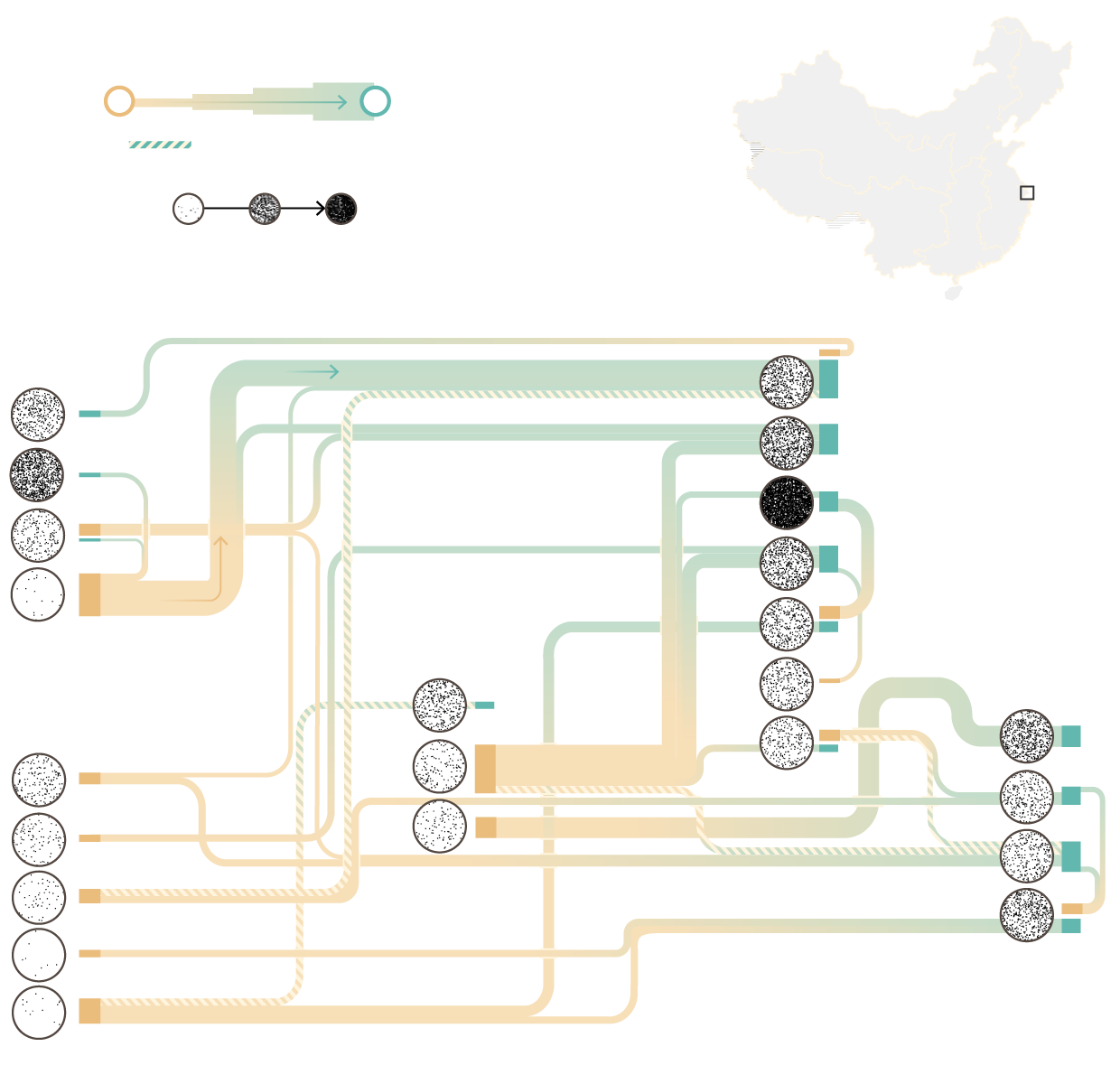
Line width represents delivery capacity of the UHV power line
Northeast
Source
province
Destination
North
Northwest
Under construction
Shanghai
West
More populated
Less populated
East
South
East China
Bring energy from Inner Mongolia
to provinces like Shandong
North
Helps densely populated mega-cities meet their rapidly growing demand for electricity
Shanghai
Inner Mongolia
Southwest
South
Northwest
Sichuan
Hubei
Allows less-populated areas rich in sunlight, wind and coal to build more power generation than they can use themselves
Xinjiang
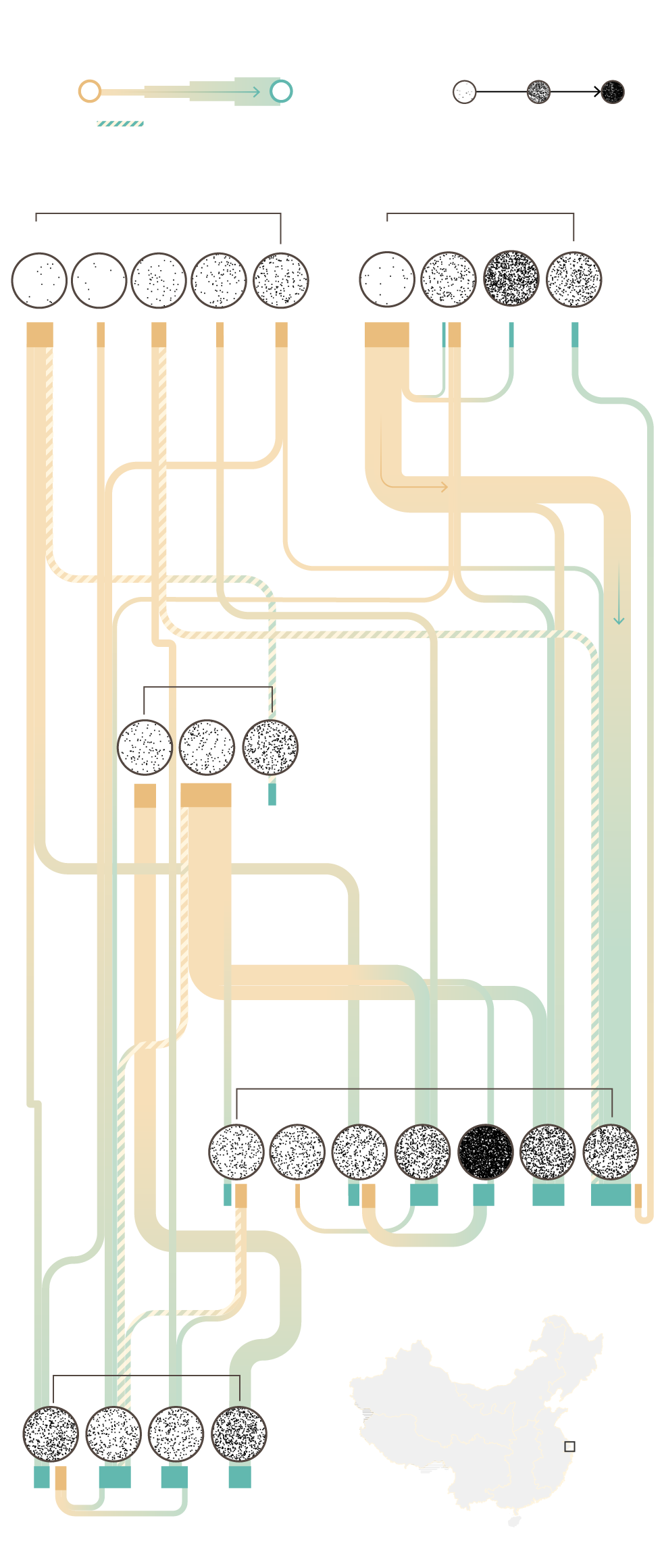
Line width represents delivery
capacity of the UHV power line
More
populated
Less
populated
Source
province
Destination
Under construction
North
Northwest China
Xinjiang
Inner Mongolia
Allows less-populated areas rich in sunlight, wind and coal to build more power generation than they can use themselves
Bring energy from Inner Mongolia to provinces like Shandong
Southwest
Sichuan
Helps densely populated mega-cities meet their rapidly growing demand for electricity
East China
Shanghai
Northeast
South
North
Northwest
Hubei
Shanghai
West
East
South
Line width represents delivery
capacity of the UHV power line
Source
province
Destination
Under construction
More populated
Less populated
Northwest China
North
Xinjiang
Inner Mongolia
Allows less-populated areas rich in sunlight, wind and coal to build more power generation than they can use themselves
Bring energy from Inner Mongolia to provinces like Shandong
Southwest
Sichuan
Helps densely populated mega-cities meet their rapidly growing demand for electricity
East China
Shanghai
Northeast
South
North
Northwest
Hubei
Shanghai
West
East
South
Several of China’s existing UHV lines criss-cross northern deserts that are now home to the renewables projects. They’re currently underutilized and transmit mainly coal-generated electricity. Authorities aim to use the infrastructure to deliver clean power to eastern mega-cities like Shanghai and Beijing.
State Grid Corp. of China, which supplies electricity to more than 1.1 billion people, began work last year on a 150 billion yuan ($21 billion) power line project.
There is also another prospect. Instead of electrons just flowing east, factories could move west. Around the hydropower-rich mountains and rivers of Sichuan and Yunnan, local leaders previously used the promise of cheap electricity to woo energy-intensive industries and now host plants for Toyota Motor Corp. and Contemporary Amperex Technology Co., the world’s top battery maker.
Inner Mongolia’s industrial hub Baotou, traditionally a center for coal and steel, is marketing itself as the “World’s Green Silicon City,” to lure factories that process the metal needed for semiconductors with low-cost, renewable power. About 70 miles south in Ordos, Envision Energy — a battery producer and China’s second-largest turbine maker — is building a wind, solar and hydrogen-powered industrial park for the production of electric vehicles and components.
Investment in renewables in Inner Mongolia has surged this year and is acting as a catalyst for high-tech industries, Wang Lixia, head of the autonomous region’s government, said last month in Beijing. “The growth of new energy has brought rapid growth to our economy,” she said, following a meeting with California Governor Gavin Newsom.
Renewable equipment manufacturers are also following the solar and wind projects north, aiming to benefit from the rush of investment. China is forecast to see average annual investment in its energy supply of at least $386 billion to 2050, and potentially more than $600 billion a year under more aggressive climate action, BNEF said in May.

Ming Yang Smart Energy Group Ltd., which produces the world’s largest wind turbines — some almost as tall as the Eiffel Tower, is using a factory in Baotou to seek more orders from the desert buildout, according to Liu Wei, a manager at the site. The facility has an initial pact to sell as many as 180 turbines to a development that’ll form part of the second wave of projects, he said.
In some of the remote locations, residents also see a chance to prosper.
Wen Maohua, a 61-year-old farmer, was plowing sandy ground at the Kubuqi Desert solar project on a sunny afternoon this spring. He’d been hired to experiment by planting tomatoes, potatoes and melons across about two acres under the vast rows of panels.
While many neighbors are taking up new jobs in the renewables sector, Wen intends to keep farming and seize an opportunity to lease extra land at a low price inside the energy project area. “This year I should be able to make more money,” he said.
A key challenge for Xi’s desert strategy — and for China’s wider adoption of renewables — is whether the nation’s infrastructure can keep pace with the torrent of new solar and wind. A previous, and much smaller, boom in renewables in the middle of last decade resulted in billions of dollars worth of clean energy equipment sitting idle because the grid couldn’t handle the surge in generation.
Some local governments have been limiting solar capacity this year and lowering power rates during daytime hours when photovoltaic generation is at its strongest. China’s rapidly growing battery storage sector, intended to help ensure clean electricity can be reserved to be delivered when it’s needed, is struggling with low utilization rates and safety problems.
Another awkward reality is the still crucial role of coal.
China is continuing to add new coal-fired power stations and last year approved the most new capacity since 2015, according to the Centre for Research on Energy and Clean Air and Global Energy Monitor.
Many new coal facilities, including in Inner Mongolia, are even being constructed alongside the solar and wind arrays.
Beijing says its aim is to provide a potentially rarely-employed backstop for intermittent renewable generation, and to maintain energy security by keeping an option to use its domestically abundant coal. To help encourage the policy, China’s government this month set fees to compensate the fossil fuel plants when they’re left unused.
Xi calls it the principle of “building the new before discarding the old.”
Watch: Bloomberg News reporter Dan Murtaugh discuss China’s renewables boom
Critics like Greenpeace argue that adding new coal-fired capacity raises risks of higher emissions and diverts spending from alternatives like grid improvements and battery storage.
China burned more coal last year than the rest of the world combined, and relied on the fuel for more than 60% of its electricity generation, the IEA said in a report last month. While the nation’s coal power output will peak around 2025, the speed at which the fuel is relegated to a supporting role remains uncertain, according to the agency.
Even with a world-leading adoption of clean energy, solar and wind currently deliver only about 10% of China’s electricity.
Solar, wind, nuclear and hydro capacity is now at a level where it can meet and eventually outpace growth in energy demand in China, according to Lauri Myllyvirta, lead analyst for CREA. If the tempo of deployments is sustained China’s emissions will fall next year, and potentially “enter into a structural decline,” he said.
In Hangjin Banner, a desert town with a population of about 112,000, officials are preparing to install 12 gigawatts of renewables under the second batch of Xi’s strategy, about the same amount currently installed in all of Denmark.
Developers will first prioritize grid infrastructure, and then add a combination of wind, coal and solar plants that they expect will contribute to global climate action.
“You can drive all the cars you want,” said Li Lijun, head of the local energy administration. “We will be responsible for cutting the emissions from here.”