England’s Graduates Suffer the Worst Jobs Market in Years
Fewer openings and lower wages add financial pain for those whose education was blighted by lockdowns.
Graduates preparing to leave Britain’s universities are facing the toughest jobs market in years, with fewer spots available and wages for those posts lagging a jump in the cost of living.
Data from Reed Recruitment, one of the UK’s largest employment platforms, shows the number of positions available and marked suitable for graduates is about 40% below 2018 levels, and pay for those posts has declined over much of the last 18 months. While listings are up since the depths of the pandemic, they’ve declined steadily for almost two years.
The findings underscore a historic combination of pressures on people just entering the workforce. A rising tax burden and soaring inflation is colliding with a dearth of opportunities and more competition for the few slots available. It’s also evidence of the mismatch between the near record vacancies and the skills of the workers available.
England’s Graduates Are Seeing Fewer Opportunities
Number of grad postings, 3-month trailing average

Together, those factors are feeding a vicious circle, with companies holding back on offering new graduate jobs because they’re pessimistic about finding the people to fill them. That’s both limiting the pace of potential growth in the economy and pushing up wages for older workers — fanning the inflation that triggered the longest series of interest-rate increases in four decades.
“Price pressures are biting, and businesses are taking longer to make hiring decisions,” said Kate Shoesmith, deputy chief executive of the Recruitment and Employment Confederation. “There is a general sentiment that new entrants to the jobs market don’t have the same levels of work experience or social interactions in a work place. They don’t have the same level of understanding of the workplace as graduates pre-Covid.”
The latest graduates missed out on in-person internships during the pandemic and “simply didn’t have the same opportunities,” she said. That impact has lingered with the older millennial generation, many of whom are still struggling to find career-track positions after Covid lockdowns interrupted their progress.
After taking gap years, completing extended degrees or achieving post-graduate qualifications, those millennials are taking jobs that previously would have been filled by recent graduates, increasing competition for each slot.
The figures help to explain why younger people are feeling increasingly disillusioned with the Conservative Party, a worrying sign for Prime Minister Rishi Sunak, who is likely to face a general election next year. A report by the Onward research group found that “missing millennials” in the 25-40 age bracket aren’t becoming as conservative as older generations did when they aged.
And more young people appear to have dropped out of the workforce in frustration. The number of people aged 18 to 24 deemed too sick to work has doubled in the past decade, according to the Resolution Foundation. Most of those cases are due to mental health issues, and many are among people who struggled in their secondary education and progressed no further.
Some of the Biggest Grad Job Markets are Narrowing
Grad job postings, 3-month average 👆
Note: Includes only towns and cities in England where the relevant Built-Up Area mid-2020 population was at least 100,000 people and with 3-month-average postings of 50 or greater.
Sources: Reed Recruitment; Office for National Statistics
The National Picture
Their best bet may be to work outside London. Reed’s data shows that while the capital is still home to the largest pool of graduate jobs, it’s slowly losing share to cities such as Birmingham, Manchester and Reading.
Graduate vacancies across England were down 40.5% in the three months to May compared with the same period in 2018, when Reed began collecting data. They’ve fallen by 41.6% from their peak in July 2021, when the pandemic was starting to ease thanks to an aggressive vaccination campaign.
The slump in graduate vacancies was emerging even before the pandemic. In London, the number of postings has fallen 50% in the past five years, shrinking what historically has been a hive of opportunity.
James Reed, chief executive of the company which bears his name, is hopeful that the headline figures are disguising some more positive trends.
“It looks like traditional graduate jobs are going out of fashion,” Reed said, noting that there’s more alternative routes into the jobs market due to a nationwide shortage of workers. “Rather than participate in graduate programmes that would tie graduates in for one to three years and not always guarantee full-time employment, entry-level roles arguably provide a better first ‘rung on the ladder’ for graduates.”
The appetite for workers in the economy remains high, with overall vacancies still above 1 million — about 25% higher than the pre-pandemic average of 800,000. But as the UK faces the prospect of a recession and business costs creep upwards, Reed’s data suggests that employers are shunning inexperienced youngsters who may require more training and support.
“Investments in recent graduates yield a lot less return for employers in comparison with experienced candidates,” said Julia Morgan, director of permanent recruitment at IT recruitment firm Experis. “With the threat of a financial downturn and the cost-of-living crisis continuing, businesses are less able to absorb the learning period typically required for recent graduates.”
Wages Are Suffering
While the latest data show pay for new posts matching inflation, it isn't clear that marks an end to what's been the worst cost of living crisis in generations.
“The situation for recent graduates is definitely worsening,” said James Reed. “Real wages have been squeezed across all sectors, and graduates are no exception. The impact of inflation will be felt more acutely by people in lower paid roles — often entry level.”
Graduates’ Wages Slumped Just as Inflation Began to Bite
Year-over-year change in median salary, 3-month trailing average
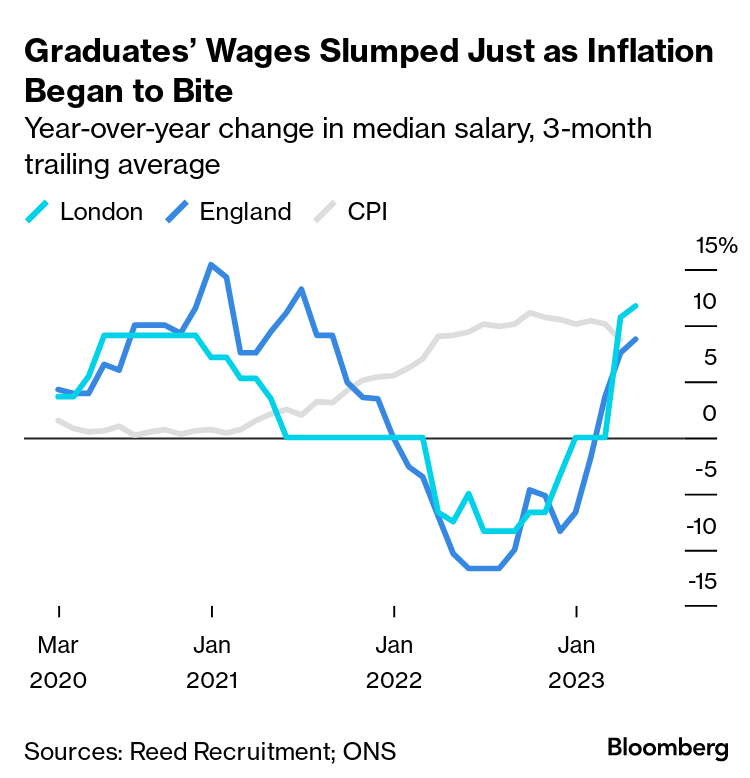
People working in London unsurprisingly reaped the highest wages among at least 100 posted on Reed’s site — a premium of £2,500 over their peers elsewhere. But there are some caveats. Reed figures tend not to include some of the most lucrative graduate training schemes offered by top-end consultants, law firms and banks, which choose to advertise their openings through more specialized routes.
Higher-paid sectors are more concentrated in the capital. Graduate positions in strategy and consulting on Reed’s platform pay an average of £55,000. But in some of the largest graduate sectors — recruitment consultancy, education, and the broadly defined “training and apprenticeships” category — wages are stagnant or falling.
Salaries are Stagnant or Falling in Some of the Largest Graduate-Employing Sectors
Median salary and year-over-year change, March-May 2023

Regional Trends for Graduates
The hit to wages means graduates are increasingly looking for positions outside of London where it’s cheaper to live. The capital’s share of graduate job postings has fallen to 31.8% from 37.8% five years ago.
Many students still have a desire to work in London — 52% would most like to work in London for their first job, according to research into what graduates want from Bright Network, a platform for students to find graduate work and connect with employers.
“London remains the magnet for young talent, but it’s not as strong as it used to be,” said James Reed. “We’ve noticed that graduates are no longer as eager to relocate for career opportunities, especially to London where the cost of living is higher.”
Sheffield Leads and London Lags For Graduates’ Wage-to-Rent Ratio
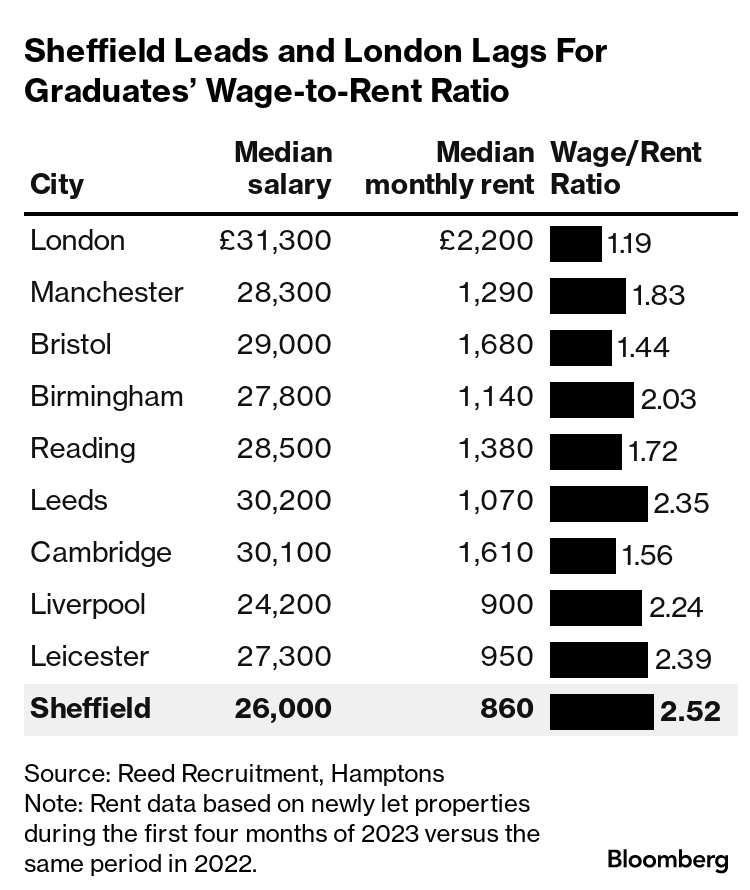
Simone Payne, chief executive of education recruitment agency 4MySchools, has also noticed cost concerns deterring graduates from moving to the capital. “Rent is skyrocketing,” she said. “But graduates do want that city vibe, they want to know what the communication links are like in places. They don’t want to have to drive to get around easily.”
London’s loss, however, is other cities’ gain. In Manchester, Bristol and Birmingham, the proportion of graduate jobs has more than doubled since bottoming out in the pandemic.
London Is Losing Graduate Jobs to England’s Regional Cities
Share of graduate postings, 3-month trailing average
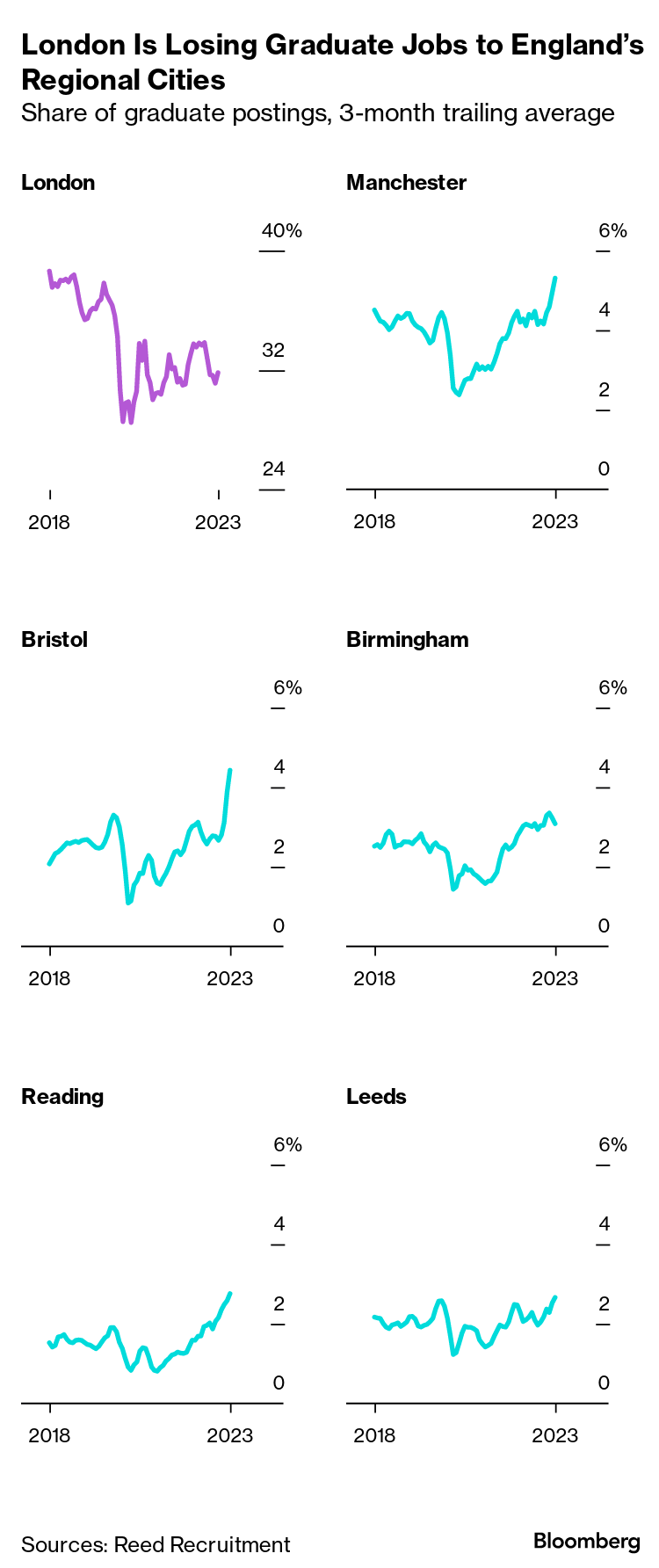
This may be a sign that attempts by the Government to “level-up” the regions of the UK is starting to pay off. Goldman Sachs recently opened an office in Birmingham, and Manchester is fast gaining a reputation as a northern alternative to London. BT Group Plc this year opened a new flagship office in Bristol. Each of those are spreading opportunities outside of the South East.
Conor McCabe, market director for Manchester, Leeds and Edinburgh at recruitment agency Robert Half, said his office had seen a 20% uptick in graduate positions across the cities it covers in the last year.
This was “primarily driven by companies creating roles outside of London and the huge explosion of tech in the North,” he said, adding that businesses were “starting to see the benefit of hiring high-potential, willing-to-learn, trainable graduates to help them fill these skills gaps.”
For those firms which are shunning graduates, and are reluctant to put investment into training, James Reed has a word of warning.
“There is a clear danger of short-term thinking that sees employers fail to attract and retain graduate talent within the business,” he said.