
The Climate Impact of Our Insatiable Plastic Addiction

Plastic is a miracle material, shaped and folded into our lives in everything from cigarette filters to medical tubing to car bumpers. It’s in the toys we give our children; it keeps our food fresh and it makes our clothes stretchy.
And we can’t get enough of it.
In the 1950s the world produced 2 million metric tons of the stuff annually, according to the UN Environment Program. Now the amount has risen to more than 400 million metric tons. If current production stays on track, yearly plastic production could reach 1.1 billion metric tons by 2050.
The convenience of plastic comes at a terrible environmental cost. Some of that is visible: In Accra, Ghana, where Bloomberg Green has reported on the plastic crisis, mounds of garbage stand on beaches and clog streams, while in Bangkok, people who live near plants that melt plastic down cite acrid fumes and health problems. But there’s an invisible and just as damaging toll, too. Plastic adds significantly to the emissions that cause climate change as the world struggles to limit warming to 1.5C. The planet is already 1.2C warmer than it was before industrialization.
Plastic’s Global Emissions Are on Pace to Rise Dramatically

Billion metric tons CO2e:
3.0
2.5
2.0
1.5
1.0
0.5
0
2020
2030
2040
2050

Billion metric tons CO2e:
3.0
2.5
2.0
1.5
1.0
0.5
0
2020
2030
2040
2050

Billion metric tons CO2e:
3.0
2.5
2.0
1.5
1.0
0.5
0
2020
2050
Plastic was responsible for 1.8 billion metric tons of greenhouse gas emissions in 2019, according to the Organisation for Economic Co-operation and Development. That’s 3.4% of the global total, more than the percentage of CO2 contributed by the aviation sector or emissions from all the rice grown worldwide. And plastic’s share is set to increase in coming years. Researchers project that the emissions from plastic will exceed 2.5 billion metric tons by 2050 if the current pace of growth and manner of production continue.
Producing all the many varieties of plastic requires a wide range of chemical additives, but while each product has its own special formula, ultimately they all come from a base of fossil fuels. Across every stage of the life cycle they emit planet-warming pollution.
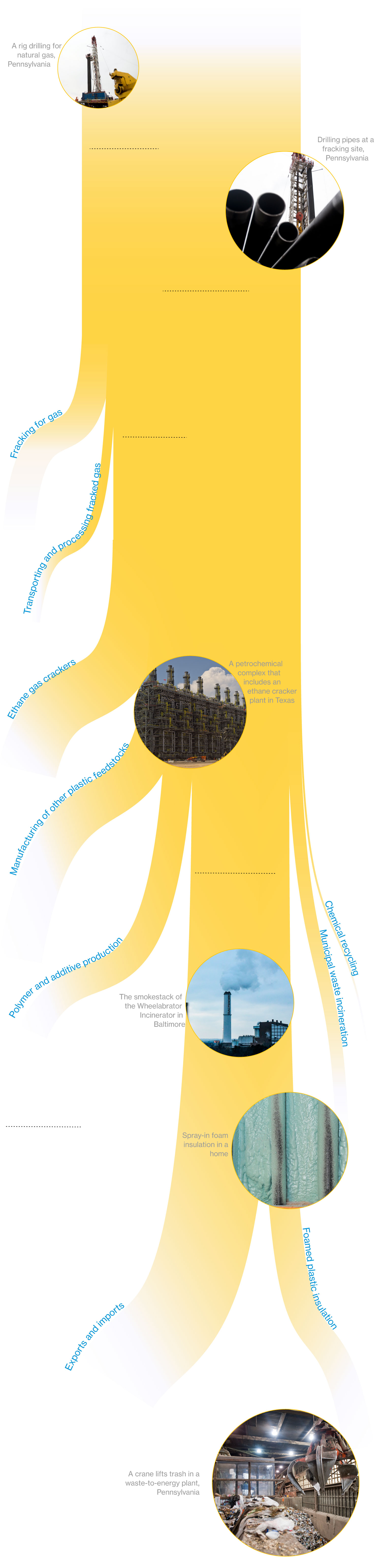
The US has become a global center of plastic production as well as one of the biggest markets for plastic goods. Here’s how the emissions break down just in the US.
Where US Plastic Emissions Will Come From in 2025

401M METRIC TONS CO2E*
RESOURCE EXTRACTION
The large majority of plastics are derived from natural gas. Methane and CO2 are both natural byproducts of gas production and they are routinely released, both on purpose and by accident, at wellheads.
41M TONS CO2E
TRANSPORTATION
Gas or oil used to make plastic is conveyed on a network of pipelines. In the US alone there are 2.5 million miles of such pipes. Flaring and venting occur along these networks, as well as gas leaks. The transportation estimate at left doesn’t include the emissions from truck and train transport of fossil fuels.
12M
77.2M
57M
PRODUCTION
To make plastic, fossil fuel feedstocks such as ethane are sent to plants known as steam crackers. There they are heated to very high temperatures and mixed with steam to separate the different molecules of hydrocarbons. They are then compressed and frozen so they may be sorted by weight.
The energy needs for such a process are intensive and the emissions vary by fuel, but can be very high. Other sources of production emissions include air emissions from oil refineries that produce feedstocks for polyethylene terephthalate (PET), a form of plastic that can be molded into bottles and packaging for countless food and personal care products.
2M
17M
39M
116M
INCINERATION
The amount of plastic entering municipal waste streams and being burned has steadily increased over the decades.
CONSUMPTION
& IMPORTS
40M
Two major emission drivers are imported vinyl floor and wall coverings, made from coal overseas, and plastic insulation for buildings, which off-gasses even after it is installed.
401M METRIC TONS CO2E*
RESOURCE EXTRACTION
The large majority of plastics are derived from natural gas. Methane and CO2 are both natural byproducts of gas production and they are routinely released, both on purpose and by accident, at wellheads.
TRANSPORTATION
Gas or oil used to make plastic is conveyed on a network of pipelines. In the US alone there are 2.5 million miles of such pipes. Flaring and venting occur along these networks, as well as gas leaks. The transportation estimate at left doesn’t include the emissions from truck and train transport of fossil fuels.
PRODUCTION
To make plastic, fossil fuel feedstocks such as ethane are sent to plants known as steam crackers. There they are heated to very high temperatures and mixed with steam to separate the different molecules of hydrocarbons. They are then compressed and frozen so they may be sorted by weight.
The energy needs for such a process are intensive and the emissions vary by fuel, but can be very high. Other sources of production emissions include air emissions from oil refineries that produce feedstocks for polyethylene terephthalate (PET), a form of plastic that can be molded into bottles and packaging for countless food and personal care products.
41M TONS CO2E
12M
77.2M
INCINERATION
The amount of plastic entering municipal waste streams and being burned has steadily increased over the decades.
57M
2M
39M
17M
CONSUMPTION & IMPORTS
Two major emission drivers are imported vinyl floor and wall coverings, made from coal overseas, and plastic insulation for buildings, which off-gasses even after it is installed.
116M
40M

mobile 375px (variable height)
00px (variable height)
401M METRIC TONS CO2E*
RESOURCE EXTRACTION
The large majority of plastics are derived from natural gas. Methane and CO2 are both natural byproducts of gas production and they are routinely released, both on purpose and by accident, at wellheads.
41M TONS CO2E
12M
TRANSPORTATION
Gas or oil used to make plastic is conveyed on a network of pipelines. In the US alone there are 2.5 million miles of such pipes. Flaring and venting occur along these networks, as well as gas leaks. The transportation estimate at left doesn’t include the emissions from truck and train transport of fossil fuels.
PRODUCTION
To make plastic, fossil fuel feedstocks such as ethane are sent to plants known as steam crackers. There they are heated to very high temperatures and mixed with steam to separate the different molecules of hydrocarbons. They are then compressed and frozen so they may be sorted by weight.
The energy needs for such a process are intensive and the emissions vary by fuel, but can be very high. Other sources of production emissions include air emissions from oil refineries that produce feedstocks for polyethylene terephthalate (PET), a form of plastic that can be molded into bottles and packaging for countless food and personal care products.
77.2M
57M
The smokestack of the Wheelabrator Incinerator in Baltimore
39M
116M
CONSUMPTION & IMPORTS
Two major emission drivers are imported vinyl floor and wall coverings, made from coal overseas, and plastic insulation for buildings, which off-gasses even after it is installed.
2M
40M
INCINERATION
The amount of plastic entering municipal waste streams and being burned has steadily increased over the decades.
17M
A crane lifts trash in a waste-to-energy plant, Pennsylvania
A Growing Footprint
Since 1995, the global carbon footprint of the plastic industry is estimated to have doubled, in large part because production shifted to countries that use more coal, such as India, China and Indonesia.
In the effort to tame global warming, nations are racing to decarbonize buildings and electricity generation and agriculture. But as other industries emit less carbon pollution, plastic is going in the opposite direction.
Plastic production is going to continue its explosive growth — and that’s by design. Oil majors have explicitly said they expect it to help make up for declining revenues from fuel sales as countries shift to clean energy. The US fracking boom contributed to the buildout of the domestic petrochemical industry, which now exports raw materials for plastic manufacturing around the world. In the US alone, some $200 billion was invested between 2010 and 2018 to secure natural gas supplies for plastics and other chemicals.
Estimating how much global plastic production will grow in the future is tricky since it is based on industry-provided numbers. The OECD says it could triple by 2060 to 1.2 billion metric tons.
But one thing is certain: As production rises, so will the carbon emissions of the industry.
The infrastructure in the US is growing. There are currently 201 working factories that support plastic production. But another 36 projects — some new, some expansions of current plants — are in permitting or construction and should be complete by 2029, according to the organization Material Research. If all become fully operational, they will potentially add at least 94 million tons of emissions on top of what occurs now. (That figure does not account for 10 of the 36 plants because information on their potential emissions is not yet available.)
America’s Plastic Heartlands

8M tons CO2e emissions from plastics
2M
100K
CANADA
ME
NY
MI
PA
IA
NJ
OH
IN
IL
WV
VA
KS
KY
NC
TN
AR
SC
AL
MS
LA
TX
Concentration of oil and gas well locations
FL
Gulf of Mexico
MEXICO
250mi
250km

8M tons CO2e emissions from plastics
2M
100K
CANADA
ME
NY
MI
PA
IA
NJ
OH
IN
IL
WV
VA
KS
KY
NC
TN
AR
SC
AL
MS
LA
TX
Concentration of oil and gas well locations
FL
Gulf of Mexico
MEXICO
250mi
250km

8M tons CO2e emissions from plastics
2M
CANADA
MEXICO
Gulf of Mexico
250mi
Concentration of oil and gas well locations
250km
Even After Disposal, Plastic Keeps Emitting
Plastic’s greenhouse gas emissions don’t end once a product is made. More follows upon its disposal, through incineration and off-gassing.
The Center for International Environmental Law (CIEL), a US-based research and advocacy nonprofit, estimates that in 2015 the world recycled just 20% of plastic packaging waste and incinerated about the same amount. Thirty-one percent of it went to landfills and the rest was unaccounted for.
And packaging only represents 40% of plastic waste. For a sense of the impact of the broader plastic waste stream, the emissions from plastic incineration alone in the US in 2015 were 5.9 million metric tons of CO2e, says CIEL. That’s roughly equivalent to 1.3 million passenger vehicles driven for a year, or 675 million gallons of gasoline consumed.
Plastics that are landfilled are more benign from an emissions perspective, but they eat away at land that is desperately needed for other things. While recycling plastic also releases greenhouse gases, CIEL found it is a net positive because it saves from using virgin materials.
The rest of the plastic ends up in the environment, where it is hardly inert. Researchers at the University of Hawaii found that low-density polyethylene — one of the most common types of plastics — releases methane when exposed to sunlight. Methane is 80 times as potent as CO2 in the first two decades after its release.
More from Bloomberg Green’s Big Plastic series:
• A Plastic Bag’s 2,000-Mile Journey
• West Africa Is Drowning in Plastic
• TerraCycle’s Recycling Dream
• Thailand Is Tired of Recycling Your Trash
• Big Plastic’s Faltering Global Cleanup Effort
• Amazon Packages Burn in India, Final Stop in Broken Recycling System
Plastic does not biodegrade like natural materials, but it does decompose. As plastic breaks down in the environment it creates more surface area, and the gas it releases rises exponentially.
Finally, plastics may be harming the climate in one other way. The science of microplastics is still in its infancy, but every year we learn a little bit more about how these tiny shreds of chemicals are entering our world, and bodies. They’ve been found in human blood and in breast milk. They also have been found by some researchers to disrupt the microorganisms that eat CO2 and reduce the planet’s natural ability to sequester carbon and heal itself.
No Clear Agreement on Solutions
Proposals for tackling the crisis have come from industry, governments, academics and activists, but they don’t agree on a course of action. In December, the UN held the first round of talks to negotiate a global plastic treaty. Nations were split on the best approach, with the US and Saudi Arabia — major petrochemical producers — supporting country-based pledges while European Union members and others argued for mandatory controls on virgin plastic production.
Industry is pushing recycling. The Coca-Cola Co., for example, has promised that 50% of its bottles will be made of recycled plastic by 2030. But there is a long history of companies making pledges and failing to fulfill them. A recent Bloomberg Green investigation found that a high-profile campaign to fight plastic pollution, backed by plastic makers themselves, has met less than 1% of its recycling target. Only about 9% of plastic worldwide is recycled. Even in countries with advanced waste streams like the US, a small fraction of plastic is captured for recycling. In developing countries the percentage is too small to count.
Many activists say the only real solution is to drastically cut the amount of plastic produced. Governments are increasingly banning some single-use plastics, as California, Kenya, India and Thailand have done. However, these bans are small dams against a tsunami of new plastic.
Another solution gaining favor with policymakers in the US is extended producer responsibility laws, which require manufacturers to be accountable for their products’ afterlife through a fee or regulation or both. Maine and Oregon are two states that have recently passed such laws.
Material and technological innovation offers another path forward. But plant-based plastics is still an inchoate industry and, despite the name, many of them are plant materials like sugar or corn that are mixed with as much as 70% fossil fuels, so they pose pollution problems just like regular plastics.
Analysts at BloombergNEF, a clean energy research group, say the best hope of decarbonizing plastics is to invest in improvements along the supply chain, from consumer product designs that require less plastic to electrification of plastic plants.
We asked three experts what they believe would be the most effective ways to limit plastic’s role in climate change. Here’s what they told us:

Julia Attwood
Head of sustainable materials, BNEF
There are technologies available to remove most of the CO2 from petrochemicals production. However, they come with a hefty cost of about $759 billion in additional capital expenditures by 2050. They include carbon capture, electric furnaces and, most expensive, an option to use green methanol made from hydrogen and captured CO2 in a specialized reactor to make the aromatic chemicals needed for PET.

Keefe Harrison
Chief executive officer, The Recycling Partnership
Data is a powerful force for system change. At the plastic treaty negotiations [in December 2022], there was a clear call for internationally recognized data, not only to share baseline information on the current state of plastics waste but to inform goal setting rooted in measurable achievements. And as the process moves forward, connecting data-driven information to action will be key.

Judith Enck
President of Beyond Plastics and senior fellow and visiting faculty member, Bennington College
Any effective plastics treaty must include:
1. Banning unnecessary single-use plastic products such as plastic bags, utensils, stirrers, polystyrene, shipping envelopes, etc.
2. Investing in reuse and refill system infrastructure that reduces our reliance on single-use products
3. Requiring that plastics be reduced by 50% in the next decade and that what is left can actually be safely recycled, which means eliminating toxins from plastics
4. Making plastic polluters pay for the damage that they continue to cause
5. Banning waste exports so that nations are required to manage their own waste and stop dumping it on other countries.