All I Want for Christmas Is ... More Christmas Music
Whether you consider it torture or treasure, blaring Christmas music has become a reliable part of the holiday shopping season.
From malls to grocery stores, highly curated playlists are all part of the bigger scheme to create the best consumer experience possible, one where customers are put in the mood to buy.
“Retailers definitely lean in,” said Radhika Giri, the senior vice president for emerging business at SiriusXM, which has a few enterprises devoted entirely to providing playlists for retail stores. During her more than 12 years at the company, she’s seen demand for such songs only increase. “Every year one of the requests we would get is whether we would start playing holiday music earlier and earlier.”
When Retailers Started Playing Holiday Music This Year
Nearly all of SiriusXM’s playlists for businesses begin streaming on Nov. 1, and have names ranging from “Jingle Jamz” to “Country Christmas.” With a market value of $23 billion, SiriusXM, which bought Pandora Media in 2019 for $3.5 billion, is one of the largest audio providers in North America. Both entities have teams devoted entirely to creating playlists for stores, and last January, the company expanded further into the arena by buying Cloud Cover Media, a company that has dominated the space of curating music for national brands, like McDonald’s and Party City.
The bulk of national brands opt to outsource their playlists in part because of how cumbersome it can be to deal with music licensing in order to play songs in public spaces, according to Giri. Whole teams of business experts and musicologists work together behind the scenes at companies like SiriusXM to determine the delicate balance of striking a perfect mood for customers. Obviously, many shoppers don’t observe Christmas and may be keen to hear songs celebrating other holidays, like Hanukkah, which starts Dec. 18 this year. Although there are no Hanukkah songs on the US Billboard Hot 100, big retailers like Crate & Barrel and Old Navy include ones like The Festival of Lights and 8 Days of Hanukkah in their line-ups.
Across the US, holiday music has seen a boost in popularity since the 2010s, thanks in large part to the rise of streaming services. In recent years, holiday songs have consistently ranked in the Billboard Hot 100 as early as four weeks before Christmas — around the same time many retailers start playing the tunes in stores — and even two weeks after. The songs made up more than a third of the list the week following Christmas 2020. Of those songs, only seven were actually released that year, and just four were original hits. Most of the tunes flooding the charts were released years, and even decades, earlier. The resurgence is at least in part due to Billboard assigning more weight to paid subscription streams for its rankings.

Yuletide Cheer on the Billboard Hot 100 Through the Years
HOW TO READ THIS GRAPHIC
Weeks before
Christmas
Higher Billboard ranking
-4
-2
Each circle represents a song’s ranking on the Billboard Hot 100 during each week of the holiday season
Christmas
+2
Weeks after

Yuletide Cheer on the Billboard Hot 100
Through the Years
HOW TO READ THIS GRAPHIC
Weeks before
Christmas
Higher Billboard ranking
-4
-2
Each circle represents a song’s ranking on the Billboard Hot 100 during each week of the holiday season
Christmas
+2
Weeks after
All I Want for Christmas Is You turned Mariah Carey into the unofficial Queen of Christmas, with more than 80 appearances on the Billboard Hot 100 since its release nearly three decades ago. Last year, the song accounted for 1 in every 50 holiday music streams on Spotify. The original or one of the numerous renditions appear again and again on store holiday playlists. Across retailers who gave us their playlists, we identified 13 different versions of the song, including Mariah Carey’s original.
Another Christmas classic Rudolph the Red-Nosed Reindeer got its start as a story in a Montgomery Ward coloring book the retailer gifted to children in 1939 before being released as a song from Gene Autry in 1949. It’s since been covered by a huge variety of artists, from Burl Ives to DMX, and the original was in the top 25 on the Billboard charts earlier this year.
Those retailers’ playlists share other similarities, too. Eight other songs made it to all the playlists, either originals or covers. Let It Snow! is the most popular, with 18 different versions across all retailers who provided their playlists. Jingle Bells follows closely, with 16 different versions identified across retailers.
Many Ways to Sing Jingle Bells
- Song on Bath & Body Works playlist
- Song on other retailer’s playlist
According to Elizabeth Margulis, a professor of music at Princeton University and director of the Music Cognition Lab, there’s a lot to consider when trying to please customers, especially in how to simultaneously curate songs for everyone from Gen Zers to octogenarians.
One such consideration: the so-called “reminiscence bump,” which is the phenomenon that the music people listen to in their teenage years is the music that they remember the best, and often like the most, according to Margulis. Sometimes that reminiscence bump is passed from one generation to the next, with parents playing songs for their children that they loved during their teenage years, making it a smarter strategy to play songs from decades like the ’70s and ’80s in order to hit at least two generations with the same playlist.
When the Holiday Songs on Store Playlists Were Released
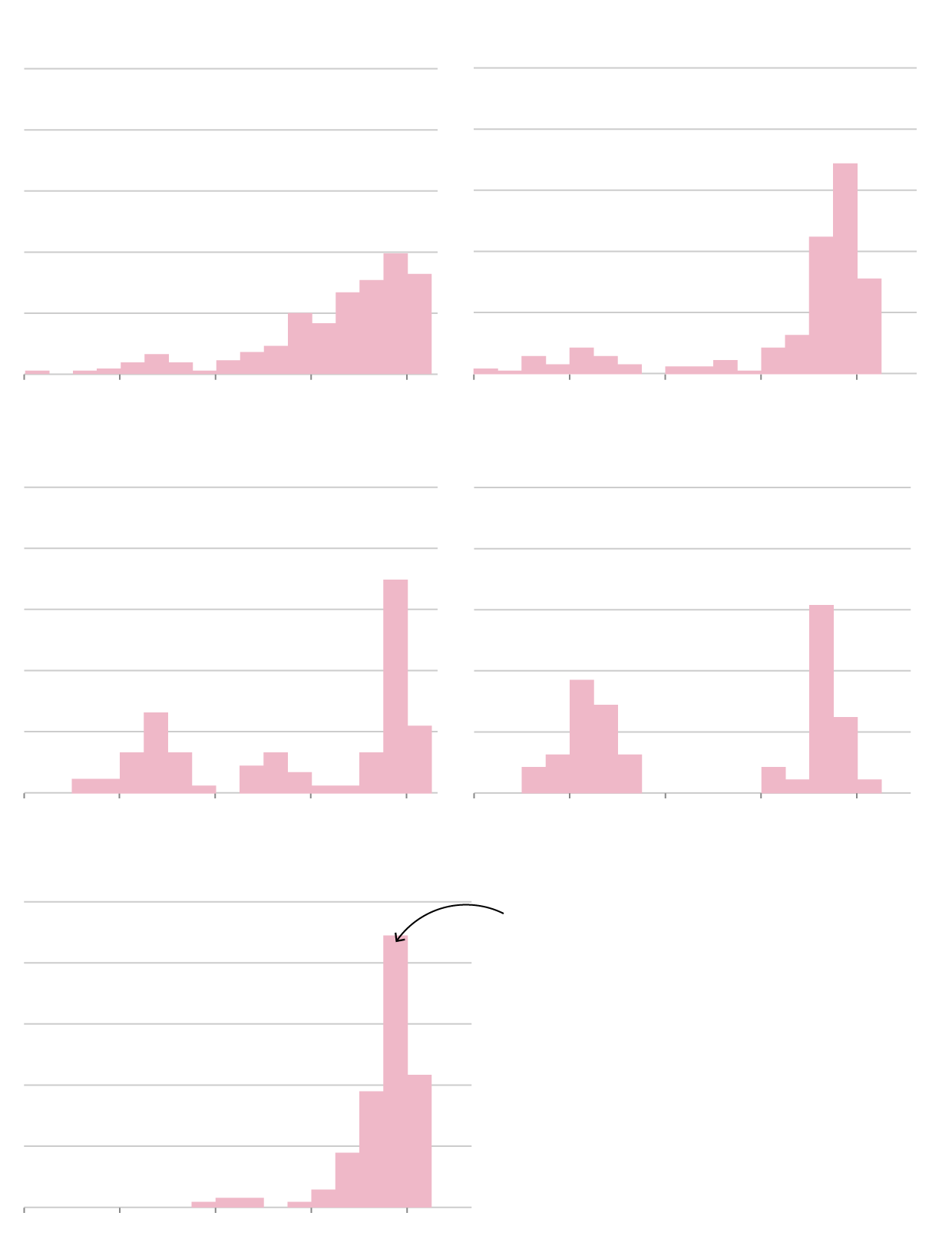
From a business perspective, Dave Wasby, vice president and general manager of music for business at SiriusXM, agrees. “The depth of our library goes back to Bing Crosby and big bands of that era because in our business music, we’re very careful to think about multi-decade and not just what one age group wants to hear,” he said. “Whatever decade we were teenagers in, that’s our preference. And that’s true even if you’re 80 years old.”
While some retailers try to cater to the widest range of customers with eclectic holiday playlists, others have a very specific kind of shopper in mind. Rural King, a chain whose 130 locations across the midwest sell farming equipment, is one of those streaming Cloud Cover’s “Country Music” playlist in its stores. According to a Bloomberg analysis, 58% percent of Rural King’s current playlist has a country-related music genre. It features artists like Blake Shelton (whose Christmas album Cheers, It’s Christmas was released in 2012), Martina McBride or Kenny Chesney and his album All I Want for Christmas Is a Real Good Tan.
Stores Cater Playlists to Customers



A landmark study from 1993 showed clear evidence that background music can shape shopping habits. Customers at a wine store ended up spending more money — on pricier bottles — when classical music was playing, as opposed to Top 40 hits, according to the study’s results. It also found that the type of music should match the store’s atmosphere and target audience.
Not everyone is thrilled when Christmas songs roll around. The revolving playlists are notoriously tough for retail employees, many of whom dread the holidays where working can often mean hearing the same songs again and again.
Timing is another important consideration. Raymond, a general manager at a national sporting goods chain in Tennessee, says that he doesn’t mind the holiday music, in part because his store waits until Dec. 2. “Some stores decorate for Christmas before Halloween,” he said, asking to omit his last name because of privacy concerns. “We give holidays the time to come and pass before we put on Rudolph.”
Hearing the same song repeatedly can grate on any listener, but holiday music has the advantage of not being played for the majority of the year, which gives Americans time to recover. “There’s a non-linear response to repetition,” Margulis explained. Instead of enjoying a song more and more as you hear it again, the listening experience resembles an inverted U-curve.
“There’s this point where it turns around and starts going down the other side,” she said. “Often at the end you like it even less than in the beginning.” Stores, and firms like SiriusXM, have to be strategic to not play any one song too frequently.
“There’s this whole other dimension around music from the holidays because there’s this rhythmic quality to it,” she said. “It comes about reliably at this one time of year,” which means customers often have deeper emotional responses to certain songs.
“Christmas songs do put people in the spirit,” Raymond said. “And if there’s cheerful, upbeat music, people will probably buy more.”