Americans’ Commitment to Social Distancing Is Eroding
Many Americans have proven diligent in staying home to limit the spread of Covid-19. But their acceptance of social distancing seems to be waning, even as the country’s leading infectious disease expert warns of “an outbreak that you might not be able to control” if states reopen too soon.
Most states have lifted at least some restrictions on the types of businesses that can be open, and distancing in nearly every one is on the decline—particularly on weekends—according to data from Unacast, a location data and analytics firm.
Before states began lifting restrictions, many Americans had accepted social distancing. People in the U.S. moved around 41% less in April than they normally would. In every state, residents reduced their travel long before most governors issued stay-at-home orders. Travel remained higher from Monday through Friday, suggesting that many were still leaving home when their jobs required it.
States curbed travel well before lockdowns put in place

MORE DISTANCING
LOCKDOWN DATE
WEEKEND

MORE DISTANCING
LOCKDOWN DATE
WEEKEND

MORE DISTANCING
LOCKDOWN DATE
WEEKEND

MORE DISTANCING
LOCKDOWN DATE
WEEKEND
Perception of personal risk, community norms and a belief they could help prevent the virus from spreading were among the main reasons people cited for staying home, according to a national survey conducted by the non-profit Surgo Foundation. A partisan split has emerged over reopening, with only about half of Republicans in favor of keeping businesses closed to help slow the spread of Covid-19. Almost all Democrats and the majority of Independents are in favor.
Partisan split on lockdowns

Democrats
92%
Independent
79%
Republicans
49%

Democrats
92%
Independent
79%
Republicans
49%

Democrats
92%
Independent
79%
Republicans
49%
Unsurprisingly, those who can afford to stay home—or whose employers allow them to—do. Surgo’s survey also found that financial stability was significantly higher among those who traveled less. While employees at Facebook, Google and Amazon’s corporate offices have the option to work remotely through at least this fall, essential workers in food, grocery and delivery jobs continued their normal routines or worked overtime, often without personal protective equipment.
As states begin to reopen—whether or not they’ve met basic federal recommendations—more employees may be required to return to jobs that expose them to greater coronavirus risk. Although OSHA issued advisory guidance in early March on how to protect workers from Covid-19, it’s not enforceable. The document states that it’s “not a standard or regulation and creates no new legal obligations.”
While lockdown measures have helped slow the virus in San Francisco, New York and other areas, outbreaks at facilities such as meat processing plants, prisons and nursing homes have sent case counts soaring in parts of the country. In Trousdale County, Tennessee—which currently has the highest per capita infection rate in the country—98% of coronavirus cases can be linked to the Trousdale Turner Correctional Center, a private prison run by CoreCivic.
After President Donald Trump signed an executive order on April 28 to reopen meatpacking plants, cases in counties with plants rose at twice the national rate. A Tyson plant in Black Hawk County, Iowa reported 1,031 coronavirus infections among its employees as of May 7, more than 70% of the county’s total. In Minnesota, where infections have recently spiked, 28% of cases are in counties where meat processing plants are located, while only 7% of the state’s population lives in these counties.
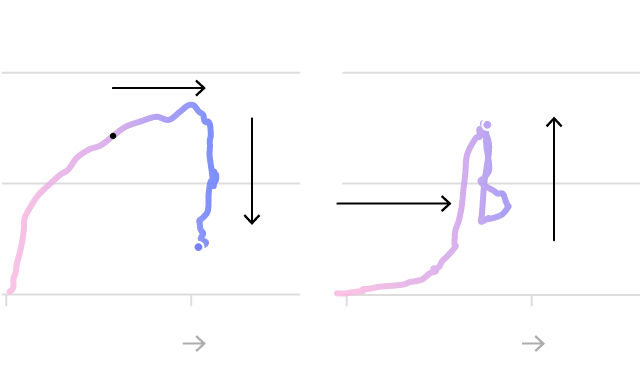
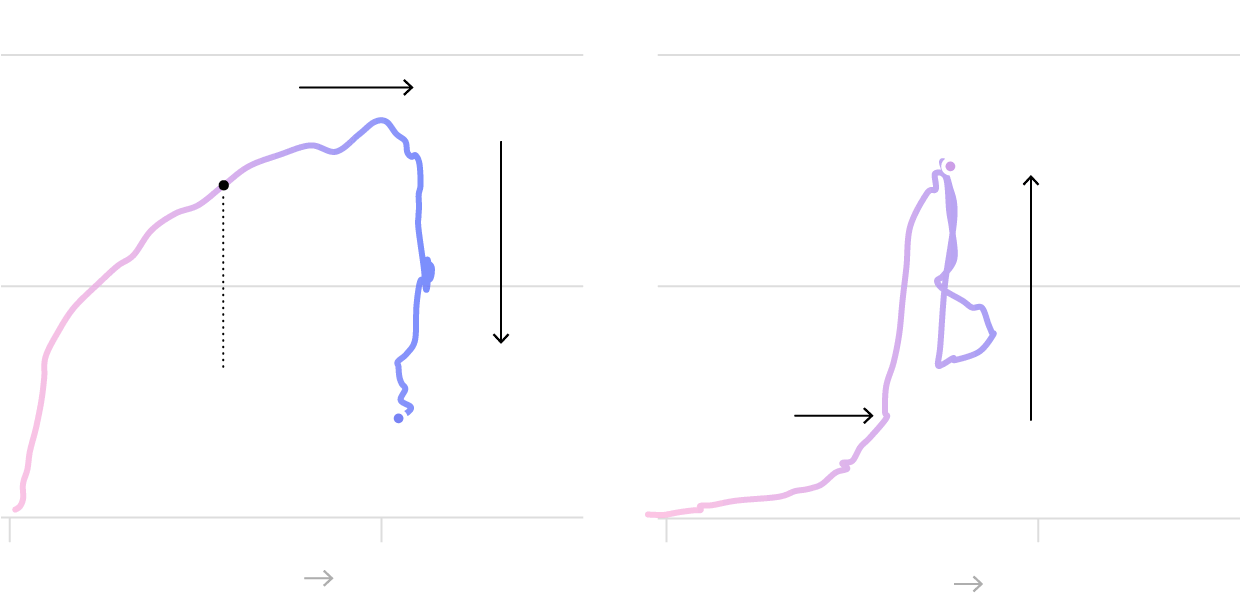
In states with the greatest decrease in average distance traveled per day, confirmed Covid-19 cases were more likely to stabilize or decline when plotted on a two-week lag, the maximum incubation period of the virus. New York, one of the earliest states hit, reduced its travel more than most other states and saw its daily case rate drop.
States where cases rose steadily or spiked tended to have lower rates of distancing. For example, South Dakota only reduced travel by about 28%, on average. The number of cases per day had been declining—as was distancing. Then the state experienced an increase in new cases.

New York
South Dakota
CASES PER 100K:
60
CASES PER 100K:
20
CASES
DECREASED
WITH MORE
DISTANCING
APRIL 28
30
10
By the March 20 lockdown, New Yorkers had already decreased average travel by 43%
DESPITE SOME
DISTANCING
CASES STILL
CLIMBED
APRIL 28
0
0
0%
50%
0%
50%
MORE DISTANCING
MORE DISTANCING
New York
South Dakota
CASES PER 100K:
60
CASES PER 100K:
20
WITH MORE
DISTANCING
CASES
DECREASED
APRIL 28
DESPITE
SOME
DISTANCING
30
10
CASES STILL
CLIMBED
APRIL 28
0
0
0%
50%
0%
50%
MORE DISTANCING
MORE DISTANCING
New York
South Dakota
CASES PER 100K:
60
CASES PER 100K:
20
WITH MORE DISTANCING
CASES
DECREASED
APRIL 28
30
10
By the March 20 lockdown, New Yorkers had already decreased average travel by 43%
DESPITE SOME
DISTANCING
APRIL 28
CASES STILL
CLIMBED
0
0
0%
50%
0%
50%
MORE DISTANCING
MORE DISTANCING
Here’s how each state’s efforts at social distancing have—or have not—slowed the rate of coronavirus infections per capita.
How social distancing worked in every state

MORE DISTANCING
LOCKDOWN DATE

Rate of infection
increased after
social distancing
Rate of infection
decreased after
social distancing
Rate of infection
stabilized after
social distancing

Rate of infection
increased after
social distancing
Rate of infection
decreased after
social distancing
Rate of infection
stabilized after
social distancing

Rate of infection
increased after
social distancing
Rate of infection
decreased after
social distancing
Rate of infection
stabilized after
social distancing

Rate of infection
increased after
social distancing
Rate of infection
decreased after
social distancing
Rate of infection
stabilized after
social distancing