Sanders Dominates in California, Where Income Gap Looms Large
California’s crisis over income inequality and housing affordability has boosted Democratic presidential front-runner Bernie Sanders to a dominant standing days before the state’s primary.
Sanders has ridden his promise of housing and health care for all to a commanding lead in state polls against a backdrop of wage and cost-of-living disparities from north to south. From the affluent San Francisco Bay Area to the population centers of Southern California, Sanders is the favorite of Democratic voters.
California Democrats Lean Toward Sanders
Democratic primary for president preference

Note: Response percentages may not add due to rounding
Source: Public Policy Institute of California survey, February 7-17, 2020, among California Democratic Primary likely voters. Margin of error ±5.7 percentage points
“The Democratic electorate has moved significantly to the left on economic issues, and there’s alignment on where the base has moved and where Sanders has always been,” said Garry South, a Democratic consultant who has advised California governors Gavin Newsom and Gray Davis. “His railing about millionaires and billionaires would have been less effective 10 years ago. It resonates more today, especially here in California.”
California is among 14 states that vote on March 3. It is Super Tuesday’s biggest prize, awarding 415 pledged delegates of the 1,991 needed to secure the Democratic presidential nomination.
California is the country’s most populous and prosperous state, with an economy that ranks fifth-largest in the world.
From a bird’s-eye view, California’s economy is thriving. The unemployment rate is at an all-time low and incomes continue to rise.
But for many, the costs of daily life—especially housing—are rising faster than wages. That’s left a growing number of people struggling with basic necessities as they teach, police, build and clean for others more affluent than they are. A housing shortage has pushed the median home price in California to more than twice the national level. Rising rents are straining many, forcing them to move ever farther away from where they work, and homelessness is rising. California has a higher share of households spending more than 30% of their income on their homes than any other state.
Paychecks that may be growing but are buying much less play to the strengths of democratic socialist Sanders, whose campaign theme is eliminating income inequality, offering free health-care, child care and higher education while also promising affordable housing.
California Ground Game
Sanders organized early, but Bloomberg has now caught up

Source: Candidate websites or spokespersons as of Feb. 27
“The American people are sick and tired of massive levels of income and wealth inequality,” Sanders told a crowd of more than 8,000 people during a rally last week in Richmond, a working-class San Francisco suburb. “We’re going to put millions of people to work at good-paying jobs building 10 million units of low-income and affordable housing.”
While Pete Buttigieg has enjoyed large fundraising hauls from California money centers such as Hollywood and Silicon Valley, Sanders has raised more money than any of his rivals with small dollar donations. Buttigieg and other Democratic candidates remain far behind Sanders in the polls.
Sanders had support from 32% of likely Democratic voters, with especially strong backing among Latinos and people younger than 45 years old, in a poll released Feb. 18 by the Public Policy Institute of California, a nonpartisan think tank. Joe Biden, Elizabeth Warren, Michael Bloomberg and Buttigieg were bunched within the poll’s margin of error for second place, with Biden at 14%, Warren at 13% and Bloomberg and Buttigieg each with 12%.
Sanders Leads in Most Populous Areas
Democratic presidential candidate preference by geographic region

Note: Since candidate preference in “All other counties” polling region is within statistical margin of error, the region has no color shading.
Sources: U.S. Commerce Department; Public Policy Institute of California survey of Democratic Primary likely voters, February 7-17, 2020
Here’s a look at factors supporting Sanders in regions throughout California:
Los Angeles
Southern California’s iconic heart is the most-populous city in the state and the second most-populous in the country. It’s a complex urban sprawl that stretches from its popular beaches through Hollywood and residential enclaves such as affluent Bel Air to economically challenged communities like West Adams and Watts.
“There’s two sides to the story of the health of the L.A. economy,” said Chris Tilly, a labor economist and professor of urban planning at the University of California, Los Angeles. By some measures it reflects the wider U.S. economy, with low unemployment and steady job growth, but, “There are people who are being left out and who are being caught in the gap between what a lot of jobs pay and what housing and other expenses are.”
The median monthly rent for an apartment or condo in Los Angeles County in January increased 13% from the year before, according to data from Redfin. By comparison, hourly wages increased just 3.1% on average during that same period nationally.
California Housing Crunch
Home prices continue to increase, leading much of the state to choose to rent
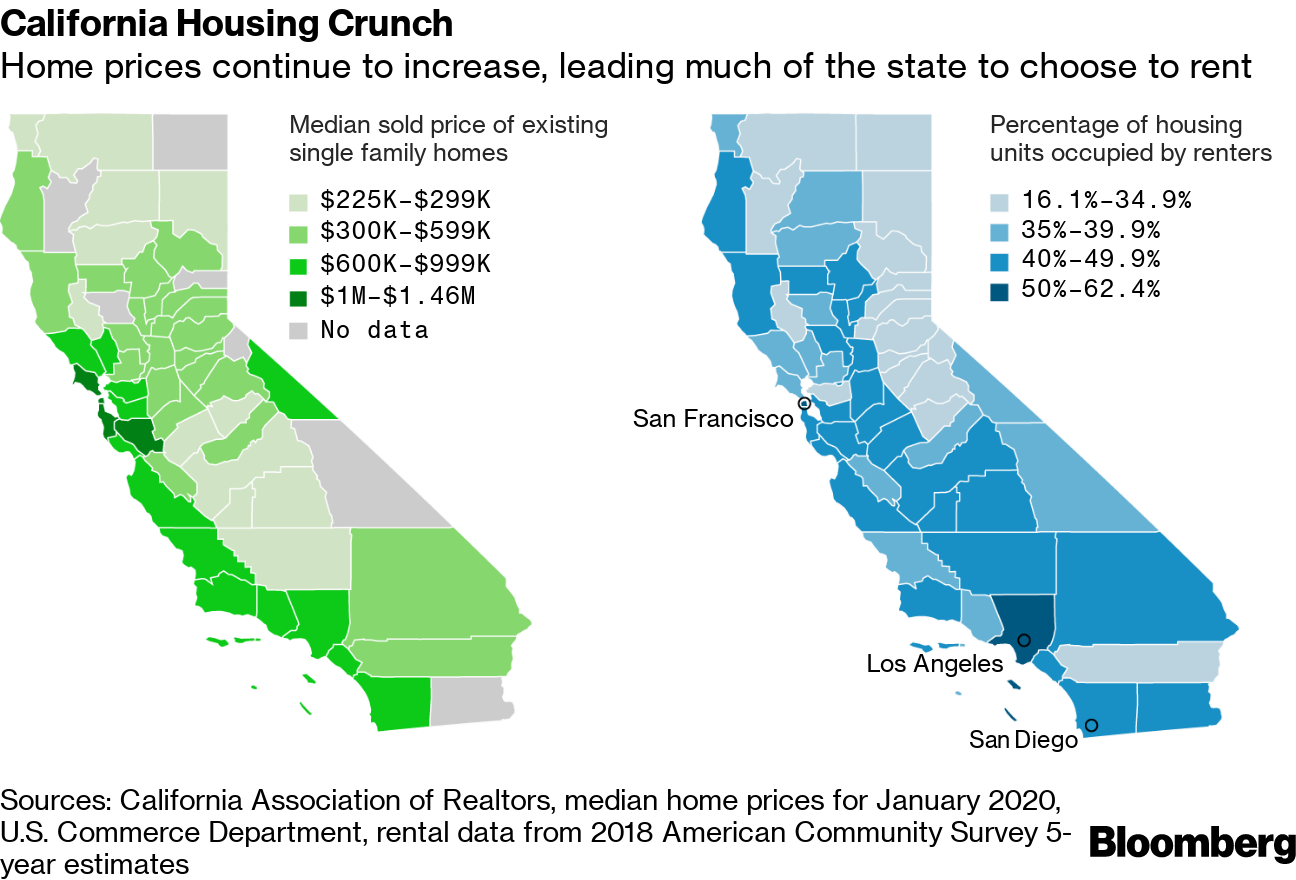
Sources: California Association of Realtors, median home prices for January 2020, U.S. Commerce Department, rental data from 2018 American Community Survey 5-year estimates
The majority of residents in the area rent in part because houses are too expensive to buy. The median home price in the Los Angeles metro area grew about 8% in January from the year before, according to data from the California Association of Realtors.
Sanders had support from 36% of likely Democratic voters in Los Angeles County in the PPIC survey. Biden was next at 16%.
The union representing teachers in the Los Angeles school system, the country’s second-largest, is among those backing Sanders. He has also widespread popularity among the 4.9 million Latinos who live in the county, polling data show.
San Francisco Bay Area
Sanders has tapped into the raging controversy in the Bay area over the vast disparity between the lives of tech company workers and those in lower-paying industries, despite the city having one of the highest minimum wages in the country.
“The high wage jobs are growing the fastest, the low wage jobs are growing the second fastest, and the middle wage jobs are growing the least,” said Stephen Levy, director of the Center for Continuing Study of the California Economy.
Sanders Polls Highest at All Income Levels
Democratic presidential candidate preference by household income
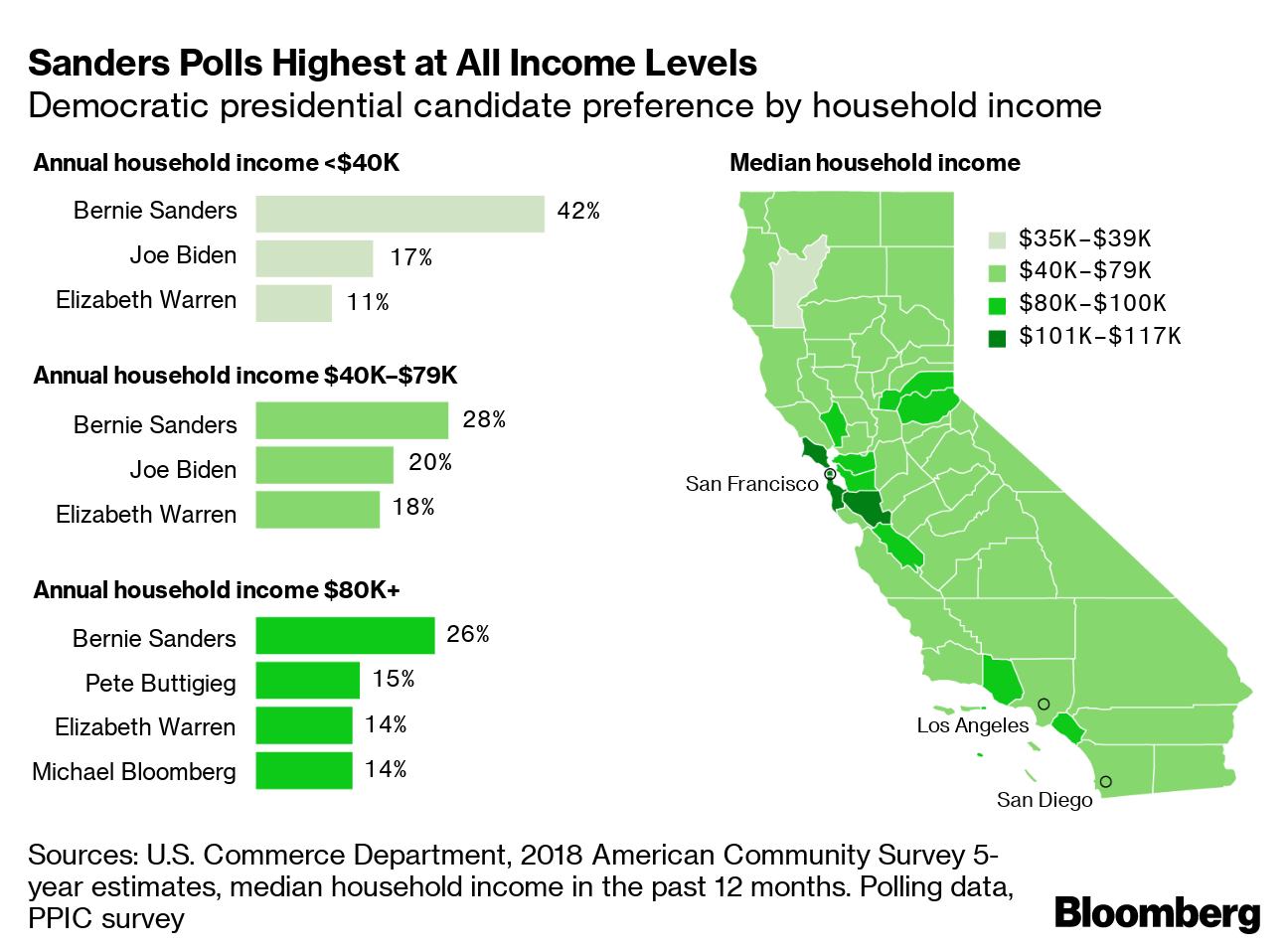
Sources: U.S. Commerce Department, 2018 American Community Survey 5-year estimates, median household income in the past 12 months. Polling data, PPIC survey
That split growth has further exacerbated inequality in a region that has some of the highest home prices in the country. Between 2018 and 2019, homelessness in California increased by about 16%, or more than 21,000 people.
Home prices in the already expensive Bay area rose 2% in January from a year earlier, according to the California Association of Realtors.
Even residents of San Francisco bedroom communities such as those in nearby Marin County -- where the median home price is more than $1 million -- complain of diminishing buying power.
“There needs to be housing for those who aren’t wealthy,” said Doug Herr, 75, a retired advertising industry artist and Sanders supporter who lives in the affluent Marin County suburb of Mill Valley. “People are fed up with the disparity. A lot of people like me came here before it was this imbalanced, and we still have a strong egalitarian mindset.”
Housing is a crisis that Sanders has repeatedly addressed on the campaign trail. At his Richmond rally, he was introduced by affordable housing advocates who bemoaned the housing shortage they said was fueling homelessness as the economy booms.
Sanders leads in the nine-county Bay area as he does in most other regions of the state, with support from 31% of likely Democratic voters, according to the PPIC poll. Warren, who is also campaigning on a progressive economic platform, was next-highest at 18%.
Central Valley
Sanders doesn’t have a comfortable lead everywhere in California.
He was locked in a virtual tie with Warren and Biden among likely Democratic voters in the large geographical area denoted as “other” in the PPIC poll, which includes the Central Valley.
In the state’s agricultural heartland, which tends to lean more conservative, unemployment rates are double the national average in some places. While Sanders policies are aimed at those left behind, some of the area's sizable immigrant population may not be eligible to vote on Super Tuesday.
“We’re at a 30% poverty rate in Merced,” said Justin Hicks, an economics professor at the University of California, Merced. “But they aren’t voters.”
Housing prices are lower in the landlocked Central Valley than they are in coastal regions, but rising. In Bakersfield’s Kern County, for instance, the median home price was $252,000 in January, lower than much of the state but still a 5% increase from the year before.
“We moved to Bakersfield because it was cheaper,” said Jonah Hopkins, 20, a student in Bakersfield who volunteers for Sanders. “In L.A. and San Francisco, the cost of living is ridiculously high -- rent is thousands per month for apartments. If you get low-priced housing, it’s in a really bad neighborhood and it’s a really bad house.”
But even in the Central Valley, home prices were up more than 8% in January from a year earlier.
Inland Empire and San Diego
Sanders’ lead is the largest in this region, with support from 41% of likely Democratic voters, the PPIC poll showed.
The booming area east of Los Angeles called the Inland Empire is anchored by the growing cities of San Bernardino and Riverside. It’s a highly diverse Democratic stronghold where support for Sanders runs deep. Sanders visited the Inland Empire’s Moreno Valley and Coachella Valley in December and has about a half dozen campaign offices in the region. Home prices in the Inland Empire jumped nearly 9% in January from the year before, according to the California Association of Realtors
The area has seen sizable growth in recent years. Gross domestic product -- a measure of the size of an economy -- in both Riverside and San Bernardino counties grew by more than 3% in 2018 from the year before, outpacing the nation as a whole.
To the south, San Diego has seen a transformation as new arrivals have erased its reputation as a Republican bastion and put Democrats in the majority.
While sunny San Diego seems a world apart from fog-draped San Francisco, it shares some of the same challenges. The median sold price of a home in San Diego county was $660,000 in January, up 8.2% since last year, according to the California Association of Realtors. And San Diego, like San Francisco, has a large homeless population.
Polling data show that Sanders supporters throughout California believe policies like the ones he promotes can make a difference in their lives.
“Californians’ concerns over poverty, income inequality and homelessness mesh well with the progressive message Sanders is putting forth,” said Dean Bonner, associate survey director at the PPIC and co-author of its poll. “Our data show that people believe government policies can do a lot to reduce poverty in California. That’s obviously very significant.”
(Bloomberg is the founder and majority owner of Bloomberg LP, the parent company of Bloomberg News.)