The Supreme Court Has Never Struck Down a Partisan Voter Map. Will North Carolina’s Be the First?
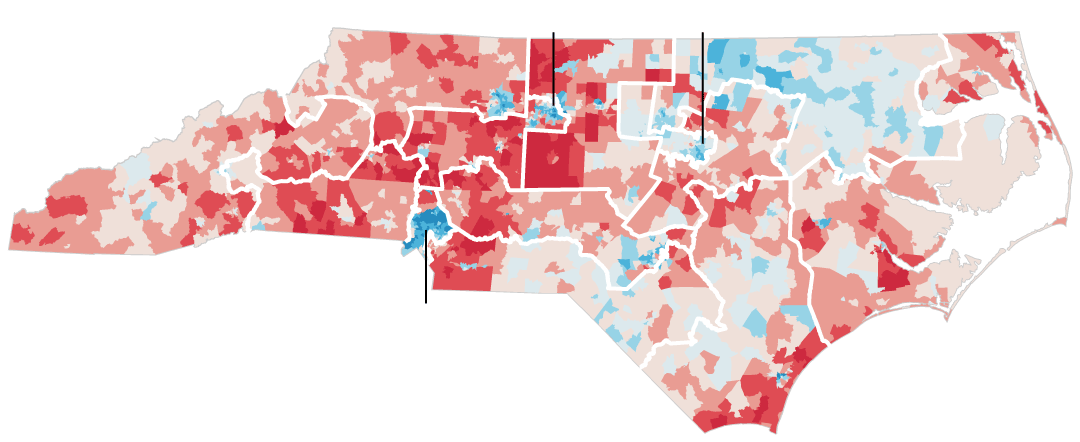
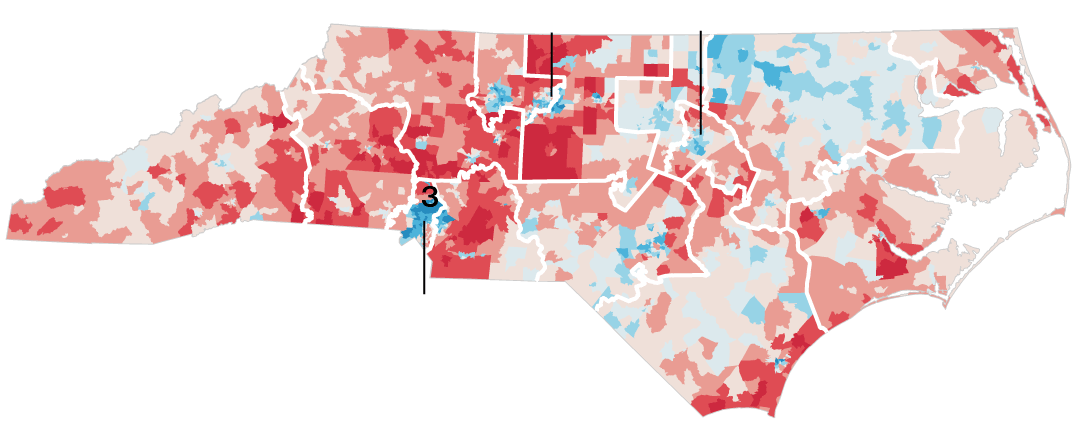
North Carolina Republicans didn’t hide their goal when they approved a new congressional voting map in 2016: They wanted to give their party the biggest advantage possible.
“I propose that we draw the maps to give a partisan advantage to 10 Republicans and three Democrats because I do not believe it’s possible to draw a map with 11 Republicans and two Democrats,” David Lewis, a Republican state representative who led the redistricting effort, said at the time.
Now the U.S. Supreme Court is set to consider the North Carolina districts in a clash opponents hope will produce the court’s first-ever ruling striking down a map as too partisan. The justices hear arguments Tuesday in the case, along with a fight over a Democratic-drawn congressional district in Maryland.
Lines on a Map

D +3.7K
R +3.7K votes

D +3.7K
R +3.7K votes

D +3.7K
R +3.7K votes

D +3.7K
R +3.7K votes
Current Districts

★ Raleigh
1
5
4
13
6
10
2
12
3
11
8
9
7
Charlotte
Greensboro
★ Raleigh
5
1
4
2
13
6
10
11
8
12
3
9
7
Charlotte

★ Raleigh
Greensboro
Asheville
5
1
4
2
13
6
11
10
8
12
3
9
Charlotte
7
Fayetteville
Wilmington

★ Raleigh
Greensboro
Asheville
5
1
4
2
13
6
11
10
8
12
3
9
Charlotte
7
Fayetteville
Wilmington
Alternative Map Drawn by Plaintiffs

★ Raleigh
6
5
11
12
7
2
10
1
13
3
4
8
9
Charlotte
★ Raleigh
Greensboro
6
5
11
12
2
7
10
1
3
13
8
4
9
Charlotte
★ Raleigh
Greensboro
Asheville
5
6
11
12
2
7
10
1
3
13
8
4
Charlotte
Fayetteville
9
Wilmington
★ Raleigh
Greensboro
Asheville
5
6
11
12
2
7
10
1
3
13
8
4
Charlotte
Fayetteville
9
Wilmington
The odds are probably against the challengers. The court refused to outlaw partisan gerrymanders in a Wisconsin case a year ago, even though swing Justice Anthony Kennedy had suggested he was open to that step. Kennedy has since retired and been replaced by Justice Brett Kavanaugh, who could give the conservative wing enough votes to insulate partisan maps from constitutional challenges.
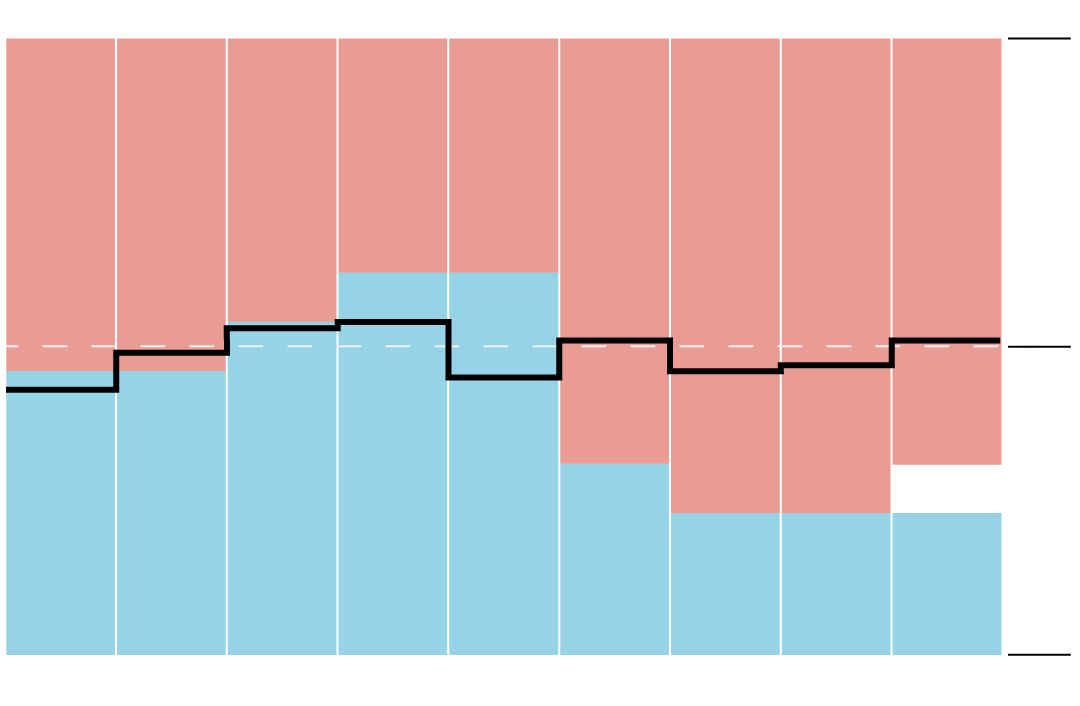
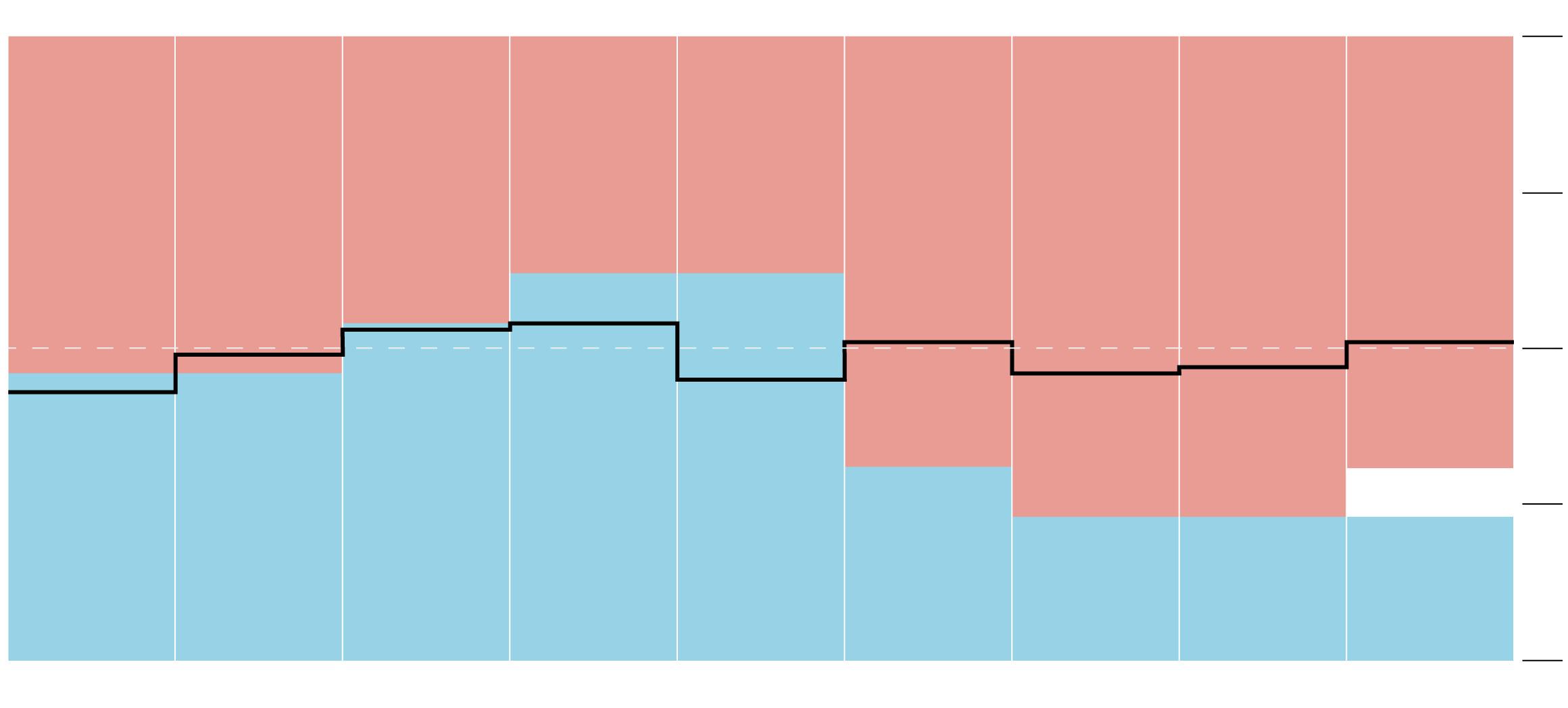
But the Supreme Court has rarely if ever considered a map born out of such brazen partisanship, or one that produced such clear results. North Carolina Republicans won 10 of the 13 seats in 2016, when Democrats got 47 percent of the statewide vote. In 2018 Republicans took nine, with one seat undecided, even though Democrats got 48 percent of the overall vote. (Excluding one district where a Republican ran unopposed, Democrats’ share in 2018 was 51 percent.)
The stakes for American democracy are high. Critics say partisan gerrymandering leads to uncompetitive elections that don’t reflect the will of the voters. Those on the other side say judges should be wary of entering such a deeply political fray, contending that judges lack any principled way to separate legitimate partisan considerations from unconstitutional ones.
Although the Supreme Court has long restricted gerrymandering based on race, it has never struck down a voting map as being too partisan.
The court’s rulings will shape the next round of map-drawing, which will take place around the country after the 2020 census. Right now Republicans are the more frequent beneficiaries of gerrymanders, largely because their electoral success in 2010 let them draw many of the current maps.
What Gerrymandering Looks Like
- Dem. statewide House vote share
- Dem. share of House seats
- Rep. share of House seats

100%
50
0
2002
2006
2010
2014
2018
100%
50
0
2002
2004
2006
2008
2010
2012
2014
2016
2018

100%
75
50
25
0
2002
2004
2006
2008
2010
2012
2014
2016
2018
100%
75
50
25
0
2002
2004
2006
2008
2010
2012
2014
2016
2018
The North Carolina voting districts came together quickly in February 2016, right after a three-judge panel struck down parts of an earlier map for relying too heavily on race. The panel gave the Republican-controlled state legislature two weeks to enact a replacement.
Lewis and Republican Senator Robert Rucho, the co-chairmen of the redistricting committee, told their map-drawer to make the lines as Republican-friendly as possible. The committee later included “partisan advantage” as one of eight criteria for the map, explicitly aiming to “maintain the current partisan makeup” of 10 Republicans and three Democrats.
It was in that context that Lewis made his now-controversial comment about not being able to carve out 11 GOP districts. In an interview, he attributed the remark in part to exhaustion as he finished a redistricting that normally would have taken five or six months.
Lewis said lawmakers made partisanship explicit to show they weren’t using race. Partisanship and race are often highly correlated, with minority voters tending to vote Democratic and white voters leaning Republican.
“I was trying to make sure that I was getting on the record that we were in fact using politics for politics’ sake and not politics as a proxy for race,” Lewis said in the interview.
The North Carolina map is being challenged in two lawsuits by two dozen voters, the state Democratic Party, the state chapter of the League of Women Voters, and the interest group Common Cause.
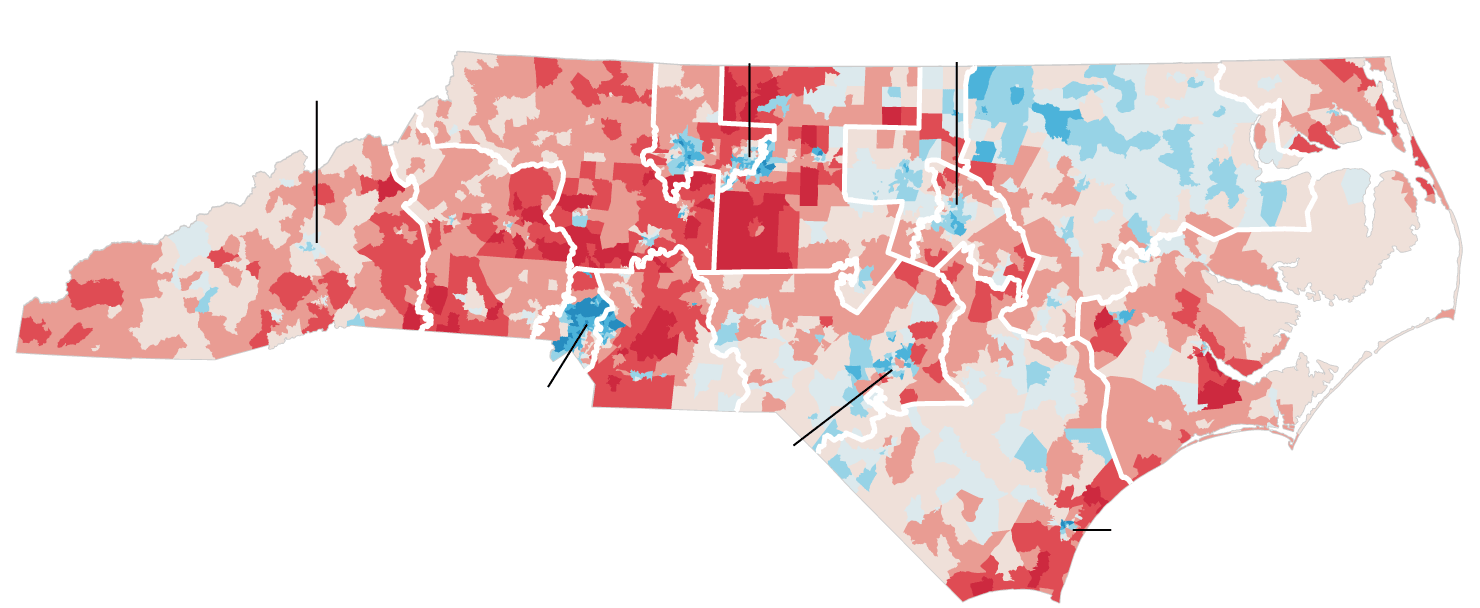
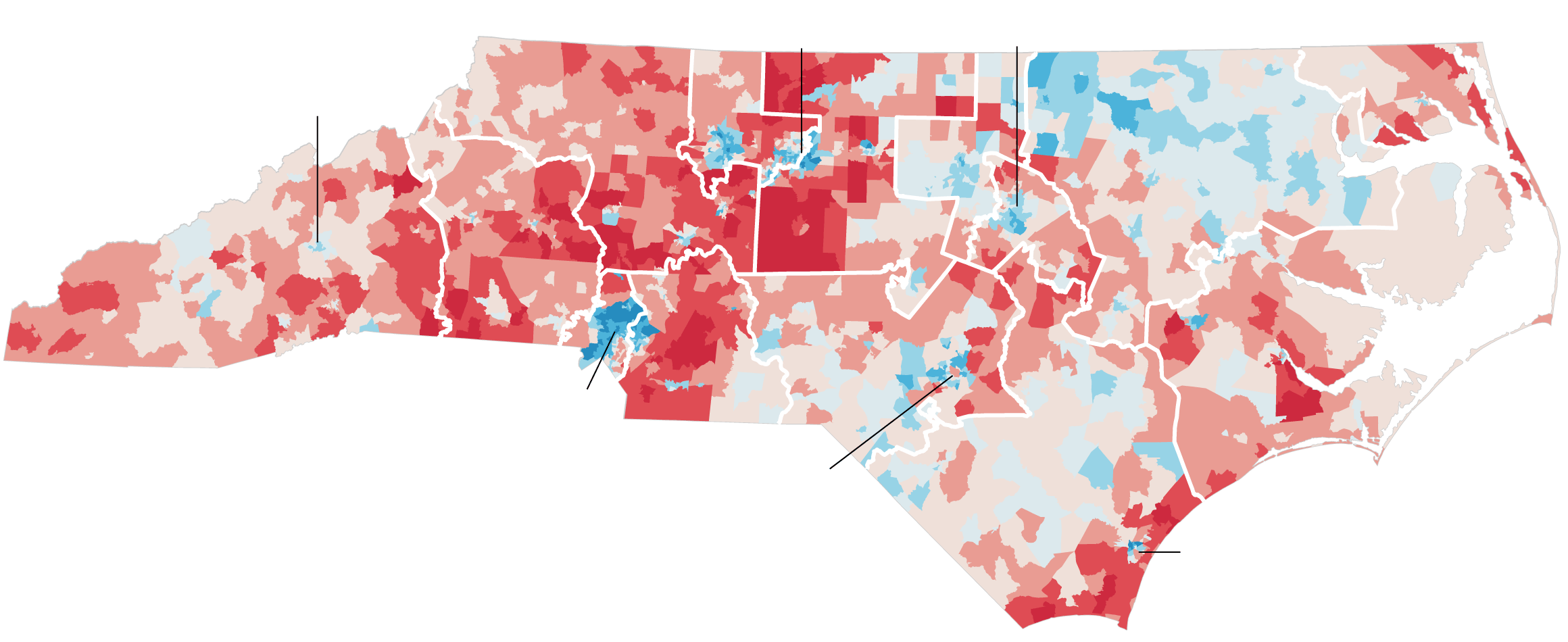
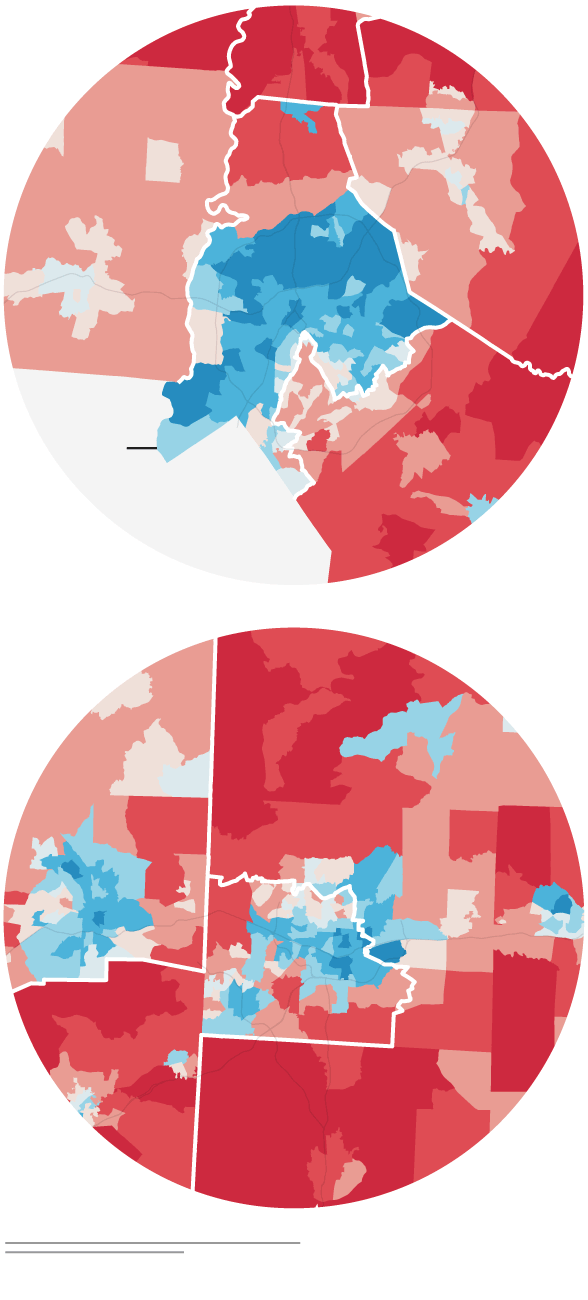
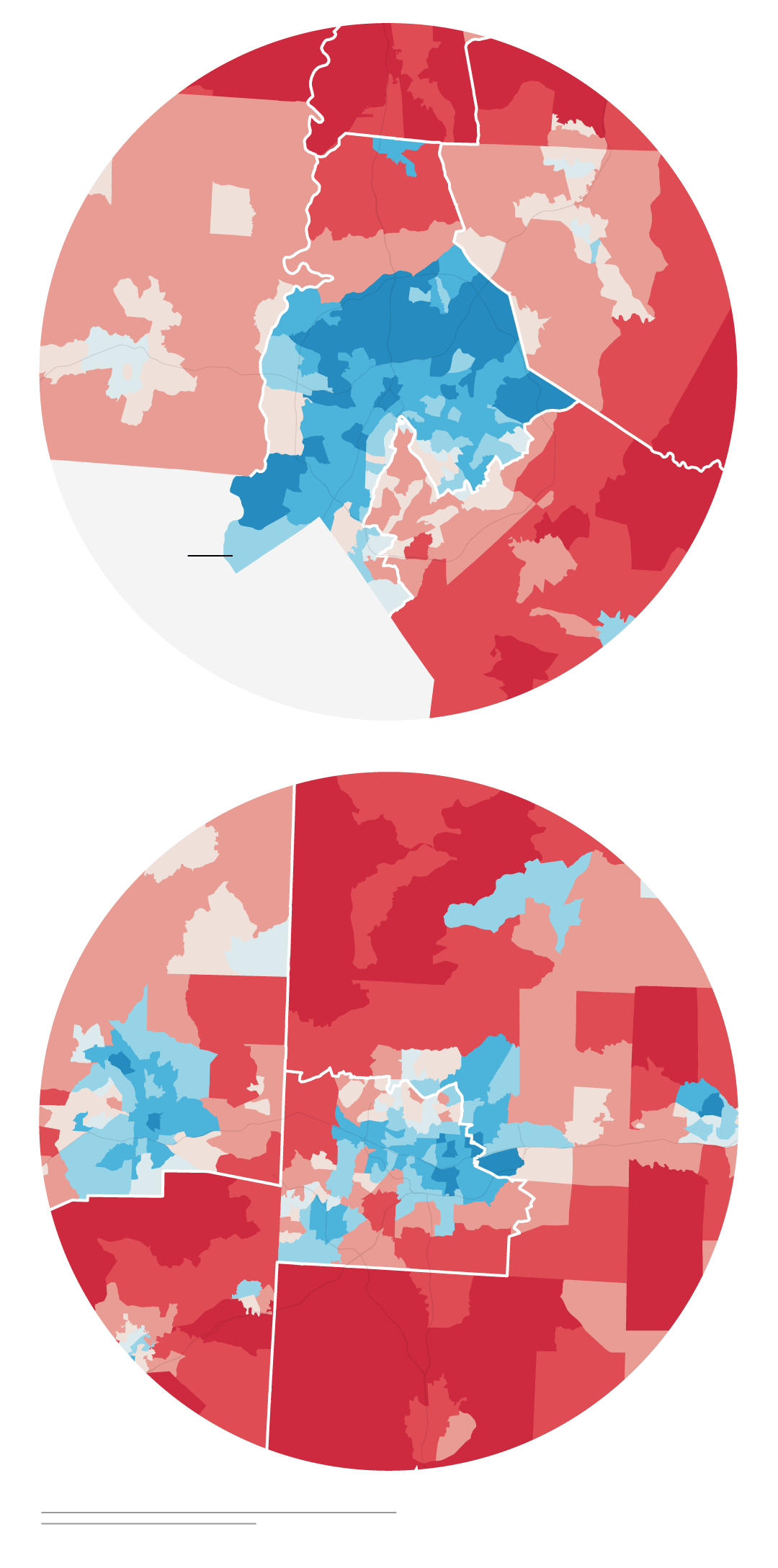
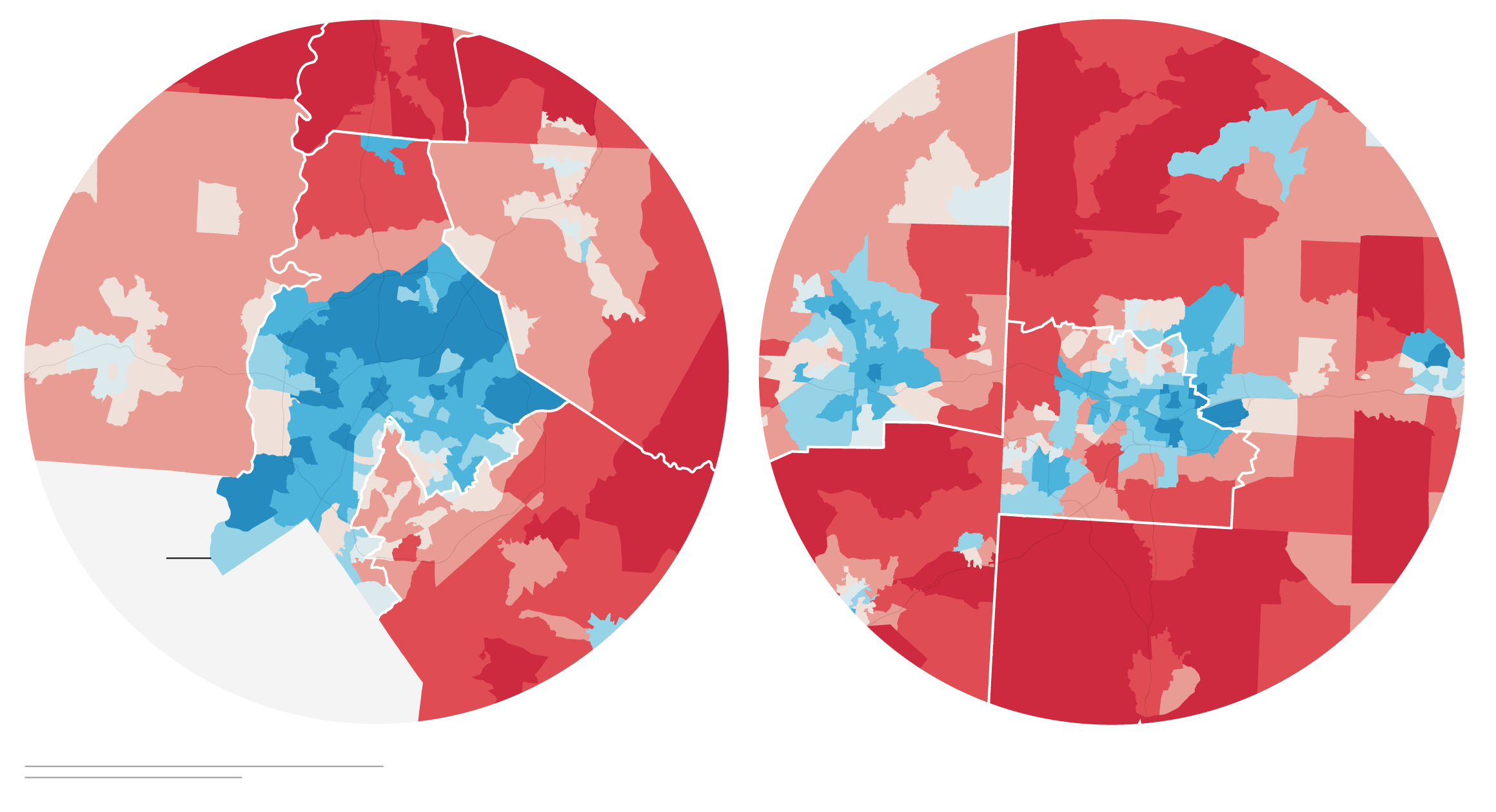
They contend that Democrats were either “packed” into overwhelmingly liberal districts or “cracked” into districts where their party was likely to fall just short of winning. They say a more balanced map, including an alternative drawn by an expert for the League of Women Voters, would produce something closer to an even Republican-Democratic split in the congressional delegation.
Packed Votes in Charlotte, Cracked Votes in Greensboro
D +3.7K
R +3.7K votes
D +3.7K
R +3.7K votes
D +3.7K
R +3.7K votes
D +3.7K
R +3.7K votes
13
10
8
Charlotte
12
9
SOUTH
CAROLINA
5
6
Winston-Salem
Greensboro
13
25 miles
25 km
13
10
8
Charlotte
12
9
SOUTH
CAROLINA
5
6
Winston-Salem
Greensboro
13
25 miles
25 km

13
5
10
6
8
Charlotte
Winston-Salem
Greensboro
13
12
9
SOUTH
CAROLINA
25 miles
25 km
13
5
10
6
8
Charlotte
Winston-Salem
Greensboro
13
12
9
SOUTH
CAROLINA
25 miles
25 km
“As far as we’ve been able to discern, this is the first time in American history that a legislature or a legislative body has explicitly ratified the pursuit of partisan advantage,” said Nicholas Stephanopoulos, a University of Chicago Law School professor and one of the lawyers pressing the challenge.
Judged by statistical measures, “the North Carolina plan is pretty much the worst congressional plan of the last half century,” Stephanopoulos said.
Republicans now hold eight of the 13 seats, with two vacancies. A new election is being held for North Carolina’s 9th district after the state elections board concluded that absentee-ballot fraud tainted the results of the November vote. In the 3rd district Republican Walter Jones died in February and will be replaced by the winner of a special election.
North Carolina Republicans say the whole subject should be off limits for the judiciary. They say that none of the tests suggested by the three-judge panel—or any other lower court—provides the clarity judges need to be able to say when partisanship has gone too far.
Maps everywhere would face protracted litigation “with no certainty as to what the outcome would be,” said Misha Tseytlin, who represents seven Republican members of the North Carolina congressional delegation. Tseytlin previously served as Wisconsin solicitor general and defended that state’s map at the Supreme Court last term.
The high court said in the Wisconsin case that the Democratic voters pressing the suit hadn’t shown they were injured. The same issue could derail the North Carolina challengers, though they say they’ve shown that individual voters in most districts were harmed.
The Maryland appeal, pressed by the state’s Democratic attorney general, is narrower and doesn’t seek to categorically protect partisan gerrymanders. A three-judge panel ordered the state to redraw a congressional district in western Maryland for the 2020 election, saying Democrats improperly drew it to squeeze out an incumbent Republican.
Democrat David Trone now represents the district, and Democrats captured seven of the state’s eight congressional seats in November.
Kavanaugh and Chief Justice John Roberts are likely to cast the key votes. Roberts sounded last term as if he wanted no part of the partisan gerrymandering debate.
During arguments on the Wisconsin map, Roberts questioned whether there was any principled way to separate out gerrymanders that go too far, deriding proposed tests offered by opponents as “sociological gobbledygook.”
Roberts said the Supreme Court risks looking in each case as though it is favoring one party over another.
“That is going to cause very serious harm to the status and integrity of the decisions of this court in the eyes of the country,” he said.
The cases are Rucho v. Common Cause, 18-422, and Lamone v. Benisek, 18-726.