Here’s What Most Americans Agree Will Happen in 2019

The issues on which Americans agreed in 2018 seemed few and far between. Republicans and Democrats are ideologically the furthest apart they’ve been in decades. They disagree on how well President Trump is doing his job, and they clash on the country’s biggest problems. Most Democrats but few Republicans said climate change and racial disparities in criminal justice were big issues, according to Pew Research, while most Republicans feared illegal immigration. Around half of Americans support the Affordable Care Act; the other half oppose it.

Bloomberg and pollster Morning Consult set out to discover what the majority of Americans agree on for the year ahead. Below are predictions for 2019 that poll respondents across party lines and across generations said were likely:

separator

Hollywood will continue to produce movies with diverse casts, such as Black Panther and Crazy Rich Asians

79 percent said was “somewhat likely” or “very likely”
Black Panther, the first big superhero movie with a mostly black cast and black director, was the country’s highest grossing movie in 2018. Another box-office hit was Crazy Rich Asians, a movie starring, written by and directed by an all-Asian ensemble. The #OscarsSoWhite movement, which began almost four years ago, highlighted Hollywood’s long reputation for disproportionately excluding minority actors from leading roles. At the time, all but eight Academy Awards Best Actor and Best Actress winners in history were white. But this year’s box-office successes showed that movies directed by and starring more diverse casts can have broad appeal, and Americans think Hollywood will take note.
Most likely to disagree: 12 percent of respondents ages 18 to 21 and 11 percent of African American respondents said it was “somewhat unlikely” or “very unlikely”

The majority of onscreen characters are white

Prevalence of character race/ethnicity on screen
Source: University of Southern California Annenberg School
separator

A major department store like Sears or Macy’s will go out of business
79 percent said was “somewhat likely” or “very likely”
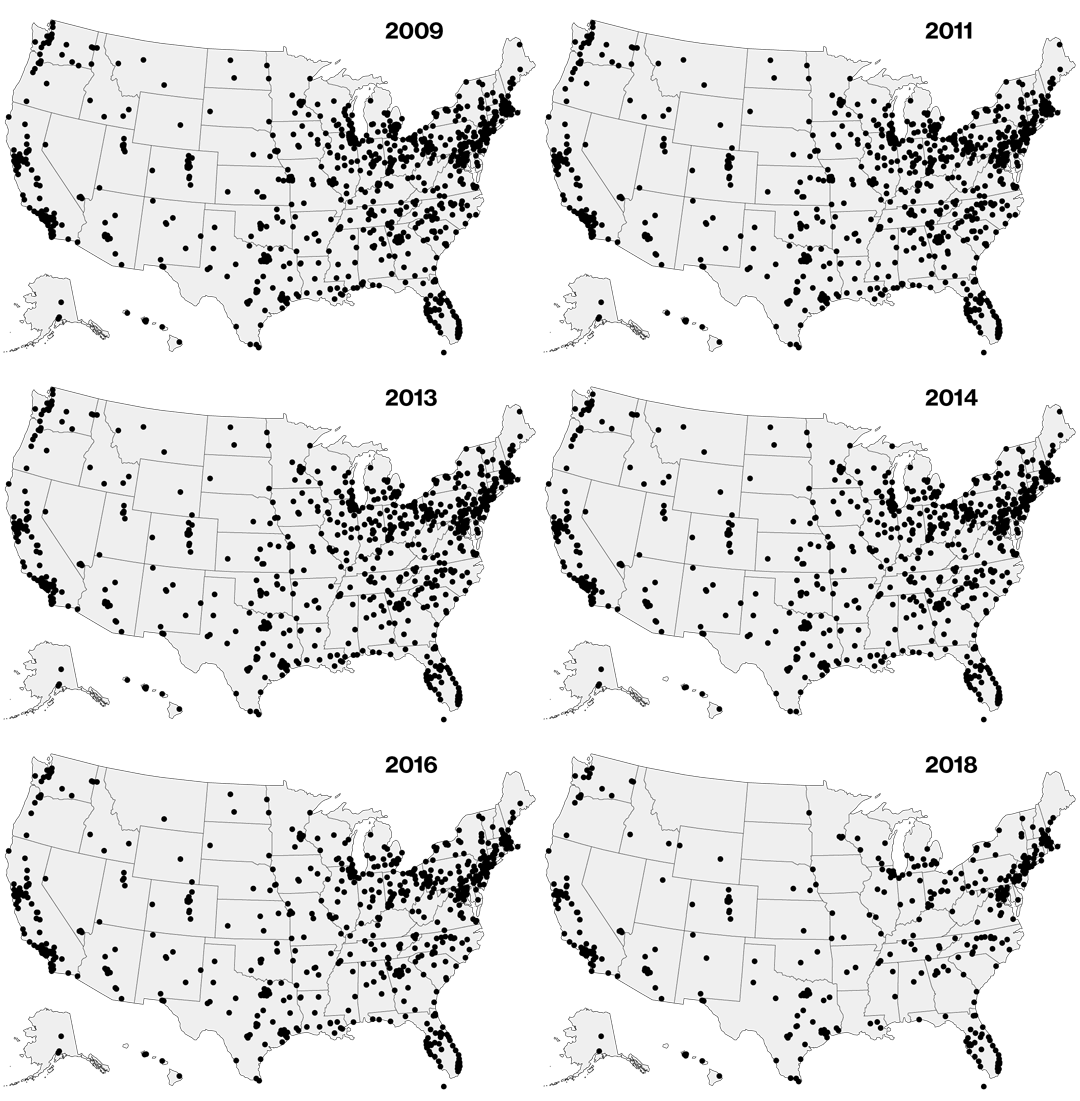
Not long ago the Sears catalog, like a pre-internet Amazon, was many Americans’ first destination for a vast array of items—a new dishwasher, clothing, a lawnmower or tools—sent right to their door. But in 2018, Sears filed for Chapter 11 bankruptcy, announcing the 125-year-old company would close 142 stores in addition to the 46 already slated to close. JCPenney announced it would close 140 stores in 2017, and in 2016 Macy’s said it planned to close 100 stores nationwide. Department stores haven’t been able to keep up with online retailers, along with other originally brick-and-mortar stores that have expanded into e-commerce, like Walmart, H&M and Zara. Americans see an even bleaker future for legacy department stores in 2019.
Most likely to disagree: 22 percent of students and 20 percent of respondents ages 18 to 21 said it was “somewhat unlikely” or “very unlikely”

Sears closings

U.S. Sears locations over time
Source: Aggdata
separator

More major companies will experience data breaches than in 2018

75 percent said was “somewhat likely” or “very likely”
Americans whose data has remained safe online are an endangered species: in each of the past few years, data breaches have affected hundreds of millions—if not billions—of customers. As companies and consumers alike rely more heavily on the internet, Americans are pessimistic about the safety of their data. Three in four respondents said more companies would experience data breaches in 2019 than in 2018.
Most likely to disagree: 18 percent of respondents who said education would be the most talked-about social issue in 2019 and 16 percent of Hispanic respondents said it was “somewhat unlikely” or “very unlikely”

Data breaches are getting bigger

Records lost in major data breaches
Source: Information is Beautiful, Bloomberg research
Not pictured: A 2013 attack against Yahoo compromised the data of 3 billion accounts, the full extent of which wasn’t discovered until 2017. The 3 billion figure dwarfs data breaches before and after it.
separator

Housing prices will increase across the country

69 percent said was “somewhat likely” or “very likely”
Even with signs that housing prices could be headed for their biggest slowdown in years—housing prices in 20 cities grew at their slowest rate in two years—they’re far from the negative growth of a decade ago. Most Americans said it was somewhat or very likely that housing prices would continue to increase across the country.
Most likely to disagree: 26 percent of respondents who said energy would be the most talked-about social issue in 2019 said it was “somewhat unlikely” or “very unlikely”

U.S. housing price gains are cooling off

Year-on-year change of 20-city home price index
Source: S&P CoreLogic Case-Shiller
separator

Amazon will make another major acquisition

78 percent said was “somewhat likely” or “very likely”
Far from its origins as an online bookseller, Amazon has grown too sprawling to categorize. It has business in industries as varied as groceries, tech, pharmaceuticals and shipping, many of which it expanded into through acquisitions. Amazon’s biggest acquisition to date was its 2017 purchase of Whole Foods for $13.7 billion. Despite a revenue and profit forecast that disappointed investors ahead of the holiday season, Americans think Amazon is still feeling spendy: 78 percent agreed it seemed “somewhat likely” or “very likely” Amazon would acquire another large company in the coming year.
Most likely to disagree: 13 percent of respondents ages 18 to 21 said it was “somewhat unlikely” or “very unlikely”

Largest Amazon acquisitions

Amazon acquisitions by price
Source: CB Insights
separator

Podcasts will continue to expand as a medium for entertainment and news

73 percent said was “somewhat likely” or “very likely”
The number of podcast listeners has grown for the past decade. Podcast companies like Gimlet Media have raised millions of dollars in investments, and media companies have staffed up their podcast teams. But as the number of listeners grew, there was fear of a bubble: Just this year, podcasting company Panoply closed its editorial arm, and Buzzfeed laid off its podcast staff. But if podcasting companies have hit headwinds, Americans don’t think that will halt the expansion of podcasts themselves: 73 percent believed it was somewhat or “very likely” podcasts would expand in 2019.
Most likely to disagree: 14 percent of students and 13 percent of respondents ages 18 to 21 said it was “somewhat unlikely” or “very unlikely”

Podcasts are booming

Share of Americans who listened to a podcast in the past month
Source: Edison Research and Triton Digital
separator

Crime rates will fall

67 percent said was “somewhat unlikely” or “very unlikely”
The U.S. violent crime rate has fallen sharply over the last two decades, but the number of crimes per 100,000 residents has crept up slightly since 2014, according to FBI data. Property crime, meanwhile, has stayed down. Most Americans were pessimistic about crime in 2019 in the Bloomberg/Morning Consult poll. Just over two-thirds of respondents said it was “somewhat unlikely” or “very unlikely” that crime rates would fall in 2019.
Most likely to disagree: 33 percent of respondents who strongly approved of the job Trump is doing and 32 percent of Jewish respondents said crime falling was “somewhat likely” or “very likely”

A pause in violent crime’s fall

Violent crime rate per 100,000 inhabitants
Source: FBI