U.K. Election: What The Parties Are Promising
Britons are voting today in a general election Prime Minister Theresa May called early under the premise that she needed a stronger hand going into negotiations to leave the European Union.
But over the course of a seven-week campaign, the political landscape changed. Brexit has slipped into the background and May's once-commanding lead began to wane after a flip-flop on elderly care. And then there were the twin terror attacks, which thrust security into the debate.
Here is a reminder on where the three main parties stand on the key issues:
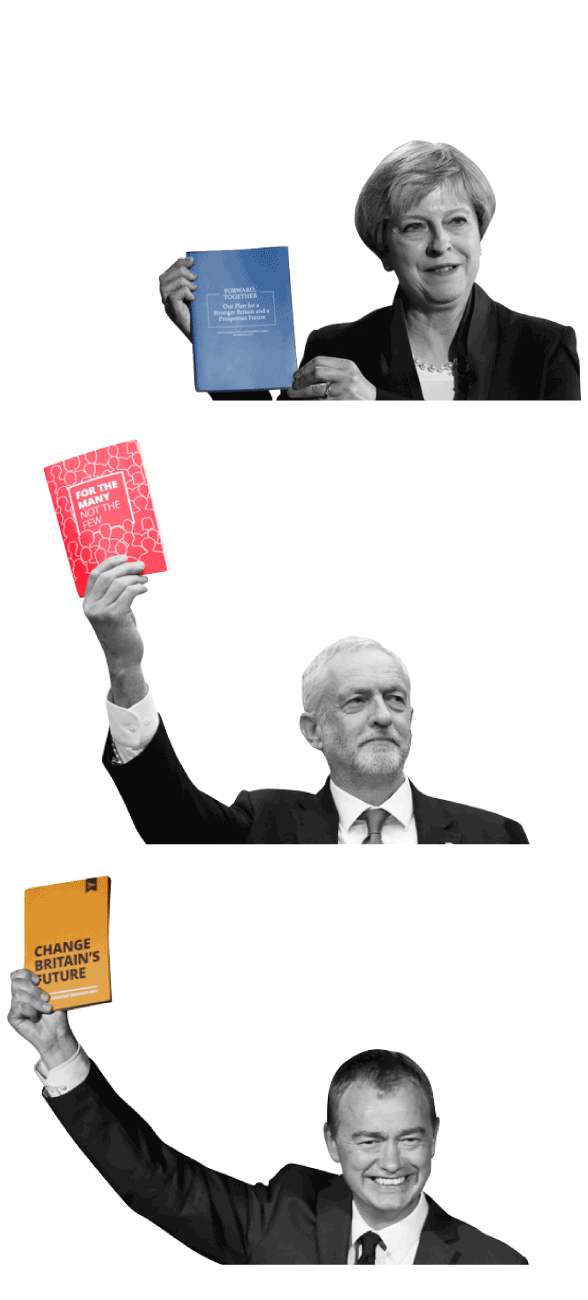
Theresa May
Conservatives
“Forward
Together”
Jeremy Corbyn
Labour
“For the many,
not the few”
Tim Farron
Liberal Democrats
“Change Britain’s
future”
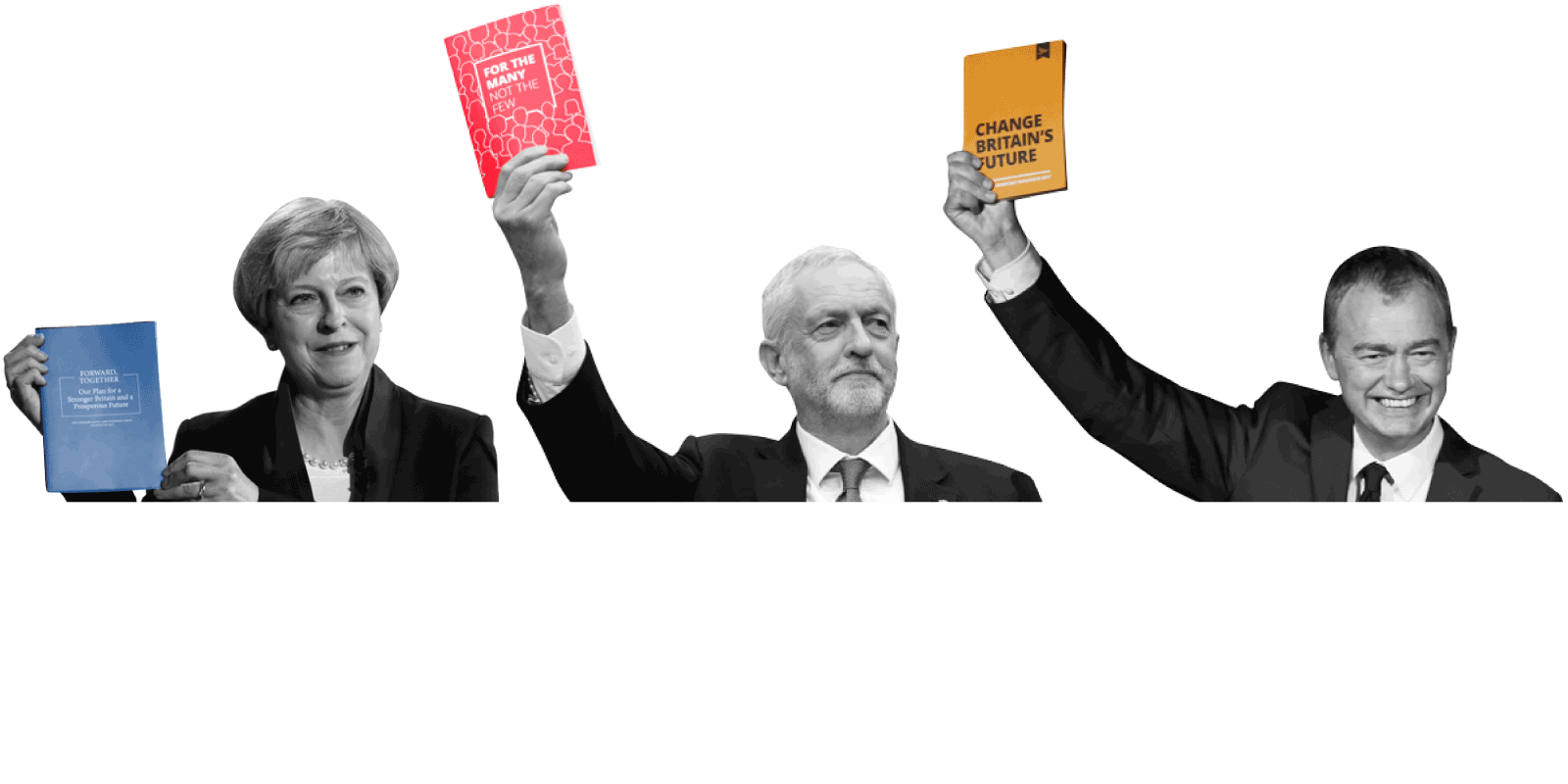
Jeremy Corbyn
Labour
Theresa May
Conservatives
Tim Farron
Liberal Democrats
“Forward
“For the many,
“Change Britain’s
Together”
not the few”
future”
Jeremy Corbyn
Labour
Tim Farron
Liberal Democrats
Theresa May
Conservatives
“Forward
“For the many,
“Change Britain’s
Together”
not the few”
future”
Security
Conservatives
Promises to create a new police force to guard critical pieces of infrastructure such as power stations and the transport network
Vows to spend at least 2 percent of GDP on defence, play a leading role in NATO, keep the current size of the armed forces and renew Britain's nuclear deterrent
Continue to invest in security services, develop counter-terrorism strategy
Labour
Pledges to recruit 10,000 more officers and 500 more border guards. Also promises 3,000 new firefighters. Also has a pledge made on the campaign trail, but not in the manifesto, to hire 1,000 more intelligence staff
Retains commitments to NATO, to spend 2 percent of GDP on defence. Renew Britain's nuclear deterrent while also vowing to lead efforts for global nuclear disarmament
Liberal Democrats
Will fight to maintain U.K. access to key EU agencies and databases as Brexit proceeds, including Europol and the European Arrest Warrant
Plow an additional 300 million pounds a year into community policing and end a cap on police pay rises
Commits to spending 2 percent of GDP on defence. Maintain a “minimum” nuclear deterrent, dropping to three nuclear-armed submarines from four currently, while pushing for global nuclear disarmament
Brexit
The defining issue of this election is how Britain will act on its referendum vote to leave the European Union last year. The country’s future relationship with its closest and biggest trading partners is critical in determining the path the economy will take
Conservatives
Will uphold EU referendum result and push ahead with Brexit
Pledges to leave single market and customs union, while seeking “deep and special” future relationship with EU, including free trade and customs agreements
Says “no deal is better than a bad deal”
Labour
Party “accepts” referendum result, but would scrap May’s negotiating strategy
Prioritizes keeping benefits of membership of the Single Market and Customs Union
Says leaving EU with no deal is “worst possible” option
Liberal Democrats
Accepts last year’s vote as mandate to start negotiations to leave the EU
Maintains country is better off in the bloc
Says final Brexit deal should be put to the vote, with the alternative being to stay in the EU
Immigration
A divisive topic that May believes was at the root of last year’s vote for Brexit. Her Conservatives are sticking to rigid targets to rein in immigration, while Labour and the Liberal Democrats have steered clear of numerical targets, offering a more flexible stance.
Conservatives
Pledges to “reduce and control” immigration to the “tens of thousands”
Will double immigration-skills charge paid by companies employing migrant workers to 2,000 pounds a year, using revenues to boost training at home
Will devise immigration policy that works for business sectors where there are skills shortages
Labour
Acknowledges that free movement of EU nationals will end after Brexit, but says it won’t “scapegoat” immigrants
Pledges to stop “overseas-only” recruitment practices, introduce a fund to help areas where immigration puts pressure on services and take “decisive action” against employers who exploit cheaper migrant labour
Will tailor an immigration system to the needs of the economy
Liberal Democrats
Supports continued high-skilled immigration to support key sectors of economy
Will set up fund to help local communities cope with pressure on services
Promises annual debate in Parliament on skill and labour market shortfalls to identify U.K.’s immigration needs
Tax
There are clear dividing lines here, with the tories pledging to keep taxes “as low as possible” and Labour outlining 48.6 billion pounds of tax rises to pay for health and education promises. The Liberal Democrats tread a central ground, pledging to raise income and corporation tax, but not by as much as Labour
Conservatives
Tax-free earnings allowance to be raised to 12,500 pounds by 2020, with the higher tax banding raised to 50,000 pounds
Retains pledge to cut corporation tax to 17 percent in 2020 from 19 percent currently
Labour
Will raise income tax rates for earnings over 80,000 pounds to 45 percent from 40 percent, and to 50 percent for earnings over 123,000 pounds
Pledges to raise corporation tax from 19 percent now to 21 percent next year, 24 percent a year later and 26 percent the following year
Will put a 15 percent tax on homes bought by offshore trusts
Liberal Democrats
Will add a penny to income tax, raising 6.3 billion pounds
Raise corporation tax to 20 percent
Develop a health and care tax, possibly by reforming National Insurance, to pay for health and social care
Increase dividend tax by a penny in the pound
Companies and Governance
Businesses go into the election knowing that whoever comes out on top, they may face more regulations and red tape—perversely the opposite of what was pledged in the Brexit referendum
Conservatives
Will legislate to make executive pay packages subject to annual votes by shareholders. Listed companies will have to publish pay ratios to show the disparity between executive pay and the pay of ordinary workers
Pledges to increase national living wage in line with increase in median earnings
Will reform rules on mergers and takeovers, making all promises and undertakings made in the course of a takeover bid legally enforceable, and allowing for the government to pause a takeover to allow for more scrutiny.
Labour
Discourage excessive pay packages by charging companies 2.5 percent for paying employees more than 330,000 pounds
Raise minimum wage to ten pounds an hour by 2020
Four new public holidays to mark the patron saints’ days of England, Wales, Scotland and Northern Ireland
Ban so-called zero-hours contracts that tie workers to a job without guarantee of any paid work
Amend takeover code to make sure all takeovers have clear plan to protect workers and pensions
Introduce maximum pay ratio between executives and everyday workers of 20-to-1 for public sector bodies and companies bidding for public contracts
Liberal Democrats
Will reverse Conservative cuts to capital gains tax
Push for 40 percent of FTSE 350 company board members to be women
Increase representation of ethnic minorities and all companies with 250 employees or more to publish pay and employment data broken down by gender, ethnicity and sexuality
Energy
There’s a lot to be chewed over for the energy industry, with the different parties offering up a menu of price caps, nationalizations and go-aheads for key projects.
Conservatives
No more large-scale onshore wind power plants in England
Support for developing shale gas industry in Britain
Price cap on gas and electricity charges paid by most homes. Independent review into the cost of energy
Labour
Ensure that 60 percent of energy comes from zero-carbon or renewable sources by 2030
Ban on fracking
Support future nuclear power projects
Take power and gas grids back into public control.
Bring in emergency price cap to ensure average dual power and gas bill is no more than 1,000 pounds per household
Liberal Democrats
Aim to generate 60 percent of electricity from renewables by 2030
Make energy efficiency a priority, legislating for energy standards in buildings
Cut the share of domestic power and gas provided by the so-called Big 6 Utilities to 30 percent in 2022 from about 90 percent now by encouraging new entrants to the market
Other key pledges
Conservatives
Retains promise to build 1 million homes from 2015 through 2020
Fund social care from the proceeds of selling a person's house after they and their partner have died — with a floor of 100,000 pounds that they can pass on as inheritance. May later promised a cap after the policy sparked uproar and was dubbed “dementia tax''
Ensure pensions rise by whichever is higher out of inflation and earnings growth but drop a 2.5 percent condition after 2020.
Labour
Inject 37 billion pounds into National Health Service over next 5 years, including 10 billion pounds for buildings and IT systems
Promises to end university tuition fees and bring back grants for students.
Will nationalise rail companies and the Royal Mail
Build 100,000 affordable council and housing association homes a year by 2022
Keep pensions triple lock
Set up National Investment Bank to generate 250 billion to support small businesses, projects, and research and development
Liberal Democrats
Will legalize cannabis, and tax it, raising 1 billion pounds
Almost double the current annual rate of homebuilding to 300,000 a year
Keep triple lock on pensions
Oppose expanding Heathrow, Gatwick, or Stansted airport
An extra 6 billion pounds of year to be spent on National Health Service
Bring back maintenance grants for university students