

University Is More Important Than Ever in Britain's Jobs Market
Reed Recruitment data suggest alternative pathways into the workforce have lost traction as jobs dry up.
Young people in Britain need a university degree now more than ever to thrive in a bumpy economy, defying the government’s push for vocational training and apprenticeships as an alternative route into the workforce.
That’s the conclusion of a Bloomberg analysis of data from Reed Recruitment, which shows that businesses shed job postings not requiring a diploma when the UK slipped into recession last year. The pay premium for graduates has also widened lately.
The findings mark a reverse for employers who in recent years boasted about dropping degree requirements, part of an effort to tap a more diverse pool of workers. Ahead of the July 4 election, the Conservative government and Labour opposition have emphasized routes that circumvent higher education, especially apprenticeships. But as unemployment ticks up and the economy stagnates, it’s university graduates who have the upper-leg.
“Ultimately, having a degree does give candidates a competitive edge over non-graduates,” said James Reed, chairman of the recruitment company that bears his name. “The alternative pathways to work aren’t as readily available.”
It’s an issue the main political parties are campaigning on. Prime Minister Rishi Sunak promised to fund 100,000 new apprenticeships in England every year by the end of the next Parliament term and to scrap “rip-off” degrees if his Conservatives win another term. Labour, which is leading in polls, plans to revamp the apprenticeship levy to allow businesses to spend part of the funds on other forms of training.
UK Degree Jobs Are More Popular Than Ever
Index, 100 = 2019 levels

The divergent approaches became apparent during a debate at Bloomberg’s London headquarters with Business Secretary Kemi Badenoch and Labor’s Jonathan Reynolds. Badenoch criticized degrees that come with student debt and few job prospects, saying apprenticeships, not universities provide the key skills needed for growth. Reynolds retorted by highlighting higher education as one of the strengths of the UK economy.
But those leaving school and weighing a route into work can look at data that shows those with degrees have an edge. Job postings that require a degree as a proportion of total vacancies rose as much as 40% since 2016, according to the data from Reed Recruitment, which covers England. Those listings climbed above the historical average last year when the economy slid into a mild downturn. Employers started scaling back non-degree postings in 2023 until they hit almost 50% of 2016 numbers in May. By contrast, degree postings held up relatively well over the period.
“During times of economic distress, graduates are somewhat protected from the downturn,” said Lizzie Crowley, senior skills policy adviser at the Chartered Institute of Personnel and Development. “The knowledge economy is the type of employment that is likely to hold up during a recession.”
UK Degree Jobs Held Up Better During Last Year's Recession
Index, 100 = 2019 levels
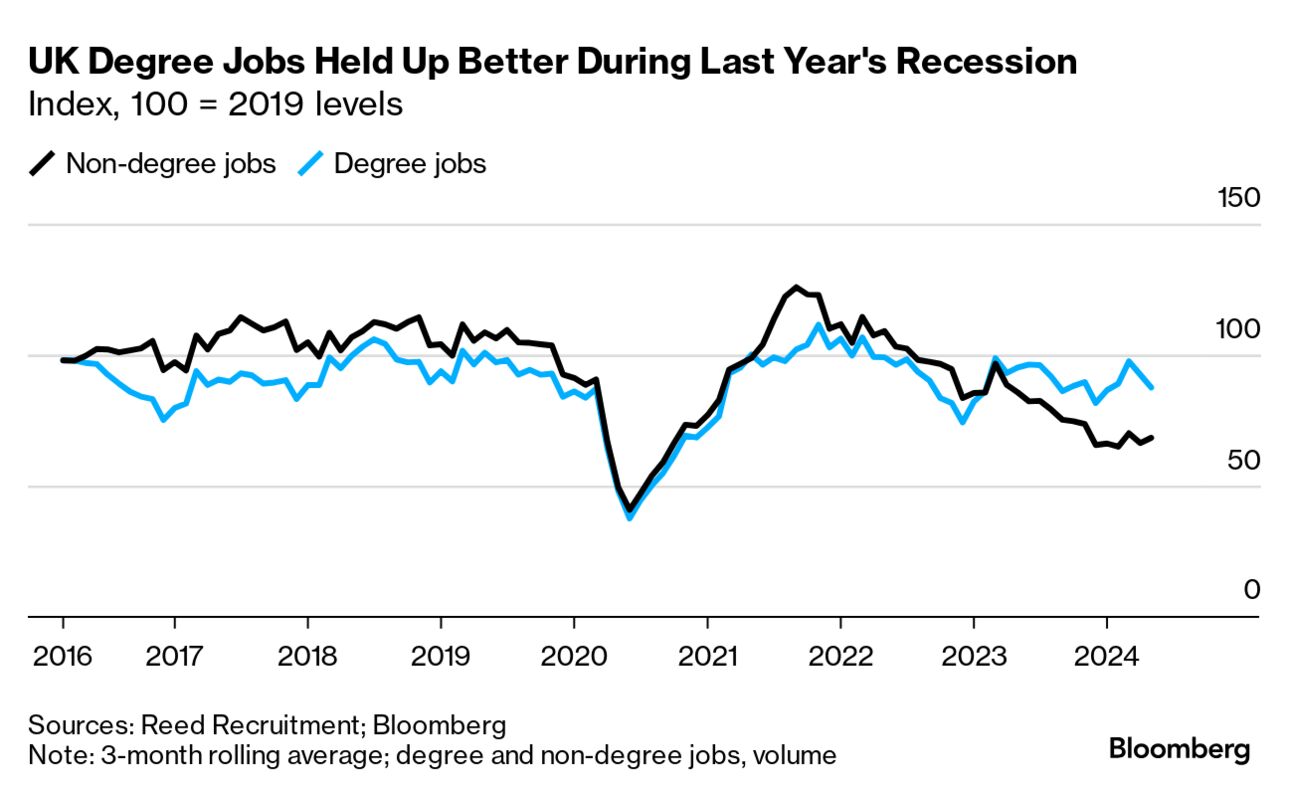
Britain’s economy is facing another year of near-zero growth as the recovery from last year’s slump loses momentum. With interest rates at a 16-year high and the lingering effects of the cost of living crisis, companies are moving cautiously on hiring. Unemployment has risen to the highest since the pandemic lockdowns in 2021, and job vacancies have declined sharply.
The bleak outlook means businesses are becoming pickier about who they hire. Managers use degrees to filter a growing pile of applications instead of doing complex, more subjective work to assess skills. That’s making a diploma a must-have even for roles like real estate agents or payroll managers that didn’t traditionally require academic qualifications, according to Crowley. At the same time, some non-degree, lower-paid jobs tend to be seen as less urgent to fill.
“If a financial controller or a qualified accountant with a degree left an organization, they would be replaced more than if a administrator left,” said Barney Ely, managing director at Hays in the South East. “That’s the economic downturn effect. The higher-level jobs are needed more and are less vulnerable.”
Reed data also show a majority of sectors have increased their appetite for degrees since 2016. Health, construction and accountancy more than doubled vacancies requiring academic qualifications over the period. The figures suggested headcount growth was concentrated in employers that take the most graduates.
Sectors with a relatively high level of degree jobs like engineering or education expanded their overall postings between 2016 and 2024, while vacancies shrunk in those with lower qualification requirements.
That trend is just beginning. As countries are facing aging populations, net-zero targets and tech developments, a recent McKinsey report found that business appetite for roles like health, STEM or business professionals will see double-digit growth by 2030 in Europe and the US. At the same time, demand for workers in food services or office support is likely to shrink.
“The economy is shifting now toward highly-skilled occupations, and there’s a need for the capabilities that university graduates have,” said Rosalind Gill, head of policy and engagement at the National Center for Universities and Business. “It’s also some of the wider competencies that a degree education can offer — communication skills, the ability to work and research independently. These are all skills that are highly valued.”
Top Degree Employers Are Growing as Non-Degree Sectors Shrink
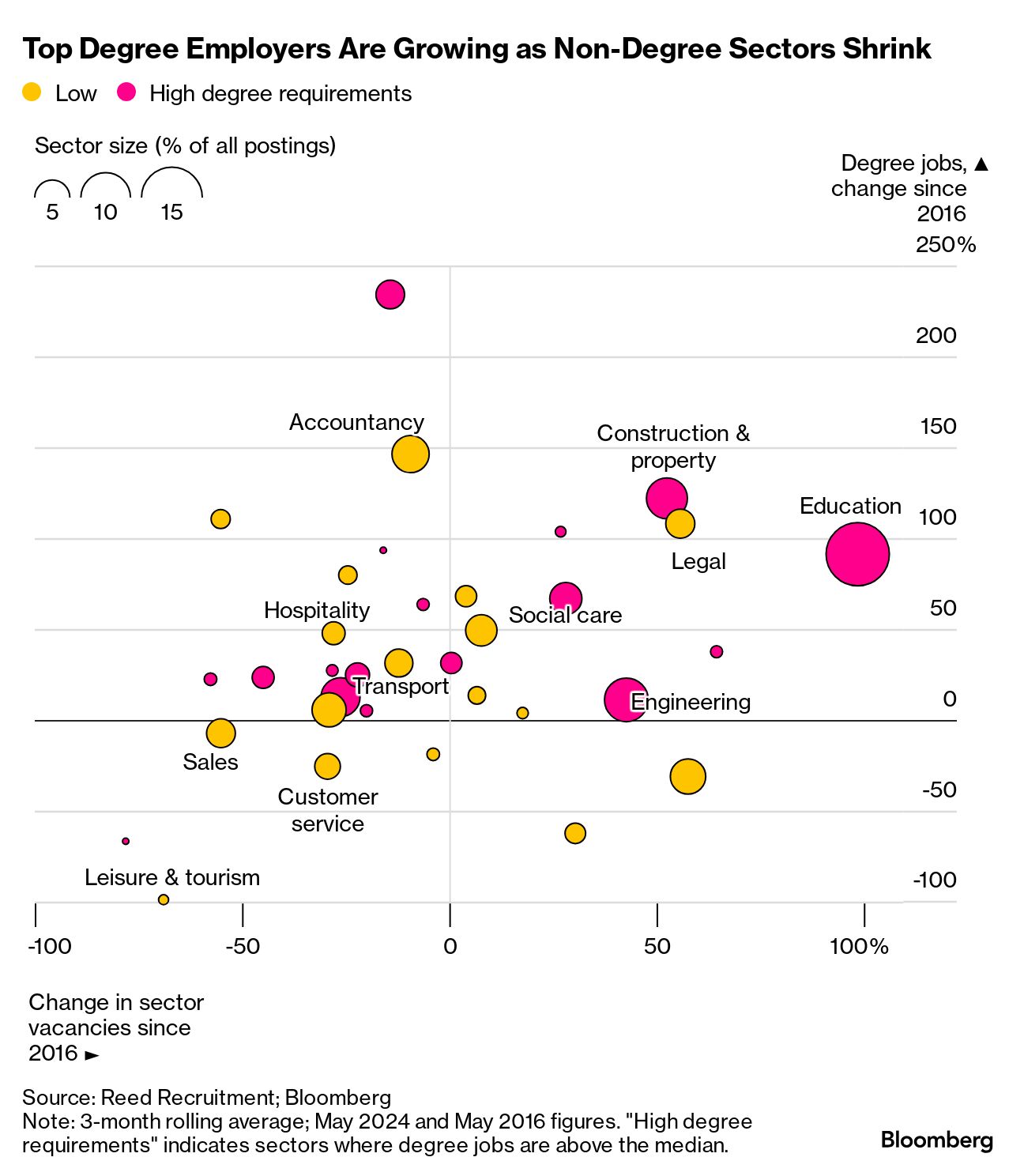
The trend has flipped the narrative of “skills, not degrees” that’s gained traction in recent years. With labor shortages hurting productivity and pushing up wages, the idea was to make hiring requirements more flexible. That would both help to appeal to a more diverse group of workers and make up for the some 800,000 people who dropped out of the jobs market during the pandemic.
That’s led consumer giant WK Kellogg Co. to drop degree requirements for all UK roles, while most FTSE 100 job postings didn’t mention academic qualifications in August last year, according to the human resources and payroll adviser MHR. Linkedin’s numbers also showed non-degree postings in the UK doubled from 2021 to 2022.
Even so, skills-based hiring remains a rarity beyond the UK’s largest companies, since few have the resources to invest in things like “gamification” to test for an applicant’s critical thinking skills or logic tests.
“It’s become more advantageous over the last decade for people without degrees to get into careers that were traditionally blocked off from them,” said Ely from Hays. “The economic downturn in the last year has meant that opportunity is reduced.”
UK Degree Pay Premium Has Been Rising in Recent Months

The government is pushing degree apprenticeships, which combine paid work with studying toward a higher-education degree for up to five years. Degree apprentices are paid a salary by a company, while their training is jointly funded by their employer and the government, which contributes an annual levy allowance of £15,000 ($19,010).
“We want to make sure that people are able to take apprenticeships so they have those practical skills rather than the university degrees which don’t necessarily deliver what we need for economic growth,” Badenoch said at Bloomberg on June 24. “One of the things we’ve put in our manifesto is talk about reducing those courses which young people go into where they actually end up earning less than if they’ve never gone into university at all.”
Those starting degree apprenticeships made up just 5% of all undergraduate degree entrants, according to official figures. The relatively low number going down that route reflects the fact that few employers can afford to provide them. Larger businesses like Cisco Systems Inc. have embraced degree apprentices, but for smaller firms it remains a significant investment to keep apprentices on their payroll for years while they also regularly take time off to study.
“Companies that have made the shift to skills-based hiring may have not yet seen the desired results,” Reed said. “A 2024 study by The Burning Glass Institute and Harvard Business School found that companies that introduced skills-based hiring only increased the share of people without a degree in their workforce by 3.5 percentage points, on average.”
UK Unemployment Increased to the Highest Since 2021
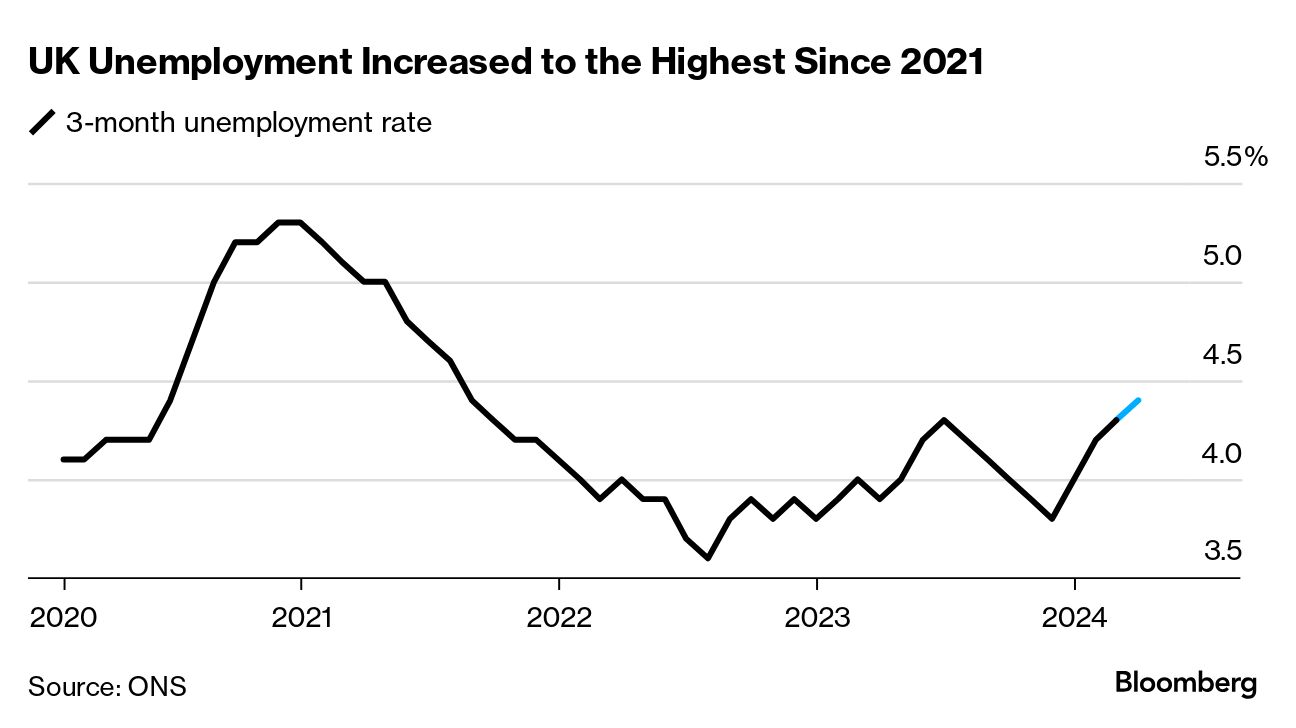
Even as these programs are becoming more popular with applicants, experts warn they’re not fulfilling their purpose of providing young people with an alternative pathway into the workforce. Most degree apprentices are over 25 years old and many are already employed.
“The economy needs graduates,” said Stephen Isherwood, joint CEO at the Institute of Student Employers. “Our economy is evolving into a high-skilled economy. The low-skilled level jobs are staying flat, manual jobs might be changing in nature, but the actual volume isn’t changing significantly.”