Weekend Interview
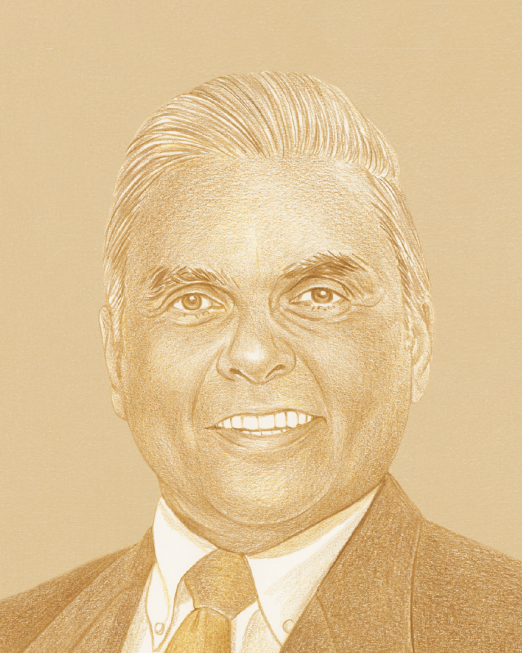
Kishore Mahbubani: ‘China Can No Longer Be Stopped’
For two decades, Kishore Mahbubani has argued that the West fundamentally misunderstands the rise of China and its challenge to American supremacy. Once a top Singaporean diplomat, Mahbubani then turned to academia, specializing in governance and public policy. Here, he traces the story behind and beyond the Trump-Xi talks in Beijing, and reveals how his own life chances were made possible by Singapore’s remarkable growth.
This conversation has been edited for length and clarity. You can listen to an extended version on the The Mishal Husain Show podcast.
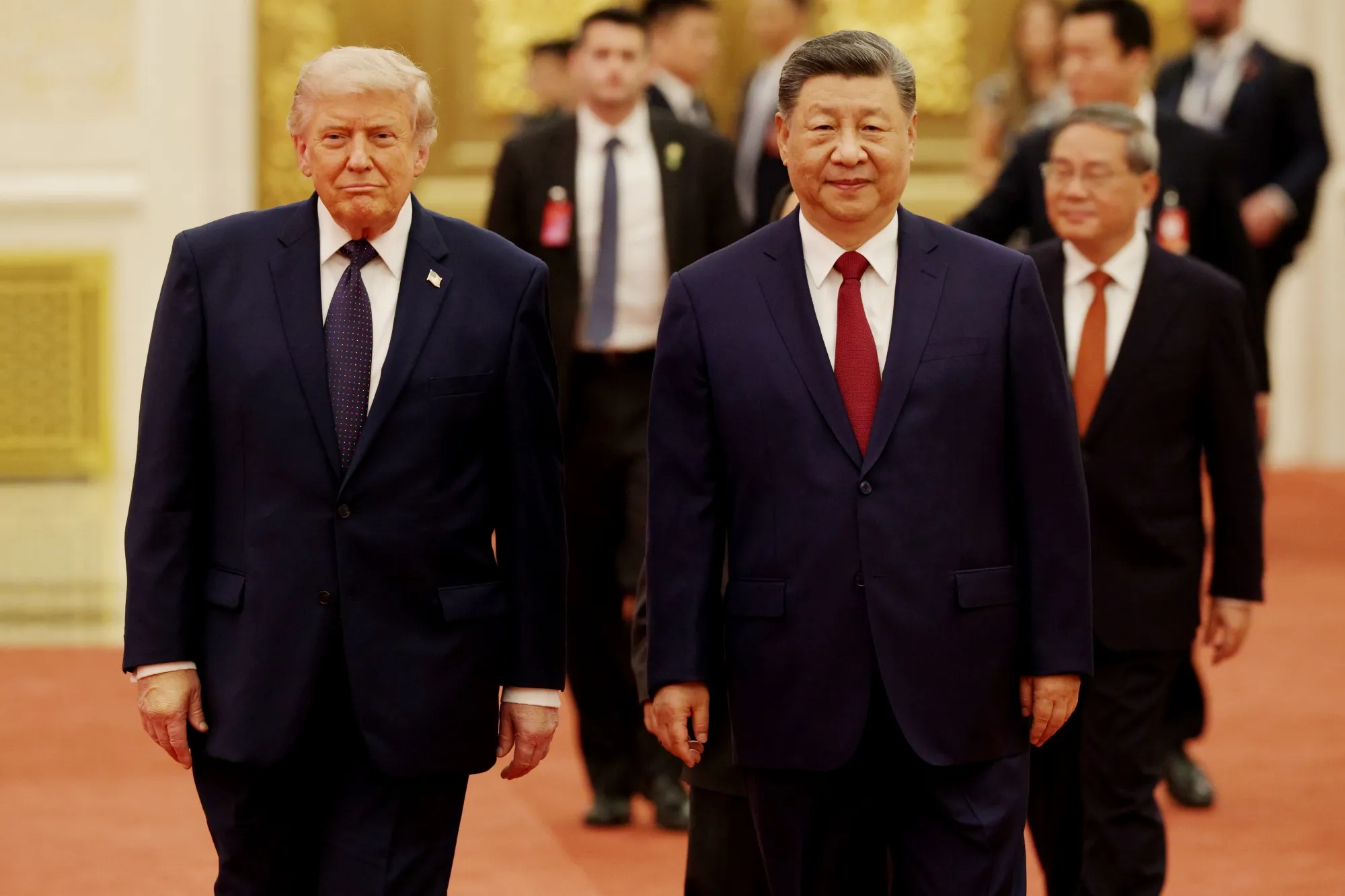
The United States and China: Is this the defining contest of our time?
It is by far the most important contest of our time. Never before in human history have we had two powers of the size, scale and reach of the United States and China confronting each other in the way that they are.
When the Soviet Union collapsed, the United States was left as the sole superpower, and few expected China to come up so quickly. But now China has achieved near parity in the scope and scale of its power. When President Trump launched his tariff wars, only one country stood up to [the] United States: That was China. 1
1Well, if we’re talking retaliatory tariffs, then Canada also stood up to the US — as Prime Minister Mark Carney was keen to emphasize when we spoke for a Weekend Interview. However, China’s retaliation was wide-ranging, with impacts felt by US farmers, and US firms labeled “unreliable” or subjected to export controls.
Is this contest bigger than the economics of it? Are you talking about power in a broader sense?
There are certain habits of behavior that all great powers share. The number one power of the time always wants to preserve its position. In geopolitics, it’s a zero-sum game, sadly. Even though Washington, DC today is a badly divided capital politically — when it comes to China there’s a near-universal consensus to stop [its] rise.
That’s why actions against China remain consistent, whether you have President Trump or President Biden. It’s not about personalities; it’s about the logic of geopolitics.
Would you say that is a foolish desire, to stop the rise of China?
No, I would say it’s not wise policy. China can no longer be stopped. The only way is to ask the government to stop improving the livelihoods of its own people — that’s the only way that China will stop growing. But [it] still has a long way to go; per capita income is way behind that of the United States.
We live now on a small, interdependent, fragile planet. Our overall priority should be to try and preserve planet Earth before we lose it — to climate change and other forces. There’s a common interest for the US and China to come together, far more important than whatever you gain in this geopolitical game of one-upmanship.
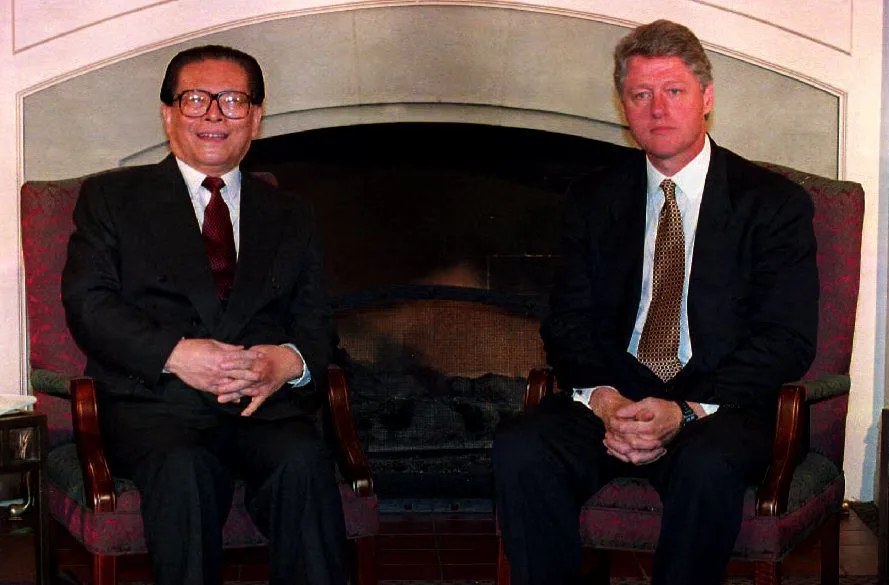
Take me back to 1993 and a moment between the two countries that you witnessed as a Singaporean diplomat at the APEC [Asia-Pacific Economic Cooperation] summit that year. What did you see and why did it matter?
Well, this was the first meeting between the new president of the United States, Bill Clinton, and [then] leader of China, Jiang Zemin. You may recall that in the 1992 election, Clinton said that unlike President [H. W.] Bush, he would not coddle the “butchers of Beijing.” So there was a lot of tension in the air, wondering whether Clinton would launch an attack on Jiang. 2
2The 1992 US presidential election campaign included Clinton accusing Bush Sr. of being soft on dictators and came only a few years after the massacre in Tiananmen Square. Mahbubani’s eyewitness account from the APEC summit comes by virtue of his then-role as a senior Singaporean diplomat accompanying his prime minister to the meeting in Washington state.
Jiang himself was a bit nervous. He read out his speech so fast that the Taiwanese delegate said to him, Slow down. The interpreters cannot follow you. Amid all this, when we had a short break for coffee, the first person Clinton approached was Jiang. I saw with my own eyes Bill Clinton coddling Jiang Zemin in a way he’d said he would never do. Everyone in the room was watching with relief and happiness — what could have been a painful, confrontational meeting turned out to be a remarkable breakthrough in US-China relations.
What did that moment unlock in the years ahead?
I think it enabled the renormalization of US-China relations.
Tiananmen set the US-China relationship back quite badly. Before then, during the Cold War, because the United States needed China as a counterweight against the Soviet Union, [it] would bend over backwards to accommodate China.
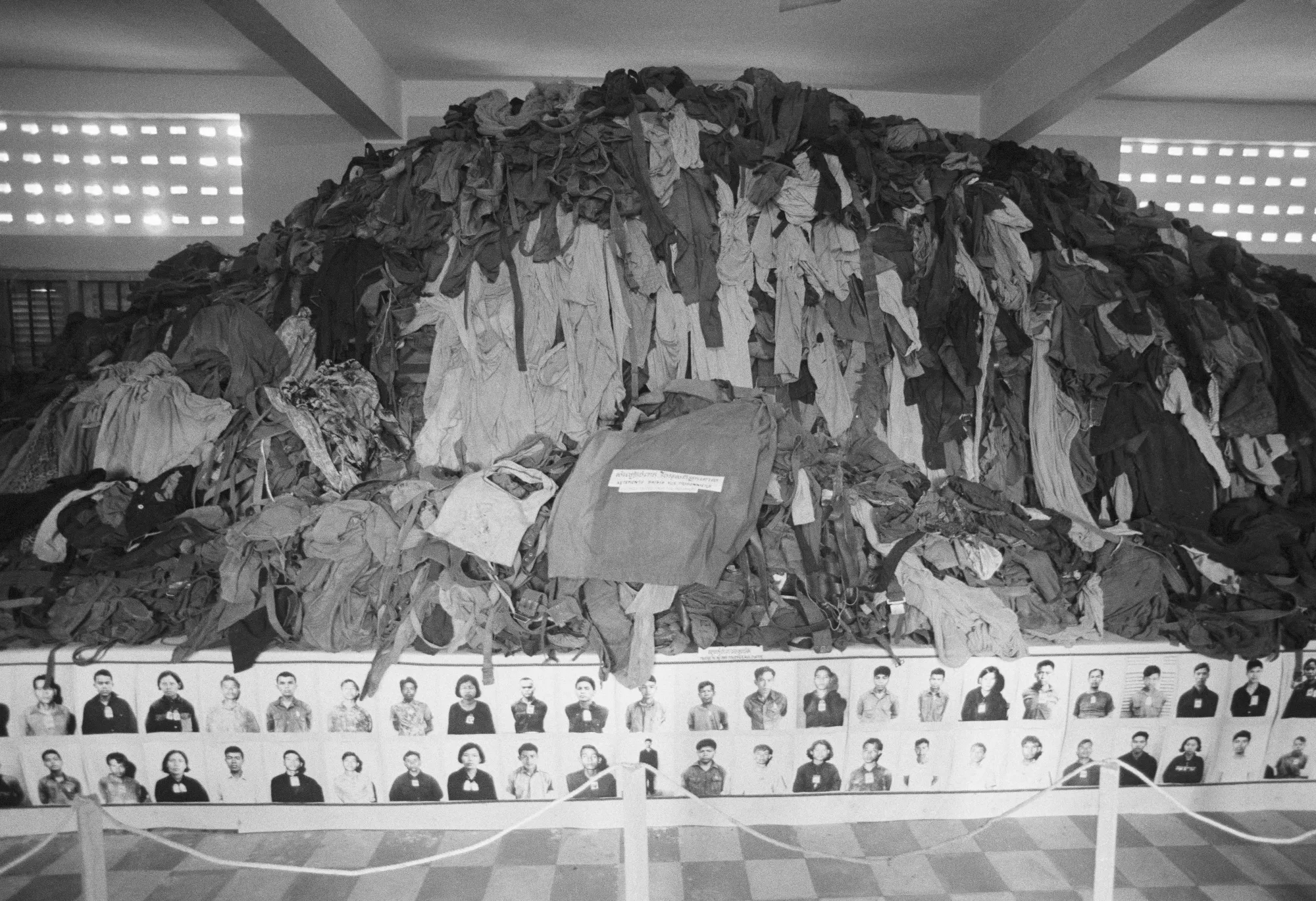
In 1981, there was a disagreement between China and ASEAN [Association of Southeast Asian Nations] countries about whether the government of Pol Pot should be allowed to go back to Phnom Penh after Vietnamese troops left Cambodia. China took the position that when a foreign invader leaves, Pol Pot comes back. ASEAN countries said, No, this cannot happen. We thought the United States would side with ASEAN, calling for free elections. Instead, to our absolute horror, the United States said, Don’t stand up to China. We need China for standing up to the Soviet Union. 3
3Mahbubani has a particular insight into Cambodia: It was his first foreign posting as a Singaporean diplomat in 1973. Pol Pot was leader of the radical communist Khmer Rouge regime, responsible for the deaths of an estimated 2 million Cambodians from torture, execution, starvation and disease between 1975 and 1979, before it was ousted by Vietnamese troops.
You’ve written that what’s happening now is like the Cold War, only “America is behaving like the Soviet Union did.” That the Soviet Union “behaved unilaterally and ignored international opinion, while America acted multilaterally and marshaled global opinion to its side.” It’s a very unflattering comparison.
Well, that comparison has been made by other scholars too, that in the contest between the United States and the Soviet Union, American society was flourishing, but Soviet society wasn’t flourishing. Today, in the contest between [the] United States and China, the bottom 50% of the American population hasn’t seen their standard of living improve in several decades. 4
4This is a reference to the work of Nobel laureate Angus Deaton, a British-born self-styled “immigrant economist” who has researched inequality in the US since arriving in the country in 1983. Among his conclusions: “Less well-educated Americans have seen little or no improvement in their material circumstances for more than fifty years.”
The logical thing for the United States to do is first focus on uplifting its people. But I can tell you in geopolitics, unfortunately, common sense doesn’t work. This desire to be number one is so deeply ingrained into the human brain that it’s very hard to persuade the policymakers, Hey, step back and think — what is a better approach to take?
The goal of my writings is not to say that China should win or the United States should win. The goal is they should reflect on whether it is in their larger, long-term, interest to engage in such a zero-sum contest.
The standard of living of the Chinese population has risen immeasurably in recent decades. There are, however, rights that they do not enjoy compared to Americans. Freedom of expression. The right to choose their own leaders.
China has rescued 800 million people out of poverty — two and a half to three times the population of the United States and an amazing achievement.
But you’re right: The Chinese don’t enjoy many of the rights that Americans enjoy. Chinese society has got its own political DNA, and over 3,000 years the big lesson learned is that when there’s chaos in the center — in the capital — the people suffer. When there’s political stability and control in the center, the people prosper and flourish.
When people say that the Chinese are not free, I ask a very simple question: Why is it over 130 million Chinese leave China each year and then, amazingly, using their own two feet, return? If China was the harsh, dark communist gulag portrayed in the Anglo-Saxon media, the Chinese people are irrational. They shouldn’t be returning to China. But the Chinese who are returning are the ones who have experienced life overseas.
China, to put it simply, is a different civilization from Western civilization. So the kind of society that the Chinese people want will be different from Western society. That’s something that we’ve got to learn to live with in the new multi-civilizational world. 5
5As (I hope!) you’d expect, I followed up on the two sets of figures Mahbubani used in this part of the conversation. The 800 million people lifted out of poverty is accepted by the World Bank, while in 2025 it was estimated that 155 million mainland Chinese traveled internationally.
I hear what you’re saying. I’m also thinking of the evidence that emerged a few years ago about re-education camps in Xinjiang province, where Chinese Muslims were detained.
Well, there’s no question that China’s internal arrangements are not the same as those of Western society.
But when the West raises concerns about Muslims in China, the one comment that the rest of the world makes is that, in general, the West doesn’t like Muslims. In general, the West doesn’t like [the] Chinese, but for some strange reason, they love Chinese Muslims. It’s a political tool to embarrass China.
Unfortunately, that political tool no longer works because the whole world is saying, If you in the West are so concerned about the conditions of Muslims who are oppressed, what have you said about Gaza? What have you done about Gaza?
You have seen international relations through your former work as a diplomat, but I want to ask about your life, too. You came of age in Singapore as it was becoming independent from Malaysia, after British colonial rule had come to an end. Your family experienced hardship: When you started school in 1954, you were seriously underweight and had to be put on a special feeding program. 6
6Mahbubani is someone I have known throughout my professional life — not personally, but as a well-regarded figure at the National University of Singapore after he retired from the diplomatic service. However, the personal details in his latest book were a revelation; I had not appreciated how difficult the circumstances of his childhood and adolescence were.
You’re right. At the age of 6, I was technically undernourished and I lived in a house with no flush toilet until I was 13 years old. One of the biggest changes in my life was when the flush toilet appeared. I felt that my sense of dignity improved dramatically.
My family was very poor. My father went to jail. The debt collectors came to our house to try and auction off the furniture. So I went through a very rough childhood. My mother was the one who took the brunt of all this pain and not once did she crack. Every time I go through a difficult patch and feel depressed, I say, My mother never cracked under much greater pressure. That resilience she gave me was an amazing gift.
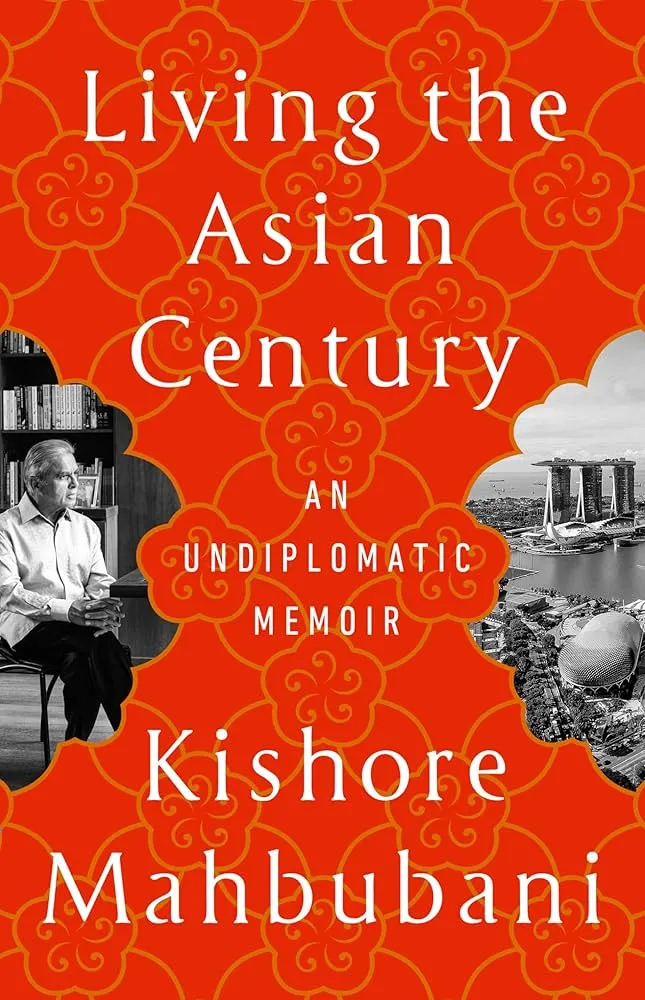
She had a narrow escape from communal violence in what is now Pakistan, at independence in 1947. Your father had a very difficult early life, sent from what was then British India to Singapore, and starting to work at the age of 13.
My parents didn’t go to university — not even to secondary school, by the way. My father was orphaned at a young age and at 13 was sent to the British colony of Singapore. Without adult supervision, he ended up engaged in bad habits like smoking, drinking and gambling. My mother, who had an arranged marriage, had no idea that she was marrying an alcoholic gambler. That was the root of our problems.
My mother, too, as you said, had a close shave because she was on a train leaving Pakistan in the middle of the night in the desert, when her compartment got decoupled. If a mob had come along, she would have been killed. So I guess our family has had lots of close shaves. 7
7In the tumult of independence in 1947, trains carrying refugees across the new India-Pakistan border became notoriously vulnerable to attack, especially as they passed through remote areas. Mahbubani’s family are Hindus, from the province of Sindh in present-day Pakistan; his mother was 22 when she arrived in Singapore in January 1948 to join her husband.
The description in your book of living without a toilet is so striking compared to what Singapore is today. You write of the “night soil men” opening a small door in the wall of every house and pulling out a metal can filled with 24 hours’ worth of feces and urine.
Yes, I can remember that vividly; the sights and smells of that experience never go away. Singapore’s per capita income at independence was around $500, the same as Ghana. Today, Singapore’s is $94,000 — among the highest in the world. That’s been one of my great privileges, to travel this remarkable journey upwards with my fellow Singaporeans.
It didn’t feel that way in 1965, did it? You were 17, still in school. Singapore exited the federation it was in with Malaysia. There was a sense of despondency about how it could survive on its own.
I remember the day vividly: August 9, 1965, when Singapore was expelled from the Malaysian Federation. No one in Singapore celebrated our independence because we thought Singapore was doomed. Singapore was a city — and when a city is cut off from its hinterland, which was Malaysia, it can die.
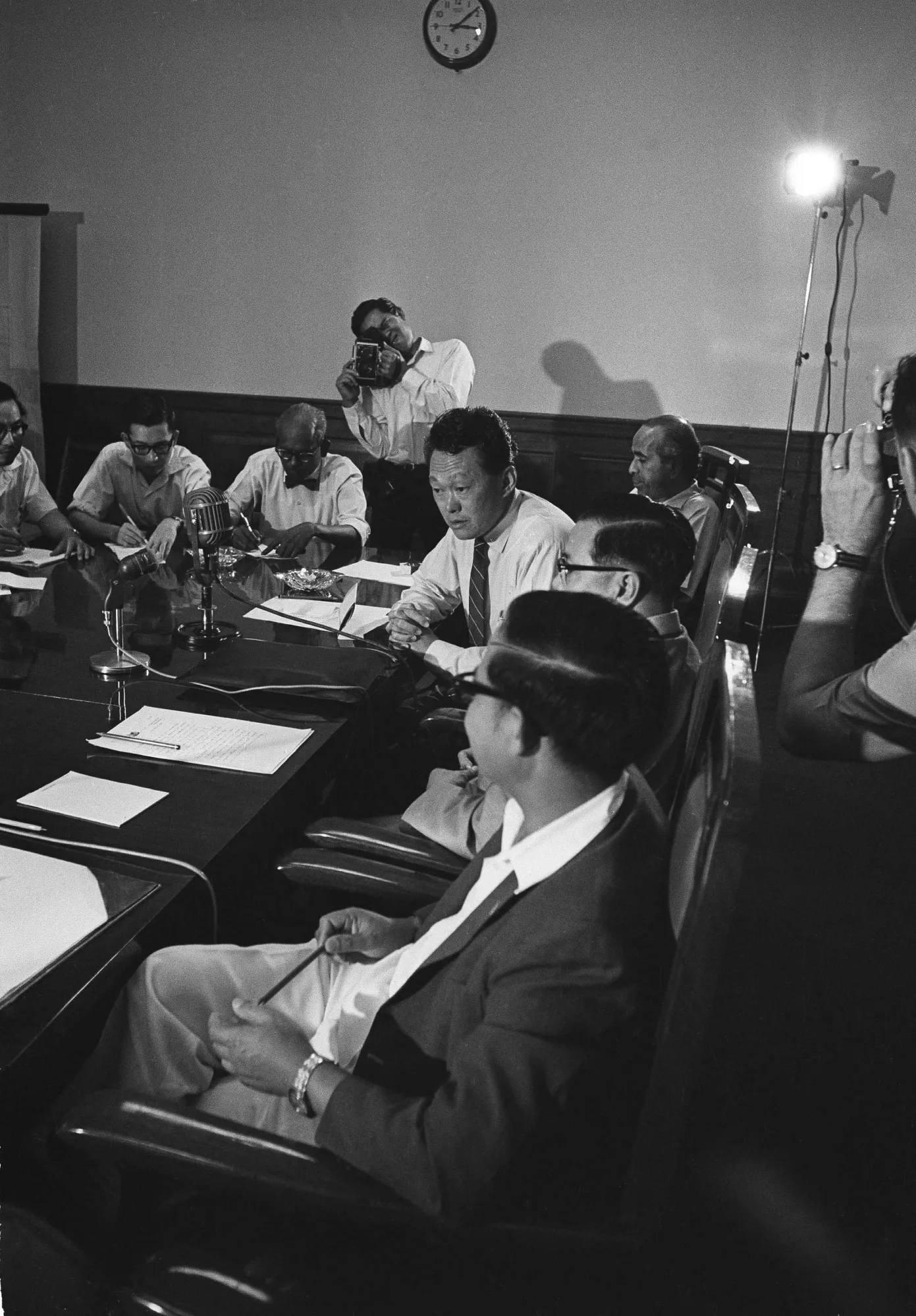
No one expected Singapore to succeed in the way that it did. The success was due to three remarkable geopolitical geniuses: [former Prime Minister] Lee Kuan Yew, [former Finance Minister] Goh Keng Swee, and [former Foreign Minister Sinnathamby] Rajaratnam. One of the greatest privileges in my life is that I got to work with all three and they were probably the best tutors I ever had. 8
8Mahbubani’s own entry into public service was almost by accident: The terms of the scholarship he received to attend university in the 1960s required him to work for the government for five years after graduation. In the end, he spent 33 years in Singapore’s diplomatic service, including serving as ambassador to the United Nations.
You’ve painted a picture of rising China. It is a country that has moments where it destabilizes neighbors. For example, closing airspace around South Korea’s borders, or doing things that upset or worry the Philippines, or Taiwan of course. How do states, including Singapore, fare in this Asian order?
We have to understand that China’s rise has been remarkable and dramatic. To explain how dramatic, just imagine when you and I began this conversation, there was a cat sitting next to me. Suddenly after 15 minutes or 20 minutes, I turn around and notice the cat has become a tiger. I was very comfortable sitting next to a cat. I’m very uncomfortable sitting next to a tiger.
China has become a tiger. You have to accept that it is now the second most powerful country in the world and still rising strongly. We have to learn to live with a much stronger power in our neighborhood. The term benevolent great power is an oxymoron. All great powers will protect their interests.
The neighbors of China therefore have to adjust to Chinese power. This doesn’t mean you kowtow, but you learn to manage it. I can tell you in our private conversations, we do tell the Chinese quite frankly what our concerns are, and they do listen. But remember, we are in Asia. In Asia, you must always save the face of the person you’re talking to. Don’t insult China publicly in the way that European leaders do, in the way that American leaders do — that’s not how you work with China.
Many countries, many leaders, are learning that’s also the way you work with President Trump.
President Trump is definitely different from his predecessors. But I also have to emphasize that all American presidents put American interests first, over the interests of other countries. That’s just a fact of life.
When I was in the UN in 2003, so many countries advised President George W. Bush not to go to war in Iraq, including France, including Germany, Egypt, Saudi Arabia. The United States didn’t listen. This is a reality when dealing with great powers.
What are the implications of the Iran war for the rest of the world, particularly Asia? Is there a reshaping that is taking place?
I’ve said this to my American friends: Every war the United States fights, especially in the Middle East, is a gift to China.
In the 10 years when the United States was bogged down in Iraq, China had its fastest-growing years. In the same way, if the United States gets bogged down in another war in Iran, again it buys time for China.
The Chinese do have a comprehensive long-term strategy for managing the challenge [the] United States is posing. By contrast, the leaders of the United States, both Democrats and Republicans, have not worked out an equally comprehensive long-term strategy for managing the return of China as a great power.
But Chinese leaders can act that way because they don’t ever have to deal with an election.
That’s true — but in the Cold War, a United States that had elections every four years defeated the authoritarian Soviet Union. Constant elections in America were in no way a handicap.
The architect of the success of the United States in the Cold War, George Kennan, said way back in 1949 that the outcome will be determined not by the number of bullets, warships, aircraft carriers or jet fighters. It’ll depend on which society creates a spiritual vitality that leads to its people flourishing. If George Kennan were alive today, he would advise the United States, Don’t try to get more aircraft carriers. Try to focus on improving the livelihood of the bottom 50% of American people.
If you succeed in doing that, you win the long-term contest against China.