
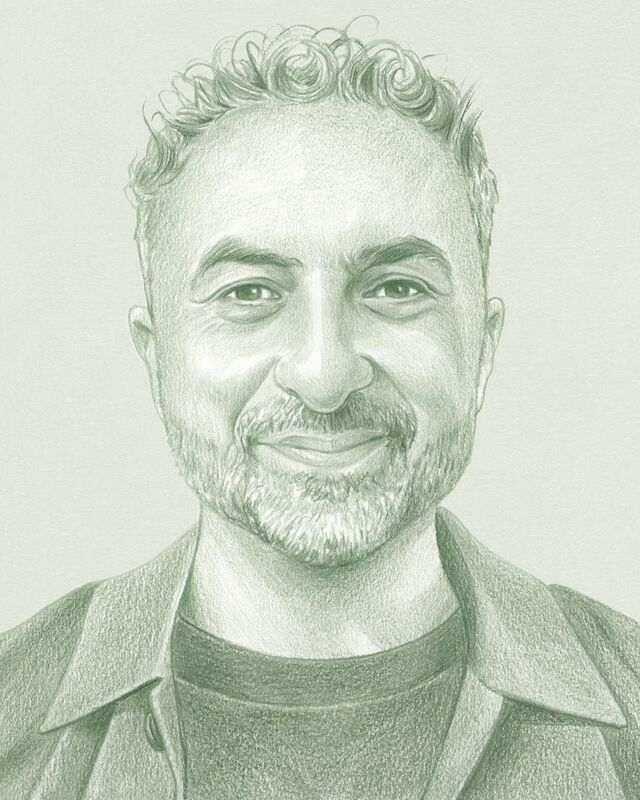
Microsoft’s Mustafa Suleyman: ‘AI Is Already Superhuman’
The tech giant’s AI chief talks about superintelligence “red lines,” why AI will transform medicine and how he unwinds by chatting with Copilot.
The AI race is entering an uncharted and expensive new phase. This has been the year of the mega-deal — billions poured into data centers, investments between the key companies, and a talent arms race for the best and brightest minds.
One of those minds is Mustafa Suleyman, who for the past 18 months has been AI chief at Microsoft. Suleyman made his name co-founding DeepMind — acquired by Google in 2014 — which later produced the AI system that defeated a world champion at Go.
At Microsoft, his ability to break new ground in the field was until recently limited by the terms of a deal with OpenAI, but a revised agreement is now enabling Suleyman to go public with new goals. We spoke remotely, at what turned out to be a very early hour in Seattle (his team had thought he’d be on the east coast that morning). Nevertheless, Suleyman launched right into the discussion — evangelical at times, but also realistic, and with hints of a political perspective rarely voiced in Big Tech these days.
This conversation has been edited for length and clarity. You can listen to an extended version in the latest episode of The Mishal Husain Show podcast.
What uses of AI are in your life that the rest of us might not yet have?
Yesterday, I stayed up far too late watching a film and afterwards, I added to a table that I’ve made in Copilot, which basically records all the films I love, lists them by date. I add my personal notes, it gives me a link to the film poster. I can keep just saying, What would be a similar one?
It’s possible to ask your AI to do pretty much any knowledge work task — just like you might ask an assistant to organize your life. The more obscure, creative [and] challenging the task you’re going to ask your AI, the better. 1
1 Suleyman also appears to be a keen reader; the bookshelf behind him in Seattle offered a glimpse of his tastes. Titles included the most recent books by Michael Wolff and Robert Kaplan, as well as The Tech Coup: How to Save Democracy from Silicon Valley, and Gaza: An Inquest Into Its Martyrdom.
Have you used AI for autonomous tasks? Has it booked tickets or bought a gift for you? I know this is the promise of Copilot Actions — it’s just not available in my region, so I haven’t been able to try it myself.
We’re still experimenting. It can do it. It doesn’t always get it right. It’s in ‘dev mode,’ so not generally available just yet.
When it does work, it is the most magical thing you’ve ever seen. It essentially types stuff into your browser, clicks on buttons, opens up new tabs. It can look at your history, [and] personalize the purchase or the response to you.
What are the mistakes it’s made that create problems? Has it bought a present for the wrong person?
[Laughs]
Well, it can buy the wrong thing, but you can intervene. And it will always ask you permission before it takes the next action, so it’s quite safe.
It’s a funny thing, technology. It’s magical and amazing, but it’s always just got a little bit further to go. In this case, a while yet before it’s everyday.
You were a founder of DeepMind and had your own company, Inflection, before you came to Microsoft. Does that mean that when you see these hiccups, you have faith?
I’m very stoic about these things. I know that it’s going to work in the next six months or 12 months or, maybe worst case, 18 months. It is already superhuman.
By this time next year, could I be buying my Christmas presents using an autonomous AI agent?
I’m pretty certain that you will be. It’s highly likely.
The term superintelligence has crept into the public debate, thanks to you and others, in the last few months. What does it mean to you? 2
2 In January, Sam Altman wrote that OpenAI would aim beyond artificial general intelligence — AGI, or AI that would match human capabilities — to creating superintelligence. The term, first popularized by philosopher Nick Bostrom, now dominates discourse in Silicon Valley. In June, Mark Zuckerberg restructured Meta’s AI division as Meta Superintelligence Labs. Suleyman unveiled Microsoft AI’s Superintelligence Team last month.
Superintelligence in the industry today means an AI system that can learn any new task and perform better than all humans combined, at all tasks. It is a very high bar and, at the moment, it comes with a great deal of risk. It’s very uncertain how we would contain and align a system that is so much more powerful than us.
The framing I prefer is one of a humanist superintelligence — one that is always in our corner, on our team, aligned to human interests. Until we can prove that it will remain safe, we won’t continue to develop a system that has the potential to run away from us. Everybody should agree to that. Yet I think it’s a novel position in the industry at the moment.
Is that how you’re trying to set Microsoft apart, by saying we will always use it through a humanist lens?
That is our position. Microsoft is a company that’s been around for 50 years. It is very careful. It’s highly trusted: 90% of the S&P 500 use us to provide email, operating systems and everyday productivity. We’ve got that reputation because the company’s been careful. We’re going to continue to be careful, and setting out a vision of humanist superintelligence is part of that program. 3
3 It will be interesting to see if this comes up against commercial imperatives — one industry watcher has suggested the approach may clash with Microsoft’s need to justify investment in AI. But angst about the “right” kind of AI is long-standing. OpenAI was first launched by Altman and Elon Musk partly out of concern that Google couldn’t be trusted to lead AI. Then in 2021 some OpenAI employees left to start Anthropic, in part because of concerns over the former’s approach to safety.
What does that mean for your rivals, some of whom you work closely with, like OpenAI? Does it mean that they’re the Wild West and you are the moral ones?
Everybody has to decide what they stand for and how they operate. I don’t want to judge how they’re operating right now.
I don’t see any evidence of large-scale mass harm. I don’t see any indication that these things are improving themselves, or operating autonomously.
We all predict a time in the next five years — maybe 10 years — where these capabilities do start to emerge. Systems like this could set their own goals. They could improve their own code. They could act autonomously.
Those are capabilities that I’ve clearly outlined as increasing the level of risk. We have to approach them with caution, with more transparency and audits, with more government engagement, and make proactive declarations about how close we are to those three capabilities. I think that’s obvious.
Does that mean you won’t be releasing a superintelligence tool until you are confident it can be controlled?
Yeah, I think that’s right. Containment and alignment are necessary prerequisites — red lines. I think everybody in the industry has to sign up to that idea.
Nobody wants to cause mass harm. Even though we all disagree, everybody is committed to the survival of our species — and, I would hope, the flourishing and wellbeing of everybody.
So that’s the discussion we are trying to push now, and require everybody to ask themselves in the industry: Are they building a humanist superintelligence?
How much confidence can we really have in that, given things do go wrong? I don’t just mean AI. Humans do wrong things. Microsoft had to cease and disable some services used by the Israeli Ministry of Defense, after reporting by The Guardian suggested they could be being used for mass surveillance.
That was very good reporting by The Guardian. We were very grateful for it. As soon as we became aware of it, we made all of the necessary changes [and] removed the IDF from those servers. They were clearly not in compliance with our terms of service and there’s an ongoing investigation internally. 4
4 Microsoft initially said it had no evidence that its products had been used to harm people or that the Israeli government had failed to comply with its terms of service or AI Code of Conduct. The company is now subject to a data protection/legal complaint in Ireland (where it has its European headquarters), alleging that its data centers continue to host applications used to monitor Palestinians.
The broader point is that it’s hard to have confidence in controls, checks and balances and uses.
It is hard. These are huge and complicated systems that carry a lot of risk. The most we can do is make sure that we are auditing them and removing actors that violate our terms of service as quickly as possible.
Are the first uses of superintelligence going to be in the medical field?
I think so. This is probably the most exciting application of superintelligence. We now have systems that can diagnose any rare condition found in the literature, significantly better than human performance, more cheaply, with fewer tests and with higher accuracy. We are putting it through independent peer review at the moment and soon there’ll be clinical trials. So this is very, very, very exciting.

Get the Bloomberg Weekend newsletter.
Big ideas and open questions in the fascinating places where finance, life and culture meet.
By continuing, I agree to the Privacy Policy and Terms of Service.
Did you push for that focus yourself? You’ve been running Microsoft AI for about 18 months now. I’m conscious that your mother was a nurse and, unusually for senior people in tech, you’ve worked in the public sector as well.
This is an area that’s very important to me. My mum was a nurse and I’m just a big believer that technology is here to serve us.
It should make our lives better, make us more comfortable. One day, I think it is going to help us to live longer. It’s going to give us the option to work less if we choose to. It’s going to produce abundance. We have to make conscious decisions to use it for those applications first. 5
5 “Abundance” is both the title of a book by US journalists Ezra Klein and Derek Thompson and the name for a loose political coalition that has gained traction in the US, the UK and beyond. The details vary, but the gist is that policymakers should make it easier to produce the stuff people value — from housing to electricity to new drugs — and not just focus on divvying up shares of a fixed pie.
Abundance is such a big promise. Tell me what you mean by it. We hear about AI destroying jobs, but are you saying that the work will be done by AI increasingly, and therefore humans won’t have to work as much?
It is inevitable that at some point over the next 20 or 30 years, machines are going to be more capable than humans at doing most work — that might come much sooner.
We have to decide as a society what our purpose is. We have to be very thoughtful about the rate of introduction of new machines, because we have to make sure that displacement is counterbalanced with a mechanism to fund people and to support people through a massive transition.
Do you believe in the idea of a universal basic income? That’s what AI making the economy more productive could unlock?
I’ve long been on record saying that. That is inevitable and very desirable. We already live in a world of abundance, it’s just poorly distributed.
Value isn’t just manifested in atoms — food, cars, physical things. It’s manifested in digital goods — ideas, knowledge, intelligence. That’s actually great news because that can proliferate; it can spread extremely quickly around the entire world. LLMs and chatbots have been the fastest spreading technology in history — basically 2 billion annual users in the space of three years.
There’s going to be massive competitive forces to reduce the cost of experiencing an AI. The challenge we’re going to have to figure out is how we tax and redistribute, so that the transition is a healthy one. 6
6 We’ll have to wait and see if Suleyman’s view on competitive forces is borne out. So far, the internet economy has been defined by a winner-take-all dynamic — for example, search being dominated by Google. If AI follows that pattern, customers won’t necessarily see the benefits he’s describing.
Tell me more about where these ideas and your beliefs come from. Your mother was a nurse, but the family you grew up in — in London in the 1980s and ’90s — how would you describe it?
Pretty working class. My dad was a cab driver. We were fairly regular, kind of unremarkable. My parents didn’t super value education. They always thought I should go get a trade — my mum would often say to me, You should be a carpenter or electrician, leave school at 16.
It comes from a place of experiencing the rougher end of things a little bit and having a desire to try to do the best we can with the short life that we have.
Your dad came to the UK from Syria. What happened when you were 16? I read that when your parents split up, you and your younger brother were pretty much left to fend for yourselves.
That’s true. I don’t know where you read that. Me and my younger brother did live on our own for a few years.
I’m curious to know what it taught you and how you dealt with it at the time.
When you’re that age, you are precocious and overconfident and fearless. We had everything that we needed. I had great teachers and mentors. I went to a very good school. I studied really hard when I was 10 for the entrance exams and it was essentially like going to a private school.
I was lucky enough to get into Oxford and that was an amazing experience. [But] I was very frustrated and eager to change the world and get stuff done. So I dropped out and helped start Muslim Youth Helpline, a non-religious, non-judgmental listening service for young British Muslims, who after 9/11 were dealing with identity crisis, lack of connection to community, family, parents, bullying. 7
7 Suleyman was reluctant to speak about this period in his life, but I can’t help feeling there’s a link to his subsequent achievements. It must have taught him resilience and responsibility and perhaps also confidence in his own instincts. Between the ages of 18 and 26 he got into one of the world’s best universities, dropped out, and then co-founded DeepMind.

Had you experienced anti-Muslim sentiment and hatred yourself after 9/11?
A little bit, yeah. I think a lot of people felt we weren't “British” enough. People were figuring out how to live their cultural [and] religious identities, in the context of families that often were first-generation, didn’t really speak the language, didn’t know how to navigate the system. The increased skepticism, that we were mostly terrorists — this general fear and exclusion. Most of the time that was dealt with by having kind and supportive conversation — somebody available on the other end of a telephone.
Now you are in this circle of power — one of a small group of people making decisions on a technology that is changing all our lives. How conscious are you of that power?
Very, very conscious. I take it very seriously. It is a great responsibility. This is a moment when decisions we make may have very lasting consequences. 8
8 This is a question I also asked Stanford computer scientist and “Godmother of AI” Fei-Fei Li, who answered in similar terms: “I’m one of the people who brought this technology to the world… everything I do has a consequence and that’s a responsibility I shoulder.”
I read history and look back [at] the social media revolution — where potential harms fell on deaf ears for too long — or smoking or oil. It’s very clear these things will cause harm. I think that we have to be very, very careful about how we deploy them, and how they’re introduced into the world.
Do you talk about this with your peers — people like Sam Altman?
Yes. Everybody in the industry does. There’s definitely a group of the CEOs. Sam and Dario [Amodei] from Anthropic were co-founders, me and Demis [Hassabis] were co-founders. We all know each other very well. On the whole, everybody is genuinely committed to trying to find the right path through. It’s also very competitive. 9
9 Hassabis and Suleyman founded DeepMind alongside Shane Legg in 2010. Four years later, it was acquired by Google for a reported $400 million. Suleyman was placed on leave in 2019, amid complaints over his management style, for which he has since apologized. He was appointed a VP of AI product management and policy at Google, a role he held until leaving the parent company altogether in 2022.
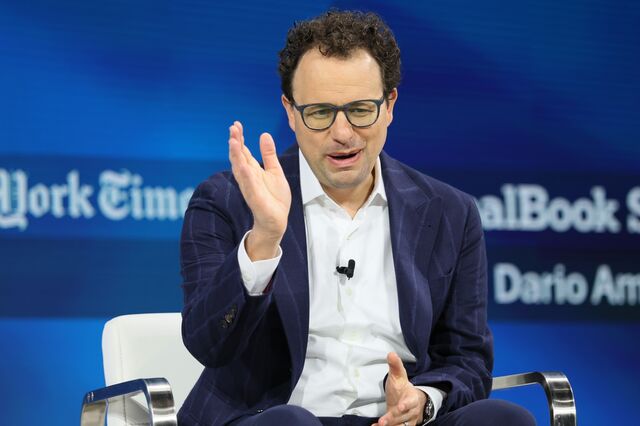
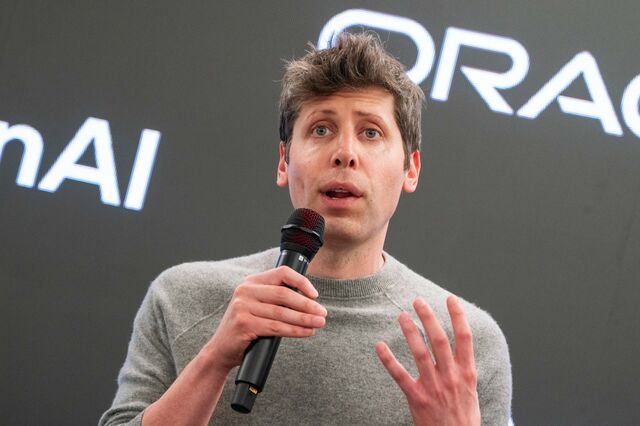
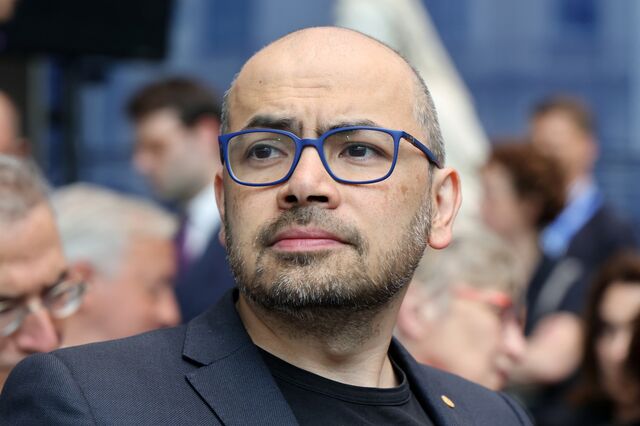
Do you recognize the term broligarchy?
[Laughs]
I haven’t heard that before, but I can figure out what it means. Yeah, I guess that’s true. It is very male-centric — although Mira Murati, the ex-CTO of OpenAI, is one of the best people in the field.
Or tech bros. I’m sure you’ve heard that one. I don’t know if you’ve seen Jesse Armstrong’s Mountainhead?
I haven’t, no. 10
10 The central characters in this dystopian satire are composites of real-life billionaire tech leaders. “They’re very important figures and very talented figures,” Armstrong told me in a Weekend Interview earlier this year. “I just think it’s interesting what happens to people as they try to marry their egos with their moral impulses, and in this case with an unbelievably large amount of money.”
I recommend it. It’s quite a sobering portrait of life in this rarefied, very powerful circle.
Part of the challenge is that we all spend a lot of time in Silicon Valley, where the skies are blue and life is very peaceful.
I try to travel a lot. I just came back from China. It’s staggering to get out of the bubble and see how this technology is being developed on the other side of the world. The pace of innovation, but also the thoughtfulness of some of the regulatory stuff. It’s impressive. 11
11 Since 2022, China has rolled out a series of AI regulations, including rules for recommendation algorithms and requiring labels for AI-generated content.

If I say to you, Sam Altman, what word first comes into your mind?
Oh my God. I guess courageous.
He’s obviously growing his data center fleet very aggressively. He may well turn out to be one of the great entrepreneurs of our generation. He’s certainly achieved a lot. He’s building data centers at a faster rate than anyone in the industry, and if he can pull it off, it will be pretty dramatic.
It’s interesting that there is an if on that, and I understand why — there are huge amounts of money being spent by OpenAI. Is it a gamble? Is it not a given that it’s going to pay off for them?
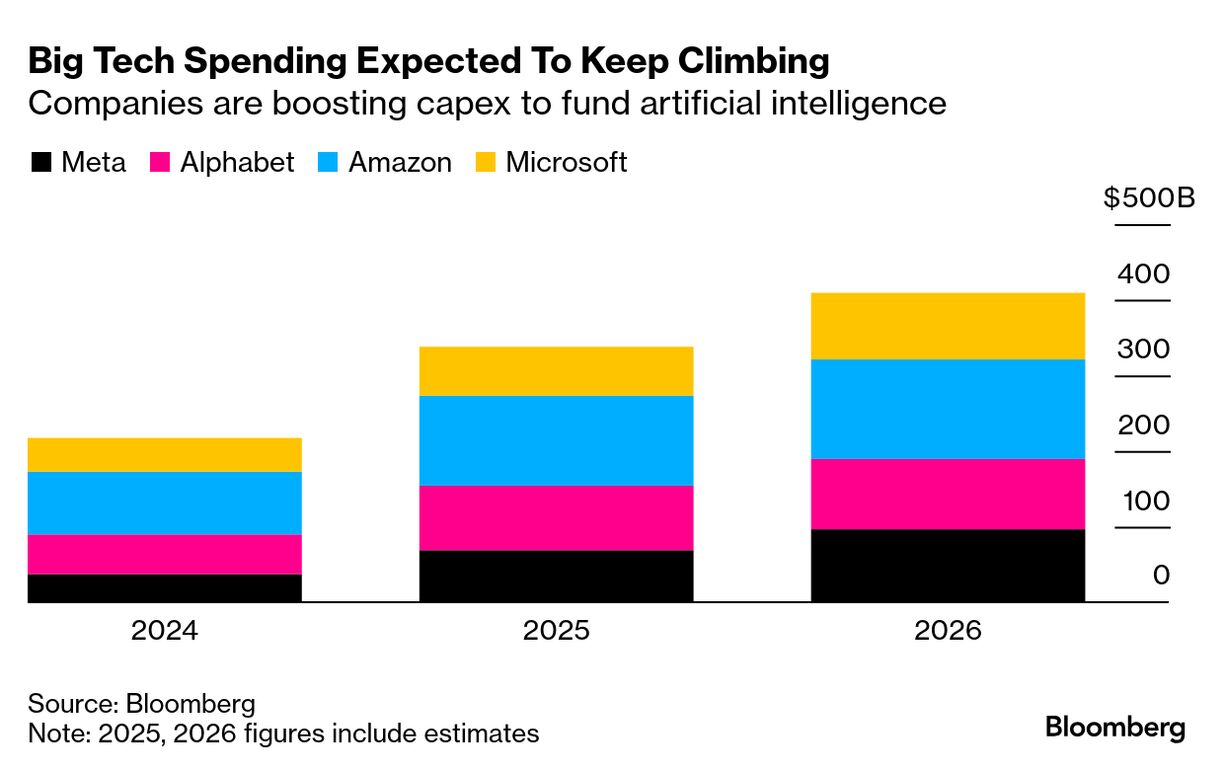
ChatGPT is one of the greatest products we’ve seen in a generation — that speaks for itself. At the same time, they’ve signed over $1.5 trillion of commitments for building data centers over the next five or 10 years, and their revenues are quite a long way from there. So they’ve got a long way to go, but they’re a very talented team. I’ve got every confidence they can do it.
Big Tech Spending Expected To Keep Climbing
Companies are boosting capex to fund artificial intelligence
What word would you use to describe Demis Hassabis?
Probably a great scientist. I think he’s a great thinker and he’s a good polymath. He’s made massive contributions in the field, multiple times. He’s truly exceptional.
You worked together, and now you are competitors.
Yeah. But we started off as very close friends, and we worked together every day for 10 years. I learnt a lot from him and have huge respect for him.
Do you still talk?
We texted last night, actually. I congratulated him on Nano Banana, Gemini 3 and five years of AlphaFold all in one week. 12
12 Gemini 3, the latest version of Google’s AI chatbot, outperforms ChatGPT on many benchmarks; its release prompted Sam Altman to declare a “code red” for his rival model. But Bloomberg Opinion’s Parmy Olsen has questioned Gemini’s ability to overtake ChatGPT in terms of market share, writing: “Google has often struggled to replicate the so-called network effects that propel an online platform to stratospheric user numbers… While Google is betting on being smarter, OpenAI is gambling on being harder to quit.”
Have you tried out Gemini 3? It’s creating quite a lot of waves.
It’s good.
Do you think it’s better than ChatGPT?
They’re kind of different. It’s definitely got more niche skills that ChatGPT doesn’t have, and it’s very fast. But ChatGPT is very strong, so I wouldn’t go that far.
Is it better than Copilot?
It can do things that Copilot can’t do, but Copilot also has features that it doesn’t have.
Copilot is actually amazing for vision. It can see everything that you are seeing and talk to you in real time. You can share your screen with Copilot on mobile or desktop, talk about it and get feedback. We’re really trying to imagine the day-to-day experience of having this really intelligent assistant at your side, that can help unblock you whenever you get stuck.
I’m only going to do one more of these. Elon Musk, how would you describe him?
I guess a bulldozer. He’s kind of got superhuman capabilities to bend reality to his will and has [a] pretty incredible track record.
Somehow he mostly manages to pull off what appears to be impossible. [He] probably [has a] different set of values.
I interviewed him. He ended up calling me an NPC.
[Laughs]
That sounds exactly like Elon. I kind of like that he speaks his mind. He’s very unfiltered.
You’ve said your politics are different from his, and Peter Thiel’s. Would you say you’re on the left of the political spectrum? 13
13 The co-founders of Tesla and Palantir can be loosely defined as right-wing libertarians. Both have funded Trump in presidential campaigns and backed JD Vance as a possible successor. For Musk, that was something of a shift — he was once a self-described centrist and Obama supporter — whereas Thiel’s politics, though unusual, are long-standing. Skeptical of government, Thiel notoriously wrote in 2009: “I no longer believe that freedom and democracy are compatible.”
I’m sort of a centrist these days. I definitely started as a lefty. I worked for Ken Livingstone back in the day, and was frankly, very inspired by a lot of those people, even though they also made a lot of mistakes. But I’m proud to say that I’m on the center-left of the spectrum. I believe that government plays an important role in society. 14
14 Livingstone, a socialist dubbed “Red Ken” in the British press, became London’s first elected mayor in 2000. Some have compared him to New York’s mayor-elect Zohran Mamdani — both figures who have been at odds with their parties’ leadership at times.
It’s a controversial thing to say in Silicon Valley, but I think regulation is necessary and it has made most technologies better. People forget this. Cars only work because we have driver training, emissions regulations, streetlights and speed limits. That’s what regulation is when it works well. We just need more of that.
Do you feel isolated saying that, because clearly the Trump administration is not into regulation, and the industry overall is quite happy with that.
Right now, we are not in a mode where there is huge catastrophic harm. The industry’s done a pretty good job of introducing very powerful chatbots where the personality is sculpted to be very even-handed, very evidence-based. It didn’t have to go like that. It went like that because the leaders have done a pretty decent job. That doesn’t mean that there aren’t going to be issues coming up, and I’m very wide-eyed about them, but I don’t think we’re in a mode where we need emergency regulation.
Some of the regulations that have been proposed in Europe are currently in talks to be wound back, with the EU AI Act. I think that’s good. People shouldn’t criticize that. That’s the process working — regulator taking feedback, seeing how things work in practice. That should be celebrated.
In your book, and a piece you wrote about the same time [2023] for Foreign Affairs, you wanted three different kinds of governance regimes, modeled on climate change, financial stability and arms control. You sound much more sanguine now. Is it because of where you are?
No, I’m still calling for those things. We should have a financial stability board for AI. We should have a climate process, [and] an ICAN [International Campaign to Abolish Nuclear Weapons], which audits the progress that we are making. I advocated for the White House AI principles under the Biden administration, where we made voluntary commitments as companies. At the time, it was my startup, Inflection, but we pushed all the other companies to do it as well. We’ve signed up to disclosures in Europe and with the UK AI Safety Institute.
So I don’t mean to say that we don’t need it, I’m saying that these are such long-term effects, and these governance processes take so long to build, that [we’ve] got to start now. But we don’t need [a] knee-jerk reaction. We don’t need some panicked overreaction. That would cause a different set of problems.
You’ve got a revised agreement with OpenAI. You suddenly have the freedom to pursue AI independently. Help me understand how that relationship with OpenAI is going to work in the future. You’ve been collaborators; now you’re also going to be competitors.
It’s a complicated setup for people to follow, but the bottom line is that up until a few weeks ago, Microsoft was not allowed — by contract — to pursue artificial general intelligence [AGI] or superintelligence independently.
The deal with OpenAI was that it would then go and build AGI when they signed the agreements back in 2019, and in return Microsoft would build the AI infrastructure — the chips and the data centers. Microsoft would get a license to the models that have been built. And we still have that license to everything that OpenAI builds, up until 2032.
But OpenAI decided that they wanted to take on more compute, and buy compute from other providers — they now have deals with SoftBank, and many others, to build more data centers than Microsoft wanted to build for them. In return, we have the right to go and develop our own AI.
Obviously that was a big part of me joining the company 18 months ago. We are now hiring a superintelligence team, and pursuing our own AI development.
Was that deal a relief? Without it, how much could you have done as Microsoft’s AI chief?
Well, I mean a lot. We have $280 billion of revenue. All major institutions in the world need to be able to use our AI features and AI tools every single day. We’ve been a general-purpose AI development shop over the last 18 months. Now we can work on some techniques and methodologies that have the potential to exceed human performance at all tasks. So it is a shift for us.
Does your relationship with OpenAI include not poaching each other’s staff? We’ve just had another bit of evidence of the talent war that’s underway — you lost one of your key people to Apple.
There’s huge rotation. We just got a whole bunch of people from Google DeepMind [and] OpenAI. This is part of the industry.
There’s certainly no no-poach agreements — that would not be legal. People can go work for whoever they want to go work for. At this time in the industry, it is just very, very competitive. All of that’s to be expected.
Does that mean you are prepared to — and are you already — matching the kinds of sums that Meta has been spending? The $100 million to $200 million packages?
I don’t think anyone’s matching those. Zuck’s taken a particular approach that involves hiring a lot of individuals, rather than maybe creating a team. I don’t really think that’s the right approach. What I’ve been doing at Microsoft over the last year and a half is adding people incrementally who fit the culture, suit the skillset and work well with the rest of the group — weeding out those who don’t and being very attentive to the details. We are very much creating a team, rather than a set of individuals.
So you are not prepared to match salary offers on that scale? It was recently reported you were?
Yeah, that was the rumor. I think that was obviously very, very unprecedented, and may have been the case for a few individuals, but that’s certainly not the norm.
Mark Zuckerberg — or Zuck as you call him — would you rather he rethought that? Does it make life more difficult for you?
No, not at all. He’s all-in, right? He’s building a 2 gigawatt data center, which will probably cost him a couple hundred billion dollars over the next two or three years. He said publicly to Trump that he’s going to spend upwards of $600 billion in the next three years on data centers.
Luckily for Microsoft, we have 33 gigawatts of compute capacity in our fleet. Our primary business is to build data centers and provide them to third parties. We can either use that for our own training, or we can use it for inference, where we sell it to third parties. We’ve got a very good setup in that sense. We’re hedged against that risk.
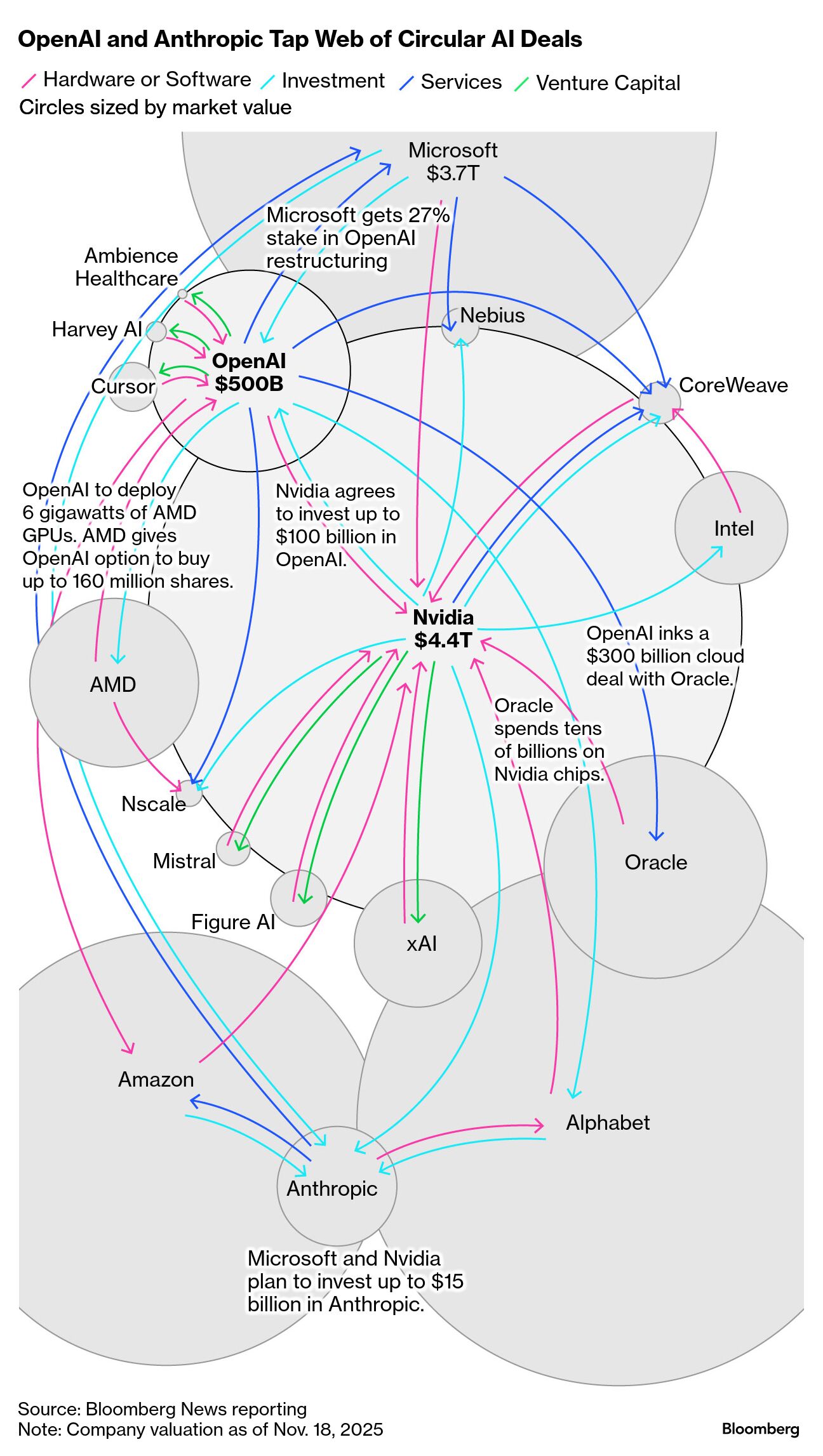
Can you see why people worry about, not just the amounts of money being spent by the industry, but the circular deals? You are an investor in OpenAI, they’re also buying services from you. Everyone seems to be in a relationship with Nvidia. There’s a huge proportion of the US economy that is dependent on things continuing to go well for firms like yours.
Yeah, I think that’s fair. Customers and providers have often invested in one another and [this] provides good stimulus to get us going, but it’s something to watch. I’m definitely watching it carefully and I think others are too.
Getting the balance right is very important. We have to deliver in the next few years. Every team is building incredibly large, very powerful computers and we’re taking a huge bet that we’re going to be able to convert this into true intelligence.
If we do, then I think the world is going to look very, very different. We will have abundant intelligence on tap.
OpenAI and Anthropic Tap Web of Circular AI Deals
You say the world, except this is really about two countries — the US and China.
That’s true, and everything has concentrated even more around Silicon Valley in the last 18 months. That’s natural. We see that in a lot of other historical technology trends.
At the same time, open source is doing very well and the cost of production is going through the floor. It costs 90% less to ask a question of one of the best AI models in the world than it did two years ago. When the cost goes down, everybody gets access.
You’ve got a lot of remarkable achievements, but is there anything left undone or that you reflect on?
I really want to nail medical superintelligence. I want to do more in energy efficiency and battery storage — developing new compounds for renewables. I think that AI will really transform the energy industry.
I’m actually very proud of a lot of the use cases in Copilot. Many people are using it for companionship, therapy, making difficult life decisions. It’s given me high-quality access to information and emotional support, and is helping keep me organized. 15
15 Copilot was also tested in the UK public sector as part of a government efficiency drive, with mixed results. Users reported time savings, but one study found little evidence that these translated into real productivity gains — and in some cases, they created extra work.
What do you mean helping you get emotional support?
At the end of the day when I’m in the car driving home, I have a 10-minute conversation with Copilot about something that was tricky, or something I felt frustrated about.
Maybe emotional support’s a little strong, but it’s like having a chat with a friend — downloading what went well and what didn’t. Copilot now remembers most of what you say and it will personalize its answers to you, and refer to something that you said last week, for example, or a trend or pattern.
That is super helpful. I feel refreshed after a conversation. It’s like a burden that I’ve released.
So it is a friend, a therapist, a family member, almost.
Yeah, it’s a little bit of everything. I mean, it’s a new thing. It’s an AI. It’s Copilot. That’s always the challenge when we’re trying to come up with words to describe something which is a little bit like many other things, but is also fundamentally different.
I just wonder if there’s any aspect that makes you pause. People go home and maybe they don’t have to bother talking to others in their life, because they’ve said it all and they’ve got what they need back.
Or the flip side is they don’t have to take it out on their partner or their best friends.
I still call my best friends every weekend and have a good old chat. If anything, it’s actually deepened some of my relationships with my friends. I come to those conversations feeling a little lighter.
Do you see your future in the US? Because I’m sure the UK would love to have you back.
I would’ve loved to have started Inflection in the UK. I love the UK. I love London. I’m very British in mentality.
One of the things I don’t like is the tall poppy syndrome. There’s not enough of a culture of risk-taking. There’s a little bit of a taboo around commercialization, making money, starting companies and being entrepreneurial. There’s not enough celebration of experimentation and failure.
In the Valley, everyone’s nuts and everyone loves failure. They’re constantly talking about how things are going wrong — how this was a disaster — and it’s very liberating. It’s also very cheesy, and it can grate when you are a bit of a cynical English person, but when you get into the rhythm of it, it’s great.
There’s also a kind of hustle culture. It’s quite humbling to see everybody just on the make, trying to understand some new technology. Random non-technical people reading science papers in a Starbucks. You’ll overhear two people who don’t know each other but are networking, almost. There’s an energy. I would love for that to be the case in London too — and I think it could be, but we’ve got to have political leaders who celebrate risk-taking and business.
Do you think AI could have had this conversation with you — could it have done a better job than me?
Probably not today. If you had prepared with an AI, it could have given you questions to ask — although you did do a lot of detailed research, so your team’s obviously very good.
There are going to be AI reporters. I run MSN at Microsoft; it’s one of the largest news sites on the planet. One of the things I’m very excited about is how AI reporters can reinvigorate local news. Imagine there are hundreds of thousands of AI reporters that can make phone calls to people who are at the scene, who can verify eyewitness footage, conduct interviews, stitch those together into little montages, and not just do it for big national stories, where the investment is justified, but do it at a very local level — to provide accurate and factually reliable information.
Are you developing AI reporters for MSN?
We’re exploring everything. I’m also on the board of The Economist and have been talking to them a lot about it. I think we’re exploring all kinds of things at the moment.
AI interviewers?
You’ve got a little bit longer. Maybe six months.
[Laughs]
I’m kidding.
I’m not sure you are.
No, I am kidding. It’ll be a very, very long time to get it perfect. This was exceptional.
Mishal Husain is Editor at Large for Bloomberg Weekend.