
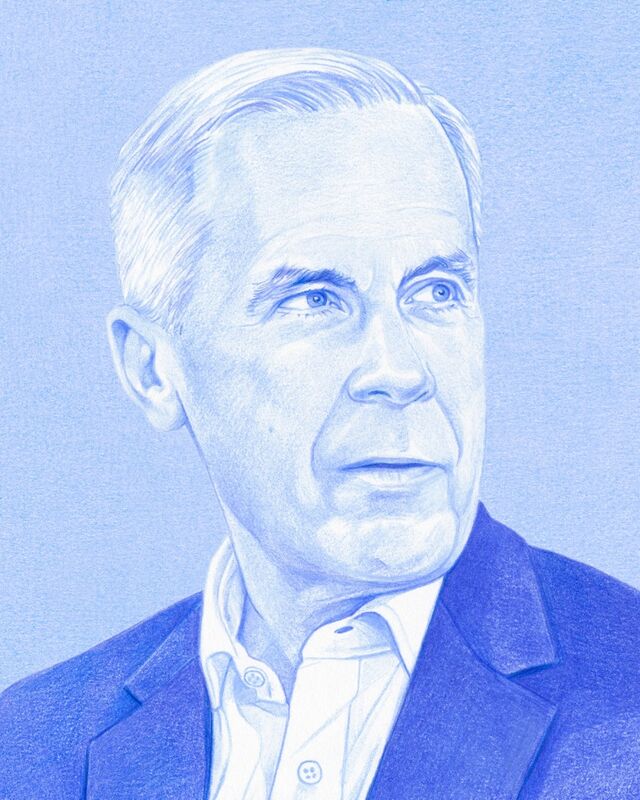
Mark Carney: ‘I’ve Learned Lots of Things From Trump’
The Canadian prime minister talks about renegotiating trade deals under Trump, balancing climate goals with oil revenue, and why Canada can’t afford to let Washington lead.
This time last year, Canada’s Liberal Party looked like it was on its way out. Voters were weary after nearly a decade of Justin Trudeau; with an election looming, the Conservatives were ahead in the polls.
Then Donald Trump returned to the White House. Canadians were forced to face rhetoric about becoming the “51st state” and started to see their interdependence with the US as a risk rather than opportunity. It was in this climate that political newcomer Mark Carney — twice a G-7 central bank governor — threw his hat in the ring, replacing Trudeau as Liberal Party leader. In April, he won the general election, albeit leading a minority government.
Seven months on, Carney joined me for the first episode of The Mishal Husain Show to talk about a time like no other in his life. He’s had to employ the language of governing rather than campaigning, and confront stark realities: Canada is one of the countries most affected by Trump’s second-term positions. I was also curious what looks different from his new vantage point — once a UN climate envoy, Carney is now at the helm of a major fossil fuel producer.
Mark Carney was chair of Bloomberg LP from 2023 to 2025. This conversation has been edited for length and clarity.
How long had you been thinking about this kind of power? Does it go back to your childhood? You were born in the Canadian Arctic, in a frontier town, and I get the impression that your parents had something of a pioneer spirit?
It wasn’t technically all the way to the Arctic, but close enough. They were young teachers and going to what seemed the frontier. So there was that element, [a] strong sense in my family of public service, a sense of higher calling. 1
1 Carney was born in Fort Smith, in Canada’s Northwest Territories. When he was 6 years old, his family moved south, to Edmonton, Alberta, and he was raised there before going to the US to study at Harvard University.
I’ve had a private-sector career; I was fortunate to be the central bank governor in two G-7 countries, at a time when — because there were major financial problems, including here in the City of London — that job was broader than usual, [with] major financial reforms having to be negotiated around the world.
Candidly, the prospect of becoming an elected politician in Canada — let alone prime minister — I felt was receding. And then I became more and more concerned about the potential direction of our country and felt that, given my background, I would have a chance to help change it.
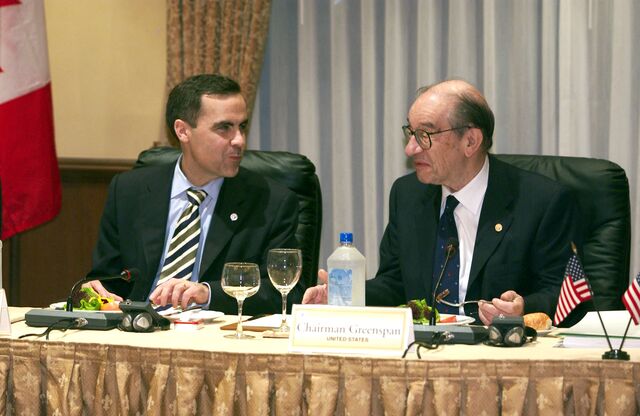
Did you get elected because of President Trump?
Well, I think you’d have to ask the voters of Canada.
You stood because of President Trump, didn’t you? You announced just before the inauguration.
I did not stand because of President Trump, no. I stood because I believed that the person who [polling showed] was likely to become prime minister was not the right person for Canada. That would’ve been a divisive government, and would’ve taken our country back as opposed to forward.
It turned out to be the case that once I was in the leadership campaign, President Trump’s actions and the trade war really intensified, and then I became more relevant. So certainly, yes, it helped that people made a judgment that I was best placed to deal with it. 2
2 As 2025 began, Conservative Party leader Pierre Poilievre enjoyed a big lead in the polls and seemed on course for victory, until the Liberals elected Carney as leader and staged a comeback. Poilievre lost his own seat but has since won another, returning to parliament as leader of the opposition.
What has surprised you in these six to seven months? 3
3 I was curious about this because Carney has been able to cast himself both as a man with the experience to lead and as an outsider, someone who has not been a career politician.
One is how relentless it is. I took a decision in early January to stand for the leadership and from that point on, it has been nonstop, close to 24/7. I conceptually knew that — I’d had high-pressure jobs before — but it’s much more so.
I knew international relations are important, but the fluidity of those relations and the importance of personal relationships with world leaders — that has surprised me.
I was thinking about something you said in 2020 about how it is “easier to be a central banker in a democracy than it is to be a politician in a democracy.” 4 That’s not even the half of it, right? You have become prime minister at a time when global trade is disrupted and alliances are under pressure as never before. How has it been?
4 Carney made these remarks in a lecture series on BBC radio, arguing that financial value had been prioritized over human value. He expanded on this in a subsequent book, where he said that “market fundamentalism” was making capitalism increasingly exclusionary and fueling populism. But before politics, his career was embedded in that very system, first as an investment banker and later leading the Canadian and UK central banks.
[Laughs] I stand by my earlier statement that it is — was — easier to be a central banker.
Part of the reason I am in this position is because of what you just described. It’s part of the reason why I put myself forward. It’s possibly one of the reasons why I was elected.
I’m going to say an odd thing. In some respects, it’s easier when the problems are very clearly out in front of everybody. I think all Canadians understand that our relationship with the United States has changed fundamentally, that the world is a more dangerous and divided place. Then the question becomes: What do we do about it?
Sometimes, if you look back [on] when times were “good,” but problems were building up, that’s when it’s more difficult to take the big decisions that are necessary.
Whereas here you know the score.
Here you know that we have to act.
It’s important to be as open as possible with people in terms of the assessment of the scale of what needs to be done, and then to be decisive.
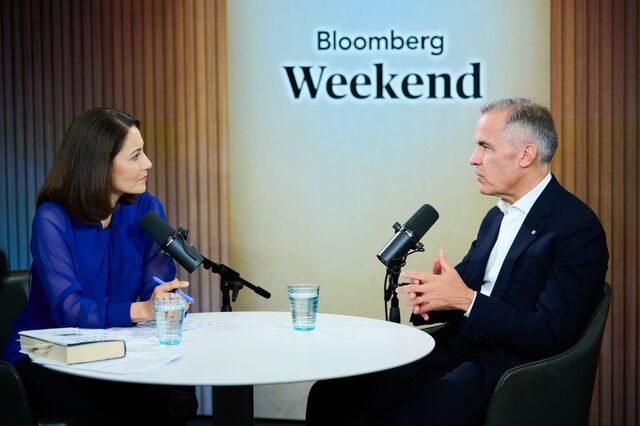
I do want to explore how much harder your task is as prime minister, in domestic and foreign policy. Because the United States is not the partner that it has been — its priorities have shifted.
You’ve got specific bilateral issues with the US primarily over trade, and the Canadian economy has been hit hard by what the president has done, particularly on steel, the auto sector and aluminum. What is your strategy for when the US-Mexico-Canada trade deal is reviewed next summer?
We want the best for the US economy just as we want — well, slightly stronger — the best for the Canadian economy.
So no, our strategy is not to expect some weakness in the US economy that is going to change the US negotiating position.
We have the best trade deal at the moment: 85% of our trade with the US is tariff-free. 5 Your question [is] what’s going to happen with the renegotiation of what they call USMCA and, secondly, some key sectors: steel, autos, aluminum, forest products being the main ones.
5 Goods covered by USMCA are currently tariff-free after the US, followed by Canada, agreed to walk back retaliatory measures imposed near the beginning of Trump’s second term.
Those issues are related. Our view is that, in effect, there will be a renegotiation of some elements of USMCA, because the president has signaled that desire. We’ll make it increasingly clear that in certain sectors — particularly steel and autos — the integration of the Canadian, US and Mexican economies is essential to US competitiveness. We make America stronger in these sectors, and our strategy is to make sure that is as well understood as possible.
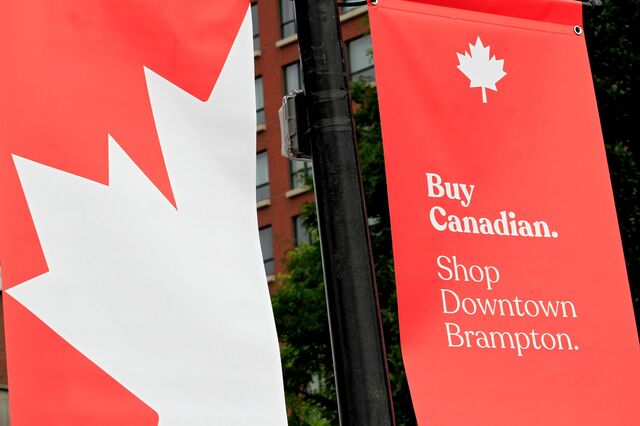
In February when you were campaigning you said of President Trump: “We’re going to stand up to a bully. We’re not going to back down.” And yet now you are much more likely to talk in more conciliatory terms.
Well let’s be clear: We’re one of two countries, effectively, that put retaliatory tariffs on the United States. Two countries in the world. 6
6 The other is China, although the worst implications of the US-China trade war are on hold until early November. The European Union had readied retaliatory measures on some €100 billion ($117 billion) worth of goods, but suspended these as it reached a trade agreement with the US in August.
But Trump has shown his power over you, hasn’t he? For example, your digital services tax. You announced it, he hated it. You had to back down.
The digital service tax was announced multiple years before. It was just effectively coming in. 7
7 This tax, which would have affected US tech giants such as Meta and Amazon, does pre-date the Carney government, but its last-minute cancellation — just hours before taking effect — was a stark display of US power after Trump threatened to cut off trade talks.
And it couldn’t because President Trump wasn’t having it.
We made a decision, in the context. What happened after we took that digital service tax off? Within weeks, the president confirmed, in an executive order, tariff-free status for the vast majority of our trade.
I wonder how you reconcile yourself to that? Because it is different from the tone you struck before. 8
8 I was thinking here of words like these, from April 2025: “President Trump is trying to break us so that America can own us. That will never ever happen.”
Well, I reckon my responsibility is to get the best possible deal for Canada.
But let’s be absolutely clear. The United States does have tremendous leverage in the near term, over Canada, over the European Union, over the United Kingdom, because our economies became linked on the basis of certain assumptions. Those assumptions have now changed. And so part of this is stabilizing that relationship.
And then a big part of why I was elected was — what else are we going to do? We can give ourselves far more than the United States can take away. We have agency. We can have one Canadian economy. We’ve taken major moves towards that one Canadian economy.
It takes time. But it’s worth it, because we never want to be in this position again. And so that’s building at home and it’s diversifying abroad. 9
9 Diversifying an economy where three-quarters of exports go to one trading partner to the south is a huge mission. As part of it, Carney is keen to reduce trade barriers between Canada’s provinces, and boost exports from both coasts. Amid big pledges, he’s been warned by business leaders to deliver a credible fiscal plan.
Have you learned anything from President Trump?
I’ve learned lots of things from President Trump.
Like what?
You always learn things from people.
I don’t fully subscribe to this, but I see the effectiveness, the value of “flooding the zone,” of doing multiple things at the same time. I think that he has a very effective way, in his own almost unique manner, of framing issues and of dominating the agenda.
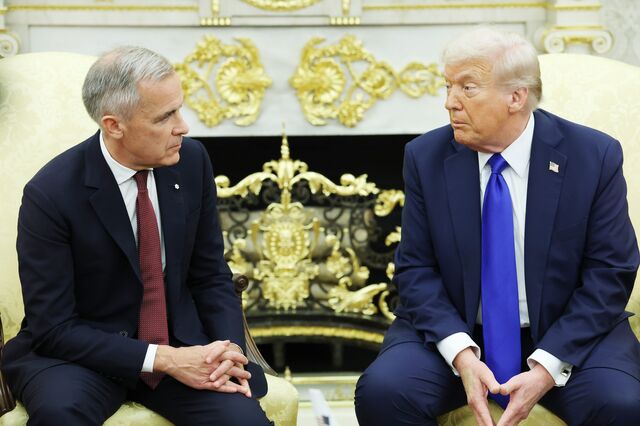
When you canceled the consumer carbon tax, you signed it on camera with a flourish. It was like executive order-style. Have you learned an element of performance from President Trump? Because it didn’t feel very Canadian.
That is interesting. I wouldn’t have ascribed it to him, per se. I just think that in a time when people are under a lot of pressure and there’s a lot of uncertainty, there is a value of being very clear.
And, sorry Mishal, but when you’re in a crisis, particularly, in this case, a trade crisis, an economic crisis, a crisis of sovereignty — given some of the points that President Trump’s saying about the “51st state” — you need to not just act decisively, but be seen to act decisively, and that’s what we were doing.

Get the Bloomberg Weekend newsletter.
Big ideas and open questions in the fascinating places where finance, life and culture meet.
By continuing, I agree to the Privacy Policy and Terms of Service.
Are we also in a climate crisis?
We are in a climate crisis, yes. 10
10 At the Bank of England, Carney became known for emphasizing the importance of tackling climate change, and later became UN special envoy on climate action and finance. In his book, climate change is described as “the ultimate betrayal of intergenerational equity. It imposes costs on future generations that the current generation has no direct incentives to fix.”
The last time we spoke was at the UN climate talks in Glasgow. You were well known for this phrase, “the tragedy of the horizon.” It’s all about how you need to think long-term on climate. Yet in office you scrapped the consumer carbon tax and paused a sales mandate on electric vehicles. There are now reports you are about to drop a cap on emissions from the oil and gas sector. What happened to you?
I’m the same me. I’m focused on the same issues. And the question is, how do you make progress towards those issues? And particularly, how do you make progress in a way that is most effective? So I’ll break those issues down.
The consumer carbon tax was extremely politically divisive, and it would have contributed to a government in place that would’ve canceled all climate policies, in effect. 11
11 Canada’s consumer carbon tax, developed by Trudeau, put a price on fossil fuels like gasoline and home heating to encourage a shift toward cleaner energy. Conservatives hoped to make it a focus of the 2025 election, promising to “ax the tax” and branding “Carbon Tax Carney” as a continuity candidate. With his characteristic pragmatism, Carney pledged to scrap the consumer element “immediately.”
So let me go more directly to what we are doing. Twenty percent of emissions in Canada comes from the building sector, from houses and commercial buildings. We’ve done very little in terms of reducing those emissions. We are now embarking on one of the biggest home building measures in our history, [with] lower embedded carbon in the production of these homes [and] a lower carbon footprint in the running of these homes. So that in itself is a housing strategy — it’s an economic strategy, it’s a climate strategy at the same time.
And yet, in your book, you emphasize that climate is an urgent issue. You are the only G-7 leader who has been a UN envoy on climate action.
Yes, that’s true.
And the world is crying out for leadership on this, right? President Trump is calling climate change a hoax. Are you in danger of squandering your reputation as a global climate champion?
I would add a few things. First, my role as prime minister is not about my reputation. My role as prime minister is about what’s in the best interest of Canada.
Canadians care about the world. They care about climate action. They care about their fellow citizens. They care about all of those things. Those values of sustainability and solidarity, fairness, are fundamental to Canadians. What we need to do is to be as effective as possible in terms of addressing climate change while growing our economy.
We are in the process of building out our clean energy footprint. We are spending almost $2 on [clean energy] for every dollar we spend on conventional energy — oil and gas — recognizing that Canada has the fourth-largest oil reserves in the world.
So what are you going to do about emissions from the oil and gas sector? There is a cap that’s supposed to come in. Is it true that you are considering dropping it?
Look, you can say there’s a cap, but saying a cap doesn’t make it happen. What makes emissions go down in the oil and gas sector will be carbon capture and storage, [and] other efficiencies.
So you are dropping it? That’s what it sounds like.
Dropping emissions, Mishal, from the oil and gas sector. This is the point. This is about results. The climate cares about results. An outcome is not a policy. What makes a difference to the climate is whether or not emissions come down.
What’s required, for the Canadian oil sands in this case, is carbon capture and storage. Related to this is ending “fugitive methane flaring,” which is up to 70 times a bigger contributor to climate change than CO2 emissions. 12
12 This has been a live issue in Canada. The Trudeau government announced regulations to limit emissions from the oil and gas sector, which is responsible for nearly a third of Canada’s total emissions. The country’s operational carbon capture projects capture around 4 million tons of carbon dioxide each year. To meet its goals, oil and gas emissions should fall to about 110 million tons each year by 2030 and carbon capture projects should store between 17 million and 50 million tons of CO2 annually, according to the Canadian Climate Institute.
And so we have an opportunity. We’re working with the industry, working with the provinces, to get those methane emissions down.
I just wonder whether the Mark Carney of 2020 would be slightly disappointed in the Mark Carney of 2025?
I think if you look in [my] book, you’ll see two important things in there. One is a discussion of exactly what I just said, emissions reductions. And secondly, using scarce public dollars to most efficiently reduce emissions.
Turning to the war in Ukraine. President Trump is now talking about Ukraine winning, with Europe’s help. To what extent can Ukraine win without the US being front-and-center, and offering security backstops?
Okay, so there’s a lot in that question and I think it’s important to distinguish the components.
Canada is contributing militarily and on a humanitarian basis as well. We’ve been there from the start. And the start was 2014, with the illegal invasion and annexation of Crimea. 13
13 Canada and Ukraine have a history that goes back to the 19th century when Ukrainian farmers emigrated to Canada. Today, their descendants make up a large Canadian-Ukrainian community. Former minister Chrystia Freeland, who is of Ukrainian heritage, recently left Carney’s government to take up a new role as Canada’s special representative for the reconstruction of Ukraine.
The US is essential for the provision of certain military equipment. We understand the need to buy that equipment on behalf of Ukraine or to help Ukraine finance that equipment — it doesn’t have to be directly supplied by the United States. Obviously it would be easier if the US were doing more direct provision, but that’s not an insuperable issue.
Which is why I asked, how far can Ukraine get?
Winning militarily on the battlefield, getting to a position where there is a peace accord, a ceasefire, a frozen conflict — they can get to that with the support of Europe, Canada, Australia, a few others, and with the US more in a secondary role.
Having a durable peace, a durable end of hostility, will require US backing. It is right that nothing has been concretely agreed and spelled out. But I would say the level of engagement [with the US] is encouraging.

It does seem Russia is emboldened, sending drones and jets into NATO airspace, as happened over Estonia.
I would rephrase. Russia’s under pressure. They were [militarily] making some progress over the course of the summer. That progress has stopped. Some of it’s begun to be reversed.
It’s unnerving for a country like Estonia to have Russian jets in its airspace.
It’s unnerving. Canada has frontline troops in Latvia.
If that happens again, do you support the idea of a NATO country shooting down that Russian jet?
All options are on the table, without question. There are ongoing consultations within NATO. Certainly, we will do what’s necessary in order to protect those countries. 14
14 Shooting down Russian jets became an active discussion after Sept. 19, when Estonia said three fighters were in its airspace without permission for 12 minutes. Trump said Russian planes should be shot down, words echoed by NATO’s secretary-general, albeit with the caveat of first exhausting all other options. There is a precedent: In 2015, Turkey shot down a Russian plane on its border with Syria, saying it had ignored warnings.
Is that the kind of message that shows Russia that NATO is serious? Because President Trump isn’t really showing Russia that America is serious about Ukraine.
I think President Trump has been very important in this process. He has given peace a chance, so to speak, with Russia. He has lines of communication with Vladimir Putin. There’s been opportunities for Putin to take off-ramps — Putin has not taken any of those.
The president speaks for himself, but I think his patience is being exhausted. His line is hardening. The likelihood of further economic sanctions against Russia is increasing.
I would underscore Russia has been moving at a snail’s pace in terms of temporary acquisition of territory in Ukraine. They’re not going to win this war.
Another one of your foreign policy priorities has been the recognition of a Palestinian state, on which the US fundamentally disagrees. What is your next step on that issue?
I would say recognition is not the end. The end is a free and viable Palestinian state living side-by-side in peace and security with the state of Israel. That’s the end goal.
To be clear about why we did what we did: The actions of the Netanyahu government were explicitly designed to end any possibility of a state of Palestine, in violation of the UN charter and going against Canadian government policy since 1947.
The US disagrees with the decision that we took, that Spain took, that France took, the United Kingdom took — [that] 150 other countries in the UN have taken. But their common objective is the same. 15
15 We spoke before Israel and Hamas reached a hostage-release deal, as part of US- and Qatari-brokered ceasefire negotiations. At the time, Carney seemed cautiously optimistic about Trump’s 20-point Gaza peace plan. On Monday, he praised the president’s leadership and said in a statement that the release of Israeli hostages “must be a turning point toward lasting peace.”
Justin Trudeau said that Canada would honor the International Criminal Court arrest warrants, i.e. Benjamin Netanyahu would be arrested if he came to Canada. Does that stand under your leadership?
Yes.
You’d be prepared to do that?
Yes.
How long do you plan to serve?
That’s a great question. My party is in a minority position in Parliament. We ran on a very strong mandate — in other words, to do big things.
And the only answer I can give you is that while I serve, we will do those big things. We will do the things that are necessary. We will be straight with Canadians about the scale, the challenges that exist, and do everything we can. And then the political process takes its course.
But I think you’ve made such big pledges that it’s hard to imagine you could fulfill them in less than a decade. So I imagine you do want to serve two terms. You want to build a huge number of houses. You’ve made a big pledge on defense spending. You’re in a tight economic framework where growth is hard to find.
Well, it’s a democracy and you have to ask permission from voters for the time served. We’re in an economic crisis. It’s a fundamental shift in the world. It’s not a transition, it’s a rupture. Big changes in a very short period of time.
I know from all my experience that in those situations you have to act big, you have to act bold — that is what we’re going to do. The politics, favorably or unfavorably, will result from that. But I need to do what I think is necessary.
And what is at stake if you don’t succeed? Do you fear the specter of populism? Because you’ve said populists don’t know how to run economies.
That’s true. They know how to talk about it, but they know how to run economies down.
I think I’ll answer the question this way. We’re building the economy, and what’s important is how we’re building as well.
We’re building, for example, with indigenous Canadians: In major projects, there will always be indigenous participation. We are building in an inclusive way with unions. We’re creating hundreds of thousands of high-paying skilled careers. We are building sustainably.
These are hard roads to go down. There are a lot of high expectations and, arguably, your chances of delivering in the next five years are relatively low. Where do you find optimism?
Well, I know that Canadians recognize the scale of the challenge. They want the government to act. They feel fundamentally that we need to take care of ourselves. They know it won’t change overnight, but they need to see us doing everything we can to make sure that it changes for the medium-term.
Can we bring it back to you to close, because this is the Weekend Interview and, as it happens, we’re talking on a weekend. What are prime ministerial weekends like?
Well, I took off my tie, so that’s a big, big step.
They are pretty indistinguishable from prime ministerial weeks.
There is no weekend?
There is in effect no weekend, with the sole exception of one evening where, with the family, you might be able to go cross-country skiing or for a run. But it’s pretty limited, and that’s fine. That’s exactly what I would’ve expected in terms of the scale of the task.
What do you miss about your old life? I imagine your family probably misses your old life.
Yes, I’m sure they do.
What do I miss about it? I miss not having any privacy, basically.
And the space to think. How do you find that?
Part of the job is to create space to think. To be a leader, you need to know where you’re going. And knowing where you’re going means you need a strategy. The world is changing very rapidly. So if I don’t carve out some time, on a weekend for example, to think about strategy, then I’m not doing my job.
It’s very easy to be consumed by the here and now. And there are so many calls on your time. Everybody wants some of your time, for valid reasons. You have to resist some of that to preserve [time] to chart the course.
Does church help? I think you go to Mass on Sundays.
I do go to Mass, yes. 16
16 Carney is of Irish Catholic heritage. After the passing of Pope Francis in April, he said he’d been guided by a 2014 challenge from the late pontiff, to make capitalism more inclusive and make the market less self-interested and more humane.
Do you have a sense of mission that’s beyond political mission?
I think you do have to have a sense of mission to be an effective leader. I’ve got the privilege to lead a country. So a mission, a sense of you are there for service, yes, it helps in reminding that your job is to serve.
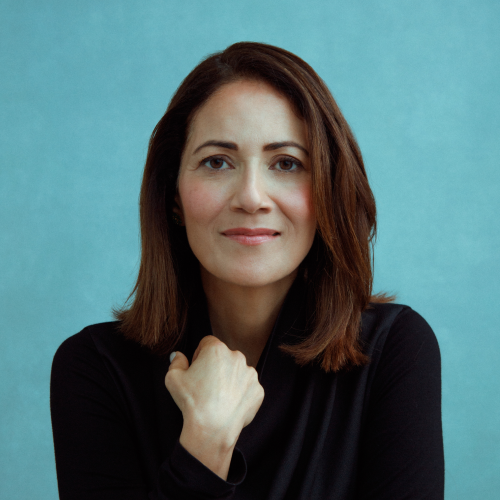
Mishal Husain is Editor at Large for Bloomberg Weekend.