

Ken Burns Still Thinks America Is Perfectible
The American Revolution filmmaker talks about the hypocrisies of US history and what’s missing from our political lives today.
Ken Burns is back. A storyteller of America for nearly 50 years, the lauded documentary maker has a new series airing on PBS — and yes, it’s another epic.
Having made his name in the 1990s with The Civil War, Burns is now tackling the United States’ origin story. Over six two-hour episodes, The American Revolution charts the period before and after 1776, and will air internationally ahead of the 250th anniversary of the Declaration of Independence. Full of Burns’ trademark visual and historical detail, the series promises new information even for those who think they know everything about the founding fathers.
Yet America’s history feels more charged now than when Burns began the project in the final months of the Obama presidency. He’s been navigating that tension as he promotes the new series, and as the end of federal funding for public broadcasting forces him to seek alternative support for his next project. For this Thanksgiving weekend, Burns joined us to talk about the lessons of the past, the characters who made history, and present-day America.
This conversation has been edited for length and clarity. You can listen to an extended version in the latest episode of The Mishal Husain Show podcast.
We’re speaking as Americans gather for Thanksgiving, and some are probably thinking about the stories of the early settlers. The story that you have immersed yourself in for the last 10 years is the American Revolution. What surprised you the most?
I had no idea of the complexity. That it was a bloody civil war, a world war — maybe the fifth global war — for the prize of North America.
[The series] has the big ideas, and all the famous founding fathers; but also hundreds of other people, who are important and give dynamics, dimension and complexity to the story.
That’s all we want from our stories. We don’t want a superficial, sanitized version of our past. We want a complete one. We have a neon sign in our editing room that says, It’s complicated.
In my business, the art has to be subservient to the facts. When you learn new facts — and sometimes they’re contradictory — you have to find a way that your narrative can tolerate them and understand them.
We live in a political world where everything is one way or the other. It’s a binary that is artificially created for the simplicity, laziness [and] cynicism of what’s going on. Telling a complex story escapes the specific gravity of cynicism and offers something in return — where you can say the whole is greater than the sum of the parts.
The series is out now, but it’s a more fractious time in America compared to the end of the Obama presidency, when you started out. Indeed, in an executive order the White House said earlier this year that they were against telling history in a way that cast the founding principles in a “negative light.”
Well, I certainly haven’t done that. I’ve put them in a very, very positive light. I’ve just put them in the correct light, which is the engagement of all the characters. 1
1 Burns deftly answers this question, but as I watched the series I was conscious of the executive order I mentioned in this question. In it, President Donald Trump attacks efforts “to rewrite our Nation’s history, replacing objective facts with a distorted narrative driven by ideology rather than truth.”
It is possible to make this a one-act, one-room play, where it all takes place in Philadelphia. But that doesn’t give you the dynamism, the underdog story. On April 19, 1775, when British troops [and] American militia [are] on Lexington Green, the chance of success is zero. Six-and-a-half long years later at Yorktown, that British army is surrendering. How that happens is 40 battles [and] enormous social and political — even religious — change within the colonies. 2
2 Lexington Green in Massachusetts has become known as the place where the first shots of the Revolution were fired. The background was growing tension, which led the British to try and seize weapons that might be used against them. In 1837, Ralph Waldo Emerson put the words “the shot heard round the world” into his poem “Concord Hymn.”
One of the many things that intrigued me was the realization of how much the colonists were influenced by Native American nations, who had what we would recognize today as a union. The Thirteen Colonies didn’t, until quite late.
It is really remarkable. At the very beginning of the film, there is a group of six native nations, often called the Iroquois Confederacy — they call it the Haudenosaunee. It permitted each of those nations to retain their identity — sort of like the European Union — and at the same time, economically, diplomatically and militarily have a union. Benjamin Franklin sees this, 20 years before the revolution [and] says, I want that.
Also, the Americans are reading. They’re very literate — percentage-wise, more than the British population. They own land in ways that ordinary folks in Britain do not. They pay less taxes. They’ve got great health. They’re reading Montesquieu [and] the French philosophers of the Enlightenment. They’re reading Locke and Hume.
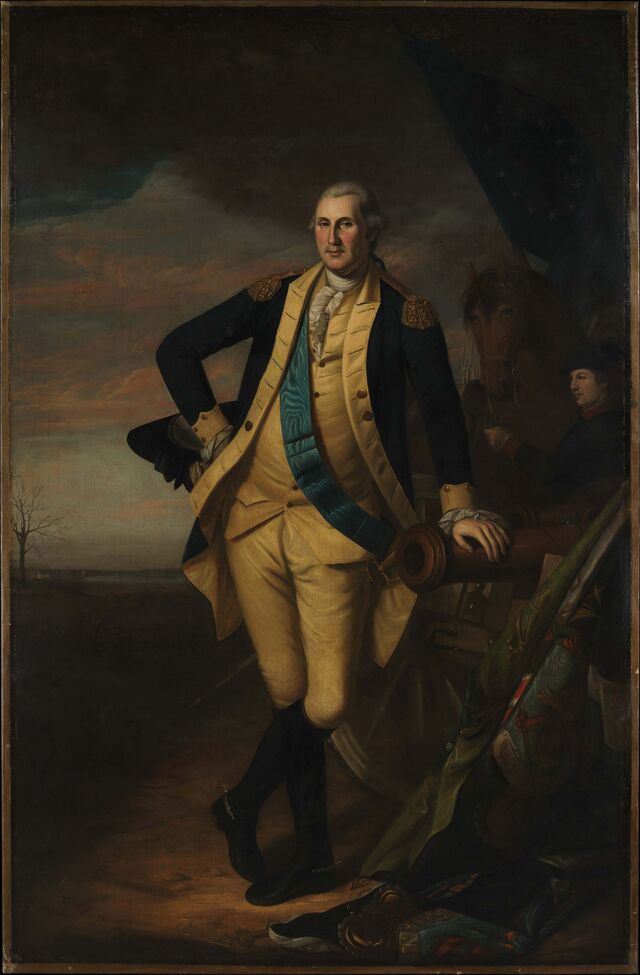
When you marry this possibility of union with arguments that get blown out into universal rights, [it’s] very powerful. The word liberty means something to everybody. It means something to George Washington who owns hundreds of human beings — but it also means something to those hundreds of human beings. It means something to women. It means something to Native Americans.
That animating spirit makes the American Revolution not just this important origin story for the United States. It makes it one of the most important events in all of world history; because that revolution is going to spawn 200 years of revolutions all around the globe. 3 This anti-colonial movement, strange to say in this day and age, the United States invented.
3 The most prominent of these is the French Revolution. Having fought Britain for control of North America — and lost — France entered into a treaty with the US in 1778. But the cost of that distant war was considerable, and helped spur the overthrow of Louis XVI in 1789. Later echoes include Ho Chi Minh quoting the US Declaration of Independence in Vietnam in 1945.
And yet, when that anti-colonial movement is successful against the British, it results in westward expansion which dispossesses Native Americans of their land.
Exactly.
African Americans who were runaway slaves are hunted down. George Washington — the great hero of your story, if there is one — is keeping those runaway slaves imprisoned, so that their owners can come back and get them.
This is the story of human beings. The contradictions, the hypocrisies, all of that is there.
We don’t have a country without George Washington, but yes, he wants those escaped enslaved people to be returned to their owners.
Don’t you struggle with the hypocrisies?
No! What do you mean?
The great scholar Annette Gordon-Reed — who is a Black woman — says that slavery bound Thomas Jefferson’s life from beginning to end.
The section [of] the Declaration of Independence where he is declaring “all men are created equal.” “We hold these truths to be self-evident,” he says. They’re not self-evident. These are brand new. [Jefferson] knows slavery is wrong. Washington knows slavery is wrong.
She is not taking Jefferson off the hook, or by extension Washington. She’s putting us on the hook for our presentism about how we’re so different. We’re all complicated.
Here’s the good news, though. Everyone who heard those words began to argue for something that changed the world. It will take four score and nine years before [the abolition of slavery]. Women will have to wait impossibly long — 144 years — to receive suffrage. But those walls are broken down. And you could extend it to all other kinds of things; child labor, gay marriage. 4
4 Gordon-Reed expanded on her view of Jefferson in a recent op-ed. “By the end of his life, Jefferson had heard from enough individuals from different backgrounds, races, and religions to know that what he had written in the Declaration spoke to people’s aspirations for equal treatment and personal liberty,” she wrote. “Indeed, he noted as much in a letter written just a month before he died. Succeeding generations would be ‘wiser,’ he said, and the new information and ideas they possessed would bring changes in attitudes.”
By saying the word all, they start something? Even if they’re not prepared to deliver it themselves?
The late historian Bernard Bailyn says nobody talked about slavery as an evil before the [American] Revolution. There were people who spoke to its evil, but it was not part of the common conversation. The second the revolution started, through to our Civil War, it was the number one topic in America.
Jefferson did see the hypocrisy. He just couldn’t act on it. There’s too much money to be made in slavery.
And may I point out that the British Empire’s wealth — its profit centers — are in the Caribbean, which are 90% enslaved people. 5
5 In Britain, transparency on how institutions and individuals benefited from the proceeds of slavery and colonialism is very recent. One example is a 2020 National Trust report documenting the wealth behind more than 90 of its properties. Among them was Penrhyn Castle, built by a family that owned sugar plantations in Jamaica and continued to profit from them — and the labor of enslaved people — after returning to England in the 1730s.
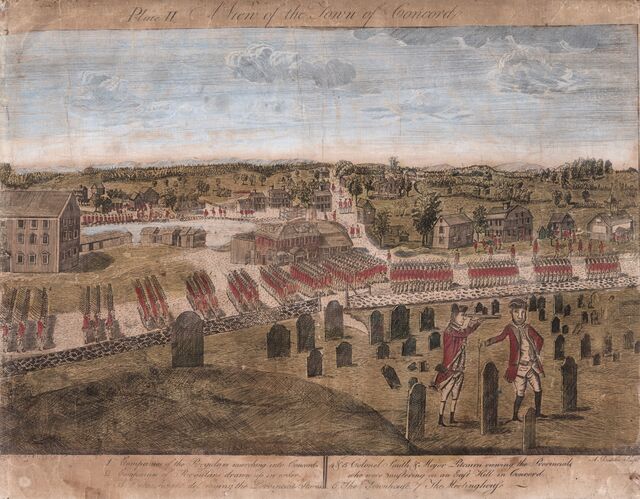
Can I tell you my connection to Lexington Green and 1775?
Yes, please. Do you have one?
One of my forefathers, Michael Farley, was the head of the Massachusetts militia. His four sons were all soldiers of the revolution. It gives me this connection to exactly the period that you are talking about. I have to reconcile myself to the fact that, when they were fighting for liberty, they didn’t mean everyone’s liberty.
I learned that I have, on my mother’s side, an enslaved person. I took that with equanimity. The thing that really bothered me was that I have an ancestor who had to move to New Brunswick [in Canada] because he refused to sign a loyalty oath after the revolution.
I am also related to Robert Burns, the national poet of Scotland, [who writes], “Oh, would some Power the gift give us. To see ourselves as others see us!” That becomes part of how we tell stories, not imprisoned by the binary but tolerant — aware of all these contradictions and undertow, which makes drama more interesting and makes us able to deal with one another.
Somehow we’ve permitted our politics to descend to this abysmal level of one thing or the other, that frankly doesn’t exist in nature.

Get the Bloomberg Weekend newsletter.
Big ideas and open questions in the fascinating places where finance, life and culture meet.
By continuing, I agree to the Privacy Policy and Terms of Service.
Can I understand a bit more about your own nature, and the story of how you came to do this work. What was it in your early life that led you to it?
My mother had cancer [and] died just a couple months short of my 12th birthday. Sometime after, I saw my father looking at an old movie and crying. I’d never seen my dad cry.
The film was Carol Reed’s Odd Man Out, about the Irish Troubles. I realized that film had given him a safe haven — nowhere else in his life could he express these emotions. At that moment, [I wanted] to be a filmmaker.
My late father-in-law [was] an eminent psychologist. He said, I bet you blew out your candles on your birthday cake, wishing she’d come back. And I said, How’d you know? He said, Look what you do for a living. You wake the dead. You make Abraham Lincoln and Jackie Robinson come alive. Who do you think you’re really trying to wake up?
By 40, I began [working] to understand what it was that I had not dealt with as a little boy — this tremendous loss. It enriched my work even more. It’s born in tragedy. It’s born in loss. My mother’s gift, in a funny [and] perverse way, was dying.
Your mother’s been gone 60 years, I think.
60 and a half. It’s way too long.
I talk about this with my brother. My dad died much later. He had moved from ‘daddy’ to ‘dad.’ She never left ‘mommy.’ You have two men in their 70s who refer to their mother as ‘mommy.’
Do you think you’re still grieving?
Yes, the half-life of grief is endless.
The style that you have made your trademark — the use of paintings, letters, photographs, where you zoom in and pan across — how much of that was born of necessity? Let’s take the Civil War documentary; you didn’t have a lot of great visuals to work with. 6
6 After The Civil War, Steve Jobs told Burns he planned to call a new video-editing feature on Macintosh computers “the Ken Burns effect,” in tribute.
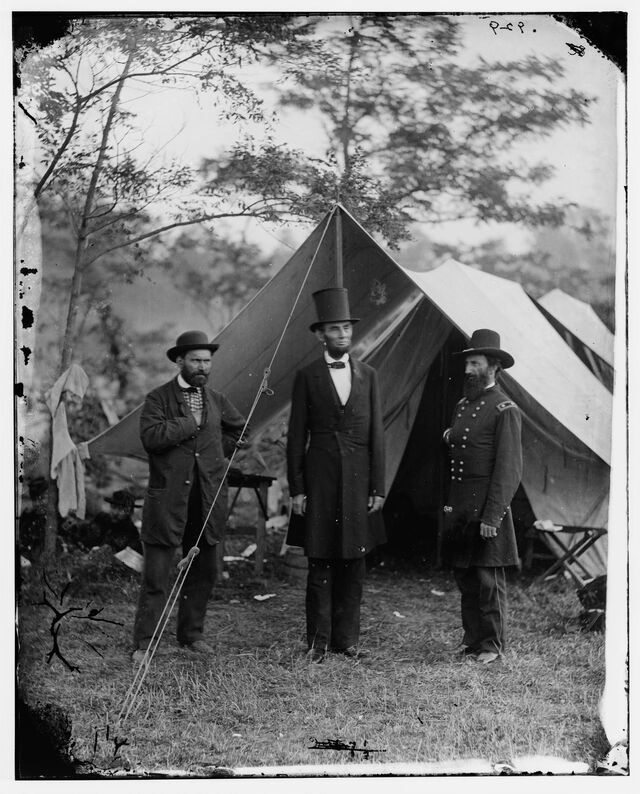
Well, we had a lot of photographs, and that’s where the American Revolution is at an even greater deficit. Photographs are real. You show a picture of Abraham Lincoln, with his general at Antietam, and you just know what’s going on.
But [with the Revolution] you don’t have that. The portraits of Washington are widely varied. Some look cartoonish, some don’t look at all like him. So you have to figure out a way to make them come alive.
You have to have a complex sound effects track. In this case, in addition to a third-person narrator [we have] first-person voices read by the finest actors in the world. I would submit that the cast list for this film is better than any film or television series that’s ever happened. Sir Kenneth Branagh could have read every single part, except the female parts. Maybe I’m selling him short. But also Tom Hanks, Meryl Streep, Paul Giamatti, Laura Linney, Claire Danes, Jeff Daniels, Josh Brolin.
Who is the voice of Washington. Let us into how you direct, because I think you’re very specific on how you want these people to sound.
Yes.
So how do you know how Washington would have come across?
I don’t know. Washington was particularly hard.
I said, You need to just inhabit the words. In the case of George Washington, you have an impossible task. This is an opaque and unknowable person, by design — he kept that rectitude so firmly.
Tom Hanks is such a good reader that he actually slips in and hides with perfection behind the eight or 10 people that he plays. I’ve worked with him now for close to 25 years. He is so talented and generous, that if you wanted somebody to read the back of your cereal box or the phone book, he’d be the guy to do it.
What you’re saying about Tom Hanks does explain why, although I knew he was in the series, when I watched I was like, Which one is Tom Hanks?
Exactly! I’ll tell him that because this is exactly what I love.
The use of reenactments in this series, why is that? For the TikTok generation, do you need a visual device?
No, no, no. It’s that I have no photographs. I have no news reels.
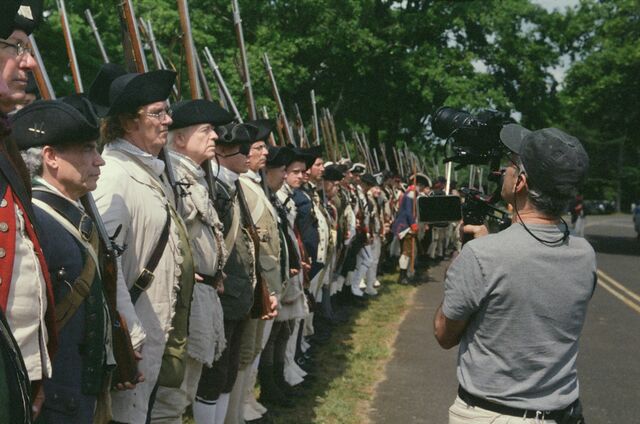
We spent more than five years filming reenactment groups — French, British, militia, Native American, Black troops, women, children that are always there [at] the battlefield. We collected a critical mass of them.
We treated them in a very impressionistic way. We filmed them at every time of day and night — usually at dawn or dusk. We don’t see faces. We see silhouettes, cannon firing. We’re not asking them to reenact a specific battle. We’re asking them to participate and to give a sense.
If you add complex soundtracks, along with the music, the third-person narrator, then some of the voices that you and I have been talking about — you get a sense that you’re there. There’s a coldness you can feel in the winter scenes. There’s a hotness you can feel in the summer scenes — when 20 British soldiers were dying in the march across New Jersey every day just of heat. Cinematography is the key to this. There’s lots of ways to wake the dead, as my late father-in-law said.
I’m going to read the words that you put right at the end of the series. These are such striking lines from Benjamin Rush in 1787: “The American war is over, but this is far from being the case with the American Revolution. On the contrary, nothing but the first act of the great drama is closed. It remains yet to establish and perfect our new forms of government… Patriots come forward. Your country demands your services... Hear her proclaiming, in sighs and groans, in her governments, in her finances, in her trade, in her manufactures, in her morals, and in her manners, the Revolution is not over.”
I’m feeling emotional, reading these words, and I’m not even American.
I am emotional.
Are you saying the revolution is not over, today?
Yes.
We sometimes focus on the phrase “pursuit of happiness.” The key word here is pursuit. This is a process. We’re a nation in the process of becoming. The story of the American adventure, which Benjamin Rush understood right away, this is an open-ended thing.
People from Wales, England, Scotland and Ireland who have worked dependent land for 1,000 years, come here and now own a plot of land — maybe taken from Native Americans but they own it. They feel the possibility of things actually changing.
One of the biggest takeaways is the perfectibility of human beings, the [capacity for] improvement.
No, I have to be disciplined. Our famous satirist Mark Twain says, “History doesn’t repeat itself” — which of course it doesn’t, no event has happened twice — “but it rhymes.”
The rhymes that were happening when we began this project — when Barack Obama was president — changed in the next year, and the next year, and the next year. If you pay attention to them, you date your film.
Hundreds of classrooms are looking at my 35-year-old film on the Civil War, the film on the Roosevelts, World War II, jazz, baseball, the US and the Holocaust, because they’re evergreen — because we did not succumb to the desire to say, Ha, isn’t this so much like today?
But what about your next work? You’ve always worked with PBS. President Trump wants to end federal funding for public broadcasting.
Congress killed the Corporation for Public Broadcasting [CPB] and it was an incredibly shortsighted thing.
I took a big hit. Money that had already been authorized and appropriated for future projects that I’m working on, and have been working on for years, has disappeared. I’ll have to fundraise.
PBS had to lay off a lot of people, but they’ll be around. They’ll continue. I’ll continue. 7
7 The American Revolution has been seen as a “we’re still here” moment for PBS as CPB, the private entity that disburses taxpayer funds to PBS and NPR stations across the US, is wound down.
Will you find other sources of funding?
Of course I will. I just will work harder.
Who do you make that up from?
Foundations, individuals of wealth, who have always contributed. The Corporation for Public Broadcasting, which was eliminated, was about 20% of my budget.
I’m worried about the next person coming up, who’s not going to be funded. I’m worried about rural stations. Sometimes PBS is the only signal they get, so there’ll be a news desert. Nobody will be covering the school board or the city council meeting.
It was an unfortunate and unnecessary political gesture. Maybe things will change, and it will be resurrected — and I feel optimistic about that, in a selfish way. [That] I’ll be able to go on, and PBS will continue.
I could, with my reputation, go to other places and get all the money I need to do The American Revolution — $30 million-plus — but they wouldn’t give me 10 years to do it.
I think the reason I occupy a position as I do in my country is because I spend that time doing it right. I don’t put any of my personal politics in it. I speak to everybody. Not because we’re trying to be all things to be all people, but if you tell a good story, it would be like saying, Well, Shakespeare’s only good for liberal Democrats — that’s poppycock. He appeals to this day because of the truths he was able to get to everybody. 8
8 Burns invoked Shakespeare numerous times during our conversation, I think because I was speaking to him from London, and he is keen to emphasize the international relevance of the series.
What stories are you telling next?
We’re working on a film, we have been for several years, on the history of LBJ [Lyndon B. Johnson] and the New Deal. His hero was FDR [Franklin D. Roosevelt].
We’re doing a film on Reconstruction, the most misunderstood period in American history, where the North was attempting to rebuild the South and integrate Black Americans into it. [The] Birth of a Nation and Gone With the Wind suggest that Reconstruction — the attempted equalization — was the bad thing. In both of those films, the Ku Klux Klan, which is our own homegrown Al-Qaeda or ISIS, were the heroes of that story, and in fact, they are the villains.
And Obama, weren’t you working on something?
I’ve had the great privilege of interviewing President Obama for eight two-hour sessions, and we’re looking forward to more.
There’s no rush because I want to escape the specific gravity of journalism, where scholarship has begun to come in to reflect on it, and for him to be able to reflect back.
That is such near history compared to what you’ve done before. Are you imagining this is something beyond his lifetime, or are you imagining releasing it in the next 10 years?
No, I think we would have it in the next five or six years. 9
9 Even more intriguing: This would be a Ken Burns take within 20 years of a president leaving office. I can’t help thinking that he might be channeling his own political instincts into this project. While a supporter of the Democratic Party and publicly critical of Trump during his first presidential run, Burns has been careful to avoid such comments since.
Ken, as you are our Thanksgiving episode, can I ask what are you grateful for?
Well, I am grateful that I’m an American.
I am incredibly patriotic, as my children and my grandchildren will tell you, probably with no small amount of discomfort. Every year, before we eat on the 4th of July, I make them listen to me read the Declaration of Independence. And each time, I get a little choked up, as you and I were listening to Benjamin Rush’s words.
I think gratitude is the missing ingredient in our degraded political lives these days. Everything is binary and so complicated, yet I have — as history will do — an essential optimism. I’m grateful for the fact that being a student of history permits me to have a sense that the human race will figure this out. We’re all so narcissistic [that we think] our moment is the worst. The sky is falling, it’s all bad.
I can point out in American Revolution [that there was] much more division back then. Maybe seeing [your] own reflection in historical figures gives you a chance to realize that, for the first time in human history, people were no longer subjects under authoritarian rule, but citizens — with all of the responsibilities attendant to that. It’s been on the whole, with lots of problems, a positive in the course of human events.
There’s no doubt in my mind that, back in 1775, you would’ve been a patriot, not a loyalist.
You know what? I don’t want to say that. I’d hope so. But I have to be realistic.
[At that time] the British constitutional monarchy is the greatest form of government so far on the planet. It is responsible for my prosperity, health, literacy and good fortune. Why would I want to change that now? That could easily be my thinking.
The next question is, Would I be willing to fight for a cause, die for a cause? I have patriots and a loyalist amongst my ancestors.
I think it is a good question that everyone in the United States should ask: Where would I be on this? I think it’s important for us to say we don’t actually know who we’d be at that moment.

Mishal Husain is Editor at Large for Bloomberg Weekend.