
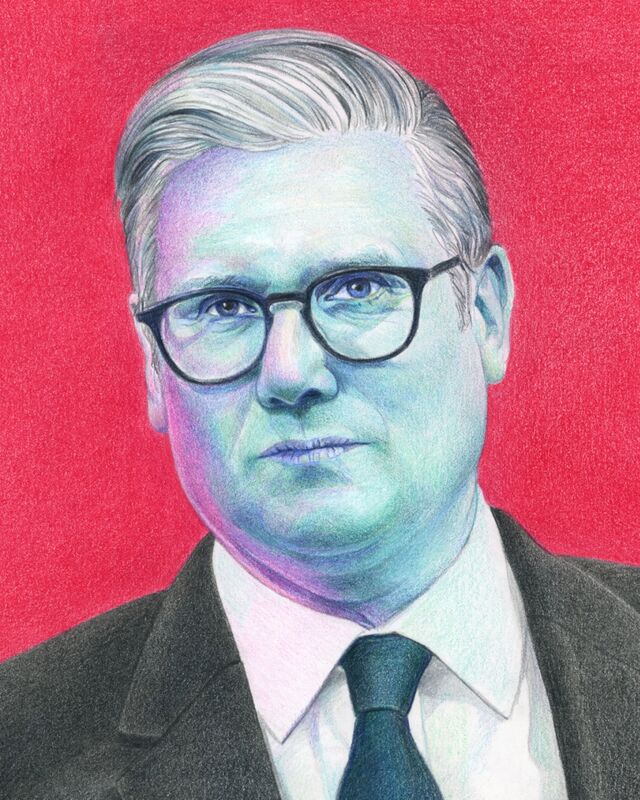
Keir Starmer: ‘We Are Gravely Concerned’
The UK’s prime minister is focused on de-escalating the Israel-Iran conflict, and sees a path forward for Ukraine and a US-UK trade deal.
Can the UK help de-escalate, well, everything?
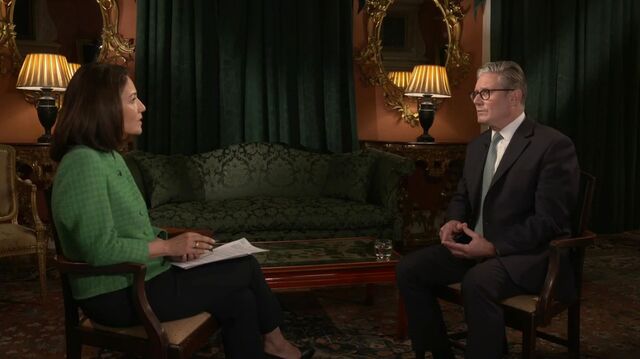
Friday morning turned out to be quite a moment to walk through the famous black door of 10 Downing Street — home and workplace of British prime ministers for nearly 300 years — to speak to current occupant Keir Starmer. Israel had attacked Iran a few hours earlier, and so our conversation about the UK’s role on the world stage began right there, slotted between Starmer’s calls with the leaders of France, Germany and Israel.
Starmer has been in power for nearly a year, and has been tested in new ways since Donald Trump returned to the White House. He prides himself on the bond they appear to have forged, though it is in some ways an unlikely one: the New York businessman and the studious former human-rights lawyer. That rapport helped the UK score a win with a trade agreement, which Starmer told me is about to enter into force. Alignment on Ukraine is harder. As Starmer heads to Canada for the G-7, he is trying his utmost to emphasize alliances and shared objectives, even as the evidence highlights their limitations.
This interview has been edited for length and clarity.
Prime Minister, just as you’re about to leave for the G-7, Israel carried out what it described as a preemptive strike on Iranian nuclear targets: 200 fighter jets, more than 300 bombs, 100 sites struck, including homes. Would you say Israel is justified in the action it’s taken?
I’m very concerned about the situation. It’s obvious that for a long time we’ve had grave concerns about the nuclear program that Iran is putting together, and we absolutely recognize Israel’s right to self-defense. We were not involved in this attack, and we’re urging all sides to deescalate and negotiate as the way forward here.
In March, US National Intelligence made it public that they did not believe Iran was developing nuclear weapons. 1 Has something changed?
1 On March 26, US Director of National Intelligence Tulsi Gabbard said the intelligence community “continues to assess that Iran is not building a nuclear weapon and Supreme leader Khamenei has not authorized the nuclear weapons program that he suspended in 2003.” But she also warned that the past year has seen “an erosion of a decades long taboo in Iran on discussing nuclear weapons in public, likely emboldening nuclear weapons advocates within Iran’s decision-making apparatus. Iran’s enriched uranium stockpile is at its highest levels and is unprecedented for a state without nuclear weapons.”
I won’t go into the intelligence assessments, but we are gravely concerned. I’ve just had a call with President Macron and Chancellor Merz and we are all on the same page. We’re all saying de-escalate, but none of us were involved in the actual attack.
Does that mean you’re also gravely concerned about this very big preemptive military action? I mean, you’re concerned about Iran’s nuclear program. Are you also concerned about Israel’s choice of action?
I’m going to speak to Prime Minister Netanyahu shortly after this interview, so obviously that’ll be a topic of discussion. Look, I do recognize Israel’s right to self-defense. But I’m very concerned about the escalation of this situation, which is why, along with Germany and France, we’re really clear that de-escalation is what is needed here.
Would the UK therefore help defend Israel from Iranian attack as it has done before? 2
2 When Iran launched a missile and drone attack against Israel in April last year, Britain’s Royal Air Force shot down a number of Iranian drones.
This is happening in real time as we speak, and I’m not going to go into operational matters. But as I say, the principle of Israel’s right to self-defense is absolutely clear, and we stand by that. But this is a fast-moving situation, as you will understand.
At the same time, we have the ongoing situation in Gaza, the suffering there, something that you have called “intolerable” and “appalling.” Three weeks ago, you made this very strong statement 3 with Canada and France, which called for three things: for Hamas to release the hostages, for Israel’s military operations in Gaza to cease, and for Israel to let aid into Gaza in accordance with the UN. None of those things have happened. What action will you take now?
3 Starmer has repeatedly supported Israel’s right to defend itself following Hamas’s Oct. 7, 2023 attacks. But in May, the UK, France and Canada issued a joint statement opposing expanded Israeli operations in Gaza.
You’ll have seen that we’ve taken action in relation to sanctions three weeks ago, but also more recently, 4 and it is important that we consider what other options we have. The situation in Gaza is absolutely intolerable. The aid arrangements are not adequate. We’ve been consistently calling for a return to the ceasefire and, of course, the release of the hostages. We’re being very clear in our messaging on this and our coordination on this, and our willingness to take action such as sanctioning.
4 On June 10, the UK sanctioned two Israeli government ministers, Itamar Ben-Gvir and Bezalel Smotrich, for “inciting extremist violence” and “serious abuses of Palestinian human rights.” The move was criticized by the US and Israel.
Which you’ve already done. And as I said, there’s been no change to the situation. An action you could take is recognizing a Palestinian state, and President Macron is leading a conference at the UN next week on that very subject.
We’ve got a longstanding policy as the Labour Party that recognition should be part of a process. Precisely what’s going to happen in the conference next week, I think, is unclear, and obviously now the immediate issue is the Israeli attack overnight. But the principle we’ve always held is that the only long-term solution in relation to Palestine and the Middle East is a two-state solution, and although it seems further off now than perhaps it’s seemed for some time, we have to be clear that is the only path through.
Britain has a historic responsibility, doesn’t it, and recognizing a Palestinian state was in your manifesto. Do you want to be the British prime minister who delivers that?
5 Here’s an extract from that manifesto pledge: “Palestinian statehood is the inalienable right of the Palestinian people... We are committed to recognising a Palestinian state as a contribution to a renewed peace process which results in a two-state solution.”
We do have a special responsibility. You’re absolutely right about that, and our manifesto was clear about our position on recognition. 5 But it must be the appropriate part of the process that will alleviate the situation and bring about meaningful change.
Can you see the moment where you might have to do things independently of any process — because there isn’t one? Through settlement expansion, the Israeli government is saying openly that it’s trying to prevent the establishment of a Palestinian state.
Well, that’s why we’re talking to international partners about what can be done, what should be done, what’s the appropriate path, and we’ll continue to do that. I strongly believe that we are better, more effective when we’re acting with allies, with others at the same time. That’s why we took the approach we did on sanctions, and it’s the same mindset that I bring to this.
Let’s turn to Russia. You’ve worked very hard to help the US administration see Ukraine slightly differently, to push them further towards greater action on Russia. You’ll be seeing President Trump at the G-7 summit. Do you understand what he is trying to do on Russia?
President Trump wants to bring about an end to the conflict. I have no doubt about that. We are moving closer, I hope, to some sort of ceasefire, some sort of deal. President Zelenskiy has been absolutely clear that he wants an unconditional ceasefire. Putin, in my view, is dragging his heels, which is why I think it is important for us, together with others, to say there will be consequences if Russia doesn’t come forward to an unconditional ceasefire.
It seemed that you thought you had persuaded President Trump on that when you went to Kyiv. 6 He talked tough for a while about Vladimir Putin, and then stopped. So is he going to pressure Mr. Putin?
6 This was on May 10, when Starmer traveled to Ukraine with three other European leaders who all called President Trump together. After the call, Starmer said, “Working with President Trump, with all our partners, we will ramp up sanctions and increase our military aid for Ukraine’s defense to pressure Russia back to the table.”
The path to peace is rarely straightforward, but I do believe that that is what President Trump wants. That is absolutely what the Ukrainians want. This is a war that’s been waged on them by the aggressor, which is Russia, and so we are doing everything we can to bring about that outcome. I’m absolutely determined that the UK will play a leading part. Not only is this about the sovereignty of Ukraine, but it is also about our values in Europe, and the direct impact it has back here at home in the United Kingdom.
Are you saying you believe that President Trump will bring in sanctions on Russia, new sanctions that might pressure Putin to come to the negotiating table?
He said on a number of occasions that’s what he would do.
He also said he’d end the war in 24 hours.
I do believe we’re making progress, but it must be a lasting peace.
You have led on this idea of the coalition of the willing and a reassurance force for post-war Ukraine. Have you got a commitment from the US that it would provide air cover for that force to deter Russia from attacking Ukraine in the future?
7 The UK government coined the term “coalition of the willing” after an emergency summit of European leaders following a week of chaotic diplomacy sparked by President Trump’s disastrous Oval Office meeting with Ukraine’s Volodymyr Zelenskiy.
President Trump has clearly said he’ll have our back, and I’ve always been clear that there must be a US element to this. But on the other hand, I do think that Europe needs to step up. And that’s why, along with President Macron, we have led on the coalition of the willing, which is to go at the pace of those that want to go furthest, rather than at the pace of those who are the most cautious. 7

Get the Bloomberg Weekend newsletter.
Big ideas and open questions in the fascinating places where finance, life and culture meet.
By continuing, I agree to the Privacy Policy and Terms of Service.
Having your back is not the same as saying “I will provide US air cover.” Bloomberg has been told that the US is refusing to commit to air cover for a post-war force.
I’m not going to get into the private discussions that we are having, but what I would say is this, that there are no two countries that act as closely together on defense, security and on intelligence-sharing as the US and the UK. And that aspect of our relationship is as strong today as it’s ever been.
Would you be prepared to put British troops on the ground as part of a post-war force in Ukraine, if there wasn’t US air cover?
I’ve always said there needs to be US protection.
So if it’s not there, what happens to the post-war force?
I have no reason to believe that the US and the UK can’t act together as we’ve done historically for many, many years.
There’s another live bilateral issue, which is the state of your trade agreement. The timeframe you set for implementing it was two weeks, which would take us to next Wednesday. So will it be implemented in that timeframe?
We’re in the final stages of implementing now.
Is that the same as within the two weeks, by next Wednesday?
I’m hoping that we will complete it pretty soon. I mean, it’s important that we do, but we’re making good progress. There’s nothing unexpected in the implementation, and so we haven’t got any hiccups or obstacles. 8
8 This was stronger language than we expected. The signals have been that the steel and aluminum parts of the agreement are proving trickier than the cars element. The US has raised concerns about China’s ownership of British Steel, though the UK took effective control of the company in April.
Not long after the G-7 summit, you’ll have the NATO summit. NATO wants you to spend 5% of GDP on defense by 2032, with 3.5% on core defense spending. Will you be committing to that?
Let me go through what we’ve already committed to, which is 2.5% of GDP being spent on defense by 2027-28. I think that’s earlier than most people thought and that’s the biggest sustained increase in defense spending since the Cold War, with an ambition then to go to 3% in the next Parliament. 9
9 This “ambition” of Starmer’s has been a point of contention. Critics have urged him to make a firmer commitment, and this week opposition MPs pointed out that the the government’s published spending plans show defense flatlining at 2.6% of GDP between 2027 and the end of the decade, with no sign of ramping up to 3%.
There’s been criticism that Europe hasn’t carried its fair share of the burden. I think that’s right. So I’ve said to European allies, we need to do more on spending, on capability and cooperation. Obviously, the precise wording that will be agreed at NATO is still a matter of some negotiation.
Your current ambition is for 3% of GDP to be spent on defense by 2034. So could it be your ambition by the time of this summit to raise that to 3.5%? Because if you don’t, you can’t really claim to be the leading European nation in NATO.
I had Mark Rutte, the secretary general of NATO, here in this room on Monday to discuss how we would go into this summit. He was very clear to me that he welcomed our uplift to 2.5%.
It’s all good. It’s just a long way from what he wants now—
Well no, but he also knows that we are—
And the US says everyone’s going to agree to this within weeks. So if we don’t, it’s going to be a very difficult summit.
We’re the only country that commits our nuclear capability to NATO, so I think NATO recognizes that the UK makes a huge contribution and I am absolutely determined that the summit will be a huge success and an opportunity to show the strength that we have as NATO allies, but also to send a very clear message to our adversaries.
Finally, let’s return to the UK. There are some concerns that the growth picture is not going to support your spending plans. Bloomberg looked into company filings and found that thousands of company directors have relocated out of the UK in the past year. Is this a group of people that you can really afford to lose?
Let me put this in the context. We inherited a complete mess at the election. Almost everything was broken — the economy, the public services, you name it.
Which is why you raised taxes.
We had to take difficult but right decisions in the budget. Year one of this Labour government was to clear up the mess. We’re now moving into phase two: Where are you putting your money? And I’m really proud that we’re rolling out a program of real saver values in terms of investment.
Might an investor visa be something you’re considering?
I want more investors to come into the country. I want top talent to come into the country. But I would just push back a little because we’ve had record investment into the UK since the last election. 10
10 It’s unclear what figures Starmer was referring to here. Last October, ministers heralded a “record” £63 billion ($85 billion) worth of deals secured at a UK investment summit. But critics later said a quarter of the deals had been agreed before Labour took office.
The economy’s lost about a quarter of a million jobs since autumn. So not all is as rosy as you suggest.
We have actually 500,000 more people at work than at the date of the last election.
There is a Bloomberg analysis that more than a quarter of a million jobs have been lost.
If you look at the number of people in work, it is 500,000 more than it was. If you look at the commitment to spending in the Strategic Defence Review, 11 there’s 30,000 jobs in nuclear submarines. [Investment in the Sizewell C nuclear plant, which] we announced earlier this week, was 10,000 jobs, and my job is to make sure that good, well-paid, secure jobs are there, and to attract that investment. Global investors have a choice as to which country they put their money in. They chose not to put their money into the UK for many years before the election. Now we’ve had record inward investment.
11 The UK’s latest defense review, published earlier this month, includes plans to rebuild weapons stockpiles, expand its nuclear deterrence and invest in submarines and drones. But the harsh reality is Britain’s arms industry has shrunk a lot in recent decades.
Final thought: Is President Trump coming in September for his state visit?
The Palace will organize the dates, but President Trump will be coming for his state visit.
Is it this year?
I hope so. I’m really pleased that we will be able to showcase the close relationship we have between the UK and the US. And this will be a historic second visit from President Trump 12 — we’re all looking forward to welcoming him here.
12 This invitation from King Charles III, handed over with a flourish by Starmer at the White House in February, has gone down very well with the US president. Trump has described the king as a “beautiful man, wonderful man.”
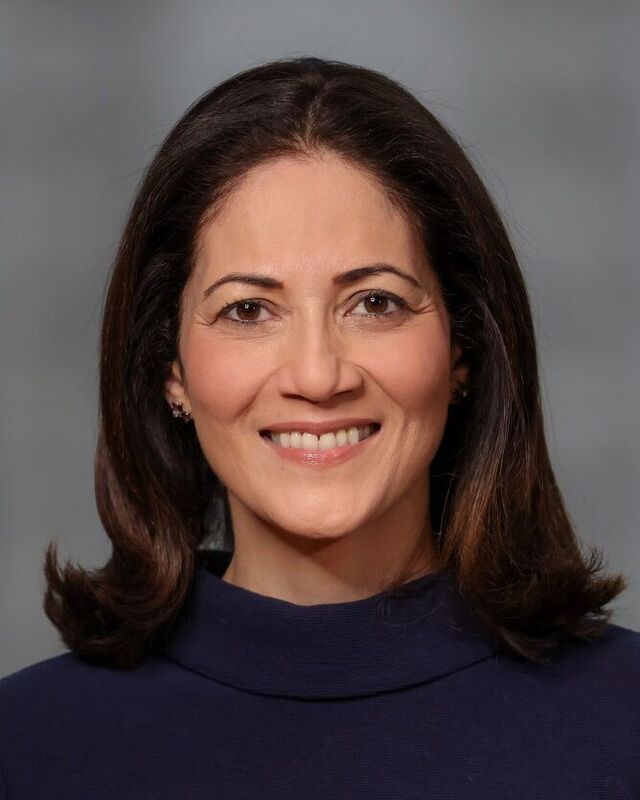
Mishal Husain is Editor at Large for Bloomberg Weekend. She joined Bloomberg from the BBC, where she presented its leading news program Today on BBC Radio 4 for over a decade.