

James Graham: ‘The Right Is So Much Better at Storytelling’
The playwright on bringing Punch to Broadway and the West End, writing about masculinity and politics, and why the left keeps losing the narrative.
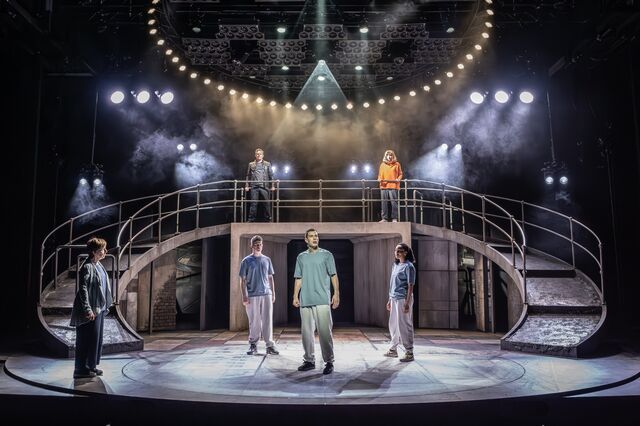
In a single moment, an act of violence ends a man’s life and changes other people forever: his parents, his community and his killer.
James Graham’s new play begins in this way, with a one-punch killing that leads, eventually, to reconciliation and redemption, but also charts how single events can have a wider ripple effect.
That premise has felt especially current in recent weeks. The Sept. 10 assassination of Charlie Kirk continues to be felt through politics, culture and even late-night television. While Jimmy Kimmel returned to the air on Tuesday after controversial remarks that drew the attention of regulators, his suspension was noted in the creative community far beyond the US. Graham called it “horrifying.”
The British playwright and screenwriter has developed a reputation for his highly political body of work, often exploring real-life events and tapping into themes of national identity. Graham’s subjects have included the ascent of Rupert Murdoch, the 1968 US TV debates between William F. Buckley Jr. and Gore Vidal, Brexit, and English football. He’s also known for speaking out on issues that matter to him, including access to the arts and AI scraping original content.
With his latest play Punch opening in both London and New York after strong reviews over the past year, Graham came to Bloomberg to talk about finding stories in unexpected places, narratives of masculinity, and who’s winning on political messaging.
This interview has been edited for length and clarity.
Congratulations on the rare honor of having a play opening on Broadway and in London’s West End in the same period. Few others have managed that. It’s got to be a good feeling.
It’s a good feeling and a bit stressful. You want to earn the right to be able to tell a story across two different cultures at the same time. I’m hoping that the themes connect with British audiences and American audiences in this moment we’re both living through. 1
1 Punch opened in London on Sept. 22 and will do so on Broadway on Sept. 29. Other shows staged simultaneously in both cities include Harry Potter and the Cursed Child and The Curious Incident of the Dog in the Nighttime.
Tell me about the new play. Why does it travel? It’s a very British story, set in your hometown, about the British criminal justice system.
Yes, it’s set in Nottingham, the closest city to where I grew up. It’s a post-industrial town, with lots of reference points American audiences would recognize: people feeling left behind, that they’re victims of globalization, feeling the sense of loss of cultural identity. It’s also about masculinity and justice.
It’s based on a real story, a young man called Jacob Dunne, who grew up in social housing and got involved at a young age in gang culture. His world was drinking and drugs. And his social language was proving yourself through violence. That’s how he got his validation: You go out, you fight, you defend your mates.
And that was your community?
That was my community, yes. I was not that guy. I was more sensitive, artistic, [but] we grew up in the same kind of single-parent family and socially deprived area.
I was totally saved by my love of a specific thing, which was theater and drama. That meant I did not get sucked into that world quite so much. But I felt those pressures of going out with the lads.
Jacob didn’t have something to counter that. One evening his friends got into a fight, he piled in, swung his fist and hit James Hodgkinson, a local paramedic. It was a one-punch killing. [Hodgkinson] died almost instantly when his head hit the ground. 2
2 I’ve followed Graham’s work ever since his first hit play on the London stage, when he was 30. He is still only 43 and his focus on political moments and real people speaks to me as a journalist. In a competitive arena, he has also had a strikingly high hit rate. He works entirely alone, he reveals later in this conversation — no writing partners, not even an assistant.
Jacob served a prison sentence for manslaughter.
A prison sentence of 13 months, which the parents of the victim — David and Joan — understandably did not feel was comparable to the pain and injustice they’d faced. [But] there’s an incredibly moving and unusually positive story to come out of it. It’s redemption and hope, and how people can change. 3
3 After a process of restorative justice, where offenders and victims are brought together through mediation, Hodgkinson’s mother Joan Scourfield and Jacob Dunne have worked together to raise awareness about the dangers of violence, including by speaking in schools.
This theme of masculinity – it’s such an important debate right now, what it means to be a man in the 21st century. Adolescence portrayed it in one way. You also did it in your play Dear England, about the England football team and its then-manager, Gareth Southgate. What is the story you are trying to tell about contemporary masculinity?
I think I’m trying to ask the questions, rather than presume for a second to answer [them] in dialogue with my own masculinity.
Growing up in a socially conservative mining community, there was a traditional sense of masculinity, often about strength, and British cultural reference points [like] “stiff upper lip” and “keep calm and carry on.” This is changing. Young men are more familiar [with] and less resistant to the idea of what vulnerability is, what sharing is – reaching out to your friends and being in dialogue with your own thoughts.
But now there are pressures, particularly online. We all know the Andrew Tates of this world, who are deliberately trying to reverse the progress made in that area. And you referenced Dear England, the Gareth Southgate play – he arrived in a culture of English male sport, where despite these guys being millionaires, successful, popular, he recognized that they were struggling. They didn’t know how to be a team.
That England team was young and diverse. He was their role model.
Absolutely. So rather than just focusing on tactics and performance, he knew that the culture, the environment had to change. 4
4 England hasn’t won a major men’s tournament since 1966. Ahead of the European Championship in 2021, Southgate published an open letter — “Dear England” — that openly linked the team’s identity to debates over patriotism, nationalism and race. “It’s clear to me that we are heading for a much more tolerant and understanding society, and I know our lads will be a big part of that,” he wrote. “It might not feel like it at times, but it’s true… I am confident that young kids today will grow up baffled by old attitudes and ways of thinking.”
There’s a moment in Dear England where Southgate displays the St. George’s Cross — the English national flag — to the players and says, “What is this? Let’s uncomplicate it. What do you think of as the place you come from?” Was that your attempt to reclaim the flag?
Yes. A more inclusive, positive version.
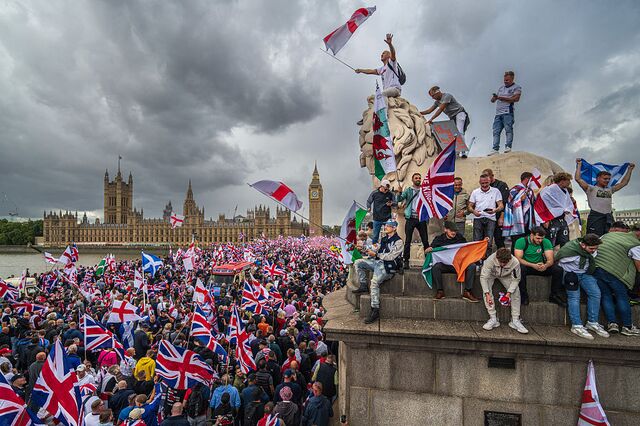
Is that challenged by the present moment? I’m thinking of the recent Unite the Kingdom march in London, led by far-right activist Tommy Robinson and attended by more than 100,000 people.
I think it reinforces and reconfirms [Southgate’s] theory. He realized these young men had a really clear understanding of what their football club identity was — Chelsea, Manchester United, Manchester City — [but] they had no idea what it was to be England.
I think the people who marched in that way are asking that same question. The darker forces and the bad actors involved in this are weaponizing that anxiety, that search for a sense of belonging and identity.
People want to be positive about their community and their country.
Tell me more about the craft of a playwright. When you know it’s your words that lead to a collective moment, drawing people’s emotions in one direction through the power of what you put on the page.
It’s extraordinary. It’s the best thing about live theater.
I’m really evangelical and sentimental about it, this ancient medium — 2,000 years old — [and] that collective experience. You have to be together in a space for it to work and you feel it when 1,000 people get together and lean forward in the story.

Get the Bloomberg Weekend newsletter.
Big ideas and open questions in the fascinating places where finance, life and culture meet.
By continuing, I agree to the Privacy Policy and Terms of Service.
Can we go back to how all of this began, to you growing up in a left-behind place? I imagine lots of boys you went to school with are probably living very different lives from you.
Yeah. They have kids, driveways and pensions, and I have none of those things. But yes, also the professions they went into, possibly their politics, their frames of reference. 5
5 Nottingham, part of the East Midlands region of England, has historically supported the left-wing Labour Party. But a majority of voters opted to leave the European Union in 2016 (Graham voted to remain), and many switched their allegiance to Boris Johnson’s Conservatives in 2019. Earlier this year, Nigel Farage’s Reform UK gained power in local government in the area for the first time.
You found theater how exactly?
I had a drama teacher that really cared — Mr. Humphrey.
Are you still in touch with him?
Absolutely. I named a character after him in my first film and we work a lot on the shared mission of how you get working-class lads to care about theater.
How old were you when he came into your life?
I would have been 12.
And what did he say? Was it about performing rather than writing?
There was a philosophy in the school that empowered young lads to imagine being creative and artful and imaginative. He got the captain of the football team to play Romeo, and got the lads to come and watch him.
Those school plays were really important moments for our community. And I just got the buzz. Some of it was the validation you get when people are laughing and clapping. I was really shy and I was able to be less tight and insecure, playing parts.
And was there credibility and confidence that came from being good at drama?
Sure, showing off. If you just do it confidently and unapologetically — I started to recognize the power of that.
I wonder if you ever have the sliding doors moment. Do you think, If I hadn’t had Mr. Humphrey, what would my life be now?
Without a doubt. Had he not gone to that school; had I not had parents that read to me and encouraged me; had I not had the mate who nudged me into the audition. You think of all the permutations that would’ve meant not getting to write these national stories.
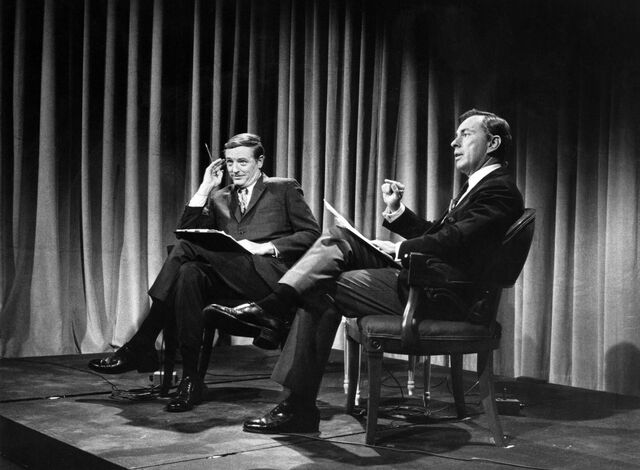
I want to explore how you’ve written about political discourse on both sides of the Atlantic. You put Best of Enemies, originally a documentary film, onto the stage. It’s about America in 1968 — an incredibly turbulent and violent year — and the debates between Gore Vidal and William Buckley. Why did it speak to you?
There are always two things you look for. I try to identify within any story a particular throbbing anxiety that we have currently, socially. With Best of Enemies, that would’ve been the anxiety we all currently share about discourse, dialogue, how we’re speaking to each other, conversation. I feel like the conversations that our political leaders have now are not as substantive or as nuanced or as complex as they used to be. 6
6 In the summer of 1968, ABC — then the smallest of the three US TV networks — decided to air debates during the Republican and Democratic National Conventions, marking a new genre of televised politics. Conservative William F. Buckley Jr. and liberal intellectual Gore Vidal traded blows: Vidal accused Buckley of being a “crypto-Nazi” and Buckley called Gore “queer” and threatened to punch him.
Do you mean in the US as well as the UK?
In the US, absolutely.
Everything you’re describing is more acute today than it was when you made Best of Enemies. We’ve just had a political assassination; 1968 was a year of political assassinations. We’ve just had Jimmy Kimmel taken off air by a major network. 7
7 Graham and I spoke on Sept. 22, five days after Kimmel was suspended by ABC, whose parent company is Disney. A few hours after our conversation, ABC announced Kimmel would return to the air on Sept. 23, though two of the network’s largest station groups declined to carry his show. “It was never my intention to make light of the death of a young man,” Kimmel said on his first night back. But he defended his right to speak freely, saying Trump “tried his best to cancel me: Instead he forced millions of people to watch this show. That backfired bigly.”
That’s really horrifying. It’s easy to dismiss that as a bit of celebrity entertainment news, but obviously the idea that an administration, a government, can censor and remove dissenting voices — particularly comedians, people who are trying to use humor to make you laugh and simultaneously still dominate the space around free speech.
The hypocrisy of that is obviously frustrating, but the democratic threat — I can’t believe more is not being done in my theater community about this. The idea that the US president has taken over the Kennedy Center in Washington and is programming the arts. If you can imagine for a second the idea that a future Prime Minister Nigel Farage would take over the National Theater in London, and take work off that stage — what would our reaction to that be as a society? 8
8 In our Weekend Interview with Shonda Rhimes, she told us about her resignation from her position as treasurer of the Kennedy Center board. Once Trump became chairman, “I was the only person left who was an artist, who was of the old regime,” she said. “I can stand there and shake my fist, but if the entire mission of an organization has changed, you are no longer useful to the organization.”
Why do you think your theater community is not saying more? Have you asked?
I think part of it is the success of Trump — the tactics of being so relentless, so disorientating, that you never know from one day to the next what the battleground is going to be.
So people are afraid?
I don’t think it’s cowardice; I don’t think it’s self-preservation. I think there’s a moment where people literally don’t know how to fight it. What would be the successful way to challenge this?
There may be some wishful thinking and hoping this is just a moment, that it will unwind. People will eventually wake up and see, as it gets worse and worse and worse. Even MAGA supporters go: You can’t be canceling TV hosts and TV shows. And yet, every week, nothing changes and we’re on that path.
I wonder if there is, from a creativity point of view, something which is more insidious — the self-limiting and the self-censorship, choosing not to push the creative boundaries.
Yeah, that’s really important. For all of the perception that theater is a liberal, progressive, ‘woke’ arena of our national life, it’s got a great history of outrageous, offensive plays. It is really important to test those boundaries on a political and a spiritual level.
I’m aware that I probably have a reputation for being incredibly balanced. Ten years ago that was seen as a virtue and something to be celebrated. But I’ve sensed a shift, post-Brexit specifically, that my own progressive side thinks it’s dangerous to tread a path that humanizes, for example, Dominic Cummings or Rupert Murdoch — where you give them a prosecution and a defense. I think there is a nervousness that there wasn’t a decade ago. 9
9 Graham has written a play about the rise of News Corp. founder Rupert Murdoch (Ink, 2017) and a TV drama about political strategist Dominic Cummings (Brexit: The Uncivil War, 2019). Cummings arguably delivered the vote to leave the EU through his slogan “Take Back Control,” alongside a controversial focus on the amount of money the UK paid into the EU budget.
I imagine you’re not a Fox News viewer, but your portrait of Rupert Murdoch was relatively sympathetic. Would you portray him in the same way today, knowing the impact he’s had on American politics?
We’re about to find out, because I’m doing a movie version, with Danny Boyle directing. We start filming in a few weeks, and we’re in dialogue about that. What is our responsibility, knowing this film will come out with Trump as president?
The exercise that you go on as a playwright is asking questions of your character’s motivation. And I can apply that to Rupert Murdoch as much as I can to someone who’s on my side of the spectrum. I want to know what he thinks he’s doing.
Would you write about Nigel Farage?
He did feature briefly in my Brexit film as a slightly comic turn. I didn’t know he was going to become the force he still is.
Would you put him front and center in a play? That’s really what I’m asking.
That would feel really provocative.
Is it because you don’t want to be even-handed to Nigel Farage?
What I would love to explore is the mood he’s unleashed, the feelings that connect to him from people in my community, who I have a huge amount of empathy for. Those voters are more aligned to a social democratic tradition that includes collectivism and investment, and not everything being about profit. So I’m amazed at the success of the narrative that the populists have sold my communities.
So why hasn’t the left had a better narrative? Is it possible that the right is better at storytelling?
They’re so much better. It’s really frustrating.
Would you write one for your side?
But then, how do I stay an anti-establishment playwright? Because one day I’m going to want to hold Keir [Starmer] to account. I’m going to write a play about him, a play about this moment, and I have to have that distance.
Is it because the right is more willing to boil it down into something simple? “Make America Great Again.” “Take Back Control.”

I think “Take Back Control” is a genius piece of writing. One day we should frame it and put it in a museum. It’s how three simple words can act as a proxy for all of the despair that people were feeling at that time. It’s really quite remarkable.
It will soon be 10 years after the Brexit vote. Is it still playing out?
I think Brexit became a vessel to unleash forces that had been long rumbling and were desperate to come out. What I find epic as a playwright — and it’s kind of beautiful in its tragedy — is the idea that those who launched that referendum campaign thought they were asking one question, and the nation answered another.
What was answered was something way bigger and more profound about something that had been rumbling in our national psyche for decades. And the same forces unleashed Trump.
Do you think that this might be a trajectory in which we become — on both sides of the Atlantic — ever more splintered? That the idea of a national story and a unifying narrative is not going to happen anymore?
It’s definitely harder to happen because we simply don’t see our country through a shared frame. That’s what was extraordinary about Best of Enemies — everyone was tuning into those debates. Millions of people watching the same thing. And now we all have our different frames through which we see the world.
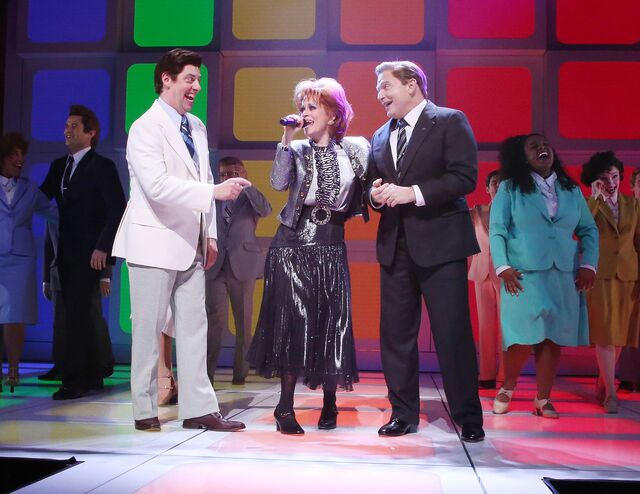
I do want to talk to you about creativity and business. You didn’t have an easy time on Broadway last year, when your musical with Elton John — about Tammy Faye Bakker — had to close almost as soon as it opened. What was the impact on you?
It was a real blow. You do feel slightly humiliated. I go back to that little boy who wanted to impress his friends at school. You want people to think you’re good at something and I’ve had a pretty fortuitous run. And then on a huge public stage, you’re told it's not good enough.
It’s the thing you feared, and it happens.
It was emotionally difficult, psychologically difficult. There are practical things — I was really annoyed I’d spent five months of my life working on something that I hoped was going to have a life, make people happy on Broadway for two, three, four years. Within about two and a half weeks we closed.
There were so many reasons — the wrong story, the wrong time, the wrong place. But one is an economic model that feels almost unsustainable.
Where the costs of putting something on are so enormous that it’s got to do fantastically well?
Even if it does fantastically well, the model is unsustainable. The investors who lose money then lose confidence in taking a risk, particularly on new work. If you look around the West End and Broadway at the moment, musicals tend to come from IP — 1990s movies, or books, something that the audience already knows.
Why are we leaning so heavily on nostalgia, more likely to watch the same thing we’ve already watched on Netflix than trust a new story? I worry about future audiences.
We are more lucky in the UK that we have an entire public subsidized sector — the arts get to take risks and to fail. That culture exists a lot less on Broadway. 10
10 Bloomberg has highlighted just how hard it is for shows to recoup their initial investment, as labor costs – pushed up by strong union protections – combine with theater rental, set materials, production budgets and marketing expenses. Even the most popular and award-winning shows are unlikely to make money these days, unless a big-name star pushes tickets as high as $900 dollars each.
I do want to dig into the “wrong story” part of what you said, because Tammy Faye did well in London. Did it fail in New York because Americans know about Christian evangelism on television and therefore it’s not new, or it’s too close to home?
Without a doubt. I do think there was a novelty element to opening a show about televangelism in London because that world — the big hair, the eyelashes, the fainting — it’s so huge, so American. Church, but with sequins; and there’s a bit of camp there.
In New York, we opened days after Trump had won, and were telling — with humor and a lightness of touch — the story of how the Christian right in the 1980s absorbed themselves into the Reagan administration. I think American audiences decided it was the wrong time in the wrong place, and you have to respect that.
You have spoken out about AI, because your work has been scraped without your permission. There was a recent settlement of a case brought against Anthropic. I wonder if you think that the tide might be turning along the lines you wanted?
I actually do, and in a weird way the AI companies are slightly ahead of our lawmakers. Sam Altman, the godfather of AI, has spoken publicly that it’s not going to be a sustainable model in the long term to not give credit or finance the people, the work that you are using.
To me it’s not just about the money. Recently Audible began using AI actors to read stories. I have a personal animosity about that because friends lost their jobs. Why do we listen to these stories? If you are listening to a real person translate the words, using their own pain, it might not be perfect — it might not be the most efficient book ever — but you know you’re receiving someone’s lived experience.
Can you imagine a future where code has written that story, and it’s a robot reading it? That’s not going to make you feel connected.
Do you worry that this is exactly the future we’re heading towards?
If we don’t intervene, yes. There’s just a natural order that means [we’re always asking], How do you make things more efficient? And in some areas that’s going to be amazing. But I don’t want my art to be efficient. I want it to be messy, and bad sometimes. It’s humanity. You’re seeing it expressed through all of our strengths and all of our flaws.
Since this is the Weekend Interview, what are your weekends like?
Unhelpfully for this question, I don’t recognize them. I work seven days a week.
Even with all your success? I find that slightly sad.
I’m really sad about it.
I know you’ve got a great work ethic, but everyone needs to decompress.
But it’s also a work problem. I have a history of work addiction, an obsessive need to say yes to things, and then continue pushing myself in the work once I’ve said yes.
Is it because of your background?
That’s a huge part of it. My mum worked three jobs in warehouses, and she worked at the weekend. It’s also a sense of responsibility, that I know how lucky I am to be doing this.
My friends keep saying, Just get an assistant. And I’m like, It’s not getting lunch in my diary that’s the problem. It’s making the work, and I’m the only one who can do that.
The problem is I really enjoy it. I think a lot about addiction. Mine makes me really happy. And also you get rewarded for it. So it’s a cycle where the worse you get, the more people celebrate you.
I wonder if there is something about the nature of your work? If you’re living with characters and you’re developing characters, how do you close the door on that?
It’s not like cooking. You know when your bread is baked and risen. It’s really hard to know when a story is done, when a scene is done — you just keep going.
What are you writing at the moment?
I’m beginning work on a play I’ve been trying to finish for ages about John Major and the Maastricht rebels. I’m trying to crack that. 11
11 In 1993, British Prime Minister John Major faced a long struggle with rebel MPs from his own Conservative party over whether there should be deeper integration with the EU. The recently negotiated Maastricht Treaty was a flashpoint, and while Major eventually won a series of high-stakes parliamentary votes, his authority was badly damaged. Several rebels played an active role in Brexit 23 years later.
Is there a dream weekend?
The dream weekend would be having an amazingly satisfying Saturday morning of writing, where you both complete the work but also you feel good in your soul. One o’clock comes around, you close your computer, go and see some friends for a pint in a pub. That second half hasn’t happened very often yet — but that would be wonderful, to be fulfilled by your work and then to leave it behind.
(Updates with critical reception of Punch. An earlier update corrected the last name of David Hodgkinson’s mother in third annotation.)

Mishal Husain is Editor at Large for Bloomberg Weekend.