Businessweek The Brutal Economics of Reaching Net Zero
Ramping down global emissions is achievable in terms of cost. But until the US and other rich countries assume a war footing, we don’t stand a chance of meeting critical climate goals.
Last year, at the 28th annual United Nations Climate Change Conference, almost 200 countries pledged to help reach “net zero”—the point at which human civilization no longer emits greenhouse gases or else removes from the atmosphere the small amount we still do—by 2050. More than half the world’s largest corporations have made comparable commitments. If we pull it off, we might limit the planet’s heating to not much more than 1.5C, which would already be costly and damaging.
The necessity of reaching net zero has been extraordinarily difficult for humankind to accept. It was only during last year’s UN meeting that world leaders acknowledged for the first time in writing that a livable Earth requires “transitioning away from fossil fuels.” Now we face a second mental leap that’s just as hard: accepting the staggering scale and urgency of the net-zero transition. Only then will there be any chance of achieving it.
The timeline to hit net zero is agonizingly brief—just 26 years. The International Energy Agency produces detailed transition scenarios, tracking more than 550 clean-energy technologies and 400 milestones we’ll need to reach along the way. The list of fields requiring revolutionary progress includes energy efficiency, wind power, solar infrastructure, energy storage and many, many more. In only a small handful of these areas are we currently moving in the right direction at the necessary speed.
There are many potential paths to net zero, but none is remotely easy. Beyond the technological challenges, the transition involves staggering amounts of money. Estimates vary: In 2022 the global consulting firm McKinsey & Co. found that businesses, governments and households worldwide need to put forward a total of $275 trillion between now and 2050, peaking in the near term at 8.8% of global gross domestic product. (For comparison, the Biden administration’s Inflation Reduction Act—widely considered to be America’s most important climate action policy to date—is expected to generate climate and energy spending that, even if it were all carried out in a single year, would only amount to an estimated 2% to 4.5% of US GDP.) A new report from the BloombergNEF research group pegs the price of achieving net zero lower than McKinsey did, though still at a mind-boggling $215 trillion.
It’s important to recognize, however, that this enormous expenditure is not simply a cost. It’s an extraordinary investment in a new energy system, heralding profitable industries, a surplus of jobs and lower energy costs for consumers from goods like EVs and heat pumps. Also, about two-thirds of the coming trillions in spending can be redirected from the decline and fall of the fossil fuel system, by McKinsey’s accounting. Still, the needed injection of new money amounts to $3.5 trillion per year on average, roughly equivalent to half of all corporate profits worldwide, say, or a quarter of all tax revenue.
Yet wealthy societies have achieved projects of comparably massive ambition before. Net-zero 2050 might be improbable, but in sheer economic terms, it’s possible. In this, there’s something resembling hope.
To get a sense of the challenge, we might look at a few of the targets the IEA says we need to hit by 2030—a year as near in the future as Harry and Meghan’s wedding is in the past—to be realistically on our way to achieving net zero by the middle of the century.
Even these numbers leave out important expenses. By 2030 the world’s countries should also spend an estimated $1.1 trillion yearly to prepare infrastructure, agriculture and water systems for a hotter planet, according to the Global Center on Adaptation. Climate disaster costs were recently pegged at $143 billion annually in a study published by Nature Communications, while warming’s drag on the global economy through lower crop yields, damaged infrastructure and other effects could reach $38 trillion each year by 2050 even if we hit net zero. Still, the costs here may be at least partially offset by investment: By the coldly neutral accounting of GDP growth, even cleaning up after extreme storms generates positive economic activity.
Taken together, these targets seem nearly impossible to meet and demand nearly incomprehensible sums of money. It’s enough that McKinsey suggests the scale of the fiscal challenge may test the limits of classical capitalism. “The prevailing notion of enlightened self-interest alone is unlikely to be sufficient to help achieve net zero,” its report says.
That doesn’t mean we’ve never spent like this before. America’s 1960s “moon shot” and the Manhattan Project that produced the first atomic bomb have often been raised as inspirations for the fight against climate change. But Daniel Gross, an economist at Duke University’s Fuqua School of Business who’s weighed historical comparators, says these are too narrow in scope.
Gross sees a more useful analogy in the broader program that produced the Manhattan Project: the US Office of Scientific Research and Development. The body that became the OSRD was convened in 1940 to apply scientific research to the military problems of World War II. In less than five years, OSRD work led to breakthroughs across technologies including computing, jet propulsion, optics, chemistry and nuclear fission. It had a medical division, too, which fostered vaccine development, the mass production of penicillin and more. The OSRD amounted to “many moon shots, pursued all at once,” Gross says.
One highlight was the development of radar. When the war broke out, Germany swiftly established air supremacy, and Allied forces desperately needed a way to see flying objects at long distance or when obscured by darkness or clouds. Within three months of the OSRD funding a research lab at the Massachusetts Institute of Technology, it was testing radar sets on rooftops. The technology changed the course of the war, making victory a possibility; it led to Allied successes in night fighting and proved decisive against German U-boats in the Battle of the Atlantic. When, in 1946, MIT reported on the first five years of its “Rad Lab,” it said the technology had advanced by 25 years compared with the conventional pace of scientific development.
According to Gross, these leaps are comparable to the ones needed to rapidly scale up climate technologies from the experimental to the everyday. The IEA estimates that 35% of emissions reductions to reach net zero must come from technologies that are currently in early stages of development. These World War II-era accomplishments make such daunting targets seem somewhat less fantastical.
There are obvious differences between meeting the climate challenge and reaching those earlier monumental goals. The race to net-zero 2050 is a quarter-century marathon, while the OSRD was a “scientific sprint,” Gross says, lasting only as long as the conflict. That said, World War II was followed by the decades-long Cold War. In the hottest years of that confrontation, from 1954 to 1969, US defense spending averaged over 10% of GDP annually, far more than in periods of relative peace, while the UK and France came in at around 7% each. By that standard, the ongoing cost of the energy transition could be described, appropriately enough, as a protracted Cool War fought by a global alliance. “If we could manage the Cold War and still have a prosperous West, we can tackle climate change and still have a prosperous West,” says Mark Harrison, a British economic historian of defense and security.
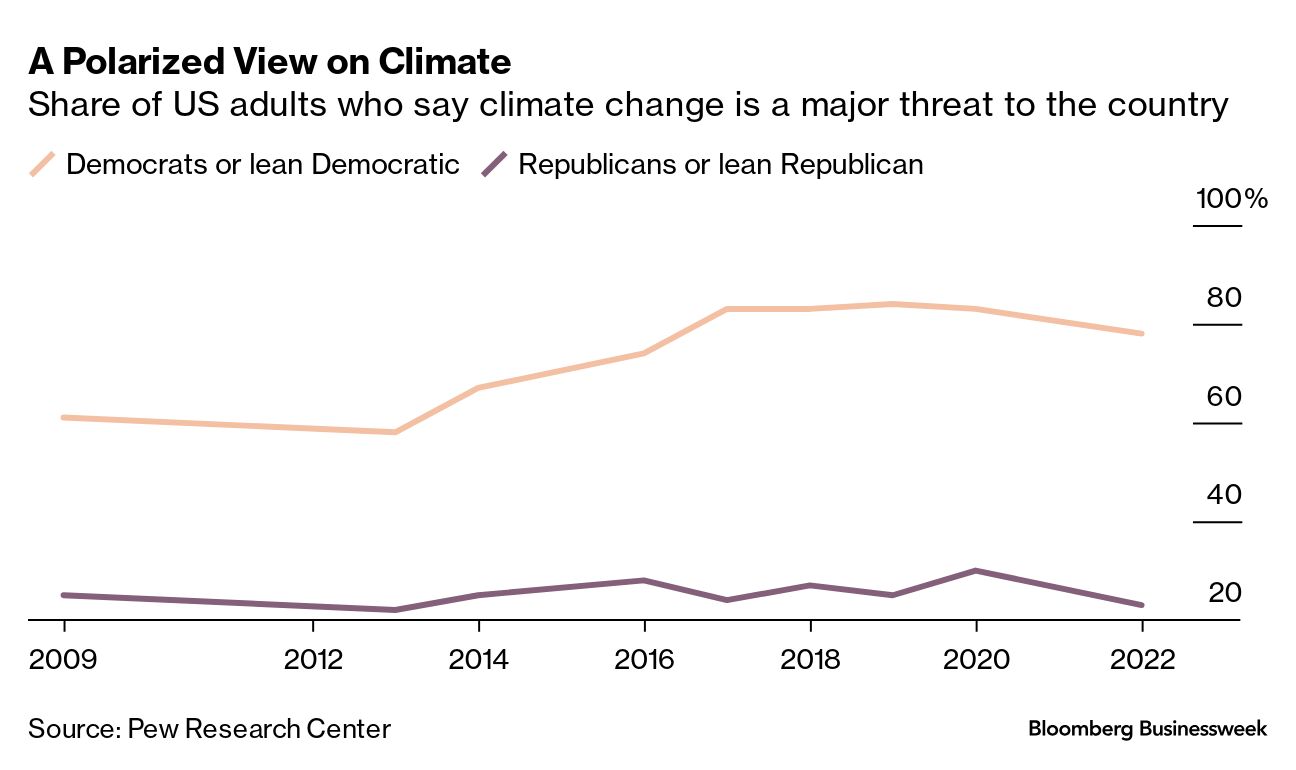
But if economics offers unexpected hope for the energy transition, it’s also only a starting point. The question of how quickly to act on climate change, or even whether we need to, has proved politically polarizing rather than unifying. And while warming’s effects are increasingly visible, its future risks remain abstract. Unlike in an actual war, our loved ones aren’t fighting and dying for the cause; we don’t see imperial domination as the price of failure. “There’s urgency to the choices,” Gross says of the climate crisis, “but not urgency to the consequences.”
A Polarized View on Climate
Share of US adults who say climate change is a major threat to the country
How urgent are those choices? One answer can be seen in the 2023 update to the IEA’s net-zero road map, which was first published in 2021. The agency felt compelled in the latest version to add a “delayed action” scenario where we still reach the goal, but in 2065 instead of 2050. Moving more slowly now, the report says, would require the breakthroughs anticipated in the 2030s and ’40s to be even more extreme, and the breakup with fossil fuels to be more sharply disruptive and expensive. The planet would reach at least 1.7C of warming. Getting back to the relative safety of 1.5C would be impossible without pulling astronomical quantities of carbon out of the atmosphere over a half-century using unproven technologies. Every extra year of delay would cost an additional $1.3 trillion.
We’d also face risks beyond control. The more we warm Earth, the greater the likelihood we trigger tipping points from which there’s no going back. Consequences before the century’s end could range from the extinction of more than 20,000 known species, to the exposure of a billion people to flooding from rising seas, to simultaneous crop failures around the world. Worst of all, we could set off cascading shifts to even higher temperatures, with more catastrophic results. Whenever we hit net zero, the global environment will begin to find balance at the new temperature we’ve reached. A few fractions of a degree could decide whether that’s still a planet we recognize as home.