Businessweek

CONE HEADS

Sugar, waffle or cake? At Joy Baking Group’s cone factory in Pennsylvania, ice cream is always put on an edible pedestal.

Ice cream cones may be an afterthought for many scoop lovers, but not for Joy Baking Group. For decades after the company’s 1918 founding in Brookfield, Ohio, its sole product was the cake cone: the flat-bottomed, barely sweet wafer creation trafficked at soda fountains and drive-through windows. Waffle cones—modern Americans’ ice cream vehicle of choice, according to the International Dairy Foods Association—were added, along with sugar cones, to Joy’s lineup in the 1980s, as supermarket sales rose amid a boom in premium ice cream brands. Pints flew off the shelves, and “cones went along for the ride,” says David George, Joy’s president and grandson of Albert George, a Lebanese immigrant who co-founded the business.

Today, thanks to a string of acquisitions, Joy is by far the dominant cone maker in North America. From four facilities in the US and Mexico, it churns out more than 2 billion of them a year for retail sale to grocers, as well as distribution to food giants such as Dairy Queen, Mister Softee and McDonald’s. The employee-owned company also makes waffle bowls, gluten-free cake cups and cones infused with Oreo cookies. Not everything sticks around: Cone flavors like birthday cake and peppermint have come and gone. “Cones are already a niche item, basically, so when you start doing something unique there, it’s a niche of a niche,” George says.

Lately, Joy is edging into another part of the dessert business. In 2018, at its flagship operation in Hermitage, Pennsylvania, the company started making cookie crumble mix-ins (think the graham cracker swirls in s’mores ice cream). That facility, now with limited capacity, is in the midst of a 200,000-square-foot expansion, featuring a cookie production line slated to start running by the first quarter of 2025. Radical? Perhaps. But cone fans can rest easy: The handheld ice cream delivery device remains “the heart of the company,” George says.

PART I:
MAKING THE BATTER
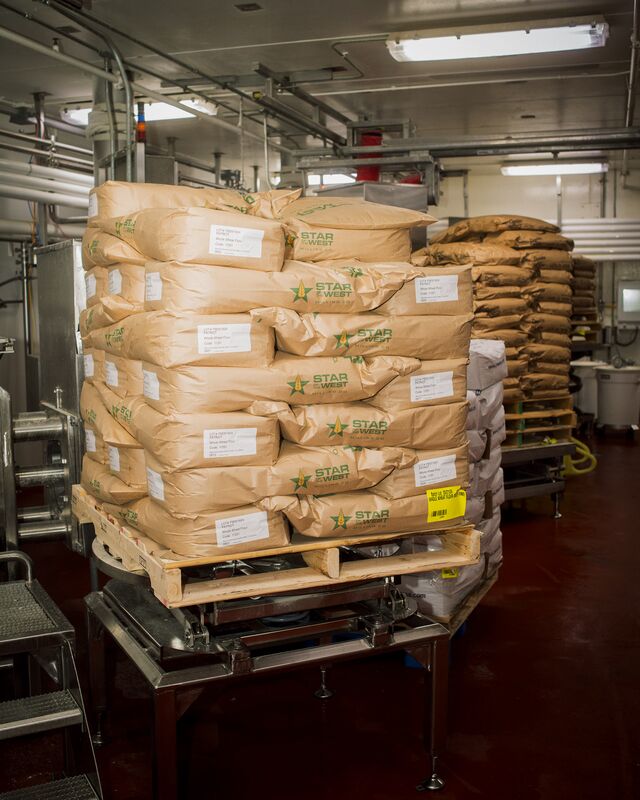
The main ingredient in waffle cones: 100-pound sacks of wheat flour.
The main ingredient in waffle cones: 100-pound sacks of wheat flour. Brown sugar, oil and water round out the mix.
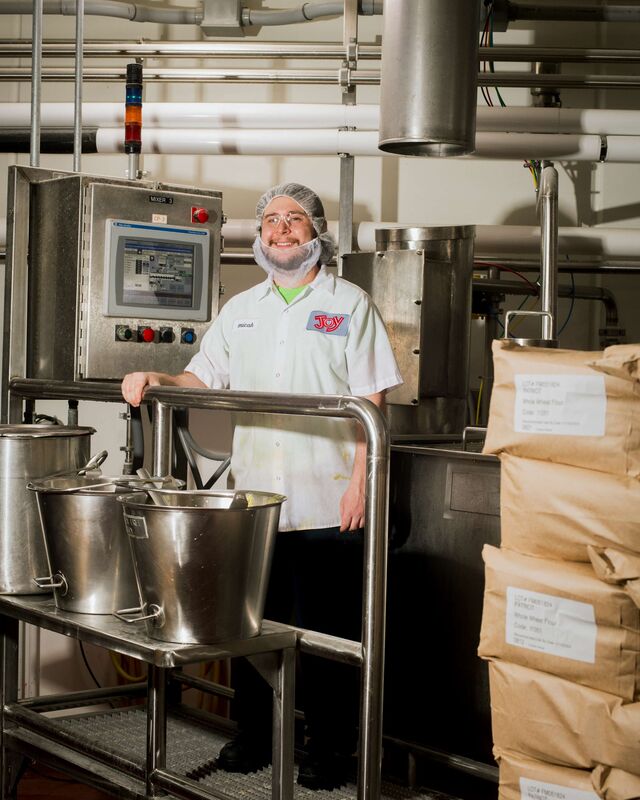
Micah Hoover, a batter attendant at the Hermitage plant, at a waffle cone mixing station.
Micah Hoover, a batter attendant at the Hermitage plant, at a waffle cone mixing station. The sweet, crispy vessels are said to have been popularized at the St. Louis World’s Fair in 1904.

Measuring oil for the batter.


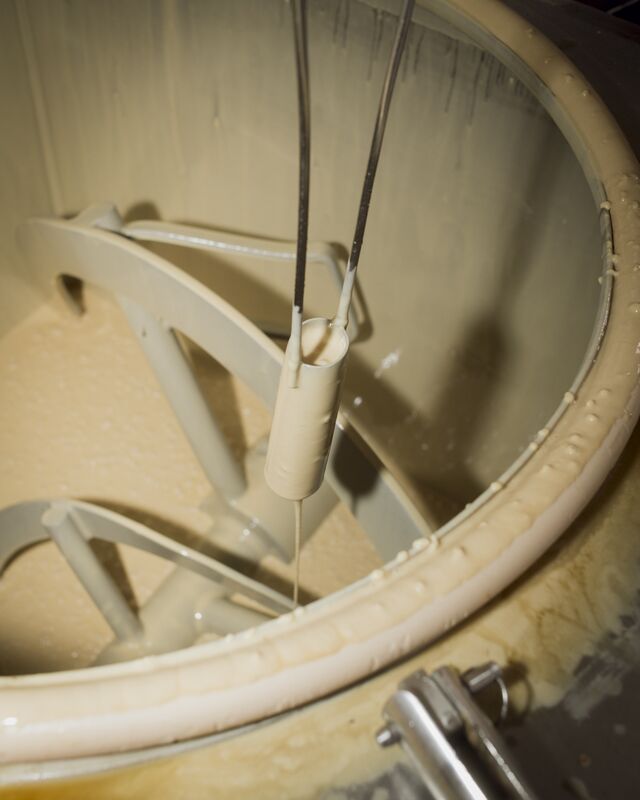
Batter flows into a cooling container before it’s sent through a series of chilled tubes. A single waffle cone production line at the Hermitage plant processes about 50,000 pounds of batter daily.


A device known as a Zahn cup is used to measure the batter’s viscosity.
A device known as a Zahn cup is used to measure the batter’s viscosity. Joy makes its own Zahn cups on-site as well as its own cake cone machinery.
Assistant plant manager Jason Loeblein adjusts a tube that receives cooled batter.

PART II:
SHAPING THE CONES

Precise portions of batter are pumped onto a gridded plate. They will then be pressed and baked for 65 seconds.


Soft, flat patties are then passed ...


… to a cone-rolling machine.


More than 400,000 waffle cones are made daily on this line, one of six waffle cone production lines in Hermitage.


A quality-control check. In addition to color—which should be golden brown, not too dark, not too light—employees also look for issues like a “high top,” where one side of the cone sticks up too much.


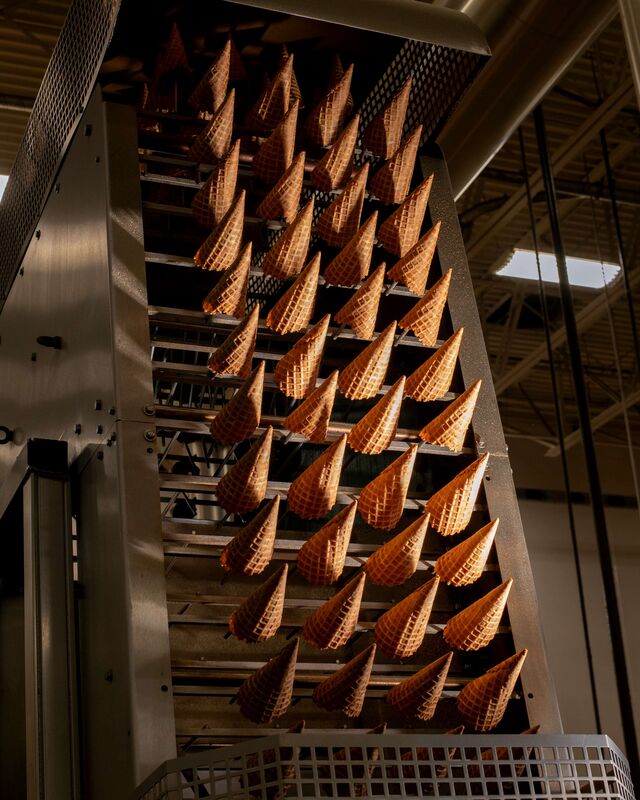
The cones are discharged onto a vertical conveyor belt, becoming cool and crisp within two minutes.

PART III:
PACKING CONES UP

Fresh cones roll off a production belt in bunches of six.


A packer stacks cones into a packaging insert. But it’s not always about work: A couple of times a week, employees at the Hermitage plant are offered soft serve and cake cups in the break room.


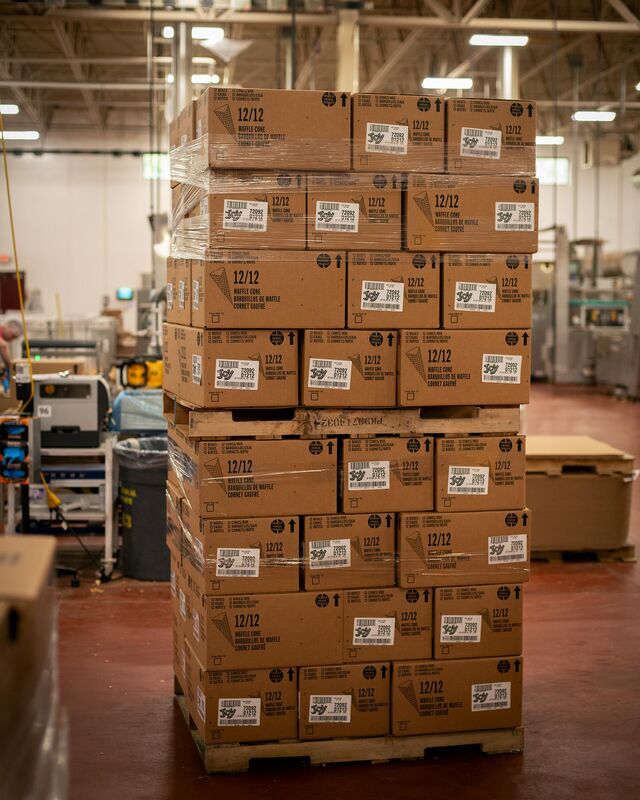
A dozen cones are packed in each box.


Cones are prepared for shipment to grocery stores across the US. Midwestern states are the biggest per capita consumers, George says.


Stacks of packed cones, ready to be shipped.
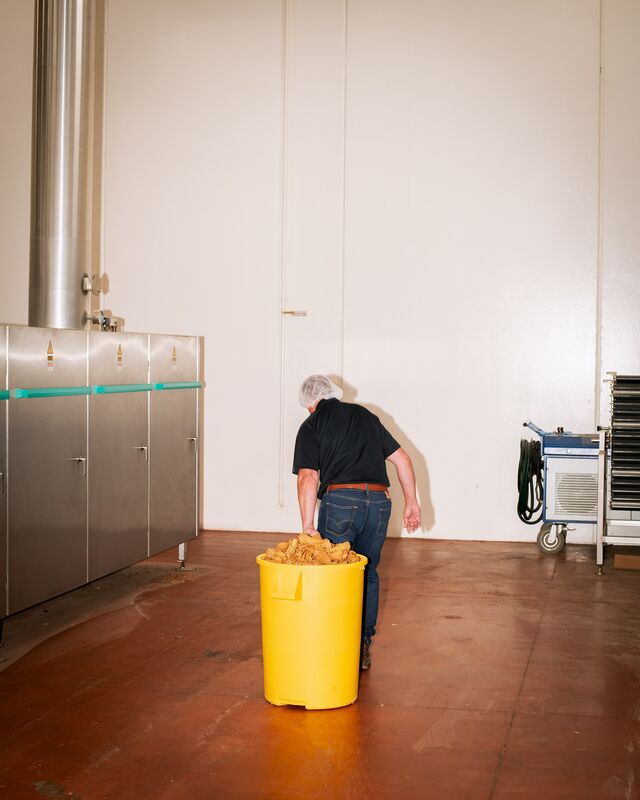
An employee drags a bucket of discarded cone fragments.
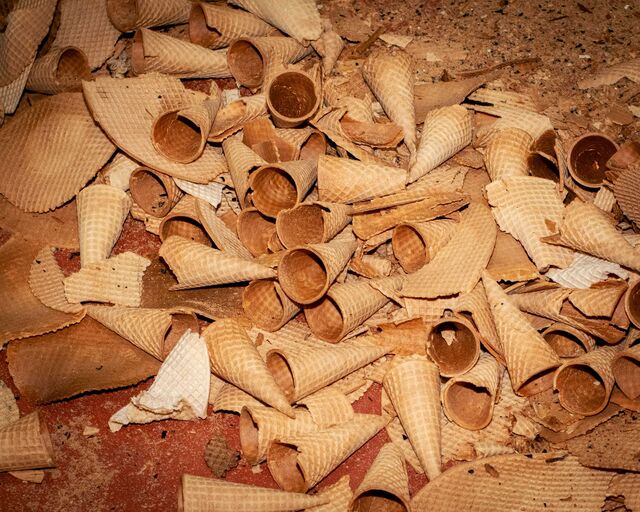
A pile of discarded waffle cones to be sold for use as animal feed.
Because of rigorous quality control, an estimated 1% to 2% of production is discarded and sold for use as animal feed.

More On Bloomberg