UNCOVERED
The Harsh Reality of ‘Hurricane Insurance’
Catastrophe bonds sound like a clever climate solution, but they can leave vulnerable nations out of luck when disaster strikes.
In the hours before Hurricane Milton reached land in Florida last week, a saildrone dispatched into the maelstrom by US government researchers sent back heart-stopping data. Ocean waves driven by supercharged winds had surged to more than 28 feet tall. It was a specter that sent millions of people fleeing for safety.
By this time, as early winds lashed the Gulf Coast, one investor in the $46 billion market for specialized financial instruments designed to pay out in the event of storms like Milton had already ditched a Florida bond for 67 cents on the dollar. It was a clear sign that investors anticipated heavy losses.
Three months earlier, lightning flashed and the wind screamed at 200 miles per hour as Stephen Pituch wrestled a 75-ton propeller plane through another mammoth storm — Hurricane Beryl. Pituch is a hurricane hunter, an elite US Air Force pilot who flies into some of the most violent weather on Earth. His plane fell a stomach-churning thousand feet in the early hours of July 3 as it flew into Beryl over the Caribbean Sea.
“We were getting beat up,” he says. “I thought it didn't bode well for Jamaica.” He was right. Though Beryl only grazed the island’s southern shore, it damaged more than 13,500 homes, shredded hospital roofs and left behind $250 million in losses.
Jamaica’s government had prepared for precisely this scenario. So, too, had the insurers and local governments exposed to the recurring storms that batter Florida. Governments in both places had spent millions of dollars on securities called catastrophe bonds, which act as insurance if disaster strikes, and they were relying on those lifelines to fund recovery efforts.
Floridians will get money in line with actual losses. Estimates available in the first days after Milton made landfall as a Category 3 storm suggest the damage, combined with the impact of Hurricane Helene two weeks earlier, could result in as much as a few hundred million dollars in payouts from catastrophe bonds. It’s too soon to know for sure, but any payouts would go from bond investors to homeowners making claims through insurers, safeguarding the region’s recovery.
A similar arrangement made by Jamaica didn’t help at all. Its government has a catastrophe bond backed by the World Bank that could have yielded a $150 million payout, but it failed to trigger despite Beryl’s brutal toll.
Cat bonds, as they’re known on Wall Street, are a bet on the probability of huge natural disasters. The catastrophe could be a hurricane, earthquake, wildfire or flood. If the calamity doesn’t occur, investors who bought the bond stand to make big returns that could be hard to find elsewhere. If it does, buyers could lose some or all their money.
Of the 300 outstanding bonds in the market, about 70% insure against US storms — and a big chunk of those cover hurricane risk in Florida. Payments are usually made when certain thresholds of real-world losses are met after assessors are deployed on the ground to survey the damage. While it can take months for those payouts to occur, stricken places like Fort Myers, Florida — walloped by both Milton and Helene — can quickly tap emergency state and federal funds while waiting for the money to materialize.
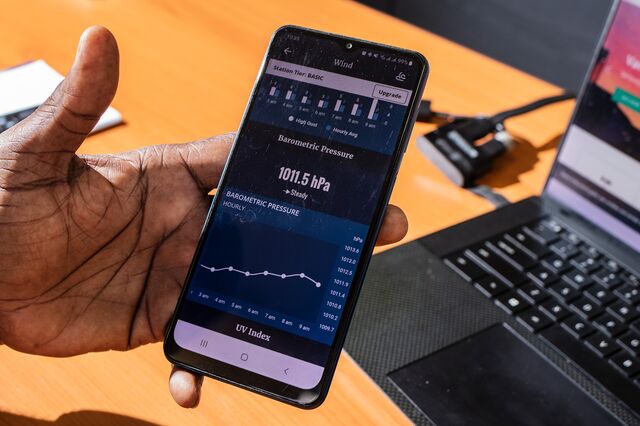
The equivalent bonds used by developing nations are designed differently and can be less forgiving. Jamaica has a small amount of infrastructure covered by insurance and therefore uses an instrument that pays out only if a storm hits a predetermined air pressure reading. Such mechanisms, known as parametric triggers, unlock money very quickly, without waiting for damage assessments. But the setup can also yield harsh results.
Jamaica was unlucky. Beryl missed the trigger laid out in its cat bond by the thinnest of margins — just nine millibars – a discovery made in part thanks to the data captured by Pituch’s plane. US and European investors who bought the bond are set to book returns of about 12% this year. Jamaicans will get nothing.
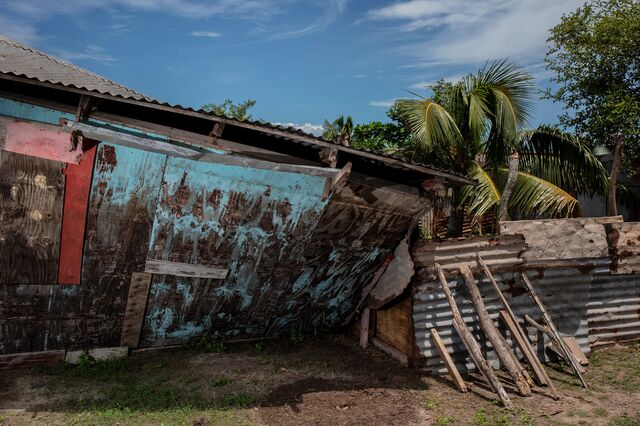
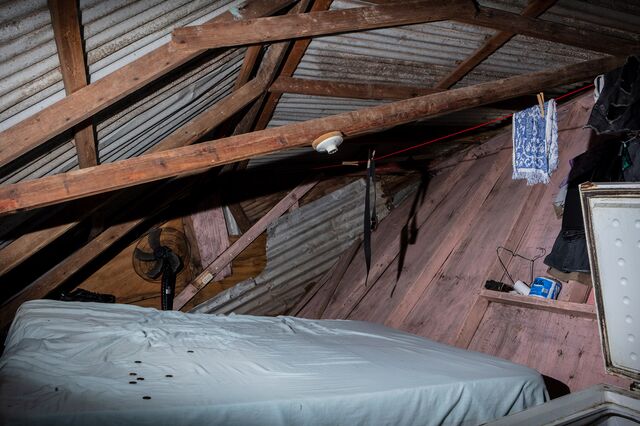
It’s an outcome that locals struggled to grasp on two levels: the complexity of the financial arrangement and the apparent unfairness of the result.
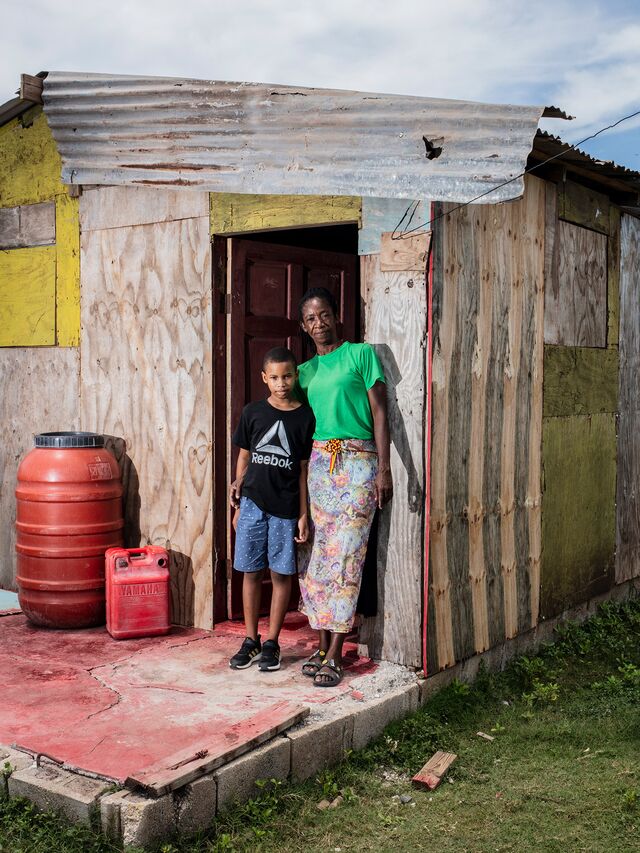
Julett Morgan, a 50-year-old vegetable seller whose wood-and-tin shack collapsed in a hard-hit area called Rocky Point southwest of Kingston, didn’t know about the government’s cat bond. But as she surveyed the damage around her, from ripped roofs to toppled homes, it seemed inconceivable that an insurance policy, of any variety, wouldn’t pay something. “My house was flat, flat, flat,” she says. “The storm took furniture, clothes, everything. I’ve never seen anything like it.”
That sense of injustice puts into doubt a market-driven tool that’s increasingly being pitched as a way to protect vulnerable populations against more extreme weather. Jamaica is among the poorer places where lives are often upended by storms, droughts and fires made more intense by planet-warming carbon emissions the locals didn’t create. The countries made rich by unbridled emissions have faced decades of pressure to offer compensation.
Insurers and governments in the wealthy world tend to dislike the binary nature of parametric cat bonds and mostly stay away from them. Yet the promise of speedy payouts has persuaded the World Bank and Western governments to push them for the developing world, even as the risk-reward curve shifts in favor of investors in London, New York and Zurich.
Mark Golding, a member of Jamaica’s parliament and the leader of the opposition People’s National Party, says he was “gung-ho” about the cat bond when Jamaica first signed up. He now takes a dimmer view. The complex payout clause “was a clever mistake — but a mistake,” he says. “The deck is stacked in a way that you may suffer substantial damage, valued at billions of Jamaican dollars… and we aren’t able to make a claim.”
Cat bonds have recently become a hot trade for some of the world’s most sophisticated finance players. It was the most profitable hedge fund strategy of 2023. And issuance in the next few months is expected to hit a record, potentially bringing the overall market to $50 billion.
Issuers in rich countries can afford the higher premiums demanded by investors to account for greater rebuilding costs, property exposure and climate impacts. It’s a different story for less developed nations, which make up a tiny part of the market and often can’t afford to pay the premiums without aid from donor countries.
The Caribbean is the world’s most exposed region to climate-related natural disasters, according to the International Monetary Fund, requiring more than $100 billion just for adaptation to these dangers, equal to a third of its annual economic output. The World Bank has tried to convince other Caribbean countries to join Jamaica in creating a regional cat bond. Barbados was one of the nations that declined to participate, says Avinash Persaud, a former special envoy to Mia Mottley, the country’s prime minister.
“Climate risks had become uninsurable,” says Persaud, an economist who now advises the president of the Inter-American Development Bank. “Rather than pay cat bond premiums, we’d much prefer to find cheap long-term financing to build resilience, say, a sea wall. For Barbados, that’s the best insurance against climate change.”
The scramble to offer financial lifelines to climate-vulnerable places will come into focus as more than 190 nations gather in November for the COP29 climate summit. For years, diplomats have fought bitterly over the need for developed nations to set aside money to assist poorer countries. That finally led to the creation of what’s known as a loss and damage facility in 2022. But the facility has only collected $700 million so far, a tiny fraction of what’s needed. Damages to developing countries could reach $580 billion in 2030, according to researchers at the Basque Center for Climate Change.
Now, there are discussions about using some of the limited resources for loss and damage to finance insurance programs that could tap Wall Street investors for greater payouts, according to people familiar with the talks. Mukhtar Babayev, the Azerbaijani minister who will preside over the COP29 talks held in Baku this year, says the option is on the table and his finance team is “discussing with all parties any possible efficient mechanism."
Several multinational development organizations have praised cat bonds as an elegant solution. The IMF called them one of “the most prominent innovations” in sustainable finance in 15 years. The Organization for Economic Cooperation and Development has endorsed their use by Asian and Pacific countries.
It’s unclear how such a proposal will be received or how cat bonds specifically will figure into the picture, given the low payout rate for developing countries. The World Bank has issued or arranged 15 weather-related cat bonds for poorer countries since 2009, with the potential to pay out up to $1.6 billion. So far, only three have triggered and delivered a collective $163 million — just 10% of their total insured value.
Persaud, who is involved in the COP29 discussions, cautioned against putting too much faith in complicated financial engineering. “I deeply worry that these illusions of magic are distracting people from doing what they need to,” he says.
The World Bank wants to issue $3.5 billion worth of cat bonds over the next four years, up from the $1.5 billion it has outstanding today. But according to Michael Bennett, who heads the cat bond team, the bank doesn’t expect to ink any new deals in the fourth quarter, usually a busy period for issuance. The Philippines recently declined to renew its bond for typhoons.
Jamaica’s experience has “opened up a discussion about the best tools we should spend scarce money on,” says Sara Jane Ahmed, managing director and finance adviser to the Vulnerable Twenty Group, which represents some of countries most in peril from climate change. “Investors are seeing double-digit returns. There should be a redesign to make the triggers fairer for countries.”
Beryl began its journey innocuously enough on June 22 as a low-pressure atmospheric wave traveling in from the African coast. Storms don’t usually form in the Caribbean until August and September, but record-high ocean temperatures have upended that assumption. On July 2, the National Hurricane Center declared it the earliest Category 5 hurricane on record.
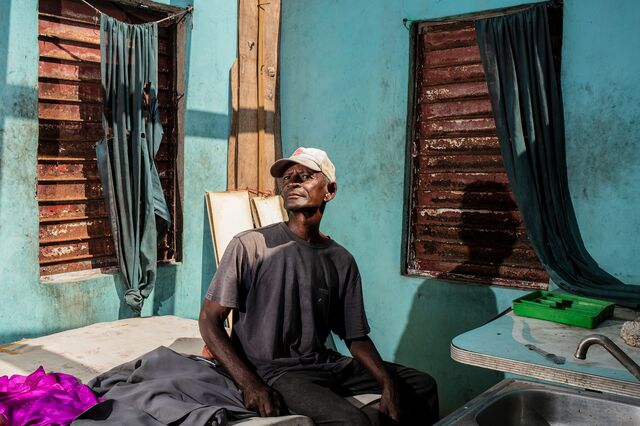
In Rocky Point, the storm tore the roof off the community center and sent water pouring into the waiting room of the local hospital. In this hamlet alone, more than a dozen homes were toppled or severely damaged. Two months later, Walter Vallum, 61, was still picking through the wreckage of his home, trying to salvage what he could. He stowed his national ID, a few Jamaican dollars, cigarettes and some letters in a plastic box underneath a broken bookshelf in hopes of keeping them safe from thieves.
The storm had flung his tin roof into a nearby field. “You could feel the earth vibrate and the wind was terrible,” Vallum says. “Everything flew out. It was the most frightening thing.”
Some 4,500 miles away, in Zurich, analysts at Plenum Investments, a boutique asset manager, were tracking Beryl’s approach toward Jamaica’s coast. The company sent out a brief note to clients warning that a partial payout was likely. As Beryl gradually weakened to a Category 4 storm, Plenum issued a bullish update: “No impact on our cat bond funds expected.”
On Saturday, even as early estimates showed the damage from Milton would be less than feared, Plenum told clients they could expect risk premiums to rise further. Such payments are already historically high for investors willing to roll the dice on cat bonds.
Investors were relieved, but the chips could easily have fallen the other way. Despite their complex design, constructing a cat bond isn’t an exact science.
In Jamaica’s case, the deal was structured by Swiss Re, one of the world’s largest reinsurers, and insurance broker Aon Plc. A key step was dividing the island and its surrounding water into 19 sections. Each was assigned a threshold for air pressure — a commonly used proxy for the strength of a hurricane — that would trigger a payout.
Then the issuers turned to catastrophe risk modelers to quantify the “expected loss,” or the amount investors should expect to lose on the bond in a given year. Typically expressed as a percentage of the issue size, it’s the figure potential investors zero in on. The higher the expected loss, the greater the interest payment they can expect for taking on that risk.
Jamaica’s magic number was determined by Verisk, a risk modeling firm that handles most cat bonds on the market. The Boston firm used computer simulations to model 150,000 synthetic storms to see how the bond would fare if past events were to occur today and what future events might look like. They computed an expected loss of 1.5% for the entire country. The new bond would end up costing Jamaica 60% more per unit of coverage compared to the 2021 bond it replaced, according to a separate calculation by London-based Centre for Disaster Protection.
Jay Guin, chief risk officer of Verisk’s extreme events unit, acknowledges that the risk is open to interpretation. A different company could easily come up with a different estimated loss that would skew the bond’s risk premium. “We could come up with 2%, and I wouldn’t be shocked if someone said 3% and someone else said 1%,” Guin says.
Swiss Re declined to comment. Aon did not respond to a request for comment. “Everything is a trade-off,” says George Richardson, director of capital markets and investments at the World Bank treasury. “If you want a cat bond to pay out more frequently, you’ll have to pay more” in risk premiums.
Relying on a narrow metric as a measure of a storm’s destructive power can also be problematic. It’s a challenge that issuers of Florida’s cat bonds don’t face because their deals are based on the actual impact of Helene and Milton.
A storm may not trigger a cat bond if its worst winds occur offshore yet cause havoc on land, says Robert Muir-Wood, chief research officer of insurance solutions at Moody’s Corp.. Unless modelers are using “the whole footprint of the storm” to make their risk assessments, he says,“they are missing a key parameter.”
Data itself can be another limitation. When Hurricane Odile slammed into Mexico in 2014 and caused about $1.2 billion in damage, the US National Hurricane Center arrived at its official pressure reading by incorporating an observation made by Josh Morgerman, an amateur storm chaser. Without his input, the NHC’s assessment of pressure would have been lower and likely triggered a $50 million payout on the country’s cat bond, according to Muir-Wood. But the government didn’t get a penny.
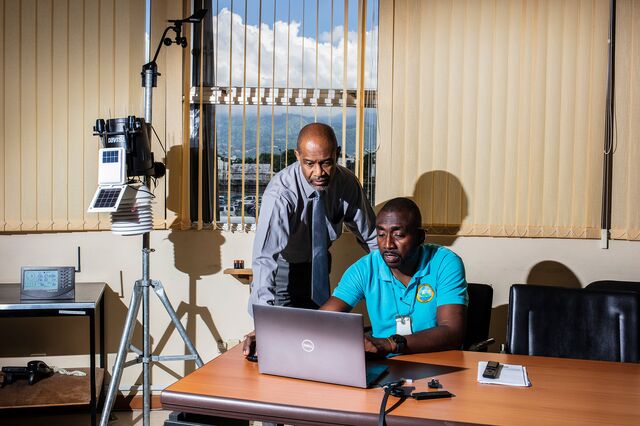
Using unofficial data “introduces new risks,” says Muir-Wood. “And you’re still in a situation in the Caribbean and Mexico where there isn’t a high density of observation stations along the coast.” Jamaica’s Meteorological Service has about 120 remote weather stations spread across the island, according to Evan Thompson, director of the country’s meteorological service. While the country feeds data to NOAA and the NHC, those US agencies ultimately decide the fate of Jamaica’s cat bonds.
Morgerman was unhappy about the role he unwittingly played in denying Mexico a payout. In a 2018 letter to the Los Angeles Times, he said using pressure to represent a storm’s strength was akin to using temperature to calculate fire insurance claims. “Who cares how hot it was?” he wrote. “The house burned down.”
As Beryl approached Jamaica, US Air Force Weather Officer Captain Cristina Pereda sat in the rear of Pituch’s plane, trying to concentrate as the fuselage bucked and hail smashed into the windscreen. “It was like being on a roller coaster in a car wash,” says Pereda. “But that’s when I’m the busiest.”
Pereda took readings on wind speed, temperature, humidity and pressure. The crew also released about 20 devices, known as dropsondes, that beamed back vital weather data as they fell through the storm and eventually hit the sea. The data was instantly relayed by satellite to the NHC headquarters in Miami and fed into a cyclone forecasting system – a piece of software that would decide the outcome of Jamaica’s cat bond. The data indicated that Beryl’s air pressure had just missed the trigger point in one of the grids drawn by Swiss Re and Aon.
Hurricane Beryl Just Missed Jamaica’s Cat Bond Trigger
The storm missed the air pressure threshold in a single grid by 9 millibars
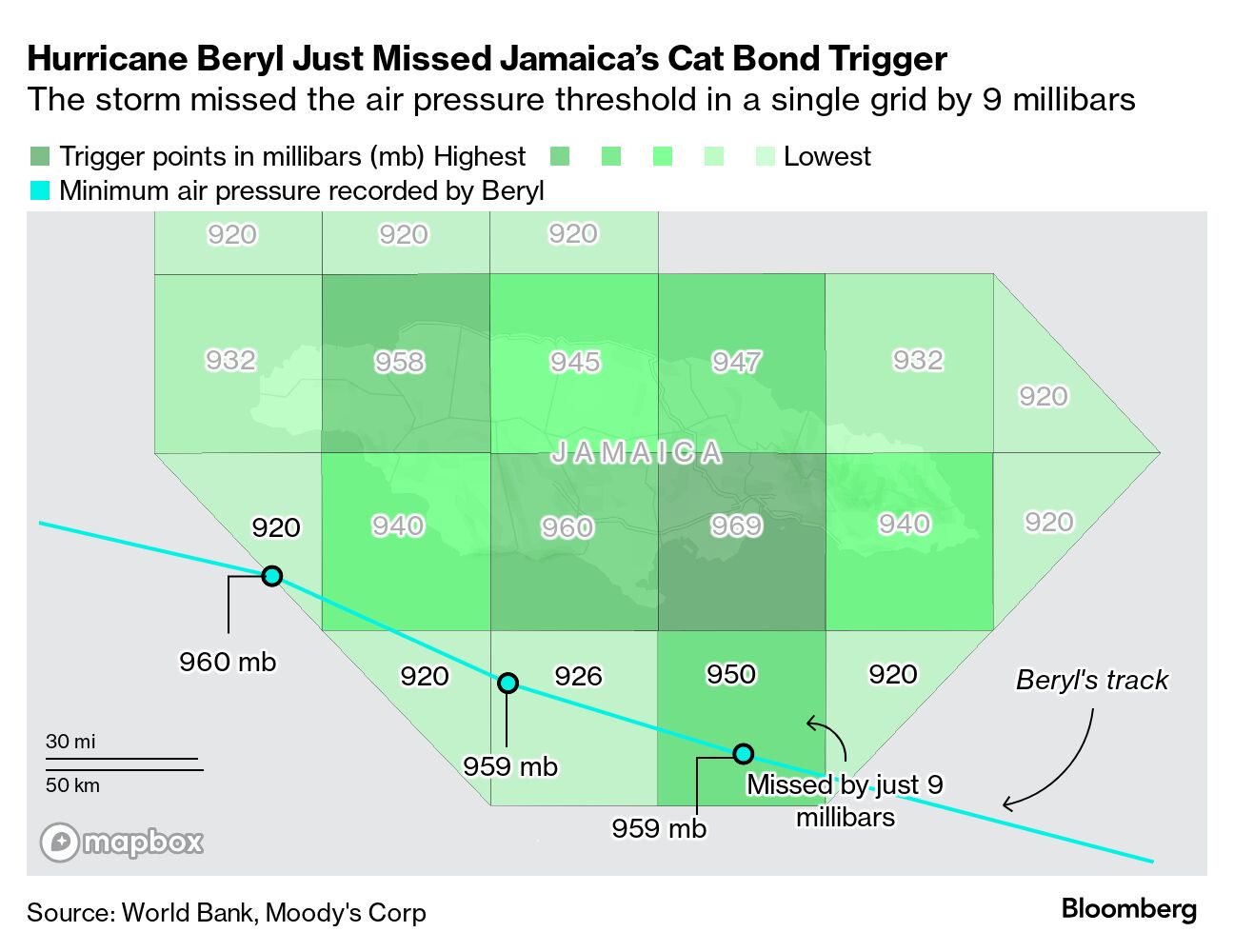
One of the selling points of parametric bonds is that they are straightforward and transparent, says Aubyn Hill, Jamaica’s minister of industry, investment and commerce. Within hours of Beryl passing, it was clear that the cat bond wouldn’t pay out. “The realities on the ground would suggest it would have been triggered,” Hill says. But the rules were clear. It makes sense that underwriters want specificity, he says, “otherwise they will be responding to all kinds of emotional calls, and very often when you have a situation like this, emotions run very high.”
Hill says the government is reassessing all its climate-protection investments to see how they can be fine-tuned to be “more effective and responsive.” While the cat bond’s strict conditions meant it didn’t trigger, more flexibly designed insurance products did. The Jamaican Co-operative Credit Union League took out a policy that protects thousands of the nation’s farmers from crop damage due to extreme weather. It was partially activated by Beryl, with 45% of the total value paid out.
Skyline Partners, which designed the policy, says that's because it uses a more responsive methodology which better reflects conditions on the ground, compared with the "binary nature" of products such as cat bonds. It allows for varying degrees of payouts depending on proximity of farms to the hurricane's path. "Other triggers are less sensitive and designed to respond only to a direct hit," says Skyline co-founder Laurent Sabatié.
A group of Caribbean heads of government known as Caricom says it will seek an examination of cat bonds and other insurance-linked securities. It wants the region’s finance ministers to take a closer look at which markets governments should choose and which they should avoid.
Jamaica has already spent 3 billion Jamaican dollars ($19 million) repairing roads and 1 billion Jamaican dollars repairing schools, says Robert Morgan, a minister in the economic ministry. “While we weren’t able to access the catastrophe bonds, there were other facilities in place that we were able to draw down on,” he says.
And countries don’t only have to rely on products that mimic traditional insurance policies.
A clause embedded into Grenada's sovereign bonds worked as intended, allowing it to defer payments to creditors for a year due to the devastation caused by Beryl. That's enabled the Grenadian government to funnel more cash into recovery efforts. Beryl damaged nearly every building on the nation’s Carriacou island; the government estimated total losses will add up to a third of its annual gross domestic product.
Sebastian Espinosa, a managing director at White Oak Advisory, which advises countries on their finances, helped insert such clauses into both Grenada's and Barbados' debt. In comparison, he says, cat bonds are an expensive way for developing countries to protect themselves against the impacts of climate change.
“If you look at the economics of these things and the premiums that need to be paid, they really don't make sense for a fiscally constrained country,” he says. “Plus, of course, they may not pay out when you need them to.” —With Akshat Rathi, Ditas Lopez, Jin Wu and Donato Paolo Mancini
(Updates with comment from Plenum in the 32nd paragraph. A previous version of the story corrected the percentage of total insured value that the World Bank’s catastrophe bonds have delivered to poorer nations in the 24th paragraph.)