Dream or Disaster, Flying Cars Face Multibillion Dollar Moment
Boeing faces upstarts like EHang and Joby as air travel enters a new era of uncrewed flight.
The bleak, blustery skies above Guangzhou are whipping the cramped two-seater aircraft with rain. One hundred feet above the ground, the plane’s 16 small electric rotors thrash alarmingly against the wind. Waiting below are murky waterways and hard-edged industrial sprawl.
Inside the tiny plane, there’s only one person — a Bloomberg News reporter — and he’s not a pilot.
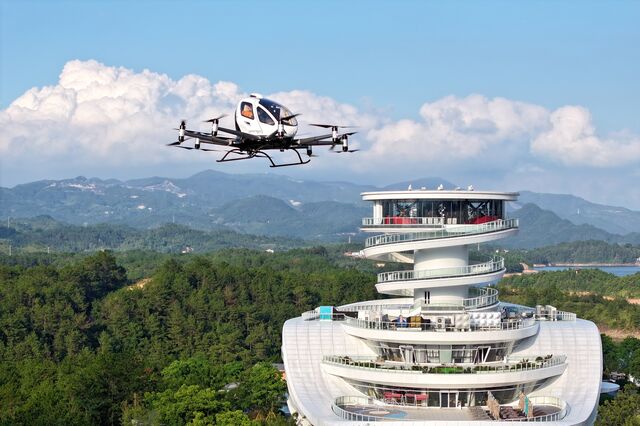
Far from an imaginary nightmare, this test flight in China last month was an unsettling reality. The bubble-like automated vehicle is made by EHang Holdings Ltd. and is vying to become the world’s first uncrewed commercial flying taxi this year.
The advances by the Chinese company give it early bragging rights in the race to break through air transport’s next frontier. The once-fictional future of electric flying cars, long a Hollywood fantasy, has, in some fashion, already arrived.
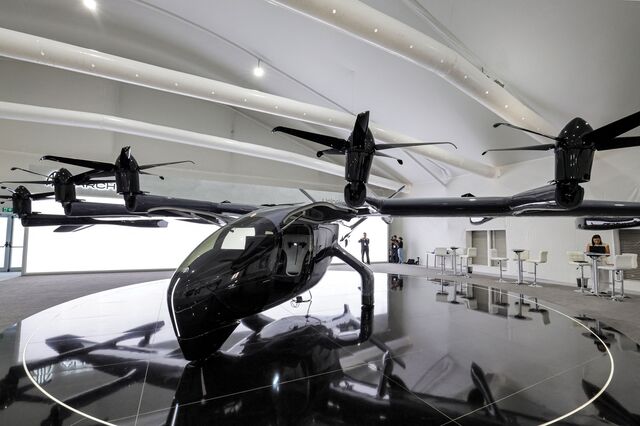
In New York, Joby Aviation Inc. and Archer Aviation Inc. aim to buzz people from downtown Manhattan to the city’s airports in a few minutes, about the same time it takes to walk two blocks. Both companies plan commercial flights with a pilot in the Middle East as soon as next year. More radically, Boeing Co.-owned Wisk wants to operate air taxis with four passengers — and no pilot — before the decade is out.
The potential market for these next-generation flights could be $1 trillion by 2040, Morgan Stanley has estimated. If that prediction is even close to accurate, in not much more than a decade, the world will be spending more on flying-car trips carrying people and goods — many of them with no pilot — than it currently does on conventional air travel.
The competition to corner these revenue streams of the future has inevitably drawn aviation’s dominant manufacturers, including Boeing. But the riches potentially up for grabs have also attracted startups and established names with little aviation expertise. Hyundai Motor Co., Toyota Motor Corp., Stellantis NV and even Chinese technology giant Tencent Holdings Ltd. have all committed money, manufacturing capacity or know-how in an emerging market loosely described as advanced air mobility.
With billions of dollars already spent, questions hang over the sector’s viability. The years of cheap money are over and even the best-known flying taxi makers in Europe like Lilium NV and Volocopter GmbH have at times battled to get funding. At the same time, it’s not clear that the traveling public will want to board a flying machine that doesn’t have a pilot, even if — and it remains a big if — regulators such as the US Federal Aviation Administration clear the aircraft to fly.
Fleets of Next Generation Taxis Set to Take Flight

To offer rides in flying taxis for the price of an Uber — the seemingly improbable goal of many manufacturers including Boeing’s Wisk — will require production of electric aircraft at unprecedented scale. It’s reasonable to assume many companies, perhaps even most of them, won’t survive, according to Robin Riedel, a San Francisco-based partner at McKinsey & Co.
“Some people will lose a lot of money. No doubt,” said Riedel, who co-leads the McKinsey Center for Future Mobility. “A whole bunch of them are not going to make it.”
The stage is set for a financial reckoning.
For some, electric flying taxis are an emissions-free solution to megacity congestion. It’s no coincidence that Sao Paulo, one of the most gridlocked cities on the planet, boasts the world’s largest helicopter fleet, with about 450 choppers. Others like Guangzhou-based EHang hope its people-carrying drones will also create a new market for affordable aerial tourism in China — at a fraction of the cost of a helicopter ride.
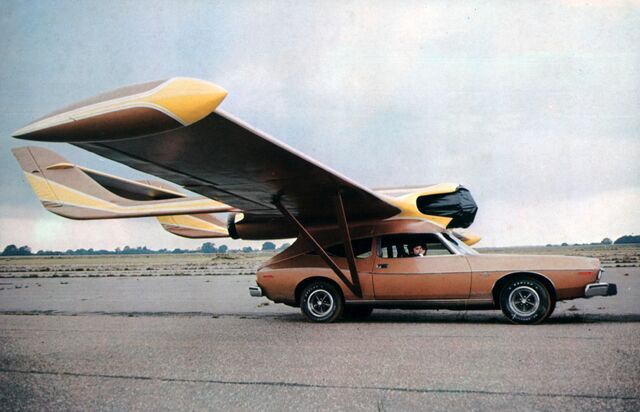
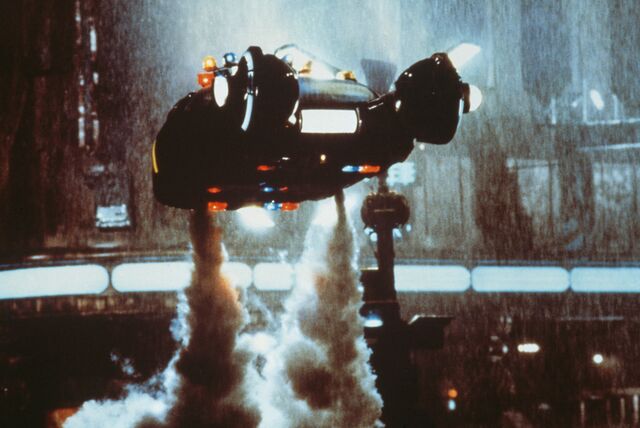
Fictional variants of these aircraft have been on the big screen for more than 50 years. An AMC Matador coupe with wings on its roof took off in the 1974 James Bond movie, The Man with the Golden Gun. The 1982 sci-fi Blade Runner, starring Harrison Ford, featured cars that could do it all — speed down roads before taking off and flying around effortlessly.
In reality, there are now dozens of companies making so-called electric vertical takeoff and landing aircraft. Often laden with small rotors that allow the aircraft to hover like a bee or cruise like a plane, battery-powered eVTOLs are largely designed for short hops in and around cities. Initially at least, they’ll shuttle back and forth along tightly controlled urban flight corridors.
In functional terms, the aircraft mirror the capabilities of the Harrier jump jet, the military attack plane that revolutionized vertical takeoffs and landings in the 1960s.
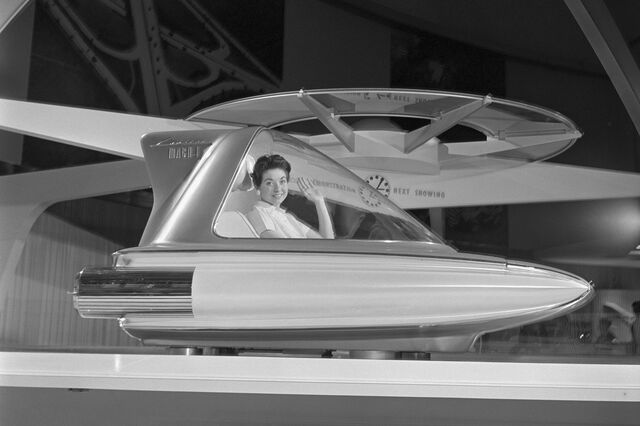
Among the growing ranks of eVTOL players, Boeing is one of the most audacious. Its development program extends more than 9,000 miles (14,500 kilometers) from the company’s Virginia headquarters to Australia, and underscores how far the industry has leaped in recent years.
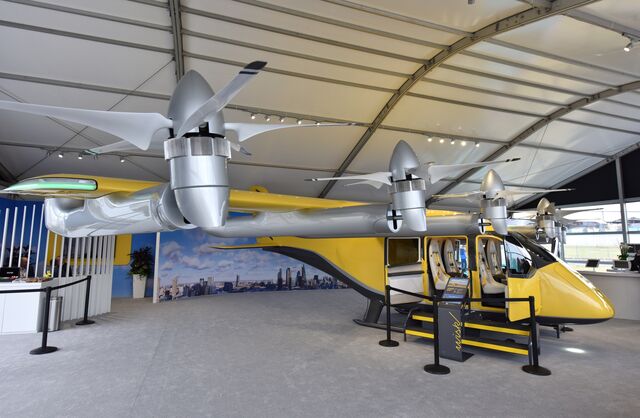
On a November day in 2022, the planemaker sent 50 of its interns to a drab warehouse on the outskirts of Brisbane, halfway up Australia’s eastern flank, to learn how the nascent sector might evolve. Inside the building was the then-future of flight: Half-plane, half-helicopter, the Frankenstein creation on display was as yellow as a New York taxi and bristled with 12 rotors. There were just two seats — neither of them for a pilot. A newly hired former New Zealand air force officer told the young crowd they’d one day look back in wonder to an era when passenger aircraft were, incredibly, all flown by humans.
Less than two years later, using the successor to that experimental plane, Boeing’s Wisk aims to become the first uncrewed passenger-carrying taxi operator certified by the FAA, still the world’s most important aviation regulator. Amid a crisis of its own, Boeing continues to divert resources and engineers into Wisk. All this as the iconic planemaker burns through cash during a production slowdown and as regulators pore over the quality of its manufacturing. Unlike Joby or Archer, Wisk’s first commercial services will be completely autonomous, even if it takes longer to get them off the ground.
Catherine MacGowan, the ex-New Zealand military officer who’s now Wisk’s vice president of air operations, argues that stripping the pilot from flying taxis is key to making them financially viable. Wisk won’t have to worry about recruiting flight crew, who are almost always in short supply, and only paying passengers will take up space in the aircraft. “Autonomy does support scale and autonomy makes things affordable,” she said.
But the very notion of commercial flights with no crew on board is drawing scrutiny. Before Wisk can launch for real, the FAA will have to approve the aircraft, every flight procedure and all emergency contingencies. That certification process will cover scenarios such as a power outage, a bird strike, or a loss of connection between the aircraft and the ground.
Among the most crucial elements will be the detect-and-avoid capability, a critical defense against crashes and mid-air collisions. “If something unexpected happens, people rightfully want to know: How will the aircraft respond?” MacGowan said.
The machine itself will ultimately be in the hands of a flight supervisor on the ground. Part pilot, part air-traffic controller, this remote backstop can monitor several Wisk flights at the same time, according to MacGowan. “We’re not removing humans from aviation, we’re changing their role,” she said.
Not everyone is convinced the concept of autonomous flight is viable.
Robert Joslin, a US Marine Corps veteran who was an FAA test pilot and flew helicopters for President George H. W. Bush, said it’s impossible to devise an automated response for every eventuality in the air. It’s simple enough to pre-program an aircraft to shut off leaky hydraulics, but things get complicated when an uncrewed plane runs into a problem that requires human judgment, said Joslin, who now teaches at Embry‑Riddle Aeronautical University.
In a recent paper on the problems that might arise when autonomous flight meets human morality, Joslin used the notional example of an autonomous aircraft carrying passengers that’s forced into an emergency landing. Any number of scenarios could unfold, and some might need the sort of ethical assessment only a human is equipped to make, Joslin said.
“The challenge is uncertain and unanticipated conditions,” Joslin said in an interview. “In terms of a fully autonomous system, we’re way behind. We haven’t learned enough.”
Those at the fore of uncrewed flight say there’s little value in wondering whether an aircraft can mimic the judgement of a person. Far better to reduce the chances that such a scenario ever arises, said Sanjiv Singh, chief executive officer and co-founder of Near Earth Autonomy, which develops technology for autonomous operations. “We tend to think of it in terms of risk, rather than a moral standpoint,” Singh said. Ultimately, he said, an uncrewed aircraft has to be at least as safe as a crewed one.
The trouble is, many of the safety guardrails surrounding commercial aviation today depend on human intervention in the cockpit if something goes wrong — and crucially sometimes rely on taking an unorthodox approach. Famously, US Airways Captain Chesley Sullenberger, a former fighter pilot, and his first officer managed to land their Airbus A320 on the Hudson River on Jan. 15, 2009, after it struck a flock of geese and lost power. No one died, and the incident became known as “The Miracle on the Hudson.”
Whatever reservations might exist about flying taxis, regulators are already laying the ground for them. In the US, the FAA’s Concept of Operations for Urban Air Mobility anticipates new rules that will allow “remotely piloted and autonomous aircraft to safely operate at increased operational tempos.” The European Union Aviation Safety Agency has published rules governing the operation of air taxis in cities.
In China, authorities are even further down the track, viewing flying taxis as a policy lever to develop a so-called low-altitude economy. The Civil Aviation Administration of China in April approved EHang’s two-passenger uncrewed flying car for mass production. Right on cue, the approach is turbo-boosting orders for EHang’s aircraft.
Xishan Tourism in China’s northern Shanxi province, for example, ordered 50 EHang flying taxis in May and plans to buy 450 more over the next two years. Wencheng county in Zhejiang province has ordered 30 aircraft and wants an additional 270 by the end of 2026.
EHang Chief Financial Officer Conor Yang reckons the potential returns from operating these tiny aircraft dwarf those of any major airline. According to Yang, a sightseeing flight on an EHang aircraft could cost between 400 yuan ($56) to 500 yuan. One aircraft flying 10 times a day with two passengers, 265 days a year (factoring in 100 days out of action due to things like bad weather), would deliver an operating margin of 50%, he said. That’s a figure a commercial airline in today’s world could only dream of.
But even Yang acknowledges that the general public won’t immediately take to the idea of uncrewed flight. “Social acceptance will take time,” he said.
According to MacGowan, the challenge for Wisk and other operators of pilotless eVTOLs is to demystify autonomous flight. The company’s research indicates that younger generations are more likely to fly on a pilotless plane than older travelers. MacGowan points out that robots already carry out critical procedures like eye surgery. By the end of the decade — when Wisk is due to start flying — the notion of putting one’s life in the hands of a computer will be more commonly accepted, she said.
All the same, Wisk knows it has a job to put passengers at ease.
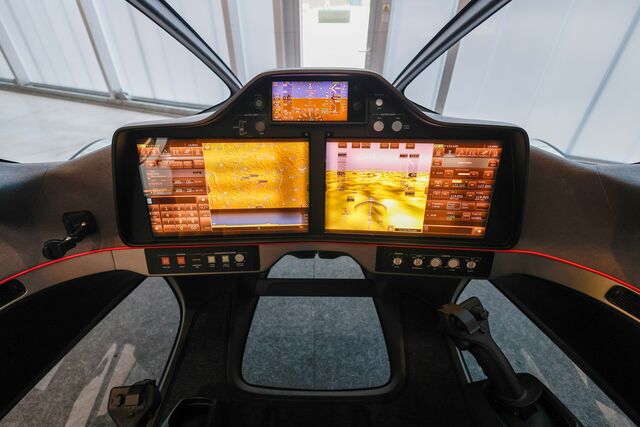
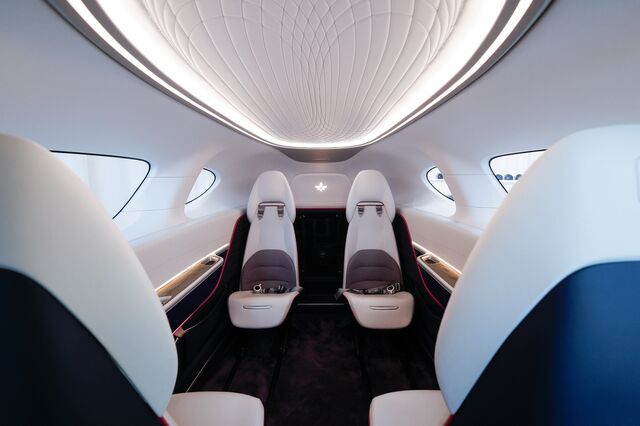
“A huge amount of thought has gone into the experience of being inside,” said MacGowan. “The cupholders, the display, lighting, the ability to communicate with the ground. How can that feel safe? How can that feel accessible?”
Wisk even made its planes bright yellow — similar to the golden arches of McDonald’s Corp.’s restaurants — to make them less imposing.
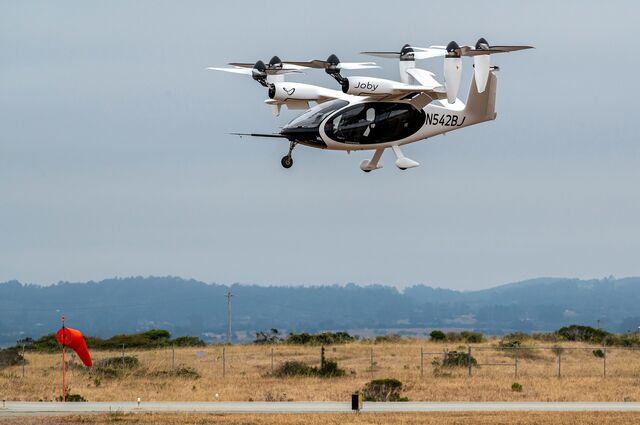
Competitor Joby, which will start with crewed services, acknowledges that autonomous flight ultimately makes sense. The company in June announced the purchase of the autonomy unit of Xwing Inc., whose Superpilot software enables flights to be supervised from the ground. “I do think that’s a logical direction for the technology to go,” Joby Chief Product Officer Eric Allison said in an interview.
By some estimates, there’s an enormous economic incentive to remove pilots from eVTOLs. Factoring in the financial drain of salaries, training and the valuable space that pilots occupy in the aircraft, crewed flights can be twice as costly to operate as autonomous operations, according to analysis by McKinsey.
Investors are set to gain a better picture of the industry’s winners and losers over the next two years as eVTOL makers near their targeted launch dates. From there, the industry could rewrite mass transit maps around the world, or it could fizzle into a failed attempt to mimic helicopters.
Some investors are already cutting their losses. South Korea’s Hanwha Aerospace Co. set aside 140 billion won ($105 million) in the second quarter for potential losses from convertible bonds issued by Californian eVTOL maker Overair Inc. “The challenges in the Urban Air Mobility industry have proven greater than anticipated,’’ Hanwha said in an email. Overair didn’t immediately reply to a request for comment on Hanwha’s decision.
According to a recent study by Roland Berger, investments in advanced air mobility jumped from $1.6 billion in 2020 to $7.5 billion the following year but have since fallen sharply to about $1.3 billion in 2023.
The barriers to success are numerous. The thousands of eVTOL aircraft expected to take to the skies in coming years will need landing and takeoff sites near population centers. The cost of using these new vertiports, which will need rapid battery-charging capability, will add to the price of tickets.
There’s also pressure to turn preliminary orders for aircraft into actual sales, key to funding production and keeping launch hopes alive.
Eve Air Mobility, for instance, the eVTOL maker controlled by Brazil-based plane manufacturer Embraer SA, had a pile of so-called letters of intent from customers to buy 2,900 flying taxis worth $14.5 billion, according to a presentation at a Jefferies Financial Group Inc. conference in May. The challenge, said Chief Financial Officer Eduardo Couto, is converting those intentions into real orders.
Among the tools to gauge the progress of eVTOL aspirants is the Advanced Air Mobility Reality Index, which tracks the likelihood of 28 manufacturers certifying their aircraft, entering service and producing thousands of machines each year. The index gives each a score between zero to 10. More than half the companies rank a five or six, indicating their fate is not yet clear.
The roadmap at German flying-taxi maker Lilium, whose biggest shareholder is Tencent, partly explains why an almost entirely unproven industry has drawn so many big names.
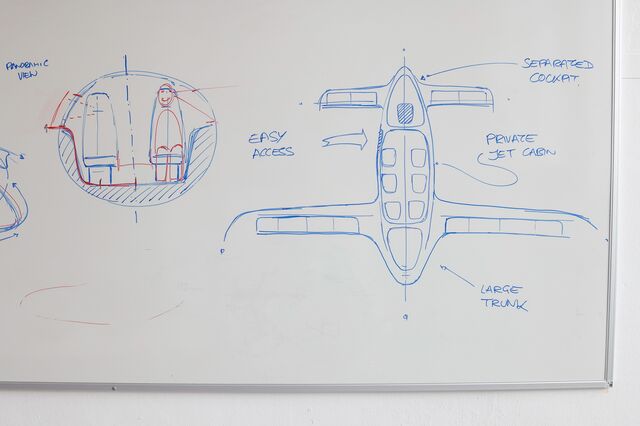
Lilium plans to offer regional flights, rather than short urban shuttles, and its futuristic four-or-six-passenger vehicle looks more like a jet than a helicopter. Lilium says its battery and electric-jet technology could allow eVTOLs to fly almost 500 kilometers by 2040, enough to cover half of all business flights taken today. The clear implication is that eVTOLs could ultimately replace some of the world’s conventional air travel.
Senior executives agree that mass production is key. Archer Aviation, which counts carmaker Stellantis as a shareholder and contract manufacturer, plans to complete a high-volume manufacturing facility in Georgia this year. The site is designed to make as many as 650 electric planes annually, more new aircraft than Boeing delivered in all of 2023.
“People haven’t built in scaled volumes in aviation since World War II,” Archer CEO Adam Goldstein said in an interview. His aim is simple: “Build as many as we possibly can.”
Like EHang’s Yang, Goldstein can reel off the numbers underpinning his goals: The company’s sleek, black “Midnight” plane can handle 40 flights a day. Operating costs are about $3 per passenger mile, accounting for things like battery-charging, insurance, pilots and maintenance. By Goldstein’s reckoning, an Uber ride would cost at least $100 for the 17-mile trip from Manhattan to JFK airport, or around $6 a mile.
“We can charge the same rates and still make money,” Goldstein said.
Archer has announced plans to set up electric aircraft hubs in metropolitan Los Angeles and New York City, along with Northern California and South Florida. A flight from a base in south San Francisco to Napa is expected take 15 minutes, compared to 90 minutes by car.
However it pans out, a century of aviation history shows that accidents do happen, even if infrequently. Any fatal incident involving a commercial eVTOL aircraft would be a huge setback and weaken the case for uncrewed flight. For Boeing, yet to fully recover from two 737 Max disasters, the fallout could be worse.
At Wisk’s warehouse on the outskirts of Brisbane, MacGowan nods indirectly to the risk, but says any misstep is also a chance to learn.
“There will be challenges and there will be hard moments,” she said. “You have to be humble. Aviation will humble you if you don’t respect it.”