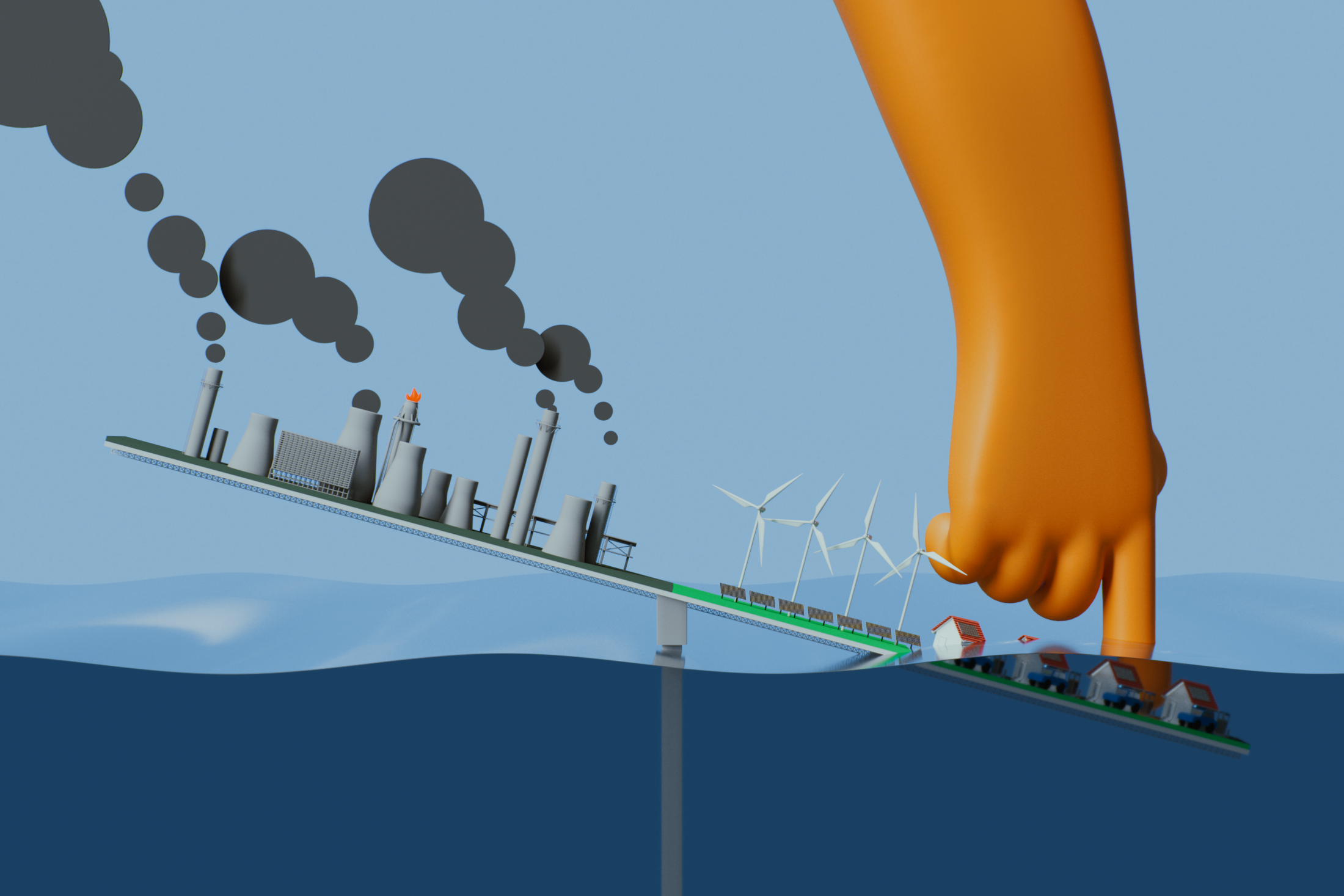
Trump 2.0 Climate Tipping Points
A guide to what a second Trump White House can — and can’t — do to the American effort to slow global warming.
For the first time ever, the entire US government has taken up the fight against climate change.
President Joe Biden unleashed hundreds of billions of dollars toward clean energy and enacted new regulations throttling planet-warming pollution from cars, oil wells and power plants. Some of those policies were explicitly designed to be popular — winning over hearts and minds as tax breaks turned homeowners into solar enthusiasts and dollars flowed into factories, creating new jobs. The dynamic has been especially pronounced in deeply red districts where voters are more likely to be skeptical of climate change.
That doesn’t mean all these changes will stick. Donald Trump, the Republican nominee and former president, has campaigned on promises to end what he calls Washington’s “green new scam” while abolishing regulations encouraging coal power plant closures and compelling more electric vehicle sales. Even if Vice President Kamala Harris, the Democratic nominee, hasn’t exactly barnstormed battleground states with a climate agenda, she’s sure to protect these hard-fought policies.
The outcome of November’s election will go a long way to deciding what happens next — but not all the way.
Investors, analysts and developers whose decisions shape the American energy transition are resolute: A victorious Trump can’t fully halt the country’s green shift. Putting campaign rhetoric aside, it’s clear that the sweeping 2022 climate law known as the Inflation Reduction Act has been built to withstand political attacks. Grant money has already gone out the door. Tax credits are now seeding factories in Republican strongholds.
There’s obvious potential for a slowdown, just not over everything that’s changed since 2021. “The question for me is not ultimately the direction of travel — it is about the pace,” said Manish Bapna, president of the NRDC Action Fund, the political arm of the Natural Resources Defense Council. “A Trump 2.0 would pull back from policies and investments and create a much more costly and disruptive transition.”
Here’s a guide to the biggest Biden-era climate initiatives and how precarious each would be if Trump returns to the White House.
Resilient
IRA TAX CREDITS
Designed to be Trump-proof

Trump has promised to redirect climate funding under the Inflation Reduction Act. But scrapping the measure and its subsidies for clean energy could prove politically difficult, even if Trump triumphs and Republicans gain control of the House and keep the Senate.
That’s because the foundation of the IRA is a host of new and expanded 10-year tax credits that are driving nationwide investments into factories that make solar panels, sustainable aviation fuel, electric vehicle batteries and other technologies key to the energy transition. Roughly 90% of the capital unlocked by the law has flowed into red congressional districts, according to the clean energy advocacy group E2, and it’s creating jobs and economic growth that Republicans in Washington may be loath to forgo. The largesse raises political obstacles to repeal, no matter who sits in the White House.
The IRA and its tax credits were “designed to be durable,” said Bob Keefe, E2’s executive director. “The framers of these policies knew that these threats would come and they did everything they possibly could to prepare for that.”
Trump can’t act unilaterally to abolish IRA tax credits without help from Congress. Even if Republicans bolster their slim majority in the House and take control of a closely divided Senate, analysts say the flood of investment into red states would likely fracture attempts to build a coalition around repealing tax credits that underwrite ventures to capture carbon dioxide, produce hydrogen and refine climate-friendly jet fuel.
“Republicans will be reluctant to tear out the IRA root and branch,” said James Lucier, managing director at research group Capital Alpha Partners. “There will be a lot of projects in Republican districts they do not want to uproot.”
A group of GOP lawmakers has made clear they’ll be on defense. “A full repeal would create a worst-case scenario where we would have spent billions of taxpayer dollars and received next to nothing in return,” wrote 18 Republicans in a blunt warning to House Speaker Mike Johnson last month.
The biggest risk isn’t in rescission of tax credits but a revision, said Kevin Book, managing director of the Washington consulting firm ClearView Energy Partners LLC. Even without a full repeal by Congress, Trump would have wide administrative power to curtail the reach of IRA tax credits by rewriting Treasury Department rules governing what projects are eligible. A second Trump administration could potentially make it easier to claim credits for industries and technologies typically favored by Republicans, such as capturing carbon and making hydrogen with the help of fossil fuels, while raising the hurdles to qualify when the subsidies target electric vehicles and renewable power.
Writing and imposing new rules could take at least 18 months — but the impact would be much more immediate. “It would chill investment immediately,” said Josh Price, a director with the Washington-based research consultancy Capstone.
There could be pressure to chip away at isolated segments of the IRA if Republicans attempt to offset the estimated $4.6 trillion cost of another Trump priority: extending the individual, estate and business tax breaks from 2017. Subsidies for electric vehicles and bonus credits for clean energy projects placed in communities that have been involved in fossil fuel production could be at risk.
This kind of maneuvering could open the window for bigger tax changes, such as replacing some IRA credits with immediate expensing that allows companies to instantly write off the cost of new factories rather than waiting decades. The idea has been floated by the Heritage Foundation as it examines China’s clean-tech dominance.
Republicans also could impose new limits or an early expiration date on a clean electricity tax credit under the IRA that supports wind farms, nuclear plants and other emission-free power. Lawmakers could still renew the credit as the expiration deadline approaches in future years — just as they did time and time again for wind and solar tax credits before the IRA.
Resilient
CLIMATE FUNDING
Most money is out the door

Clawing back funding for climate programs is another item on Trump’s to-do list. Such a move would potentially put at risk billions of dollars in grants and other support that have been earmarked — but not yet delivered — to clean energy ventures.
Trump described his plans for “dollars that are sitting there not yet spent” when accepting the Republican presidential nomination in Milwaukee over the summer. “We will redirect that money for important projects,” Trump vowed, suggesting roads, bridges and dams. “And we will not allow it to be spent on meaningless ‘green new scam’ ideas.”
It’s easy for a president to hit the pause button on spending that hasn’t gone out the door. And billions of dollars for climate and clean energy could still be sitting in government coffers by Inauguration Day. But Biden administration officials, aware of this risk, have been working to swiftly distribute climate money, putting much of it out of a new president’s reach.
The administration has been seeking to ensure IRA grant funds “are, in fact, awarded and obligated,” and “we’re doing a good job on that,” John Podesta, Biden’s senior adviser for international climate policy, said at an event in August. “The lion’s share” of the money available in fiscal 2024 will be awarded and obligated by the end of the year, he added.
The totals that still need to go out are significant. Officials inside the Energy Department have been rushing to commit roughly $60 billion out of a pool of about $80 billion in available funding by the end of the year, according to figures cited by David Crane, the agency’s undersecretary for infrastructure, in June.
“We’re trying to get as much of it contracted by the end of the year as possible,” he told attendees at an American Council on Renewable Energy forum. “Getting the money contracted is important, because that can’t really be undone — or, at least, historically, it has never been undone.”
Companies are racing to ink those deals too. At the law firm Holland & Knight, a new roughly 10-person team is focused on getting corporate clients into signed contracts with the Energy Department before January. That’s a bid to insulate such funding from any pullback, said Beth Viola, a senior policy advisor at the firm.
Some programs have already distributed funds that could prove untouchable, such as the Environmental Protection Agency’s $27 billion Greenhouse Gas Reduction Fund designed to accelerate deployment of solar panels, heat pumps and electric vehicles in disadvantaged communities.
A smaller pot of US climate funding is far more vulnerable. That could include some $16.8 billion for Energy Department grants and rebates to throttle industrial greenhouse gas emissions, accelerate the permitting of power lines, convert factories to produce electric vehicles and make other changes. While some of that money is out the door, some grants are only tentatively pledged to projects that must clear more vetting and still other funding can’t be distributed until future fiscal years.
Vulnerable
Clean Tech Loans
New priorities for a green bank

Clean technologies that struggle to attract Wall Street financing have a friendly government lender backed by congressional authority to offer more than $200 billion in loans. By late summer, less than a quarter of that has been obligated — and if Trump is elected, the remainder might never be.
The Loan Programs Office inside the Energy Department was effectively shuttered in Trump’s first term, and he could follow the same playbook of freezing its work providing financing to new ventures. It’s also possible to claw back promised support from projects where financing has been conditionally committed but deals still haven’t closed.
$66 Billion in LPO Loans and Commitments

But there’s another option being considered by some conservatives: keep the office humming while reorienting its work to focus on technologies tied to favored industries, such as fossil fuels, mining and nuclear power. There’s a lively debate about the best course among influential conservatives and former Trump officials likely to seek a return to government if he is elected, according to people familiar with the matter.
Under Biden, the Loan Programs Office has backed a lithium mine in Nevada, a nuclear power plant in Michigan, and a monitoring network that can help track methane from US oilfields — making clear that loans can go to these areas. But much of its support has gone toward virtual power plants, hydrogen and electric vehicle components, from carbide wafers to batteries.
Vulnerable
Methane Crackdown
Overhauling an already challenged rule

The Biden administration has tried to pare back oil industry emissions of methane, the potent planet-warming component of natural gas. Those policies could be targets for a redo under Trump.
Take the EPA rule finalized last December that forces oil companies to replace leak-prone equipment and regularly search for methane escaping from valves, compressors and other equipment. The measure has already drawn a federal court challenge from the oil industry. A Trump-run EPA could settle litigation by agreeing to rewrite the measure. Such an overhaul could preserve some requirements but do away with a contested initiative that allows private citizens to police oil wells and pipelines for methane leaks.
Sections of the IRA that slapped a fee on methane emissions would probably find few defenders among Republicans in Congress, leaving these provisions highly vulnerable to repeal. The fee is meant to encourage oil companies to keep methane releases in check, but industry foes say it’s tantamount to a tax on natural gas production.
New EPA rules could prove crucial to safeguarding the oil industry’s ability to sell its natural gas overseas. Buyers in the European Union face their own regulatory restrictions on methane leaks. Large gas producers and traders would likely appeal for fewer changes to US regulations, though those pleas fell on deaf ears during Trump’s first term.
Extremely Vulnerable
ELECTRIC VEHICLES
Car incentives are easy pickings

Relentless mockery of electric vehicles has been a fixture of Trump’s campaign speeches, with withering commentary on their performance as well as the government policies meant to spur their adoption. He’s also repeatedly vowed to end what he calls the “EV mandate,” referring to an EPA regulation limiting tailpipe pollution. The rule is so strict it compels automakers to sell far more electric and hybrid vehicles over time, while scaling back sales of conventional combustion engine models.
Automakers have choices in how to comply with the pollution limits that apply across entire fleets, but most are expected to sell more lower-emission hybrids and zero-emission EVs. Under one scenario modeled by the EPA, more than half of new cars and light trucks sold in 2032 would be electric and an additional 16% would be hybrids.
A second Trump administration could easily repeal and replace the rule driving this shift, putting in place more lenient standards that could be met by conventional, gas-powered cars. The EPA took a similar tack during Trump’s first term in the White House to ease Obama-era tailpipe pollution and fuel economy standards.
Such a change would take time. The EPA is required to go through a formal rulemaking process that easily stretches for months — and often much longer. Lawsuits from oil and biofuel interests could accelerate the timeline by opening a window for a potential Trump administration to settle litigation by voluntarily agreeing to rewrite the regulation.
Trump also would have a wide berth to undermine EV tax credits that were expanded by the IRA. If he’s elected in November, the Treasury Department could soon begin rewriting rules governing what cars and buyers are eligible for the credits.
US Electric Vehicle Sales Set to Accelerate

Energy policy analysts cast these rewrites as nearly guaranteed. “The EV tax credits are definitely among the most vulnerable — if not the most vulnerable — of the IRA-related provisions,” said Corey Cantor, an analyst with BloombergNEF.
Making some rules more strict could have the effect of virtually eliminating tax credits. Current policies effectively exempt leased EVs in commercial fleets from restrictions on where the cars are made, the source of their battery materials and how much money consumers make. The approach critics have dubbed the “leasing loophole” ends up making tax credits more accessible.
A new Trump White House could simply direct the Treasury to rewrite the policy to boost North American assembly and sourcing requirements for EV components, shrinking the already small pool of cars that qualify for the full $7,500 credit.
Trump said he would consider backing a full repeal of the EV tax credits in Congress, telling Reuters in an August interview that “tax credits and tax incentives are not generally a very good thing.” An attempt might draw resistance from Republicans whose districts are now benefiting from factories tied to IRA-stoked demand for EVs.
Trump’s fight against pro-EV policies would likely reach all the way into California, jeopardizing the statewide ban on the sale of new conventional combustion engine cars after 2035. Under Trump, the EPA could deny a waiver necessary to bless the policy.
Extremely Vulnerable
Offshore Wind
Necessary permits face fatal pause

Trump’s pronounced and often repeated hostility toward wind energy amounted to a surprisingly hands-off approach in his first term. He’s made no secret of his intent to change tack, which could further batter a struggling offshore wind industry that depends on the federal government for leases and project permits. “I’m going to write it out in an executive order,” Trump promised at a rally in May, without providing more details.
The biggest risk would extend to proposed wind projects that haven’t yet won approval from the Interior Department. There are at least six applications — with 11.3 gigawatts of electric generating potential — now pending before the agency. Trump could even follow a playbook written by the Biden administration, pausing new offshore wind project approvals just as Biden halted issuing licenses to export natural gas.
Nascent US Offshore Wind Industry Poised for Growth

An unofficial pause would suffice to stall permit reviews. A formal moratorium could potentially be justified by new government inquiry into the impact of wind turbine technology on marine life — something Trump regularly raises in his campaign speeches.
Just as the Biden administration is forcing oil and gas companies to set aside more money to cover eventual cleanup costs, a future Trump administration could impose hefty financial requirements on offshore wind farms. That risk became more acute after the failure of one turbine at the Vineyard Wind project under construction near Massachusetts, which sent debris onto a beach and provoked a loud backlash.
Still, even permitted offshore wind projects could face jeopardy. Ongoing lawsuits and future litigation open opportunities for a potential Trump administration to revisit earlier government approvals as part of negotiated settlements. New challenges tied to endangered whales and other species also pose a long-term risk to all offshore energy projects, potentially translating into forced redesigns and work stoppages.
Perhaps the best hope for offshore wind proponents would be leaning on Republican allies in Congress and local governments who are already seeing benefits from a surge of investment in domestic shipbuilding and manufacturing. But it would be hard to stop a determined president from having a major impact.
Extremely Vulnerable
Power Plant Pollution curbs
It’s so over

If Trump wins the election, a ticking clock would start counting down the last hours of Biden-era regulations stifling carbon dioxide from the nation’s current fleet of coal-fired power plants and many newly constructed gas units.
Trump has repeatedly vowed to “terminate” the rule in an online policy blueprint and at a rally in August. “Instead of shutting down power plants,” he told supporters in Pennsylvania, “we will open dozens and dozens more.”
The EPA could easily repeal and rewrite the regulation, potentially justifying the pivot by citing a recent Supreme Court ruling limiting the discretion federal agencies have to interpret vague statutes. During his first term in office, Trump took a similar approach to undoing former President Barack Obama’s sweeping Clean Power Plan, which also targeted greenhouse gas emissions from the electricity sector. In its place, Trump’s EPA substituted modest requirements focused on emission reductions that could be achieved at individual power plants through improvements in efficiency.
Another such shift in pollution limits could prolong the lifespan for some coal plants that would otherwise have to shut down under the current rules. And it likely would be welcomed by some utilities that say the Biden measure relies on high rates of carbon capture, a technology that’s barely been deployed in the sector and yet-to-be-built infrastructure that might take years to permit.
A separate plan to limit planet-warming pollution from existing US gas plants also could be snuffed out under Trump. The measure is unlikely to be finalized before Inauguration Day. Even if it were, the regulation would be subject to expedited repeal.
Extremely Vulnerable
Climate Diplomacy
A code red for international cooperation

Trump promised in his first term to be beholden to Pittsburgh, not Paris, when he set about extricating the US from the landmark global climate accord signed by virtually every nation in Paris in 2015. Trump 2.0 could go even further, making good on his vow to abandon the Paris Agreement while also pulling out of the 32-year-old UN Framework Convention on Climate Change that underpins the entire structure of international cooperation against warming temperatures.
There would be far-reaching and enduring impacts, potentially sidelining the US in climate talks for years to come, since the Senate might have to ratify the UNFCCC again in order for the nation to rejoin the treaty. But the change wouldn’t be immediate. To abandon the Paris Agreement or the UNFCCC, countries must provide formal notice to the United Nations and then wait a year.
Even before it’s official, however, a retreat by the world’s second-biggest greenhouse gas emitter from global climate talks could provide cover for both developing and oil-exporting nations seeking to water down emission-cutting targets. And the knock-on impacts could extend to other multilateral bodies. The US could push for a Group of Seven communique supporting natural gas while fighting off promises to curtail support for coal, sidelining another crucial venue for climate cooperation.
Extremely Vulnerable
Pausing LNG Export Permits
Rapid reversal of gas-selling slowdown

Biden used executive authority to halt the approval of new licenses to widely export liquefied natural gas, and Trump has vowed to use the same power to reverse it.
The indefinite permitting pause is supposed to allow time for the Energy Department to conduct new environmental analysis of the consequences of gas exports, which are now vetted on a case-by-case basis. Critics of the policy contend those studies aren’t needed and could be done even with permits continuing to flow.
Environmental advocates who’ve cheered Biden’s permit pause say it’s essential to help wean the warming world from natural gas. On this view, building the enormous infrastructure required to ship LNG overseas ensures the fossil fuel will be burned for generations to come.
Beyond just reversing the pause, Trump has said that if elected he’d approve new LNG exports his first day in office. His administration also could repeal an Energy Department requirement that companies begin using their licenses to export LNG within seven years of winning approvals.