Ukrainians Dig Into Their Own Pockets to Fund Everything From Drones to Mortars
Despite a ravaged economy, businesses, civic groups and citizens in Ukraine are helping replenish arms on the front and boost morale.
Look at the cash register at an OKKO filling station in Ukraine and you’ll see a counter ticking higher beneath a cartoon of a winged shark. It tells customers how much of their money is going to buy targeting drones for the army.
Come Back Alive, for which the gas station chain is helping to raise 325 million hryvnia ($8.8 million) for 25 Shark drone systems, is not your average charity; licensed to import arms, it has orders for nearly 500 mortars, according to Oleg Karpenko, the head of donor partnerships.
The group is one part of a vast donor network that’s blossomed over a year of war to supply soldiers with everything from boots to battle tanks. In some respects, the support has been as important to Ukraine’s survival against Russia’s invading forces as aid from the US and Europe.

The network reflects a self-reliance that ordinary Ukrainians developed in response to decades of corrupt and ineffective governments. It became institutionalized as they grappled with everything from internal uprisings to conflict with Russia since at least 2014.
There’s no aggregate figure for the amount that the hundreds of businesses, thousands of civic organizations and millions of individuals involved have donated to the war effort in cash or in kind. But it’s significant. From the start of last year’s invasion to the end of 2022, the central bank alone took in the equivalent of $693.5 million at the year’s average exchange rate in donations earmarked for defense. President Volodymyr Zelenskiy’s war charity United24, launched in May, has collected $287 million.
The crowdfunding goes beyond cash and equipment. It covers costs for military training, combat medical supplies and the design of apps to calculate artillery trajectories.
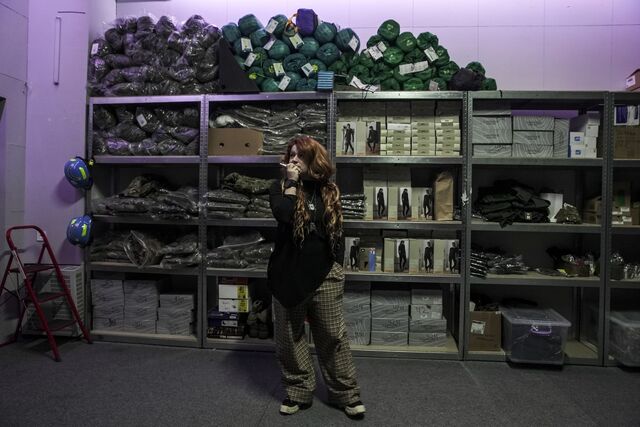
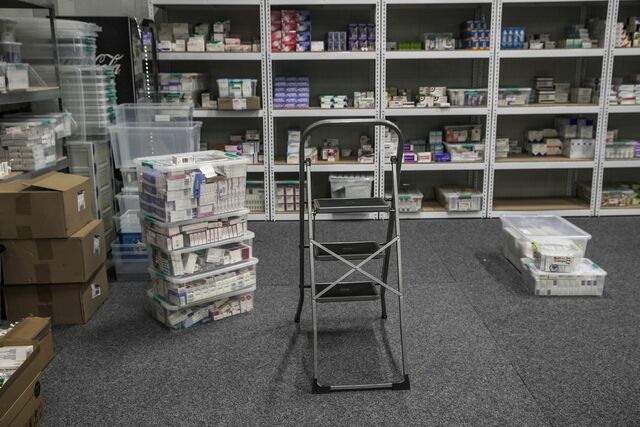
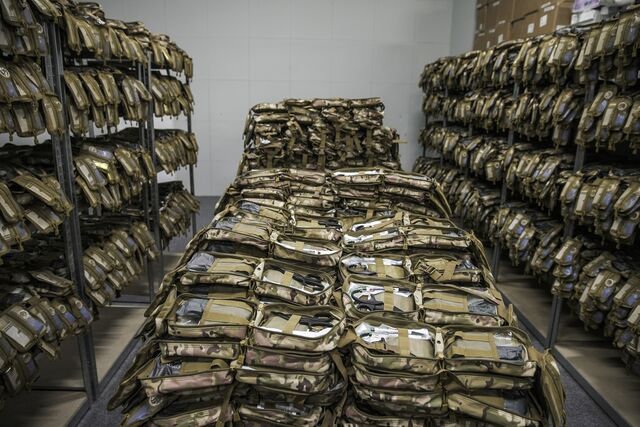
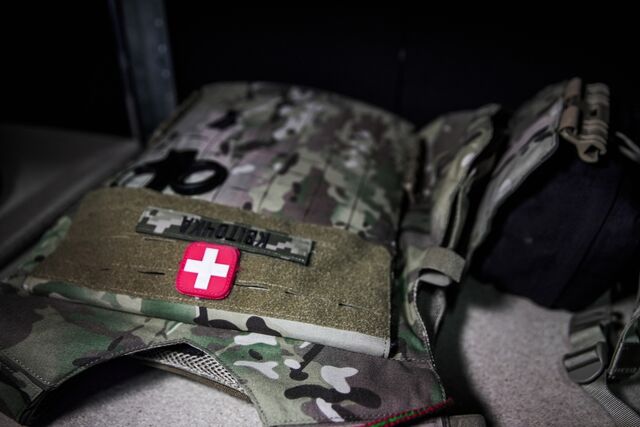
Though smaller in scale than Ukraine’s defense budget or the tens of billions of dollars of weaponry sent by the US and other allies, the domestic aid plays several vital roles. It fills supply gaps on a fast moving battlefield that the army can’t, either for lack of money or an excess of bureaucratic procedures. The financial support from foundations allows arms manufacturers in Ukraine to improve weapons systems in response to experience on the battlefield, something that procurement rules make more complicated for the Defense Ministry.
Crowdfunding also plays a less tangible, but important role in providing fighters at the front with a constant reminder of the deep public support in Ukraine for the war effort.
“Parents, relatives and just crowdfunding organizations are raising colossal amounts of money and they use it to buy stuff that is really expensive,” said Kos, an officer fighting at Vuhledar, one of the hottest flash points on the eastern front, who for security reasons asked to be identified only by his call sign. “I don’t know a single unit that isn’t receiving this kind of aid.”
Some of the equipment is essential to survival on the battlefield and needs constant replacement because it is quickly destroyed, the officer said, singling out surveillance drones and the pickup trucks that allow force maneuvers and medical evacuation.
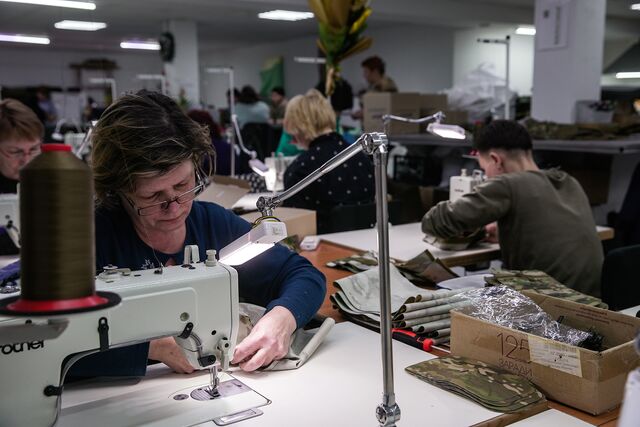
The crowdfunding effort has pulled in everyone from Hollywood celebrities to companies owned by Ukraine’s so-called oligarchs.
Metinvest, the steel and mining conglomerate controlled by Ukraine’s richest man, Rinat Akhmetov, has provided the military with 150,000 bullet-proof vests, 80,000 tank traps and 1,100 drones, as well as mobile bunkers, thermal imagers and other equipment, according to the company. Metinvest lost half its steel production assets to the war, including the Azovstal plant in Mariupol.
Zelenskiy’s United24 enlisted Barbara Streisand as its ambassador. It has bought, among many other things, a helicopter for reconnaissance and medical evacuation.
Among private charities, Come Back Alive — formed by volunteers in 2014 — has raised more than $160 million since Russia invaded, according to its website.
The eponymous charity Serhiy Prytula, founded by the TV presenter-turned-politician, has secured more than $108 million, according to public statements. It bought thousands of smaller unmanned aerial vehicles, about 900 pickup trucks, paid for the refurbishment of five tanks and other armored vehicles captured from the Russians, and funded the purchase of three of Turkey’s multi-million-dollar Bayraktar drones.
Whether these efforts, or the tanks and other equipment on the way from allies, will be enough to drive Russian forces out of Ukraine is far from clear. Russia’s arms factories are already working multiple shifts to resupply the front and, on Tuesday, President Vladimir Putin made clear in a state of the nation address he was planning for a long war. He called for a wholesale shakeup of the economy and mass production of newly developed weapons.
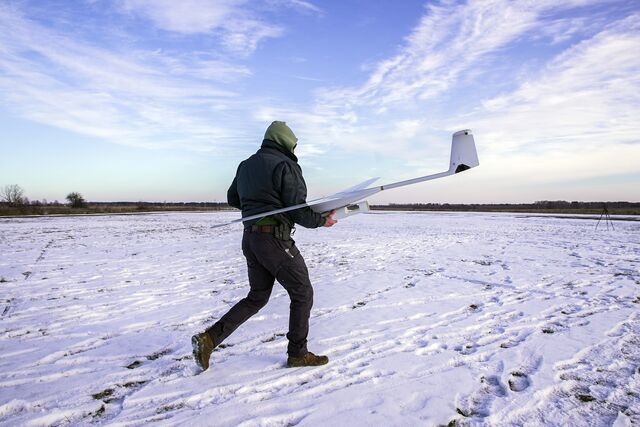
The focus in Ukraine on crowdfunding drones reflects a decisive technological change that has marked years of conflict, driving a flurry of new local manufacturers into the market. The Shark, for example, is a new drone specifically aimed at spotting targets for the US HIMARS multiple launch rockets systems that have had such an impact on the war.
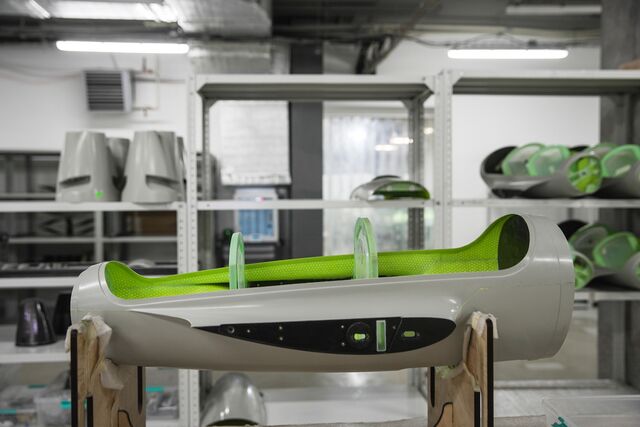
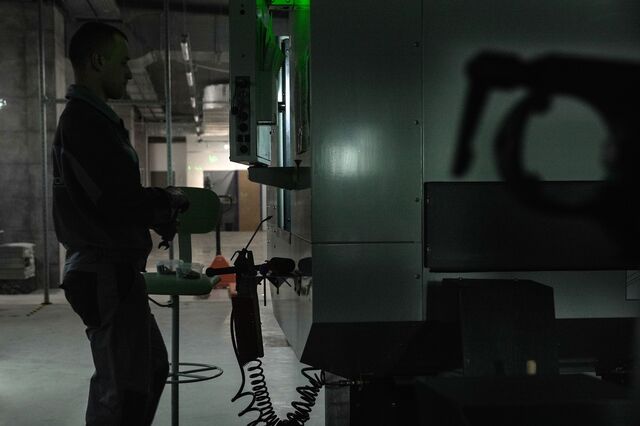
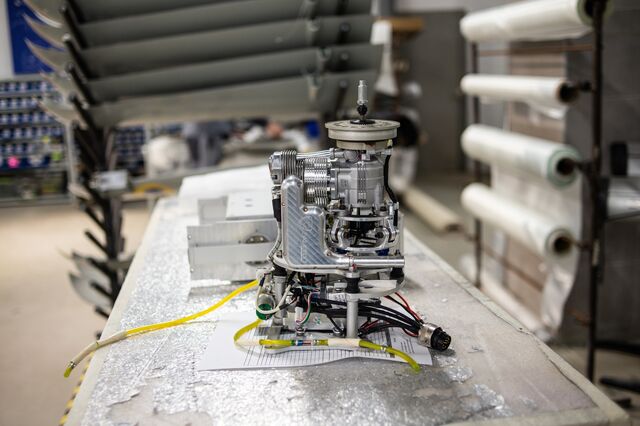
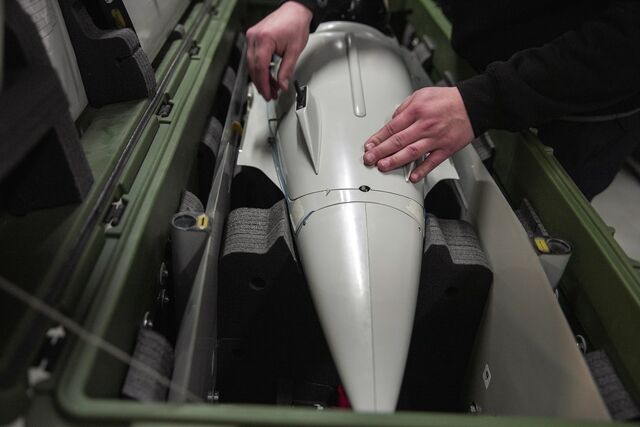
Still more sophisticated is the Raybird-3, a reconnaissance drone system that costs between $1 million and $2 million and sits near the top of the food chain in the nation’s burgeoning Unmanned Aerial Vehicle industry.
Raybirds are built by former light aircraft producer Skyeton. In 2014, as government forces battled a Russia-supported insurgency in Ukraine’s eastern Donbas region, it turned to making UAVs for the military and emergency services.
The Raybirds can stay aloft for as long as 40 hours and stream video 120 km (75 miles) from base, the company says, identifying Russian targets for Ukrainian artillery. The army operates them from the same base as the Bayraktar, the 12 meter wingspan strike UAVs that made a name for themselves at the start of the war, but proved vulnerable to Russian air defenses.
With only a 3 meter wingspan and a tiny engine, Skyeton’s drone has a radar print the size of a bird’s, making it hard to detect; it has suffered fewer than 10 losses among the three dozen vehicles in use since the start of the war, according to the company. About half were bought by the Defense Ministry, and half via private crowdfunding, said a senior executive, who asked not to be named.
The army wants as many Raybirds as the company makes, the executive said, but procurement rules mean it can only purchase existing products that have been tested. In a war where the drones and their operators are feeding back data daily in their battle of technology and wits with Russia’s electronic warfare defenses, crowdfunding is essential to financing upgraded models, they said.
The Raybird is just the tip of Ukraine’s crowdfunding.
Andriy Moruha, who runs a training program for Come Back Alive, showed how gunners feed target coordinates provided by drones into Armor, an app that calculates the required range and ballistic trajectory of fire. A drop down menu allows them to select the weapon and ammunition type to be used, before pulling in data on conditions such as temperature, humidity and wind speed.
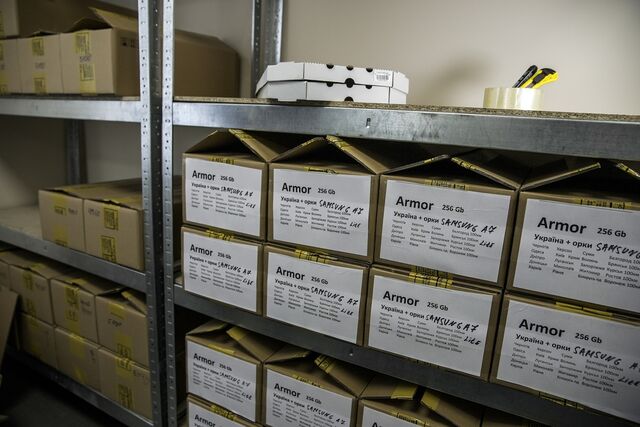
It isn’t the only such app. The state has one serving the heaviest artillery and rocket launchers, while a bevy of others fill the gaps. Moruha said he has distributed thousands of tablets loaded with the Armor app he helped to design, which serves calibers up to 105 mm. His office is stacked with another new 700 tablets.
“From getting the coordinates to being ready to fire takes about a minute,” said Moruha, who now tours the front, training soldiers on Armor. The Russians have captured some of the Ukrainian apps and are developing their own, but judging by the precision of their fire they have yet to catch up, he said.
Like many of Come Back Alive’s staff, Moruha is ex-military — one of the so-called “Cyborgs” named for their dogged defense of Donetsk airport in the Donbas in 2015. He spent five months in hospital recovering from shrapnel wounds and joined the charity the following year.
“We were hoping to raise 20 million hryvnia in 2022 and we thought that was a lot,” said Viktoriya Dvoretska, the organization’s head of veteran affairs and Ukraine’s first female commander of a mechanized company. In March alone last year, the charity pulled in 1.46 billion hryvnia. Dvoretska’s call sign is Dika, or Wild.
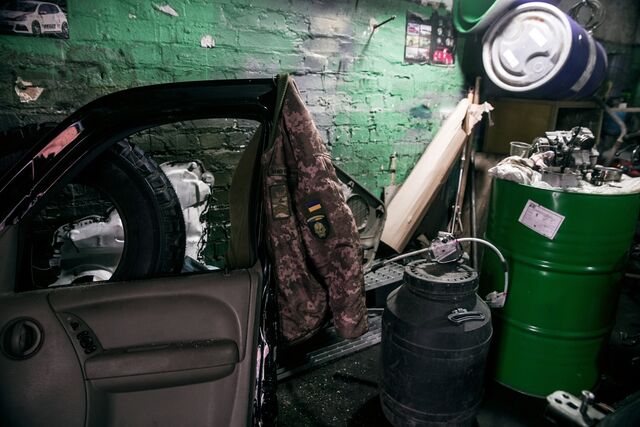
Vadym Voskoboynikov and his wife Olga could hardly be more different. They were in the fashion business before the war, bringing in French and Italian couture from Milan. Now they buy Iveco off-road troop transporters discarded by the Italian military, truck them to Ukraine, and refurbish them.
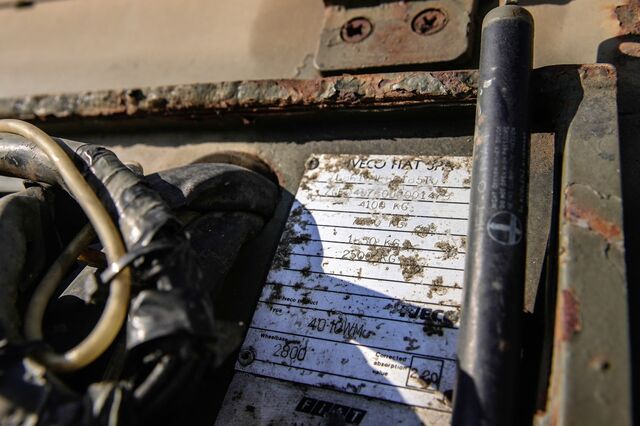
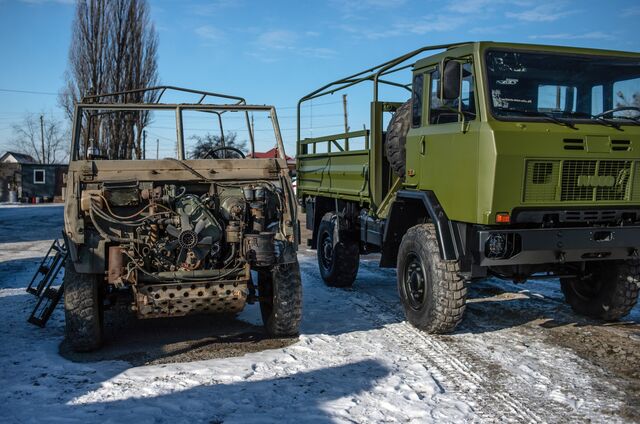
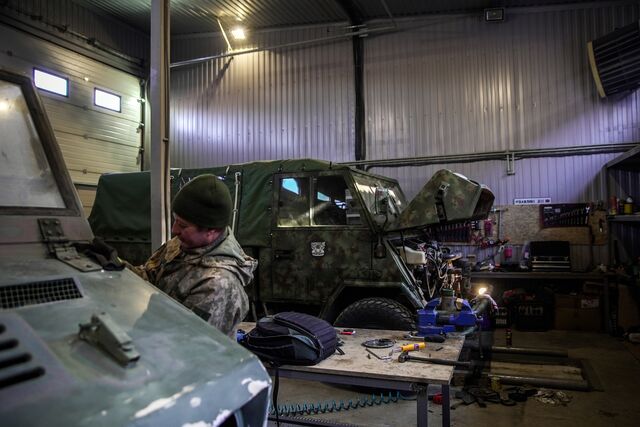
“We built everything you see here,” said Voskoboynikov, pointing to the warehouse style workshop and associated buildings a 90 minute drive from Kyiv, where a team of about 12 self-taught mechanics work on three vehicles at a time. “My wife knew every fashion brand, now she knows all about car models and weapons. It’s the new fashion in Ukraine.”
So far, they have sent 50 of the vehicles to the front, moving three every seven to 10 days, with another 50 waiting to be shipped from Italy, he said.
“They look like garbage when they arrive,” said Voskoboynikov, a tall, charismatic figure who oversees the site in a full length Stone Island coat. Judging by one of the 10-seat vehicles waiting for renewal, he was being kind. But the engines have low mileage and by the time they’re serviced, repaired and painted, with seats, tarpaulins and tires replaced, they’re like new.
One bay at the workshop is filled with pallets of self-heating cans of stew from Poland. Voskoboynikov bought 24,000 of them, because they were better than what he found soldiers eating in the Donbas. “Afterwards they use the cans for trench candles,” he said.
A store room across the site is filled with boots, uniforms and other gear. So far, the couple say they’ve clothed 3,000 soldiers. They also bought 3 metric tons of Italian pet food at €1 per kilo (a bargain due to damaged packaging) for all the cats and dogs that Ukraine’s soldiers seem to accumulate in the trenches and post pictures of on Twitter and Instagram.
“If there had been no volunteers since 2014, we would have lost this war already,” said Voskoboynikov. “Our soldiers don’t just need helmets and bullets, they need society’s support as well.”
“What they’re showing us is you need to harness the whole of society in order to win these wars,” said David van Weel, NATO’s assistant secretary general for emerging security challenges. “All of the IT companies that were making websites, all that thinking power is now being geared toward providing the best solutions to the Ukrainian forces.”
Andrii Kolesnyk was a producer for a small Kyiv TV station when his younger sister Anastasia, their father and her husband joined up to fight on the day of the invasion. Kolesnyk was unable to do so on health grounds, so with his girlfriend Kseniia Drahanyuk he co-founded an Instagram channel for women soldiers.

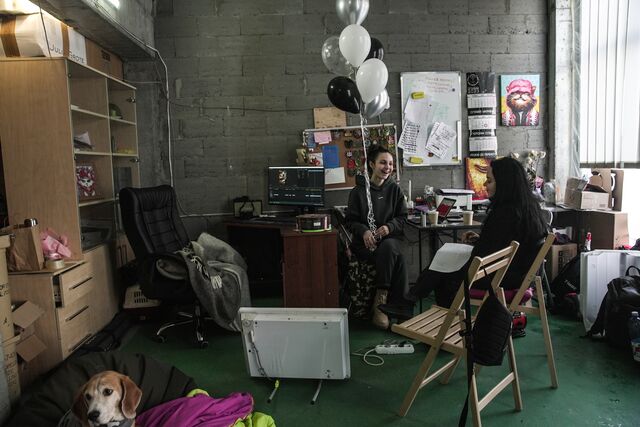
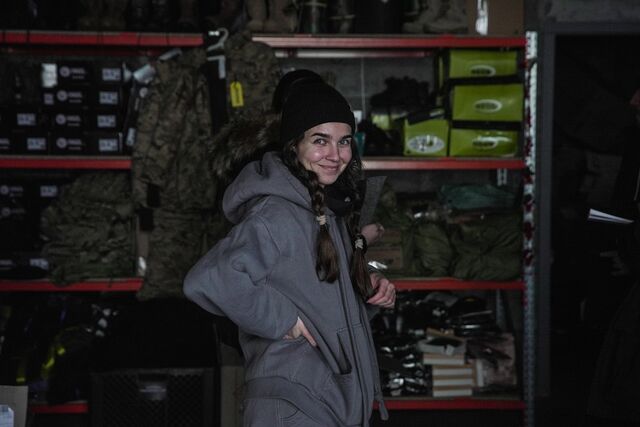
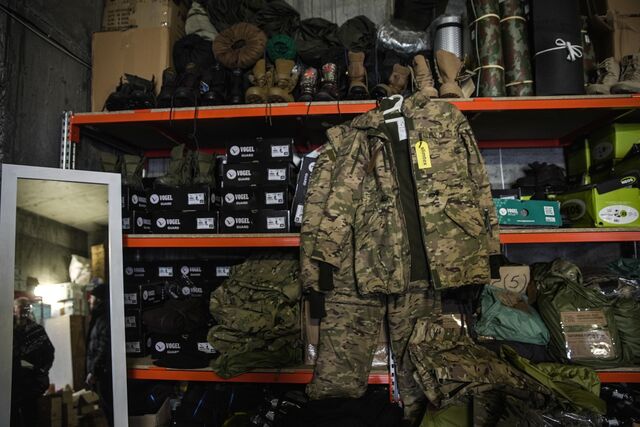
It soon became clear, he said, that the army wasn’t prepared for an influx of tens of thousands of volunteer female soldiers. The new organization, Zemliachky, asked for donations to put together boxes of female hygiene products.
Since then, they moved on to combat boots and asked a Ukrainian clothes maker to design uniforms with shoulder, chest, hip and leg sizes appropriate for women. A factory in the northeastern city of Kharkiv has made 2,000 uniforms in mid-season weight, with another 500 on order. The fund plans to order 10,000 designed for summer.
Zemliachky also sourced lightweight plates for bulletproof vests at $500 per pair. By now the organization estimates it has provided as much as $2 million worth of kit, either bought or donated in kind.
“I can’t serve, but I think she’s proud I am doing this and I didn’t leave,” Kolesnyk said of his sister, now stationed at Bakhmut, a scene of heavy fighting for months. “I had to do something.”
When the war broke out, Sabir Mamedov was a graffiti artist, while his friend Alik Mukhin was a race car mechanic. As their acquaintances signed up for the war, the pair decided to help out by painting the pickup trucks and cars they were taking with them to the front in camouflage.
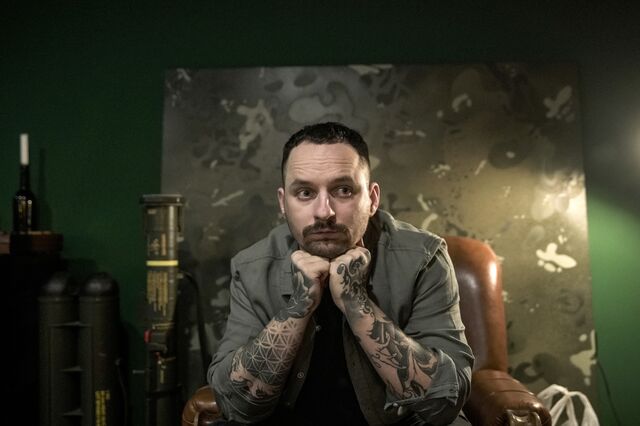
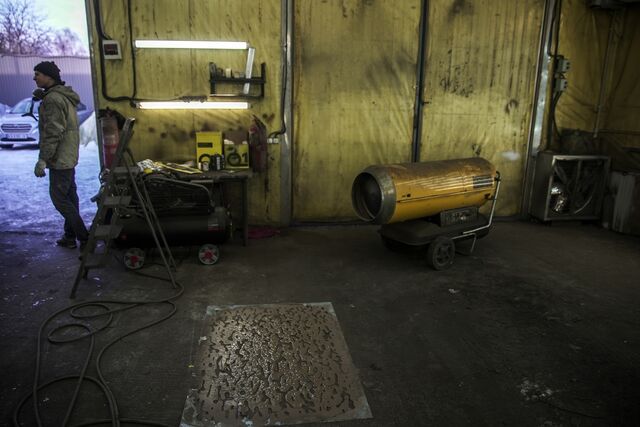
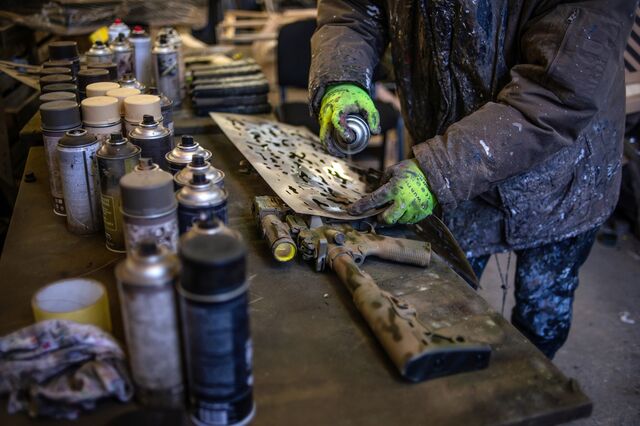
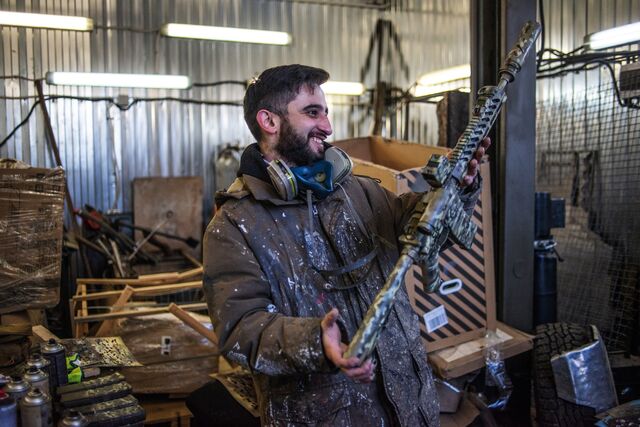
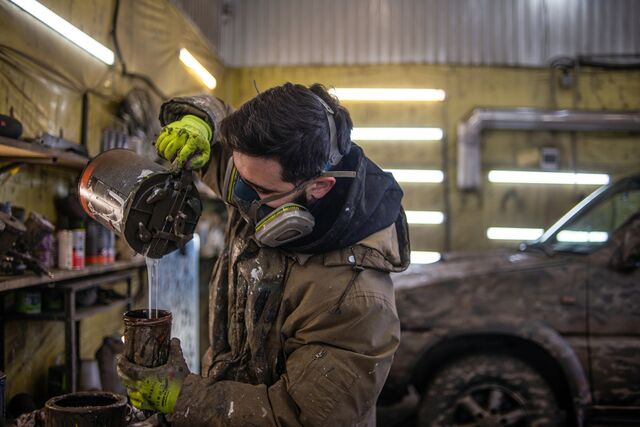
It took Mamedov about a month to get the camouflage design right, walking around the woods across from his house to understand the colors and then experiment on the cars. “They were all different at the start,” he said.
On a recent day, though, he moved swiftly around an SUV with his stencil and sprays as he painted the group’s 1,763rd vehicle, each marked with the logo of the Civil Resistance and Assistance Foundation. Two pickups and a Soviet-era motorcycle with sidecar stood painted.
Mamedov moved on to one of thousands of rifles, mortar tubes and other items that have passed through the paint shop.
“You just don’t want to be seen by their drones,” said one client, an operator of massive helicopter UAVs, as he collected his now camouflaged AR-15 rifle. He asked not to be named.
Mamedov and Mukhin say they ran through their savings in the first months of the war, when they were painting an average six to seven vehicles a day for free (their record was 16). Now units pay for materials when they can and the pace has slowed, but finding funds remains difficult, said Mamedov. “We get some donations, we run up credit card debts, but every month we’re on the verge of having to close.”
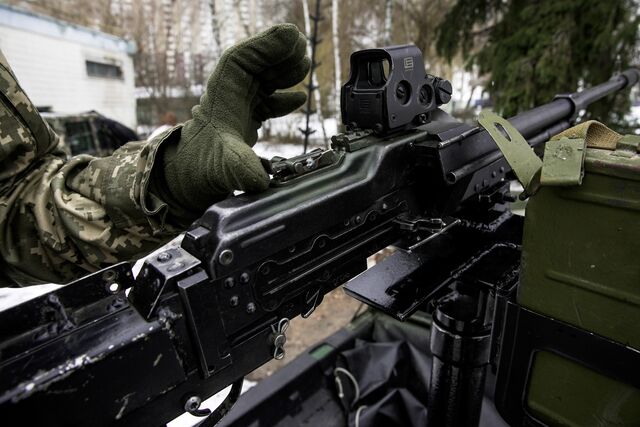
The way drones are changing the war isn’t just driving demand for camouflage. Across Kyiv, members of the 242 Territorial Defense battalion are slicing and welding steel pipes to make adjustable posts they can screw to the open beds of their pickup trucks. They fit swivel mounts for machine guns on top of the tubes, oriented vertically to shoot down drones, including the winged Shahed loitering munitions that Russia bought from Iran.
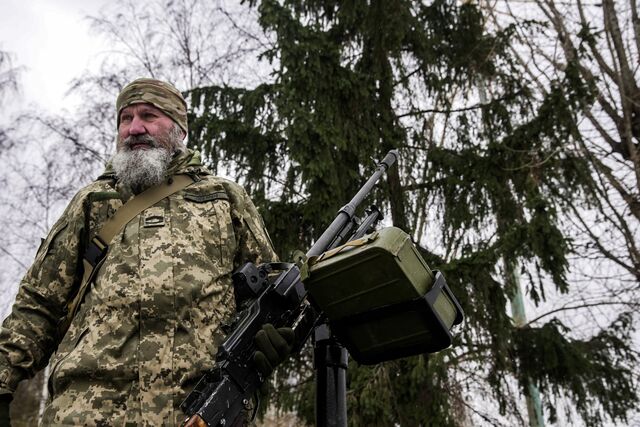
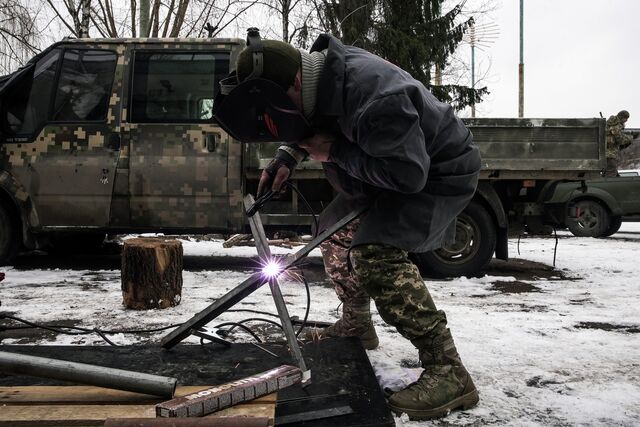
“We had no equipment like the Russians, but we needed to be able to move quickly, so we brought our own cars,” said Oleksandr Zhyhun, the battalion’s deputy commander, who before the war used to draft legislation for lawmakers in parliament. Now, like units across the front, the 242 are having to adapt again.
The crew had mounted a PK Kalashnikov machine gun stripped from an infantry fighting vehicle onto the bed of a pickup. The side windows had been replaced with heavily scratched hard plastic and there were holes in the roof from shrapnel damage. A volunteer had made sights for the gun.
“The sights cost 1,000 euros to buy and we didn’t have that money, but this one works even better,” said Vsevolod Zhytnyakov, the battalion’s weapons expert. “It’s a different war now with the drones, so we have to learn how to get at them.”
So far they’ve built 12 anti-drone pickups, said Zhytnyakov. Before the unit is ordered east they want to have 30 mounted guns in different configurations for the battalion, which at full strength consists of about 700 troops.
They’re a long way from that. Many of the original volunteers are recuperating from wounds or PTSD, and recruitment has become more difficult now soldiers know they won’t be defending their Kyiv homes, according to Zhytnyakov.
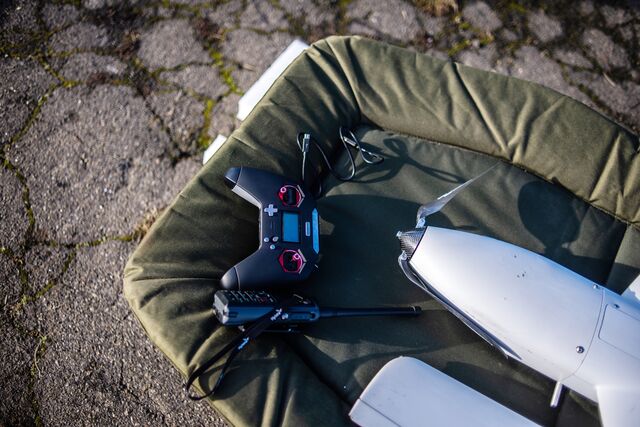
In another nondescript suburb of the capital, UA Dynamics, a small company started by a group who served in the Donbas after 2014, is producing an attack drone called the Punisher. It can fly for just 1.5 hours and 45 km, but its electric motor is silent and gives off no thermal signal, according to Maxim Subbotin, a co-founder. The drone doesn’t need to stream traceable live images back to base because target coordinates are programmed into the drone before takeoff.
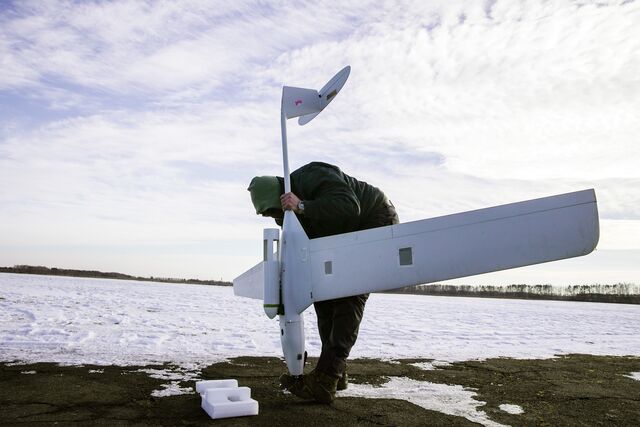
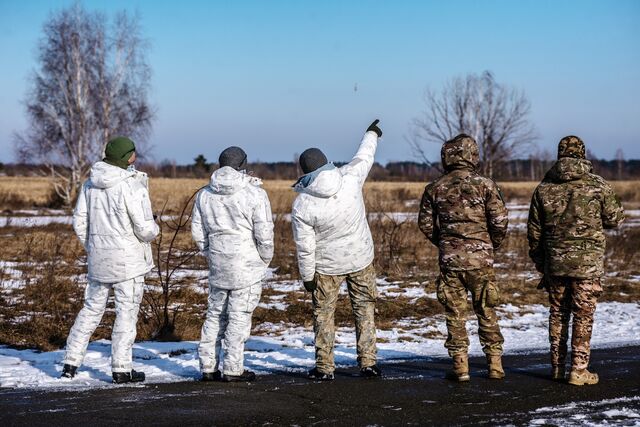
Those attributes allow the Punisher to drop 2.5 kilogram ball-bearing bombs behind Russian lines without detection, according to Subbotin.
At $50,000 a piece with a command station, the Punishers are expensive compared to the jury-rigged commercial drones that both Ukrainian and Russian forces often use to drop explosives on each other. Yet the small helicopter drones are lucky to survive a mission, whereas some Punishers have by now flown hundreds, according to Subbotin.
There are 37 crews flying 50 Punishers along the front and with the company run not-for-profit, the bomb canisters are provided for free. “Ukrainians are a creative nation,” Subbotin said. “The Russians made a big mistake.” —With Natalia Drozdiak, Jody Megson and Karolina Sekula