Step Inside the Met’s Rebuilding of Beloved La Bohème
It was in continuous use for more than 40 years. Time for an update.
New York’s Metropolitan Opera has presented an unprecedented number of new productions in recent years, but it’s taking a different approach to Puccini’s La Bohème. The opera tells the story of a young, penniless poet named Rodolfo who falls in love with his neighbor Mimi, who’s also young and penniless. For a brief moment their romance is all that matters, until Mimi’s consumption begins to worsen. (Spoiler: This doesn’t have a happy ending.)
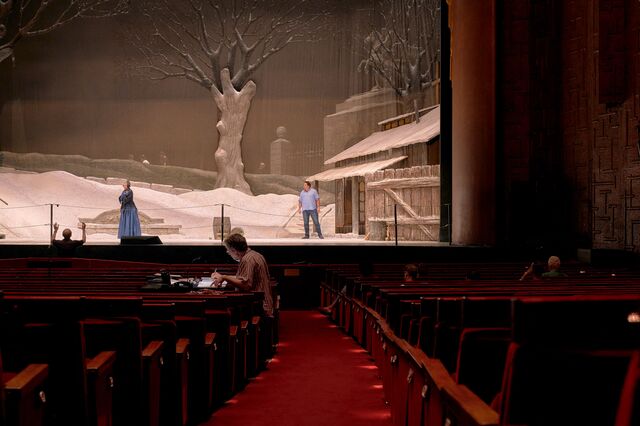
The Met’s ongoing production was created by the director-producer-designer Franco Zeffirelli, whose sets, now 40 years old, evoke a fairy-tale version of 19th century bohemian Paris. The first and fourth acts are placed in an impoverished garret in the Latin Quarter; the second act is a town scene, replete with multistory buildings; the third is staged at an inn on the edge of the city. Since the production premiered, in 1981, it’s consistently “been one of our best sellers,” says John Sellars, the Met’s assistant general manager of production. “As long as we’re selling tickets and sales are strong, it makes sense to maintain the production.”
But even though the set was, as Sellars says, “built to last,” 40 years is a long time, and the wear and tear of continuous use was beginning to show. It didn’t help, he says, that when not in use the production sits in shipping containers in a storage yard near Newark airport. “We have something in the neighborhood of 1,500 shipping containers filled with scenery there,” Sellars says. “They’re stacked up in a yard, and that’s part of the reason everything requires touch-up and maintenance. It’s not ideal conditions to store scenery.”
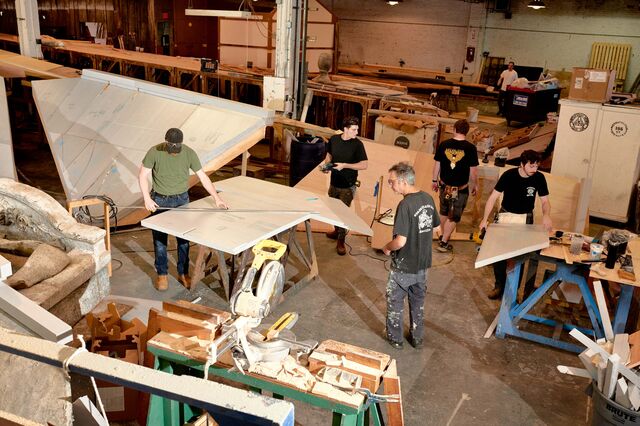
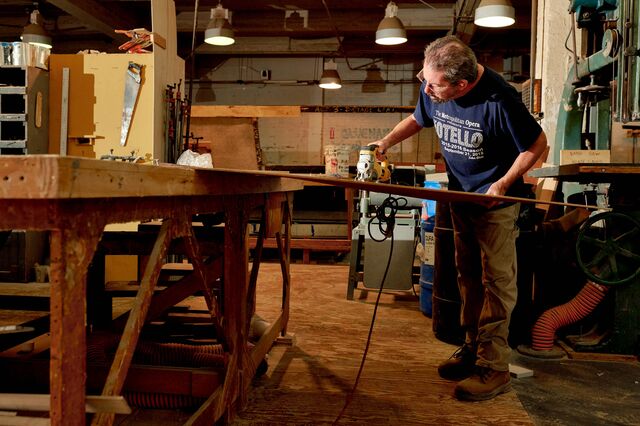
Over the years, La Bohème had been repaired piecemeal—a bit of paint here, a nail or two there. Finally, though, last spring it was time for an overhaul. A Met board member, Graham Berwind III, donated $1 million for the project. First to get refurbished were Acts 1 and 4, “which are basically the same set,” Sellars says. “So we completely rebuilt those over the course of last winter.” But there was money left over, he says, so “we kept going.”
Now, in addition to Acts 1 and 4, when La Bohème has its first performance of the season on Oct. 10, audiences will also see an entirely rebuilt Act 3—the product of 40 people working through the summer at the Met’s shop in the Bronx. Two separate divisions were involved: About 25 people in the construction shop “did all the nuts and bolts and hammering and nailing,” Sellars says, then about 15 people in the scenic department “came and put the finishes” such as paint color and texture, he says.
Sellars says the goal in rebuilding Act 3, which Bloomberg Pursuits documented, wasn’t exactly to change anything. “It will achieve its goals better,” he says. “It’s cleaner and more successful at setting the scene than it had become.”
Still, keen-eyed observers can keep a lookout for key, revitalized components in the scene, which chronicles the quarreling lovers as they resolve to hold their relationship together until springtime. (Mimi, desperately ill, is tired of Rodolfo’s jealousies, while Rodolfo, terrified of her disease, doesn’t know how to cope. Again, this isn’t a happy opera.)
The Snowbank
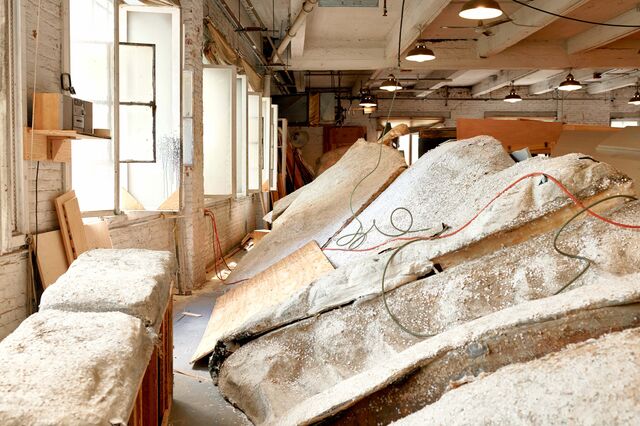
The first thing the shop wanted to work on was the snowbank, which runs almost the length of the stage. The bank is built in three sections, “and when you slide the three together there’s a seam,” Sellars says. “And what we’d have to do every night on the act change is to take boxfuls of artificial snow and throw it all over the snowbank, particularly trying to fill in the seams and around the floor, so it actually looks like snow.” This, of course, was inconvenient and time-consuming, so the shop’s solution was to cover the three sections with a cloth that’s made to resemble snow. “We still dress it with snow and blend the cloth a little bit, but we’re pretty confident it’s going to look better and you won’t see the seams as much,” he says.
The Tree
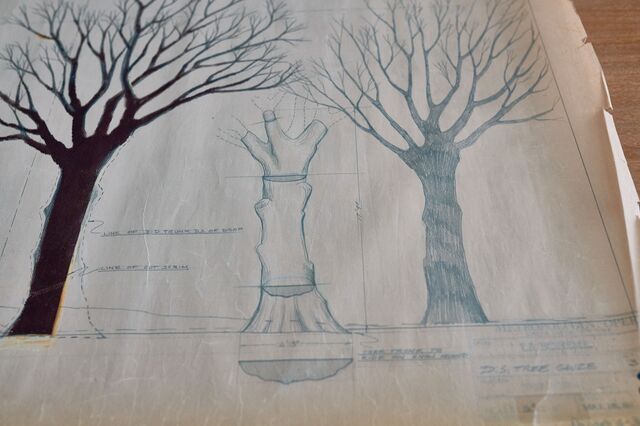
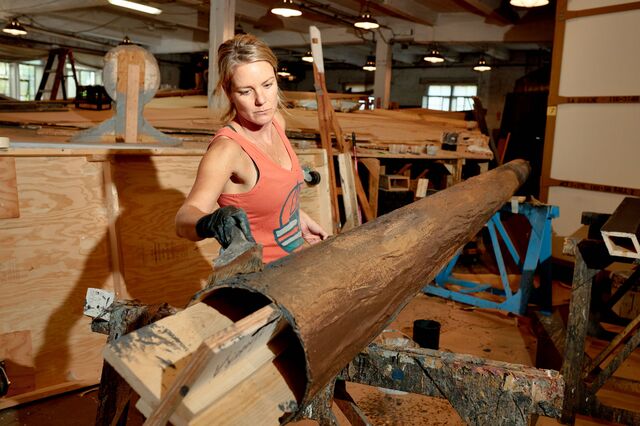
Two massive trees loom over the stage, with a third tucked behind the tavern. The canopies of the trees are painted on scrims, but the trunks are built in three dimensions in low relief. That way it appears that the vastness of the tree simply recedes into the misty winter evening. The tree in the middle needed a lot of work. “Over the years, that tree trunk got rebuilt a couple of times because it had been damaged,” says Sellars. “So just the form and shape of it started to get soft and round and didn’t look much like a tree, and the branches didn’t really look like branches, and became stubbier-looking.” In addition, at some point in the distant past the center tree’s scrim was torn and had to be replaced, and “when we repainted it, it got slightly out of line,” he says. “So there’s a struggle every night to make the tree base and canopy on the scrim look like they belong together.” By rebuilding the trunk and repainting the canopy, the two parts, Sellars says, will finally be aligned.
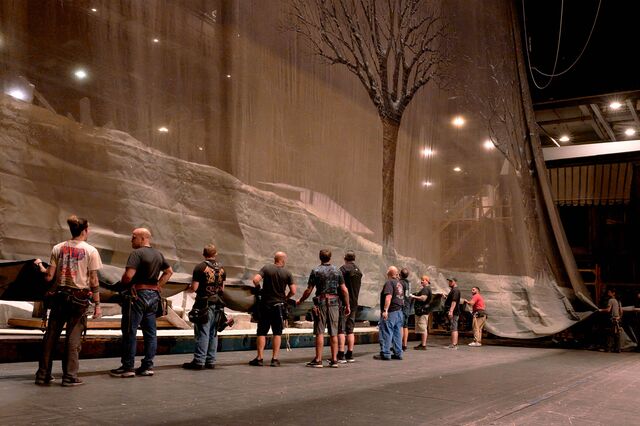
About that scrim: “One of the things I really like about Act 3 is the illusion created by the scrims,” Sellars says. One is in midstage, and another, which depicts a statue on a plinth, is behind that. “The illusion that’s created is one of the things that [Zeffirelli] did so well,” he says. “Audiences appreciate it, because they feel like the set is much deeper than it is, and there’s more environment than there really is, and that’s because of the scenic art.” Only the center scrim (which depicts the canopy for the three-dimensional tree’s base, along with the third tree behind the tavern) was repainted, with artists working from original scenery and its newly created tree trunk.
The Scenery
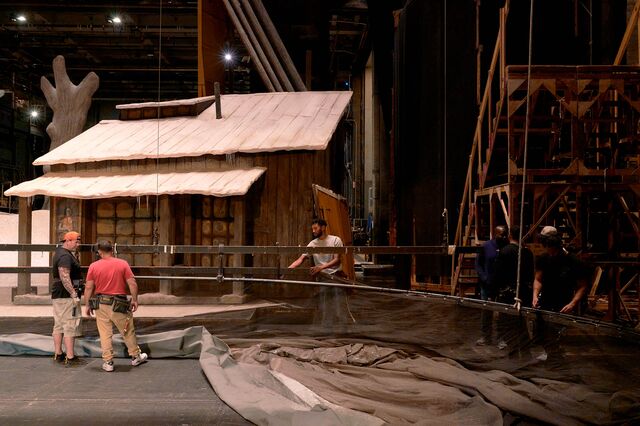
The three-dimensional scenery that depicts the gatehouse and a statue were heavily touched up. The tavern was also significantly refurbished, with some portions rebuilt and others reused. “Some of what we took into consideration with the tavern was how we’d light it from the inside,” Sellars says. For the past 40 years, he explains, the structure’s interior was lit via light fixtures bolted to the framework; when they redid the building, they made purpose-built accommodations. “The old version was built without consideration for any lighting, and lights were just added to it,” he says.
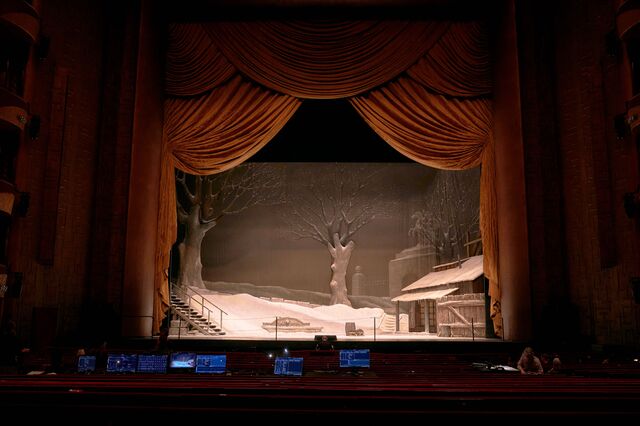
The week before the opera opened, the set was loaded into a shipping container and transported from the Bronx to the opera house. As the stagehands assembled it, “we were seeing it for the first time,” Sellars says. “Other than the main stage, we don’t have a place to assemble a full set.” And so a vast crew of people (stagehands, the construction crew and the scenic team) scurried around the set making sure it fit together, that the hardware was lined up and that everything worked as it should. Once it all fit, Sellars demonstrated a cautious satisfaction. “It went together pretty well,” he says. “Nothing unexpected,” which of course was the point of the entire reconstruction. “It’s not like if you see the show you’ll say, ‘I don’t remember this,’” he says. “You’ll be like, ‘There it is, it looks so beautiful.’ That’s the reaction, I would think.”