PB
Can you make reservation for tonight. I didn’t make lunch
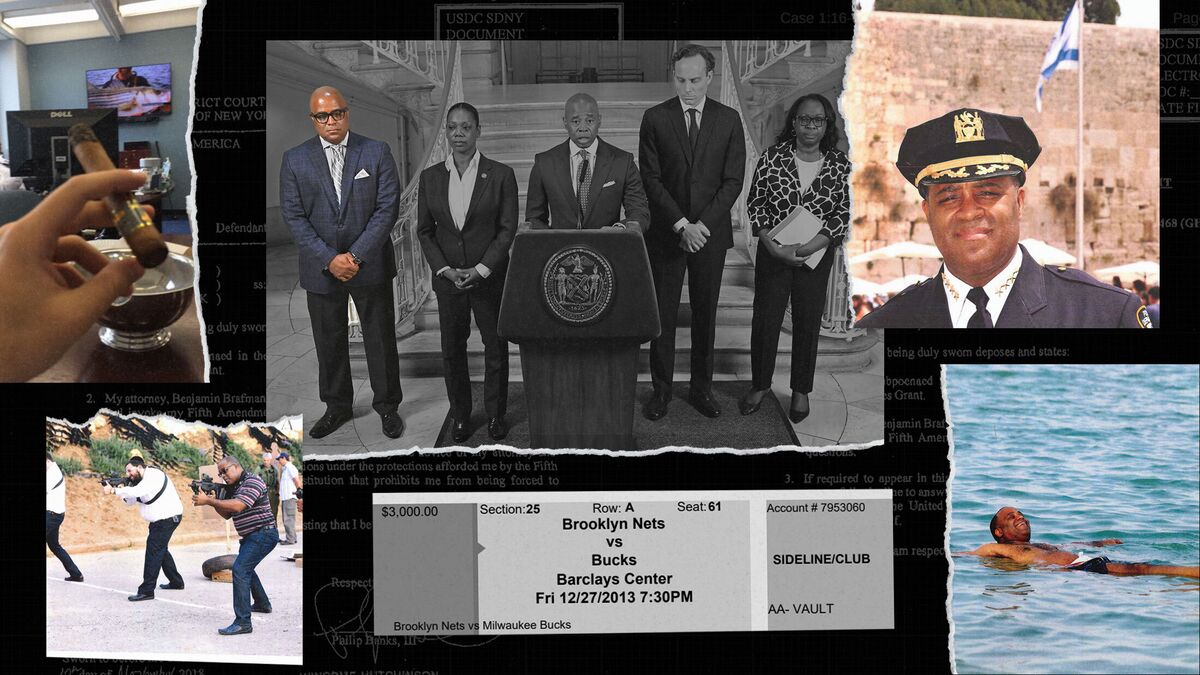
Phil Banks, a former high-ranking NYPD official who resigned from the force amid a federal public corruption probe, is making key decisions under Mayor Eric Adams.
Mayor Eric Adams is outspoken in his efforts to fight crime in New York City, but the architect behind his public safety plans is rarely heard in public.
Deputy Mayor Phil Banks works out of a nondescript Verizon office tower, away from City Hall. Unlike Adams’s other deputy mayors, and unlike deputy mayors from previous administrations, Banks hasn’t taken questions at one of the hundreds of press conferences the mayor has held since he took office.
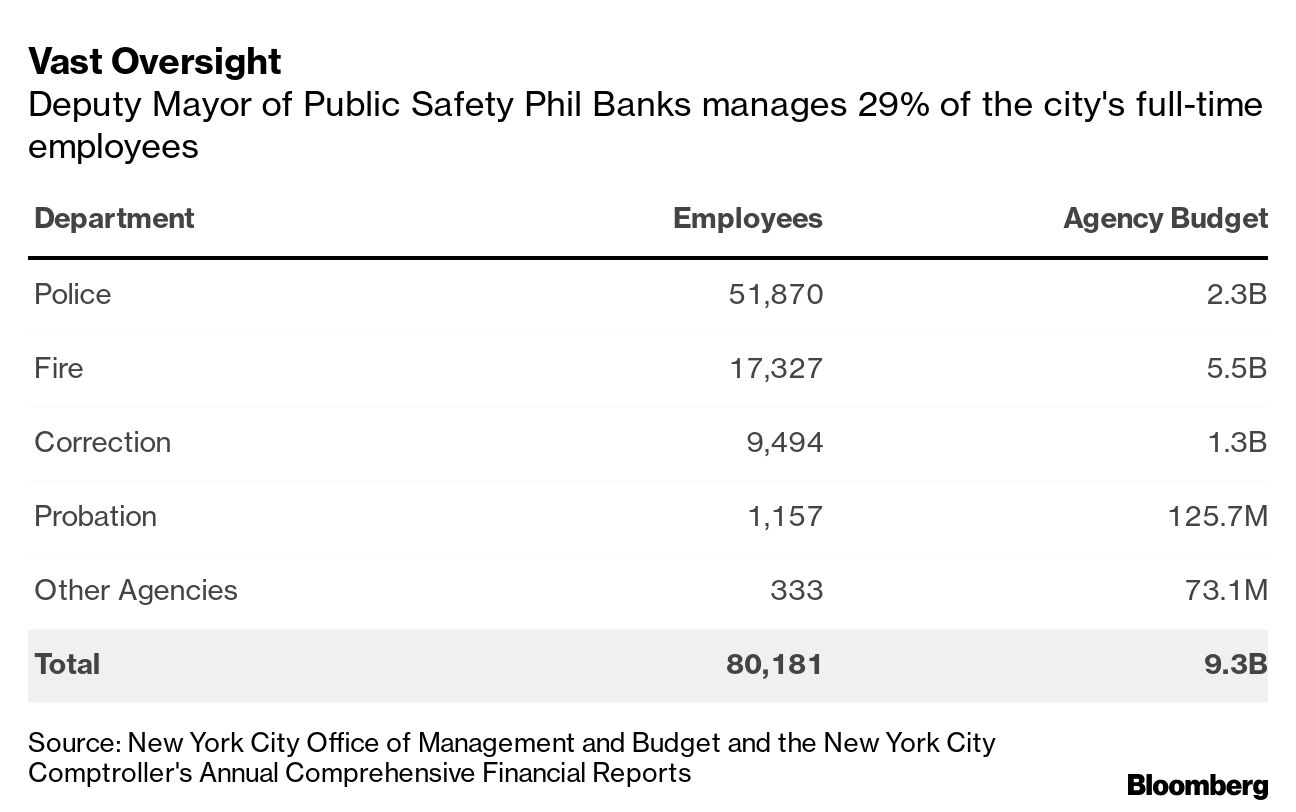
The result is that decisions about some of the most-watched elements of the mayor’s policies are made behind the scenes by a man few New Yorkers can even name: As the first deputy mayor of public safety in over two decades, Banks's charge stretches across 29% of the city’s full-time employees in the New York City Police Department, fire department, jail system and investigations unit.
Staying behind the curtain is by design, according to two people familiar with the Adams administration who requested anonymity because they weren’t authorized to speak publicly. They say that part of the reason Banks has intentionally kept out of the public eye is to avoid questions of his past involvement with a wide-ranging federal public corruption investigation into favor-trading.
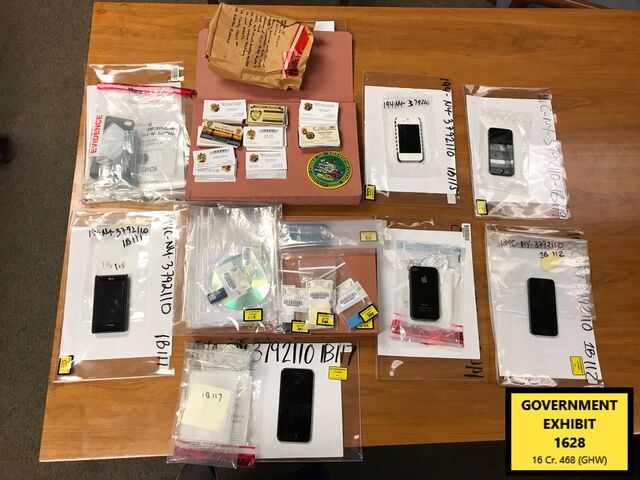
Videos, photos and recordings from evidence presented in federal corruption trials from 2016 to 2019 and obtained by Bloomberg News — some of which haven’t been previously published — help provide further detail about the allegations that surrounded Banks after he abruptly resigned in 2014 as the NYPD’s highest-ranking uniformed officer.
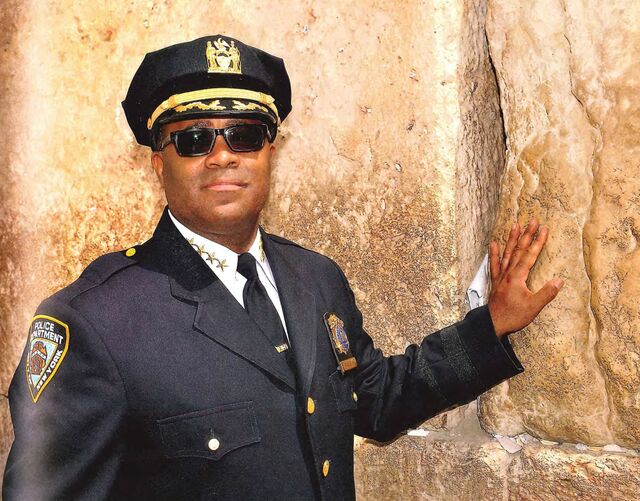
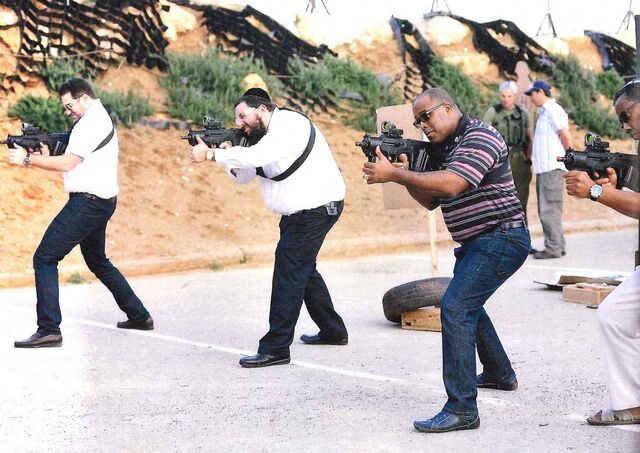
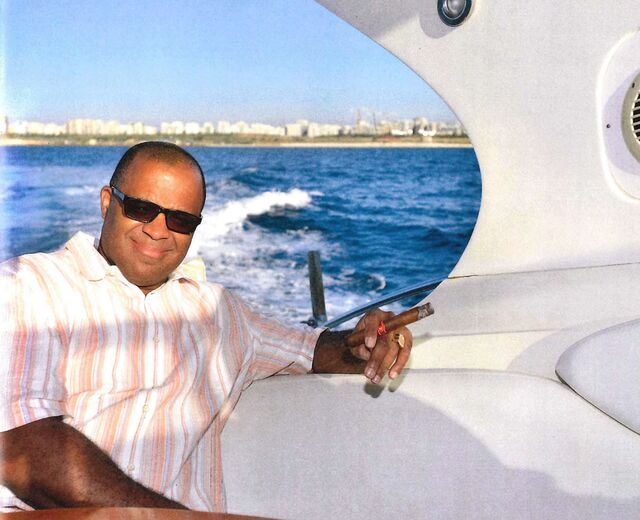
Federal prosecutors labeled the former NYPD chief of department an unindicted co-conspirator — a term that designates someone they allege was a participant in illegal activity but who has not been charged with a crime. Banks has consistently denied any wrongdoing.
The federal probe led to the convictions of the city’s correction officer union president, two Brooklyn businessmen, a former hedge fund manager and the arrest or disciplining of multiple NYPD officers.
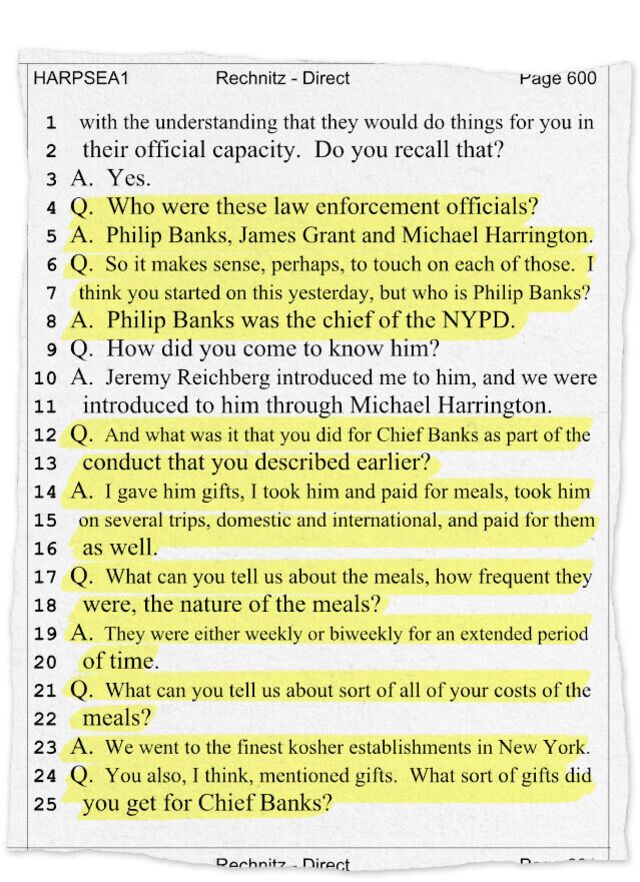
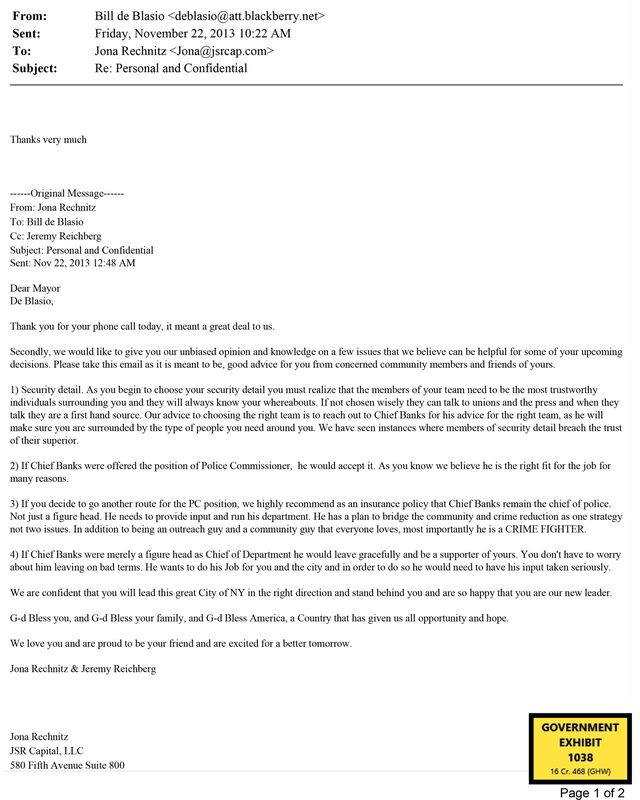
Evidence gathered shows the extent of the gifts prosecutors alleged Banks received, from steakhouse dinners and $6,000 worth of basketball tickets to an all-expense paid trip to Israel and two trips to the Dominican Republic.
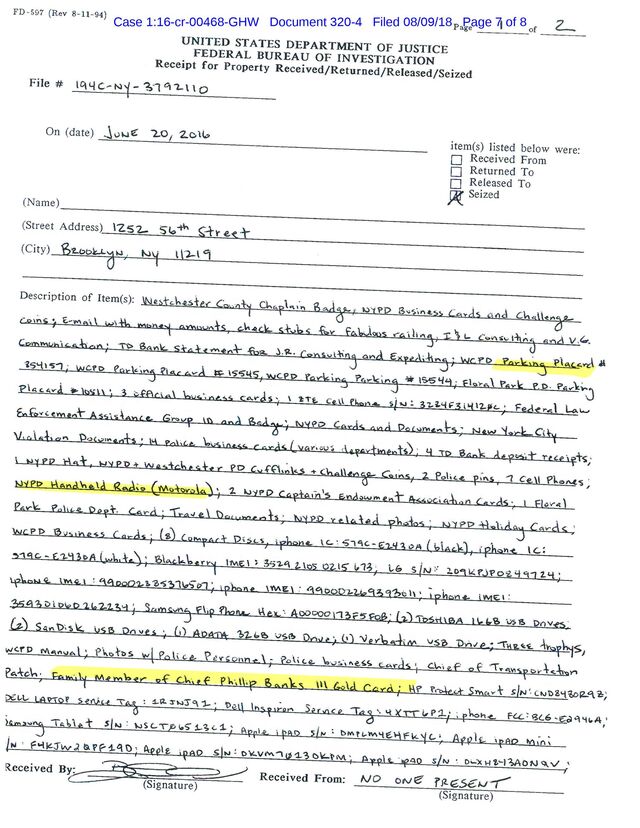
In return, prosecutors say the businessmen wanted favors. Banks afforded the men perks like parking spots at police headquarters and a police escort to the Times Square ball drop on New Year’s Eve, according to court filings. Another perk was a gold card entitled “Family Member of Chief Philip Banks III,” which could be used to get special treatment from police officers, according to a June 2016 FBI receipt of seized goods.
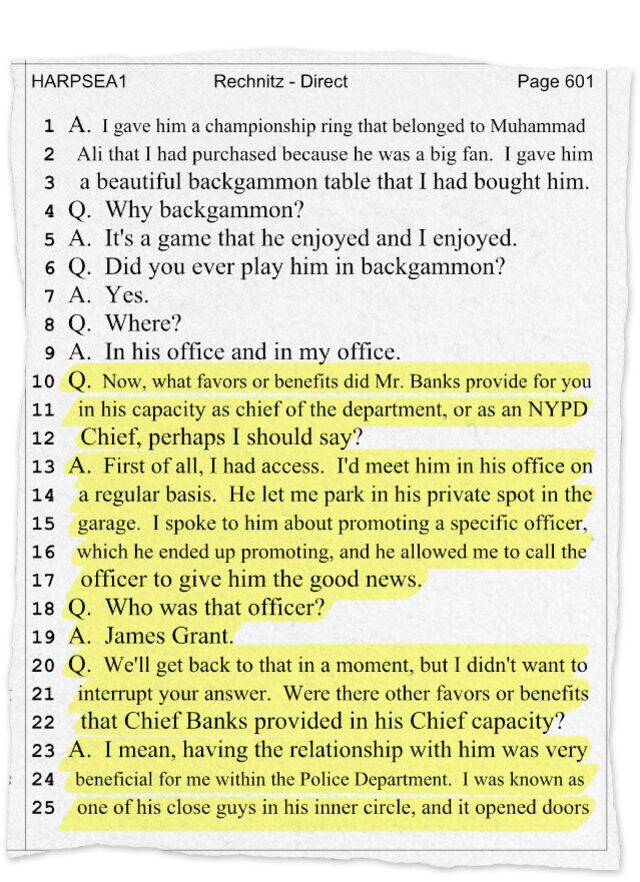
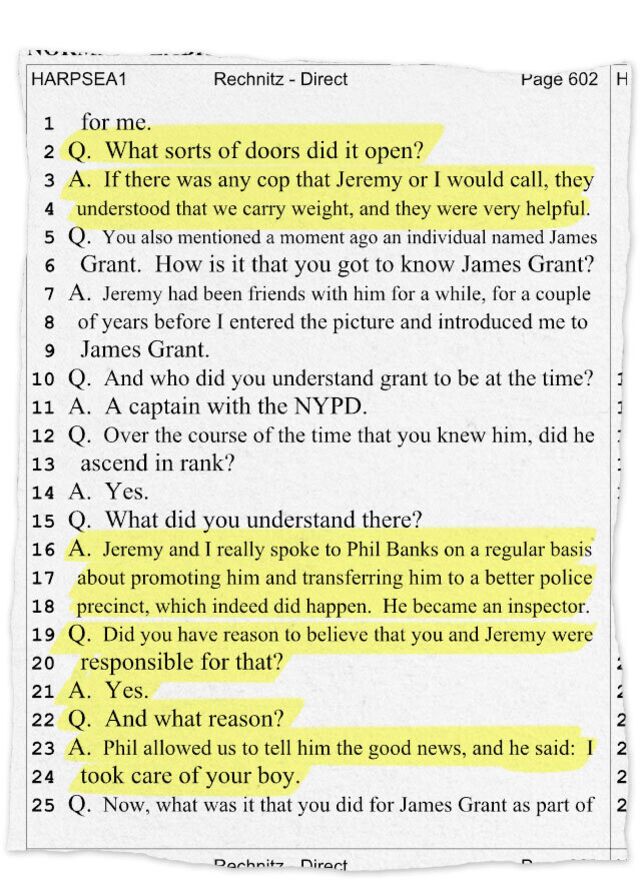
“I was known as one of the close guys in his inner circle, it opened doors for me,” one of the convicted businessmen, Jona Rechnitz, said of his relationship with Banks, in testimony at the October 2017 trial of Norman Seabrook, the former New York Correction Union head who was sentenced to 58 months in prison for accepting bribes in exchange for investing union money in a New York hedge fund.
Seabrook didn’t respond to a request for comment.
A City Hall spokesperson declined to comment, but pointed to previous statements where the mayor has stood by his hire of Banks.
“Phil acknowledges there were some real mistakes and errors that were made, he was not accused of a crime,” Adams said after Banks’s appointment. “Phil is a great person at the right time to do this job.”
Banks and his lawyer didn’t respond to requests for comment. In an op-ed Banks wrote in the Daily News in January, he said he’d never broken the law or abused his authority as an NYPD official. He said allegations of trading favors as a senior NYPD official for some form of compensation were “100% false.” “I never did anything in my official capacity” for the two convicted businessmen, but he offered an “apology to the people of New York,” for his relationships, which he called a “mistake.”
“These two men were attempting to corrupt public officials — and I now regret the time I spent with them,” Banks said. “I realize now that even the appearance of our friendship was damaging to my profession.”
Interviews with a half dozen people close to Adams and the NYPD, along with records obtained through Freedom of Information Act requests and evidence from past federal trials, may help explain why one of the most powerful officials in the city government has shied away from the limelight at a time when a number of the agencies he oversees are struggling.
From the start, Banks’s hiring was controversial. Adams seemed to downplay Banks’s hire by skipping the splashy press conferences he held when announcing his other high-profile deputy mayors and appointments. Instead, Banks disclosed his own role through the Daily News op-ed, which was followed by a press release. Neither described the prominent role Banks would play in shaping Adams’s signature policies and selecting key city appointments.
Some government watchdog groups say Banks’s op-ed never answered key questions around the investigation: Why was Banks named a co-conspirator and never charged? Why would the mayor appoint someone so intimately tied to a corruption investigation to oversee law enforcement?
“Putting him back in a place where he is making decisions, hugely important decisions and seems basically unrepentant, as if the previous scandal didn’t happen, it’s astonishing,” said John Kaehny, the executive director of Reinvent Albany, a government watchdog group.
Prosecutors never provided answers to these questions during various trials and it’s unclear why Banks wasn't charged in the case.
The law governing federal public corruption prosecutions changed significantly during the yearslong federal corruption investigation into the NYPD.
The US Supreme Court in 2016 threw out the conviction of former Virginia Governor Bob McDonnell and his wife, who accepted $175,000 in loans and gifts while in office. The unanimous court described the conduct as a “tawdry tale,” but said prosecutors failed to show the governor had undertaken an “official act” in exchange for the loans and gifts. The ruling made it harder to convict public officials for abusing the power of their office in exchange for gain. It also led to other overturned bribery convictions, including part of the case against former New York Assembly Speaker Sheldon Silver.
Phil Banks, 59, is one of Adams’s oldest friends and closest confidants. He and Adams came up together in the NYPD before the mayor left to pursue politics. His brother, David Banks, is the city’s schools commissioner and his father was a NYPD lieutenant. Adams had long talked to Banks about holding a prominent role in his administration, according to a person familiar with the discussions who was unauthorized to speak publicly on the matter.
By 2013, Banks had become the highest-ranking uniformed officer in the NYPD, and the department’s highest-ranking Black official. Former NYPD Commissioner Ray Kelly said he chose Banks for his experience as a “consummate builder of community relations” and Brooklyn Congressman Hakeem Jeffries called Banks a “bridge builder” at a time of tension in minority neighborhoods over the impact of “stop-question-and-frisk” policies.
“Phil Banks did a great job for me when I was police commissioner,” Kelly said in a statement to Bloomberg News. Jeffries declined comment.
Banks’s rise seemed even to astonish his own brother, whose memoir recalled Phil Banks’s struggles with school and hyperactivity as a child. “The kid who seemed like he might miss his chance to go to college was now protecting the entire city of New York, and seeing his name on the short list as a candidate for police commissioner,” schools commissioner David Banks wrote.
But in the fall of 2014, Phil Banks abruptly resigned after being offered a promotion to second in command to then-commissioner Bill Bratton. The decision stunned longtime supporters like then-mayor Bill de Blasio, who said at the time he was “disappointed.”
De Blasio and other top officials didn’t know it yet, but Banks was facing what for many public servants could have been a career-ending crisis, according to a person familiar with the de Blasio administration who didn’t want to speak publicly about the Adams administration.
As part of a wide-ranging corruption investigation into whether city officials were using their positions for personal gain, federal agents in New York’s Southern District sought to intercept communications between several businessmen and Banks, who was among a number of people identified as a target in a 2014 FBI wiretap application.
Years would pass before allegations about what Banks may have been doing in his final years at the NYPD would become public.
Those details would spill out in text messages, wiretapped phone calls, emails and photographs presented as evidence by federal prosecutors in a tangled, years-long NYPD scandal in which NYPD officers allegedly accepted gifts like Super Bowl tickets, prostitutes and fancy steak dinners. In exchange, they would allegedly provide favors like fixing parking tickets, expediting gun licenses and providing lights-and-sirens escorts through the city.
Banks was never charged with providing favors. Prosecutors alleged Banks accepted gifts that ranged from pricey steakhouse dinners and NBA tickets to $25,000 in investment proceeds from two of the convicted men at the center of the scandal: Jeremy Reichberg and Rechnitz, convicted Brooklyn businessmen who’d spent years ingratiating themselves with city officials. Rechnitz and Reichberg didn’t respond to requests for comment.
“Reichberg and Rechnitz persuaded Banks to ‘invest’ with Rechnitz,” federal prosecutors said in a 2019 sentencing memo submitted to a federal judge in connection with Reichberg’s conviction. “So as to advantage themselves in the ongoing contest for Banks’ affections and access to Banks’ power.”
At their peak, meals with Banks took place weekly and Banks “did not pay,” federal prosecutors said in the memo.
Some of the gifts Banks was alleged to have taken were of a high enough value that they violated NYPD and city policy, which prohibits officers from accepting any gift of more than nominal value and requires them to be declared as income. Banks has neither publicly disputed nor acknowledged that he accepted the gifts outlined by federal prosecutors’ allegations.
Evidence presented at trial suggested Banks provided the men with exclusive perks, including parking spots at police headquarters and a police escort to watch the ball drop in Times Square on New Year’s Eve.
“We’re going with the PC in his car to the ball dropping,” Rechnitz says in a 2013 cell phone video, which was introduced as evidence during the trial. “Welcome to January 2014. This is the new way of life.”
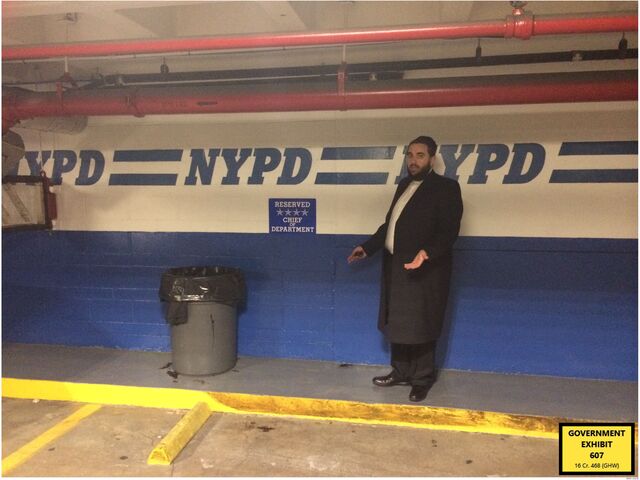
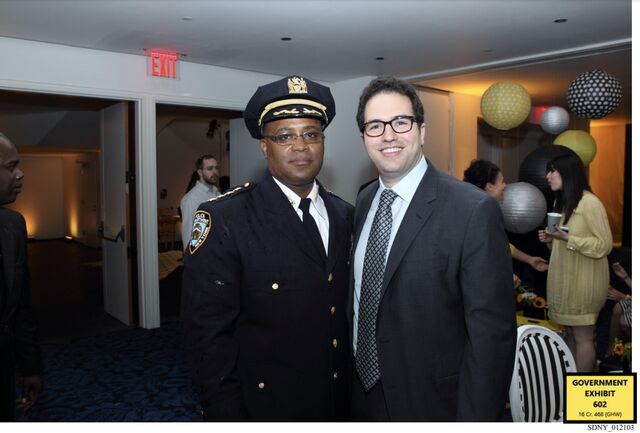
When federal agents raided Reichberg’s home, they found the “gold card” prosecutors said could be used to obtain special treatment, a photo of Reichberg standing in Banks’s parking spot and a video of Reichberg, Rechnitz and Banks smoking cigars in his NYPD office.
When asked what favors or benefits Banks provided for him during the 2017 Seabrook trial, Rechnitz said “I spoke to him about promoting a specific officer, which he ended up promoting, and he allowed me to call the officer to give him the good news,” according to transcripts of sworn testimony.
Banks hasn’t directly addressed those allegations. He said in the op-ed he “never did anything in my official capacity for Rechnitz.”
After Banks learned he could be under federal investigation, he anticipated cash troubles and called Reichberg for help, according to a call recorded by federal agents via wiretap of Reichberg’s phone. Banks said his lawyer — high-powered criminal defense lawyer Benjamin Brafman — tipped him off to a federal investigation.
“I gotta generate some kind of income, because they’re gonna hit me really hard,” Banks said. “If it doesn’t embarrass me, it could stop me from getting another job for a while.”
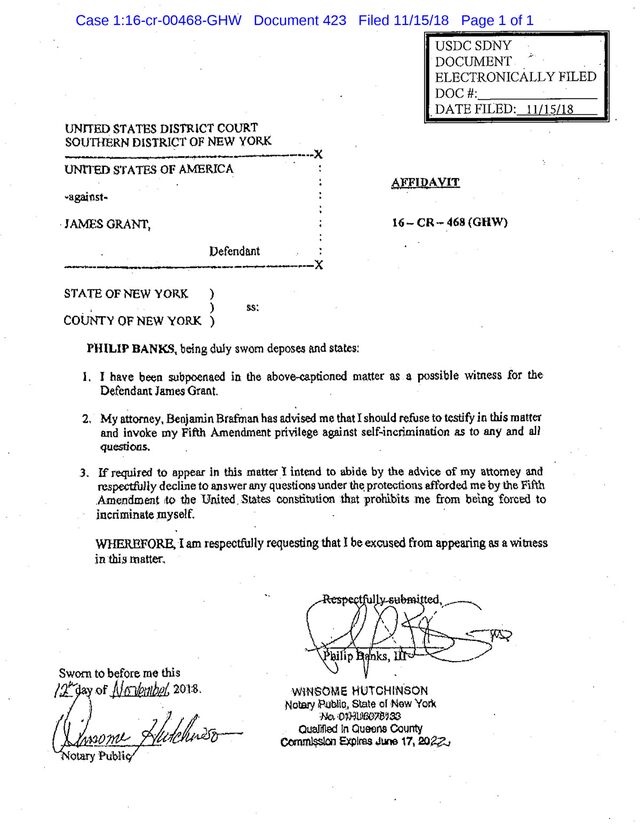
Banks had been subpoenaed to testify in one of the federal corruption trials, but in a 2018 filing submitted to the court, his attorney said that if called, Banks intended to invoke his Fifth Amendment right and refuse to answer questions that might incriminate him, according to an affidavit.
Reichberg was sentenced to four years in prison for conspiracy, honest services fraud and bribery — but was released early — in January 2022, according to the Bureau of Prisons. Rechnitz served five months in prison for conspiracy to commit honest services wire fraud.
After resigning in 2014, Banks remained close to the force. He started a security consulting firm that worked with cities and police departments that went by PB3 Solutions and CitySafe Partners, according to state business registration documents that indicate the business is still active.
In 2021, CitySafe Partners was approved by New York city officials as one of roughly four dozen companies eligible for city-funded contracts to provide security services at yeshivas and other non-public city schools, according to the Department of Citywide Administrative Services.
During Banks’s time away from the NYPD, his net worth more than tripled due to investments in tech stocks, Bitcoin and rental properties, according to financial filings released in August.
During Adams’s mayoral campaign, Banks helped craft the public safety policies that formed the core of the mayor’s successful run.
Still, it came as a surprise to some when Banks suddenly showed up at NYPD headquarters in Lower Manhattan, turned on his computer and began working on city matters before anyone knew he had formally taken the job, according to two people familiar with the matter who weren’t authorized to speak publicly on NYPD internal business. Banks’s appointment hadn’t been announced.
In one of his first acts as Deputy Mayor for Public Safety, Banks terminated the head of the NYPD’s Internal Affairs Bureau, whose investigation led to the one by the FBI. An NYPD spokesman at the time said the move was part of a “normal” transition of senior staff members.
Then came the appointment of Keechant Sewell, a Long Island detective who Banks helped pluck out of relative obscurity to become the city’s first female police chief.
Deputy Mayor of Public Safety Phil Banks manages 29% of the city's full-time employees
Banks personally oversaw the process, according to a person familiar with the decision who was unauthorized to speak publicly. But when Sewell was officially introduced to the city in a crowded press conference last December, Banks didn’t speak and wasn’t visible from the podium — a conscious effort to portray hers as the new face of the NYPD rather than the mayor or Banks, this person said.
But staying out of the public eye prevents Banks from answering to New Yorkers concerned about the city agencies he oversees and makes it hard to know what he is working on, says Kaehny, the director of the government watchdog.
Rates of major crimes are up 37% year to date from 2021, and Adams’s approval rating has dropped, in part, due to dissatisfaction with public safety. Two of the agencies Banks oversees — the NYPD and the Department of Correction — are under some form of federal monitoring due to failures to address safety issues. Hundreds of public employees have left those agencies in an unusually large wave of retirements that — combined with the impact of Covid — have made it harder to operate.
“Part of being a leader is leading and that means going out in front of the public, as a deputy mayor in charge of this huge and important portfolio,” Kaehny said. “This is one of the most important jobs in city government and you can’t go to a press conference?”