The Tiny Bubble Secret to Sustainable Denim Jeans
Jeanologia’s production methods help some of the world’s biggest clothing brands reduce their environmental impact.
The modern age’s most iconic piece of clothing—a pair of jeans—is also one of the most environmentally harmful to make.
Billions of pairs are sold every year, from stylishly distressed to faded vintage. Styles that look worn out—from hours in the sun or repeated washing—are almost never so. They’ve achieved that effect right off the production line, from toxic chemicals mixed with water. What happens to that contaminated liquid? It’s often dumped into rivers and oceans.
Enrique Silla is trying to reduce that pollution. His company, Jeanologia, over the past 26 years has developed production methods that cut as much as 90% of water from the process. He estimates 35% of jeans worldwide are made using at least one of the company’s machines. “We picked jeans because they’re the most consumed product,” Silla says.

“When we started,” he says, “we used to tell our clients that saving the planet could be a great business—and they thought we were Greenpeace.” So Silla focused on cutting costs because it was the easiest way to persuade companies to change their methods. It was “the language brands understood,” he says.
The company made some headway, but things really took off over the past five years as brands began actively embracing sustainability to appeal to younger, more climate-conscious consumers.
The shift helped Jeanologia grow from a tiny basement office in the Mediterranean city of Valencia, Spain, to a global enterprise that employs 220 people in 18 countries. In 2019 it posted revenue of just over €100 million ($120 million). Silla estimates the company saved the equivalent of 14 million cubic meters (494 million cubic feet) of water from pollution last year.
The machines designed and built by Jeanologia are used by some of world’s largest denim makers—mass producers in Bangladesh, Mexico, Pakistan, Turkey, and Vietnam that aren’t household names but supply a large share of the textiles used by big brands.
Silla remembers when it was just him, his uncle Jose, and a handful of engineers and designers working into the wee hours of the morning, brainstorming new techniques for manufacturing jeans. They’d head home with hands dyed indigo from handling so much denim.
Their first machine went on line in 1999, using laser technology to achieve the scratched, worn-out look of distressed jeans. It won over designers in part because it made it easier to replicate intricate patterns. The approach was safer, cleaner, and cheaper than the resource-heavy and toxic methods of the time. Factories either sprayed the jeans at high pressure with water mixed with chemicals such as potassium permanganate and phenol, or made the marks by hand using a file—an extremely labor-intensive and expensive process.

A second machine, developed six years later, mimicked the stonewashed effect that until then had been accomplished by using pumice stone and chlorine, or by treating jeans with large rocks in industrial-size washers. The water and chemicals were replaced with the use of ozone gas, which created the effect of bleaching the denim. The two machines brought water usage down to 30 liters (8 gallons) a pair, from as much as 100 liters before any of Jeanologia’s devices were used.
To reduce it further, Jeanologia unveiled its Airflow device in 2012. Built to resemble a giant washing machine, it uses air instead of water to “wash” the jeans. About 1 million tiny air bubbles are used for each cubic centimeter of water. They surround the jeans “like a cloud,” Silla says, as the machine spins the garments around. Because air bubbles are more efficient than water at carrying chemicals, Jeanologia was able to cut water usage to 10 liters a pair.
Completely removing water from the process is not an option for now, so Jeanologia collects and filters the liquid from its machines for reuse. “One unexpected benefit is that manufacturers are also cutting energy consumption, their biggest source of carbon emissions,” Silla says. “They don’t need to heat water to mix the chemicals, or to dry clothes to eliminate the water.”
As the methods have changed, so too have the priorities of apparel makers and retailers. Jeanologia has worked directly with some of the world’s most well-known fashion labels, including Levi Strauss, Tommy Hilfiger, and Calvin Klein, as well as retailers such as H&M, Fast Retailing’s Uniqlo, and Zara owner Inditex.
That’s prompting new innovation for all kinds of clothes, not just jeans. The fashion industry was responsible for about 4% of all greenhouses gases produced by humans in 2018, according to the nonprofit Global Fashion Agenda. If the industry were a country, it would be the world’s fourth-largest emitter after China, the U.S., and India.
“There’s definitely space to do more,” says François Souchet, head of Make Fashion Circular, an initiative at the Ellen MacArthur Foundation that focuses on reducing the industry’s environmental impact. “It’s a matter of many things—of costs, of management change at companies, of training people internally so they can embed sustainability in their work, and of the availability of solutions at scale.”
The industry’s total water usage still dwarfs the amount Jeanologia can help save. In 2017 textile production accounted for 93 billion cubic meters, according to the Ellen MacArthur Foundation. The industry is responsible for a fifth of global industrial water pollution.
As retailers get better at reducing the footprint of each individual piece of clothing, production growth fueled by fast fashion offsets these improvements. Clothing production doubled globally from 2000 to 2015 and continued to expand until the coronavirus outbreak in early 2020.
The Covid-19 pandemic also exposed the vulnerability of the fast-fashion model and its reliance on the long, fragmented supply chains that enable retailers to sell cheap clothes. With the shipping industry in turmoil and lockdowns shutting down factories around the world, companies have seen the benefits they gained from outsourcing manufacturing turn into liabilities.
Even before the pandemic, about 15% of clothes produced globally wound up in landfills before they could even make it to a store. The wait times for items to be manufactured, often in faraway countries in Asia, South America, and the Middle East, mean a lot of apparel will go out of style before it’s delivered to a buyer.
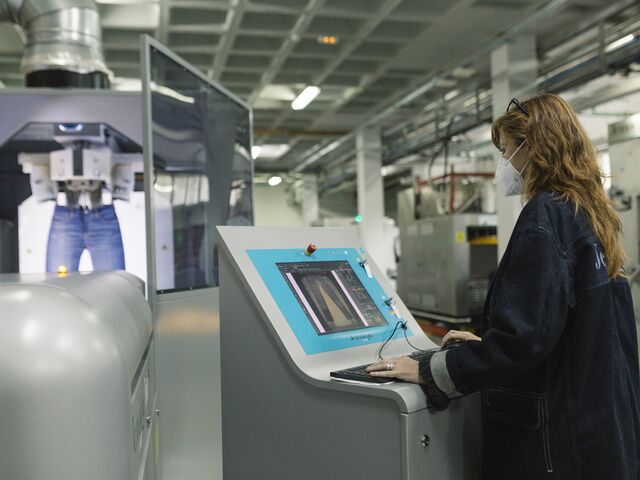
That’s the next challenge on Silla’s mind. High-tech, lower-cost production of jeans could cause some manufacturing capacity to move back to urban centers. In late 2019, Jeanologia started installing small plants near cities in Europe, the U.S., and Brazil. Silla envisions a day when what’s now known as fast fashion will transform into what he calls “accurate fashion.”
“Instead of producing in Asia what you think you’ll sell in six months’ time,” he says, “you produce today what people will want tomorrow.” —With Rodrigo Orihuela