Bloomberg Professional Services
This analysis is by Bloomberg Intelligence Litigation Analyst Holly Froum and Senior Government Analyst Nathan Dean. It appeared first on the Bloomberg Terminal.
President Trump’s imposition of 25% additional tariff s on goods from Mexico and Canada, and 10% additional tariffs on goods from China arguably is justified by the International Economic Emergency Powers Act that’s cited in Trump’s Feb. 1 executive orders, though legal challenges on grounds the president exceeded his authority are expected. Tariffs could lead to increased costs for electric-vehicle makers, like Volvo Car and Polestar, and clothing makers such as Nike and Adidas.
Our thesis: Tariffs could affect a variety of companies. Though the tariffs are on uncertain terrain legally, courts have been reluctant to second-guess the president’s powers to implement trade policy.
Tariff plan on uncharted ground
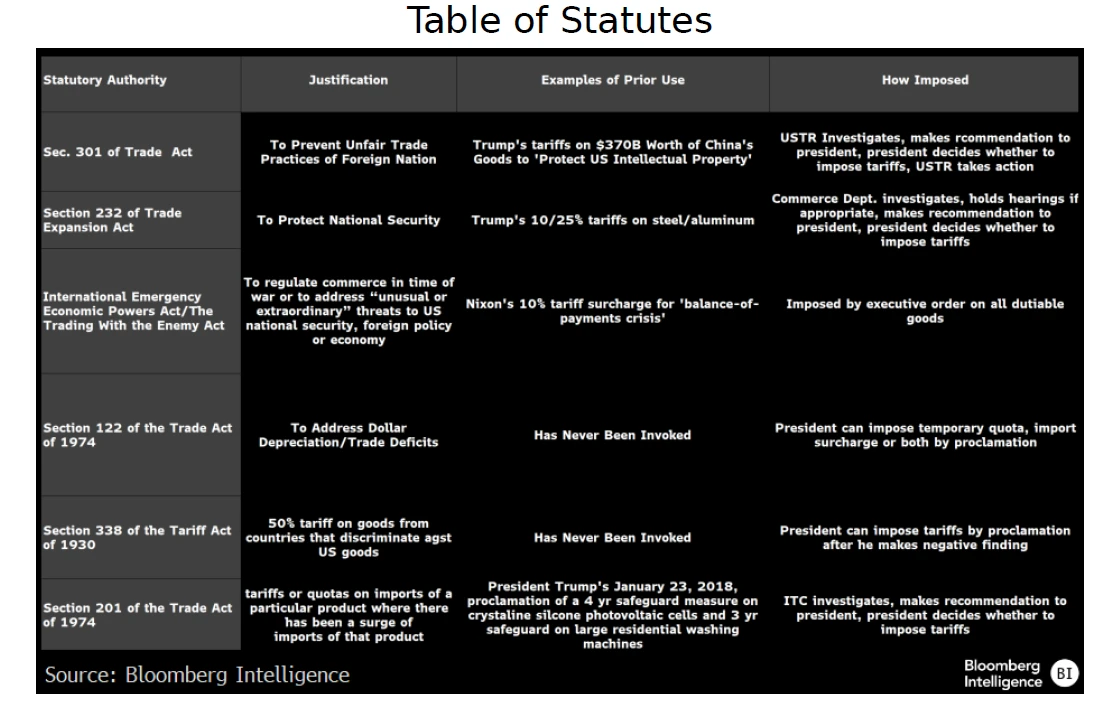
Trump’s declaration of an emergency in his Feb. 1 executive order citing the flow of illicit opioids from Canada, Mexico and China to justify his pledged 25% and 10% tariff s under the International Emergency Economic Powers Act is on uncertain legal terrain given the law has generally been applied to ban imports or exports completely when a country is for instance violating US policy. Arguably, the link to how these particular tariff s will resolve the problem cited is attenuated. Still, courts have appeared reluctant to second-guess a US president’s imposition of tariffs and even tariffs tenuously related to the purpose of statutory-tariff powers have been upheld.
Emergency tariffs could last months
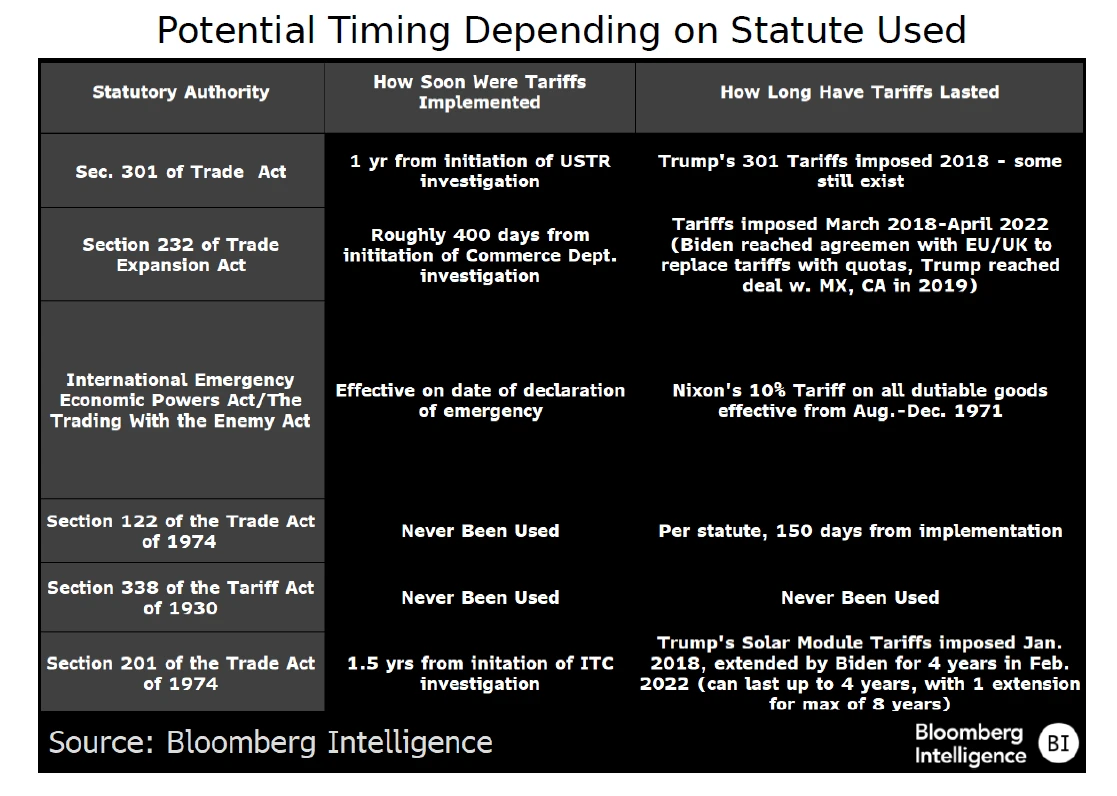
Tariffs imposed by Trump under the IEEPA could last months. Tariffs imposed by former President Richard Nixon to address an emergency under the IEEPA’s predecessor lasted about four months. Congress could also aim to pass a law terminating the emergency, which may take several months to come to a vote yet probably wouldn’t be enacted given Trump’s veto power. If, however, the tariffs are received unfavorably by consumers, the president may try to end them before a vote occurs on such a bill.
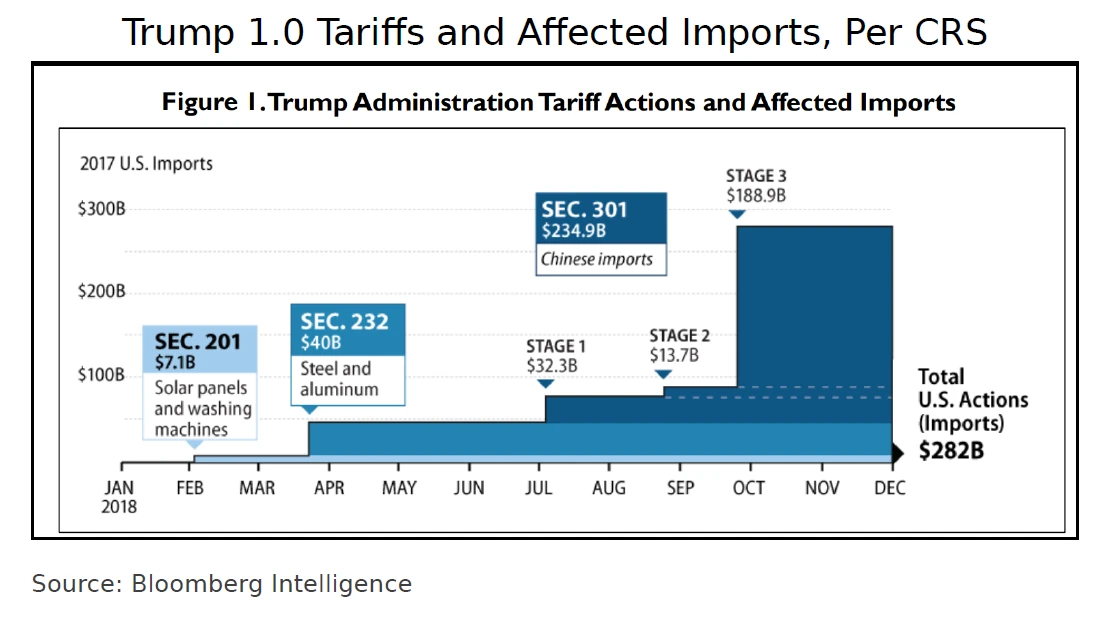
Tariffs invoked under other sections of the law, like Section 301 of the Trade Act, have lasted years. The US Trade Representative, tasked by Trump to investigate China’s trade practices, in 2017 took about seven months from initiation of the Section 301 investigation to put forth its recommendation.
Challenges may fall flat based on history
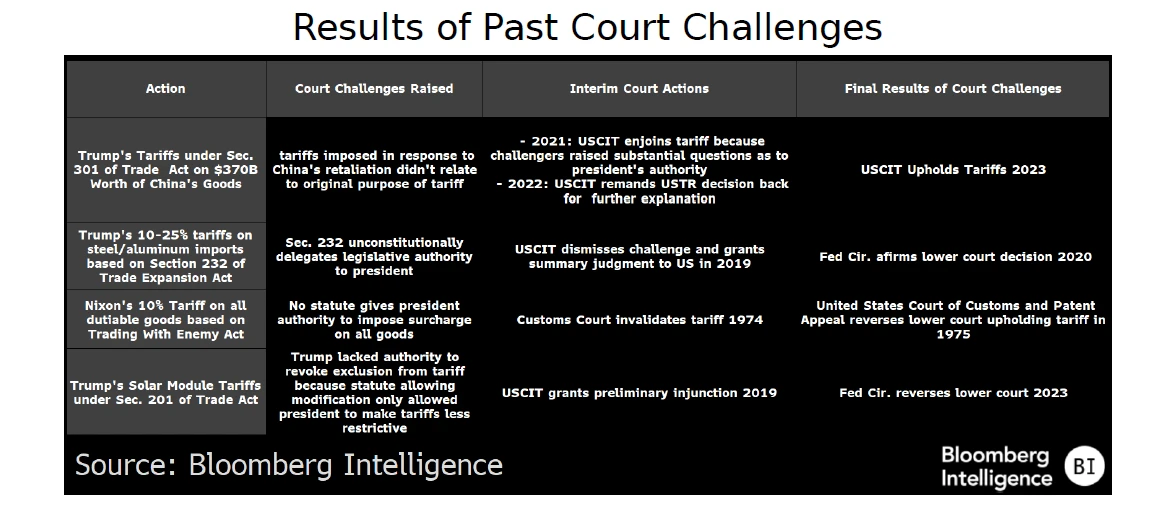
Tariffs on goods from China are likely to be upheld if challenged, based on precedent, given courts have been reluctant to second-guess the president’s emergency declarations. Challenges could be raised on grounds the president can’t justify how a 25% or 10% tariff addresses the emergency. Challengers in 2018, however, argued tariffs imposed in response to China’s retaliation for Trump’s prior Section 301 trade levies were unrelated to the original purpose of the tariff — to address failures to honor trade pacts. The tariff was enjoined but ultimately the challenge failed.
The most promising potential challenges could relate to failure of process, if for example, statutory requirements as to how or when tariffs are imposed aren’t followed. Elimination of an $800 “de minimis” exemption will also likely withstand scrutiny.
Tariffs may affect apparel, EVs
Clothing companies like Nike and Adidas could be hit by the tariff s on goods from China as could Volvo Car and Polestar, which make EVs in the Asian nation. If Trump intends to also impose staggered universal tariff s, or sector-specific tariffs, they likely would be justified under other laws that follow a different process. Section 232 of The Trade Expansion Act (tariffs where imports threaten national security) and Trade Act Section 201 (where there’s an import surge) likely must be applied to specific products. Tariffs under Section 301 of the Trade Act have been used to include various goods.
The data included in these materials are for illustrative purposes only. The BLOOMBERG TERMINAL service and Bloomberg data products (the “Services”) are owned and distributed by Bloomberg Finance L.P. (“BFLP”) except (i) in Argentina, Australia and certain jurisdictions in the Pacific Islands, Bermuda, China, India, Japan, Korea and New Zealand, where Bloomberg L.P. and its subsidiaries (“BLP”) distribute these products, and (ii) in Singapore and the jurisdictions serviced by Bloomberg’s Singapore office, where a subsidiary of BFLP distributes these products. BLP provides BFLP and its subsidiaries with global marketing and operational support and service. Certain features, functions, products and services are available only to sophisticated investors and only where permitted. BFLP, BLP and their affiliates do not guarantee the accuracy of prices or other information in the Services. Nothing in the Services shall constitute or be construed as an offering of financial instruments by BFLP, BLP or their affiliates, or as investment advice or recommendations by BFLP, BLP or their affiliates of an investment strategy or whether or not to “buy”, “sell” or “hold” an investment. Information available via the Services should not be considered as information sufficient upon which to base an investment decision. The following are trademarks and service marks of BFLP, a Delaware limited partnership, or its subsidiaries: BLOOMBERG, BLOOMBERG ANYWHERE, BLOOMBERG MARKETS, BLOOMBERG NEWS, BLOOMBERG PROFESSIONAL, BLOOMBERG TERMINAL and BLOOMBERG.COM. Absence of any trademark or service mark from this list does not waive Bloomberg’s intellectual property rights in that name, mark or logo. All rights reserved. © 2025 Bloomberg.