
Bloomberg Professional Services
- Africa’s economic potential depends on integrating fragmented markets, with regulatory alignment, trade reform, and infrastructure development offering opportunities to boost competitiveness, according to experts at the Africa Business Summit hosted by Bloomberg in Johannesburg.
- Trade, financial, andpaymentsintegration can lower transaction costs, improve cross-border commerce, and support regional value chains across manufacturing, resources, and services.
- Investment in infrastructure, fintech, and AI enables African economies to move beyond extraction, strengthen intra-African trade, and capture more value from processing, manufacturing, and exports.
Africa has size, people and natural resources on its side, but many observers agree that its markets must integrate to achieve meaningful scale, rather than operating in isolation. At Bloomberg Africa Business Summit event in Johannesburg in November, business leaders and policymakers discussed the steps required before the continent could meet its potential.
Africa is home to some of the world’s fastest-growing economies, with large mineral reserves and rapidly modernizing cities generating pent-up demand. But from tariffs to infrastructure gaps and regulatory mismatches, the region is often viewed by investors as a fragmented commercial environment. According to Jeremy Awori, Group CEO at Ecobank, without deeper integration, Africa will continue to compete at a disadvantage, regardless of the strength of its individual markets.
He says: “We operate in 34 countries across the continent, and each has its own legal framework, its own regulations and its own approach to things, but there is room to adopt the mindset of Pan-Africanism.”
“We need to create regional markets at scale that are attractive enough for investors to come in and consider us as 1.5 billion consumers, then they will invest in things like value-added manufacturing, as opposed to just the export market for the developed world,” he adds.
Payments infrastructure and cross-border trade
Modernization in Africa presents opportunities not only in large infrastructure projects but also in simplifying everyday cross-border transactions. Ecobank is working with Afrexim to develop payment mechanisms for small traders, some of who are forced to physically carry cash across borders to conduct transactions.
“You see the people moving across the border,” says Mene, focusing on the example of Ghana and Togo. “There are many, especially women, but they’re carrying cash. Why aren’t we paying digitally? Why don’t we have tap and pay?… So, when we think about infrastructure, we need to think about payments, effective cheap mechanisms to enable that.”
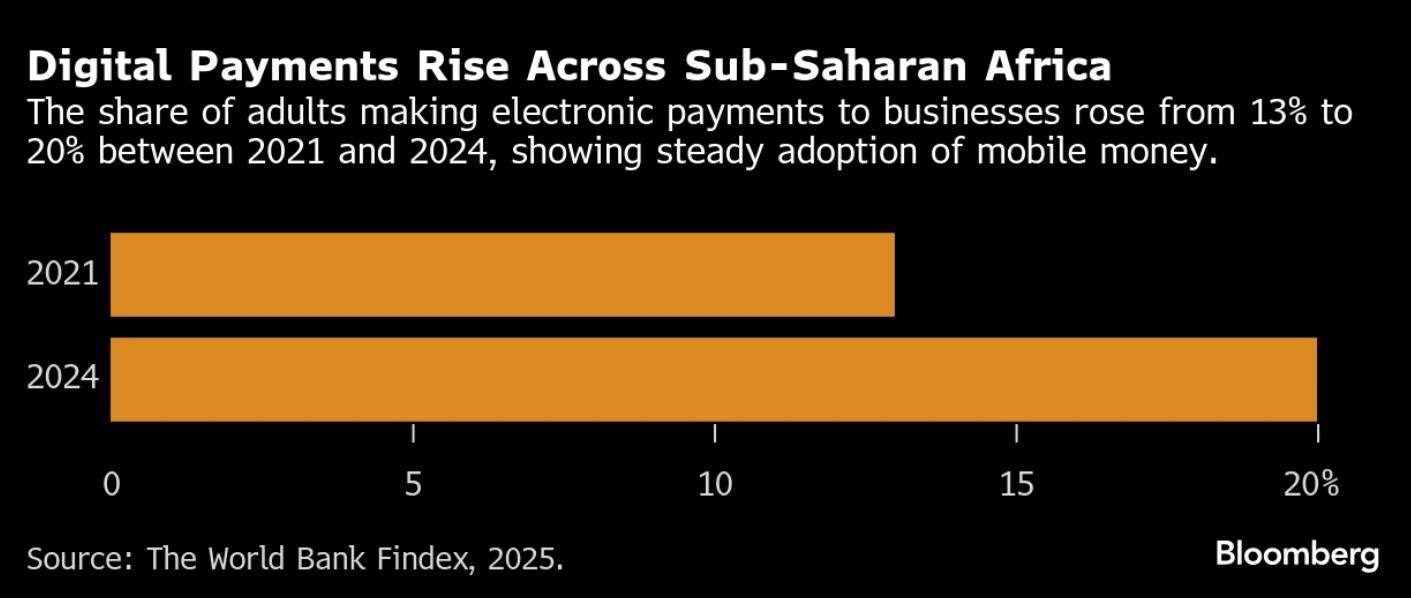
Notably, the share of adults making electronic payments to businesses rose by 7 percentage points to reach 20% between 2021 and 2024, underscoring growing demand for solutions that reduce friction in everyday transactions.
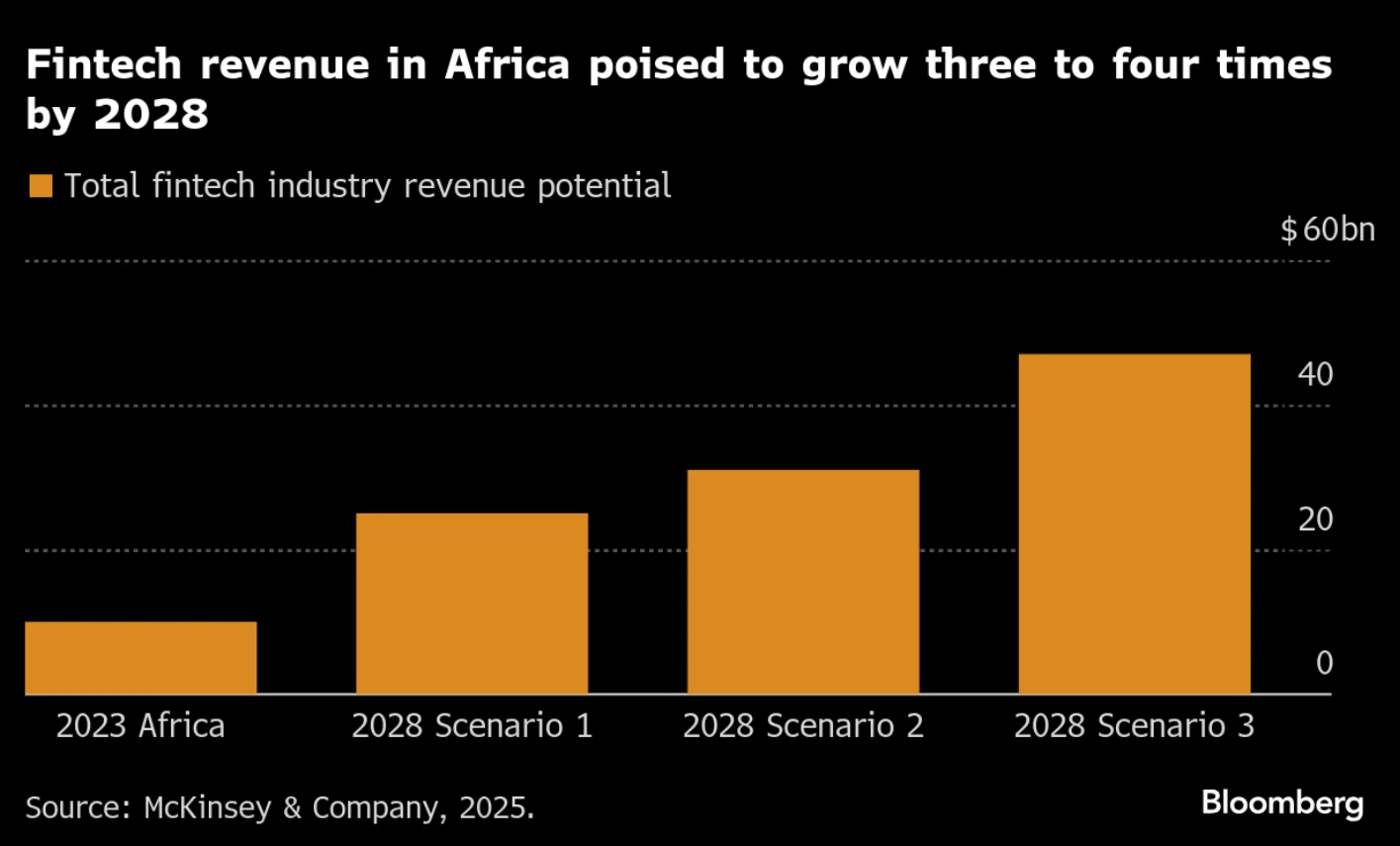
On the whole, McKinsey estimates that total fintech revenues could reach as much as $47 billion by 2028, up from $10 billion in 2023.
Integration as economic upside
Greater integration at Africa’s borders offers significant economic upside. Aligning tariffs, streamlining customs processes, and improving transport networks could materially lower the cost of moving goods across the continent. Ecobank’s Awori points to the scope for gains even in basic trade flows, where more efficient ports and rail systems could unlock faster, cheaper commerce.
“Small differences make material change. Take the rail network: if you’ve got a standard gauge railway, that might be a one-meter track. But if the next door country decides to take a 0.8-meter track, the two cannot connect,” says Awori. Aligning standards would allow networks to connect seamlessly, cutting transfer times, and reducing costs for businesses.
Wamkele Mene, General Secretary at the The African Continental Free Trade Area (AfCTA) points to this as a significant investment case needed to make this happen. “The infrastructure deficit is between $120 and $150 billion annually. There is a high cost of transport and logistics and the inability for business persons to move freely across the continent.”
Financial integration offers similar potential. With 43 currencies across the continent, deeper coordination through intra-African policies and trade agreements could simplify transactions and support cross-border trade.
Mining leaders also see opportunity in infrastructure investment. Africa holds around 30% of the world’s known mineral resources, yet attracts about 10% of global exploration spending. Richard Stewart, CEO at Sibanye Stillwater, says that gap highlights the potential to capture more value not only from extraction, but from processing, manufacturing, and exports.
He explains: “[We have] a lot of the critical minerals that we’re going to need for the [energy] transition, whether it’s copper, whether it’s graphite, whether it’s lithium, we have resources across Africa in all of these. We have an incredible geology that hasn’t yet been properly explored.”
Building value across Africa
What is good for coordination is good for jobs and for the treasury. Taxing the extraction of raw materials is one thing, but if Africa can keep more of its processing and manufacturing on the continent, countries stand to benefit.
“When you tax raw materials, the tax revenue is a pittance compared to when you tax finished goods,” says Samaila Zubairu, President and CEO of Africa Finance Corporation (AFC). He adds that this leads to more revenue generating opportunities, by identifying and taxing more of the materials being mined. “When you do the processing on the continent, you can identify all the other rare earths and other minerals that are associated with the rich ore bodies that we have.”
Financial markets are another indicator of how a more integrated Africa could spread wealth around the continent. Leila Fourie, CEO at Johannesburg Stock Exchange points out that South Africa saw R127 billion (about $6.5 billion) in net bond inflows in 2025 and added R5 trillion to its market capitalization (roughly $260 billion).
“Intra-African trade will continue to uplift [South Africa’s] GDP, she says. “The African Continental Free Trade Agreement will unlock trade between our local countries, across sectors, but largely manufacturing, resources and, of course, our exports.”
Sticking with South Africa, Daniel Mminele, Chairman at Nedbank Group, says investors increasingly recognize “a much more joined-up South African effort” around reforms and collaboration between public and private sectors. Extending across borders could unlock more affordable financing, especially for infrastructure, where project size often exceeds what any single national market can sustain.
Improvements to South Africa’s electricity system could also deliver spillover benefits for neighboring countries interconnected through the Southern African Power Pool. Similarly, better logistics performance in one market can support regional supply chains and lower costs for manufacturers and exporters.
Progress towards harmonizing African economies
Discussion of Africa’s potential is long-standing, but a combination of new approaches, expanded agreements, and improved coordination is beginning to deliver measurable progress. AFC’s Zubairu points to a critical shift in who is shaping development decisions.
“We are processing minerals for jobs for our people,” he says. “The time is different now because Africans are leading development. And because Africans are leading development, we understand all the levers we must pull to get things done.”
The example of the rise of digital payments between 2021 and 2024 shows how quickly markets can adapt to new solutions related to fintech. Fintech is earmarked as a major area for advancement. Another one is AI.
“What Africa has struggled with, and we see this with our companies, is expanding from one market to another, reaching different community groups. AI has a huge role to play in plugging fragmented markets together to allow businesses to operate much more efficiently,” says Lexi Novitske, General Partner at Norrsken22.
That does not mean building foundational models, rather leveraging open-source models to build local solutions and drive growth. Importantly, for Novitske, this approach also creates an opportunity to capture unique data sets, which are not yet available to the rest of the world.
Private sector champions are pushing beyond their home markets. Companies in e-commerce, finance, consumer goods, and telecoms report entering several new African markets over the past year, reflecting their confidence in wider regional demand.
Looking ahead
Fragmentation continues to weigh on competitiveness, but political coordination, trade reforms, and regulatory convergence offer pathways for change. AfCFTA protocols require customs reforms, digital systems, infrastructure connections, and regulatory alignment to work in practice. Many countries are still in the early stages of enabling the agreement’s full potential, leaving significant scope for progress.
“The legal foundation is there through the AfCFTA,” says Mene. “There are very positive and compelling success stories of stability, economic growth, and innovation. We have got to focus on those positive aspects and attributes of our continent.”
Insights in this article are based on panels and fireside discussions at the Africa Business Summit event organized by Bloomberg in Johannesburg in November 2025.