
Bloomberg Intelligence
This article was written by Bloomberg Intelligence Senior Industry Analyst Lee A. Klaskow. It appeared first on the Bloomberg Terminal.
Shippers including Maersk, ONE and HMM are already feeling supply-chain disruptions from the US-Israel attacks on Iran, with the end results being higher ocean and airfreight rates. Shipping lanes and air space have been closed in the Middle East, and vessels are under attack near the Strait of Hormuz, which accounts for about a quarter of crude tanker voyages.
Top ten container ports in the crosshairs
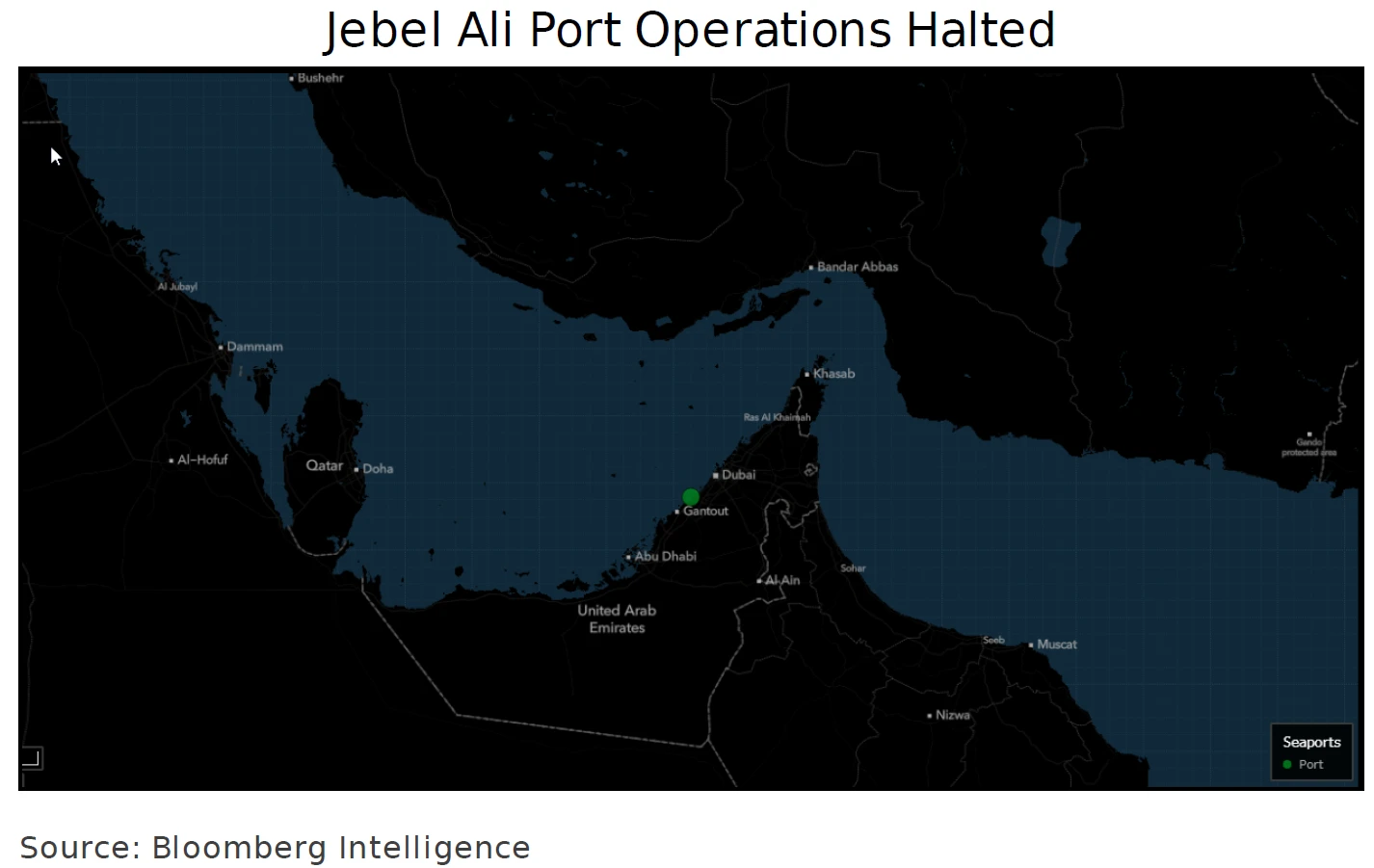
Operations were suspended at DP World’s Jebel Ali port, the world’s ninth busiest container port, according to the World Shipping Council, which is meaningful not only because it’s the region’s largest, but also because it’s a critical global transshipment and distribution hub. Scale, connectivity and industrial integration make it one of the most strategically significant ports between Asia and Europe, particularly in an era of supply-chain rerouting and geopolitical friction. Container volume at the port increased 6% in 1H25 from the year prior.
The port also supports the Jebel Ali Free Zone, which hosts more than 11,000 companies and has become a critical re-export and distribution hub for the Gulf, Africa and South Asia. The zone and related ecosystem account for 36% of Dubai’s GDP, according to press reports.
Middle East volume winding down
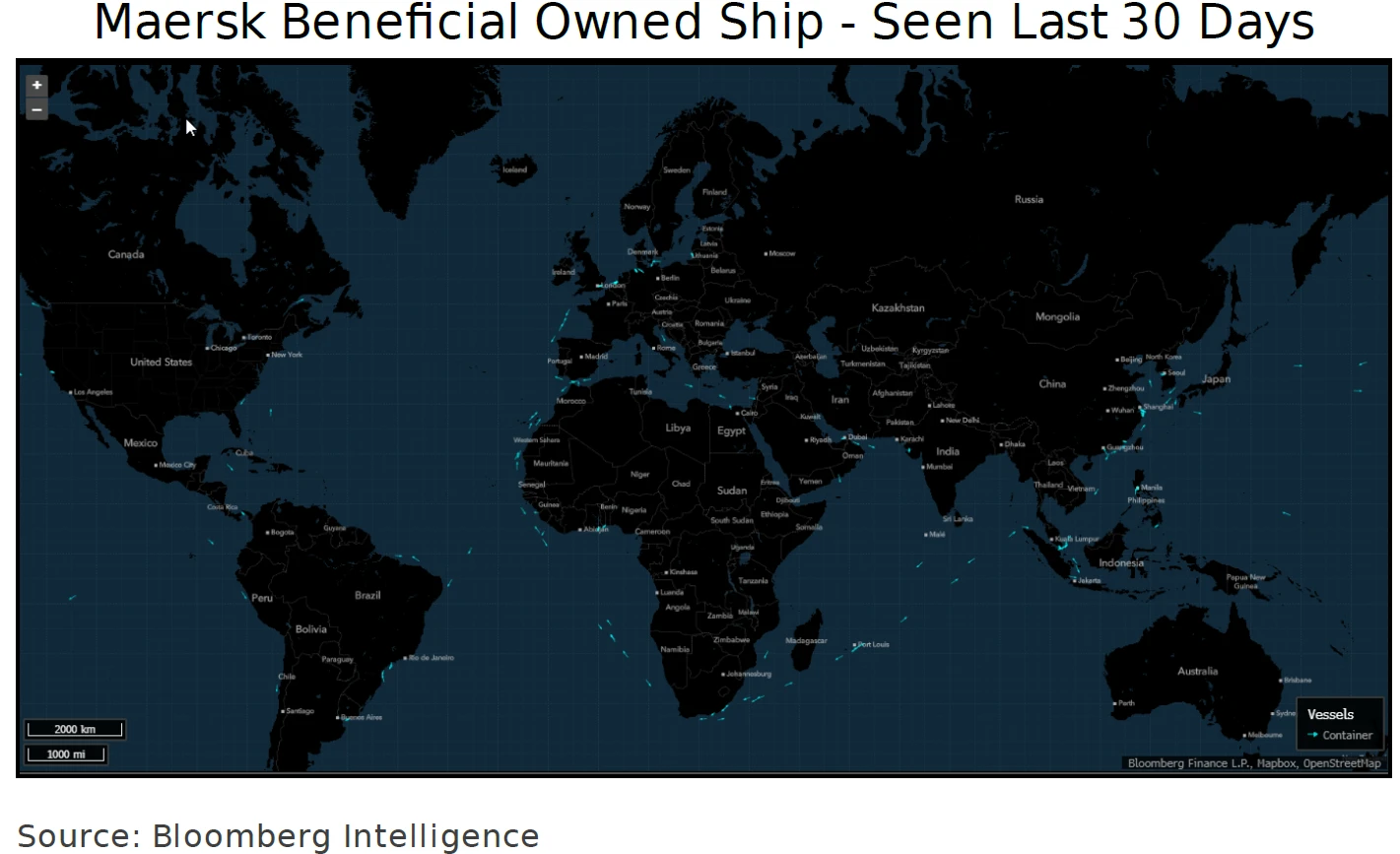
MSC Mediterranean Shipping announced it was halting all bookings for freight loaded or discharged in the Middle East following the closure of the Jebel Ali port. Maersk, ONE, HMM and most major liners call on the port as part of their long-haul, regional and feeder services, and the impact on revenue and earnings of not taking new business here depend on how long supply chains will be upended. The positive impact to rates from the closure of the Suez Canal and Red Sea could be mitigated if liners move capacity into other trades, which could happen if there’s increased uncertainty over when the Straight of Hormuz will become safely navigable again.
The Middle East accounted for about 9.8% of global container lifts in 2025 and is expected to seevolume increase 2.8% in 2026, based on Clarksons data.
Surge in VLCC rates poised to continue
The Iranian government has targeted commercial ships in the region, with Bloomberg News reporting three tankers have been hit thus far near the mouth of the Persian Gulf. Vessels will likely avoid the region altogether to ensure the safety of their crews, cargo and assets, which can reach over $130 million for a new VLCC tanker.
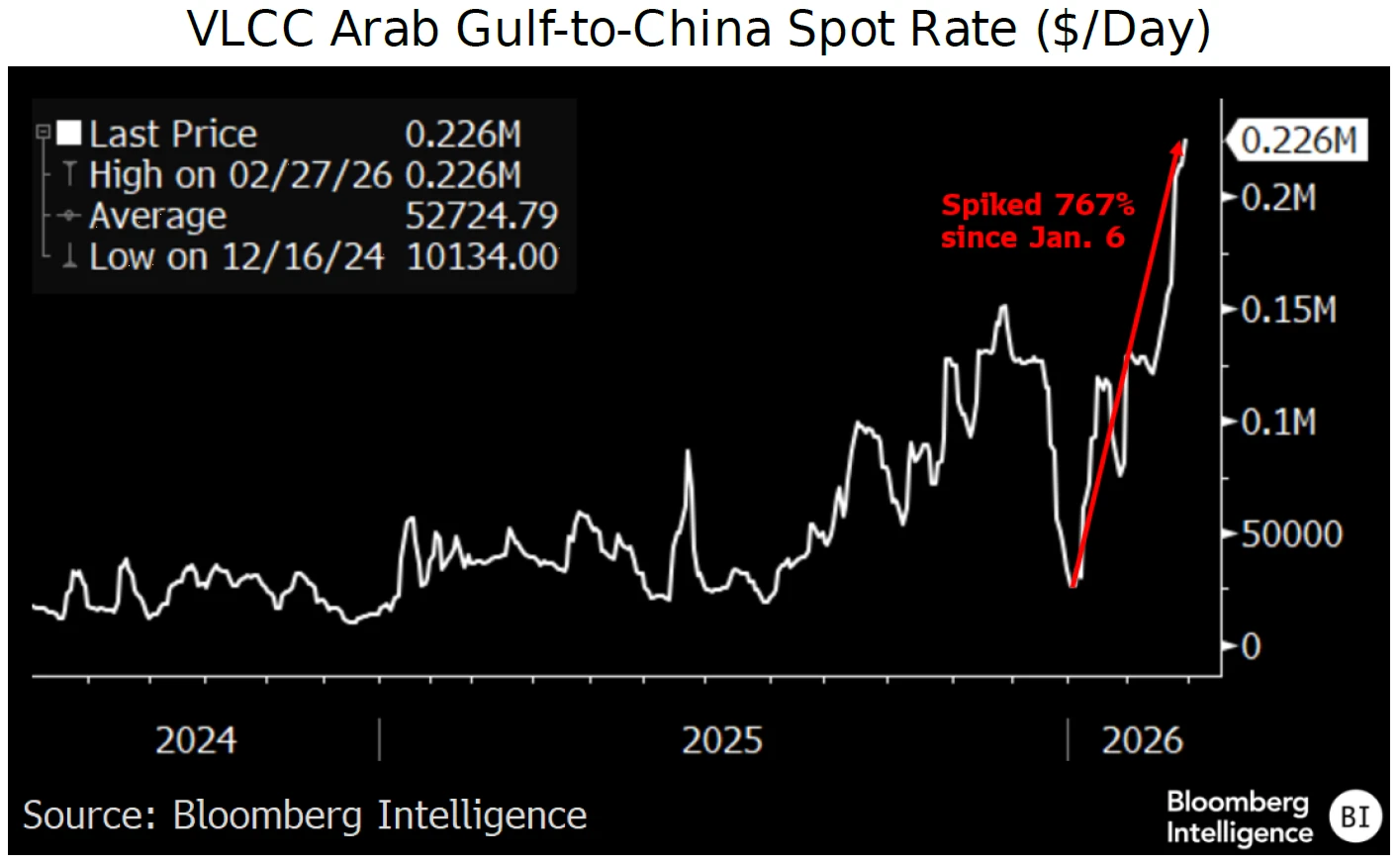
This will drive crude tanker rates higher beyond the recent surge since the beginning of 2026.The VLCC spot rate for Gulf shipments to China was $225,637 on Feb. 27, far exceeding the average breakeven of $25,000-$35,000. The recent reaction from Iran is likely to propel rates toward 2019’s record of $317,334, providing a near-term profit boost to major tanker-operators such as Cosco, Mitsui OSK and Nordic American Tankers.
The data included in these materials are for illustrative purposes only. The BLOOMBERG TERMINAL service and Bloomberg data products (the “Services”) are owned and distributed by Bloomberg Finance L.P. (“BFLP”) except (i) in Argentina, Australia and certain jurisdictions in the Pacific Islands, Bermuda, China, India, Japan, Korea and New Zealand, where Bloomberg L.P. and its subsidiaries (“BLP”) distribute these products, and (ii) in Singapore and the jurisdictions serviced by Bloomberg’s Singapore office, where a subsidiary of BFLP distributes these products. BLP provides BFLP and its subsidiaries with global marketing and operational support and service. Certain features, functions, products and services are available only to sophisticated investors and only where permitted. BFLP, BLP and their affiliates do not guarantee the accuracy of prices or other information in the Services. Nothing in the Services shall constitute or be construed as an offering of financial instruments by BFLP, BLP or their affiliates, or as investment advice or recommendations by BFLP, BLP or their affiliates of an investment strategy or whether or not to “buy”, “sell” or “hold” an investment. Information available via the Services should not be considered as information sufficient upon which to base an investment decision. The following are trademarks and service marks of BFLP, a Delaware limited partnership, or its subsidiaries: BLOOMBERG, BLOOMBERG ANYWHERE, BLOOMBERG MARKETS, BLOOMBERG NEWS, BLOOMBERG PROFESSIONAL, BLOOMBERG TERMINAL and BLOOMBERG.COM. Absence of any trademark or service mark from this list does not waive Bloomberg’s intellectual property rights in that name, mark or logo.
All rights reserved. © 2025 Bloomberg.