This article was written by Ziad Daoud and appeared first on the Bloomberg Terminal.
Saudi Arabia’s economy suffered after the detention of hundreds of royals, billionaires and government officials at the Ritz-Carlton hotel in Riyadh on corruption charges in 2017. But our heat map of economic activity shows non-oil growth bouncing back to pre-purge levels.
- Bloomberg Economics’ heat map shows non-oil growth improving in 1Q, probably to levels last seen in 3Q17 when the non-hydrocarbon economy was expanding at 2.3%.
- We expect non-oil growth to average 2.6% this year, up from 2.1% in 2018, helped by fiscal stimulus, a lower drag from monetary policy and improved private consumption.
More green, less red in activity heatmap
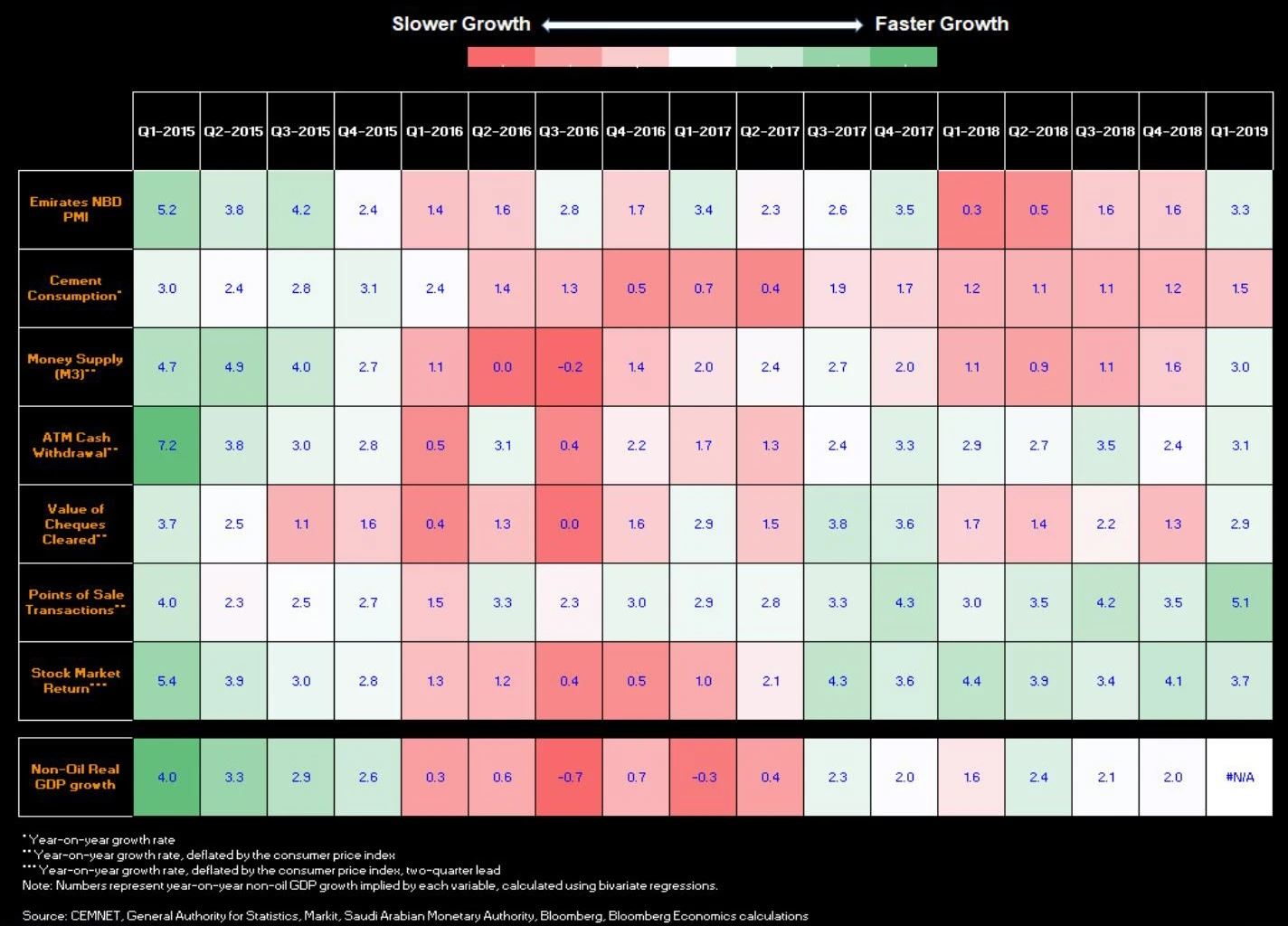
Saudi Arabia’s economy was picking up from its mid-2016 low when the corruption purge derailed its recovery. The ensuing uncertainty led an increasing number of people to take their money out of the country instead of investing domestically.
The slowdown in private consumption in early 2018 compounded the shock. Consumers faced the introduction of a value-added tax, costlier fuel prices as subsidies were reduced, higher utility bills and rising expatriate levies. The increase in government spending couldn’t reverse the trend — non-oil growth fell to 1.6% in 1Q18 from 2.3% in 3Q17.
But the economy is now showing new signs of life, according to our newly-built activity heat map. A number of indicators are picking up, showing non-oil growth has returned to levels seen before the corruption purge.
Higher than 2018, much lower than pre-2014
Official GDP data for 1Q, due for release at the end of June, will truly reveal whether the economy has recovered. But the picture given by our heat map is consistent with our outlook of a pick-up in non-oil growth this year to about 2.6%.
What’s driving the uptick? A fiscal stimulus by the government for the second consecutive year; a smaller drag from monetary policy following the Fed’s pause; and improved private consumption as the impact of the measures taken last year diminishes.
The economy might be showing signs of recovery, but it’s still a long way short of the growth rates achieved during the oil-boom of 2004-13, which averaged 7.7% a year. And growth remains mainly driven by an oil-financed fiscal stimulus rather than the private sector.
Building the heat map
We constructed our heat map using seven indicators: the Emirates NBD PMI survey, cement consumption, money supply (M3), ATM cash withdrawals, value of cheques cleared, points of sale transactions and equity prices (a measure of household wealth).
We deflated all but the first two variables using the consumer price index and then calculated year-on-year growth rates. We lag real stock market returns by two quarters in the heat map — recent research by the IMF shows it as a leading, not a coincident indicator.
All variables are transformed to GDP-equivalent units, so the numbers shown in the heat map represent year-on-year non-oil GDP growth implied by each variable. These are calculated using bivariate regressions.