Bloomberg Intelligence
This article was written by Bloomberg Intelligence Chief Emerging Markets Credit Strategist Damian Sassower and Fixed Income Strategist Basel Al-Waqayan. It appeared first on the Bloomberg Terminal.
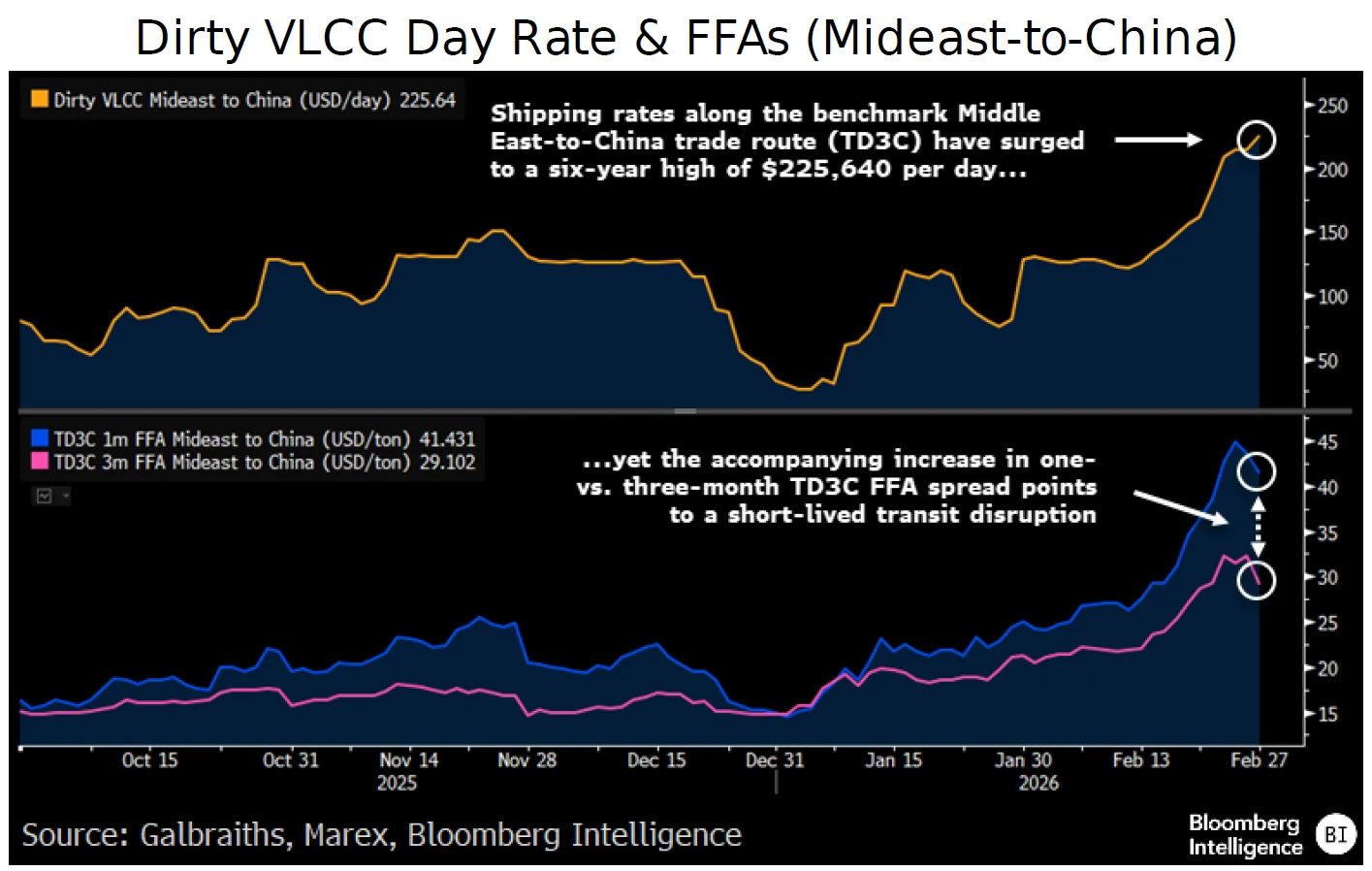
Shipping rates along the critical Middle East to China trade route have surged to a 6-year high, yet forward freight agreements are currently pricing in a short-lived disruption. Should the conflict in Iran evolve into a prolonged war, sovereign credit-default swap spreads could widen sharply and cross-asset volatility will increase.
Bloomberg Terminal clients can access more of our research at BI EMFI <GO>.
Forwards aren’t pricing in a prolonged conflict
Shipping rates along the benchmark Middle East to China trade route have surged to a 6-yearhigh, yet calendar spreads on TD3C forward-freight agreements (FFAs) are pricing in only a short-lived disruption. FFAs along the TD3C transit corridor reflect the cost for shipping crude oil from Ras Tanura (Saudi Arabia) to Ningbo (China) on a Very Large Crude Carrier (VLCC). One- vs. three-month TD3C FFA spreads steepened to $12 a ton on Feb. 27, yet they briefly broke above$16 in October 2019 after the US temporarily sanctioned COSCO shipping tanker subsidiaries for transporting Iranian crude.
According to Galbraiths, the TD3C Worldscale rate is up 76% since January to $225,640 per day, its highest since April 2020. It reached an all-time high of $317,000 in October 2019 after the COSCO sanctions.
Risk premiums should rise in sovereign CDS
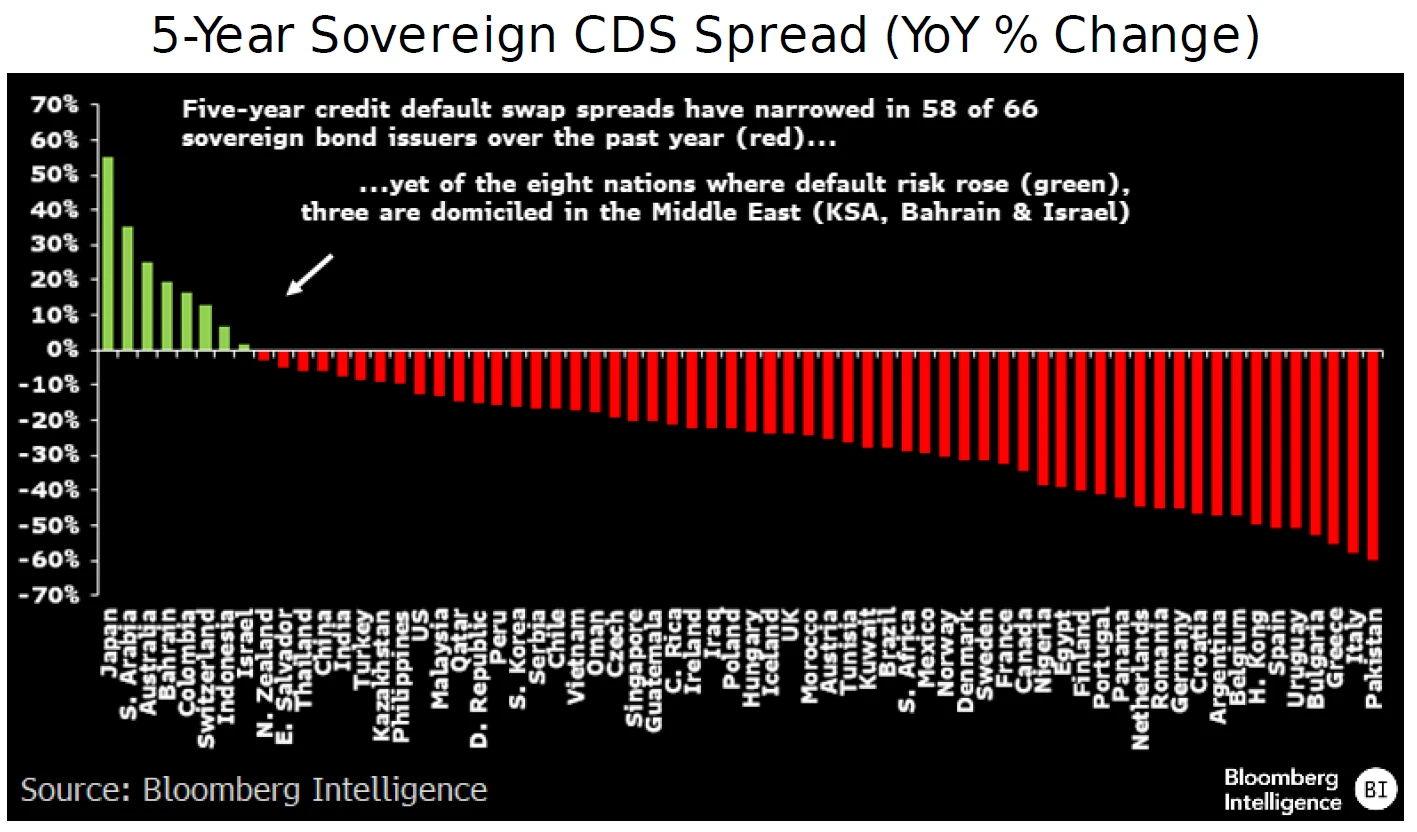
Sovereign credit-default swap (CDS) spreads signal a solid outlook for global growth, yet they could widen if the US attack on Iran turns into a prolonged war, with negative spillover to global shipping and trade. Improved growth conditions have tightened 5-year CDS spreads in 58 of 66 sovereign borrowers over the past year, with the price to protect against default declining by more than 50% in Pakistan, Italy, Greece, Bulgaria, Uruguay and Spain. Yet among the eight countries where default risk rose, three are from the Middle East, and all experienced casualties from the confrontation.
Saudi Arabia’s CDS spread is up 35% over the past year, whereas spreads in Bahrain and Israel rose by 19% and 2%, respectively. Japan is a top-3 importer of Middle East oil, yet its CDS spread is already up 55% year-over-year.
Optionality may once again come at a cost
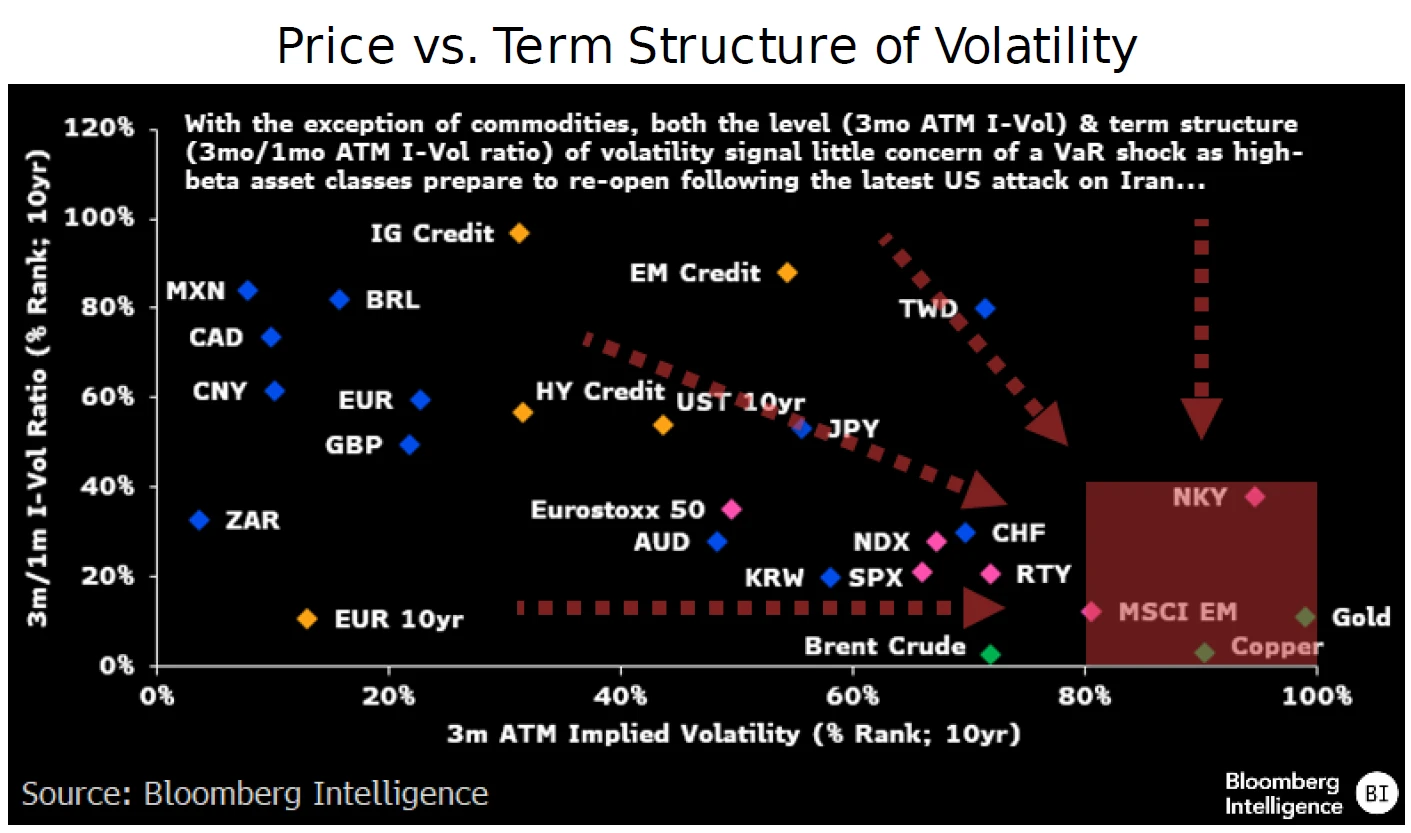
Elevated uncertainty following the US/Israeli attack on Iran should stoke demand for option hedges in major credit, currency, equity and interest-rate markets, lowering short-dated calendar ratios. Based on 10 years of daily data, 3-month implied volatility now ranks in the bottom 25% of all observations for 8 of the 26 asset classes in our analysis, with EM currencies such as the Brazilian real, Chinese yuan, Mexican peso and South African rand exhibiting relative complacency. Conversely, commodity volatility is already trading at extreme levels, as the cost for hedge protection in copper and gold is just off a 10-year high.
During periods of market stress, implied volatility spikes and the term structure of volatility flattens, causing asset classes to converge toward the lower right-hand corner of the scatterplot.
Volatility spreads should reflect any shift
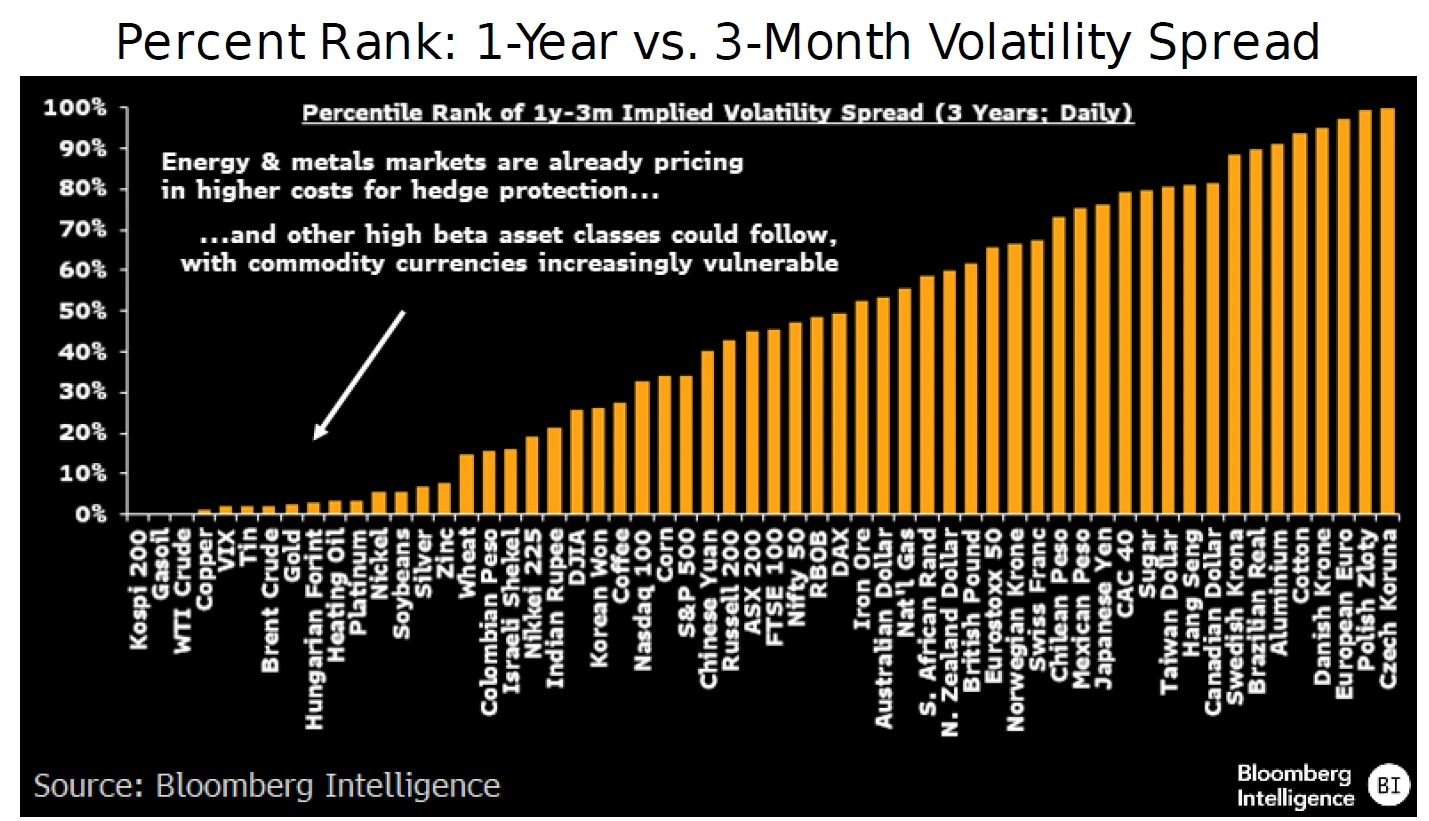
Volatility curves could flatten following the attack on Iran, as rising geopolitical uncertainty heighten risk aversion. Among the 58 high-beta asset classes in our universe, 25 now have inverted volatility curves, with commodities featuring prominently. Based on three years of daily data, the spread between 1-year and 3-month implied volatility now ranks in the bottom 1% of all observations for crude oil, gasoil, copper and the Kospi 200. Similarly, volatility spreads are in the bottom 5% for safe havens such as gold and platinum, assets that tend to outperform during periods of extreme market stress.
Conversely, the spread between 1-year and 3-month volatility is now in the top 3% of all observations for the European euro, Polish zloty and Czech koruna, reflecting elevated complacency.
Cyclical, high beta sectors more exposed In Gulf nations
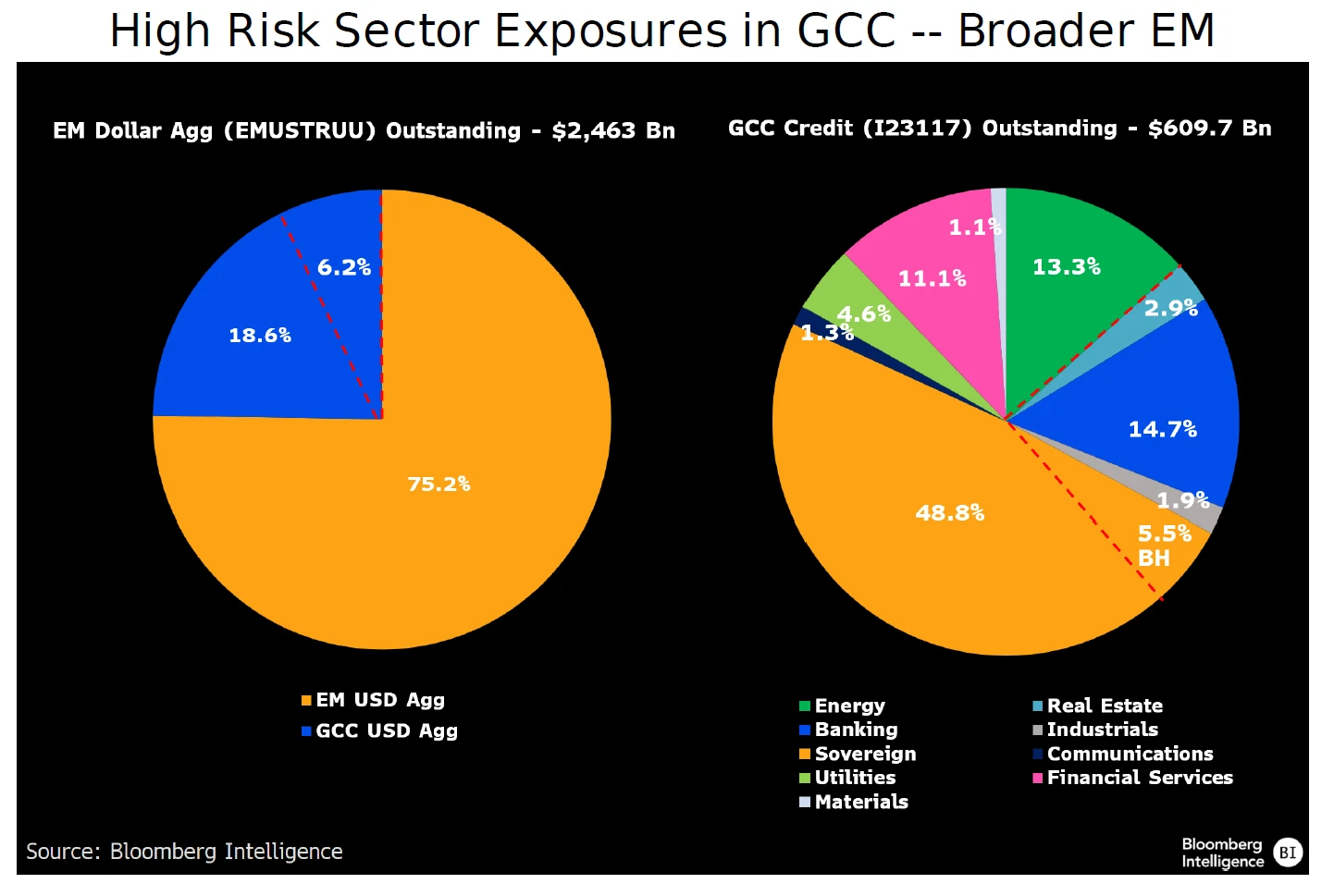
The early onset stages of the war between Israel, the US and Iran will expose greater risk of spread widening and a selloff in cyclical, higher beta sectors — namely in Real Estate, Banking, Industrials, and HY Bahrain sovereigns — on flight-to-safety measures and disrupted supply chains. Those sectors collectively total $152.4 billion, or 25% of the GCC dollar credit outstanding, and about 6.2% of the Emerging Market dollar aggregate index. High grade sovereign credit, key strategic national oil champions and defensive sectors are expected to show greater risk-off volatility resilience relative to the corporate sector, but the spillover effects from high beta securities could get more pronounced in a prolonged war scenario that lasts for week or damages key energy infrastructure facilities.
GCC credit still tied to macro systematic picture
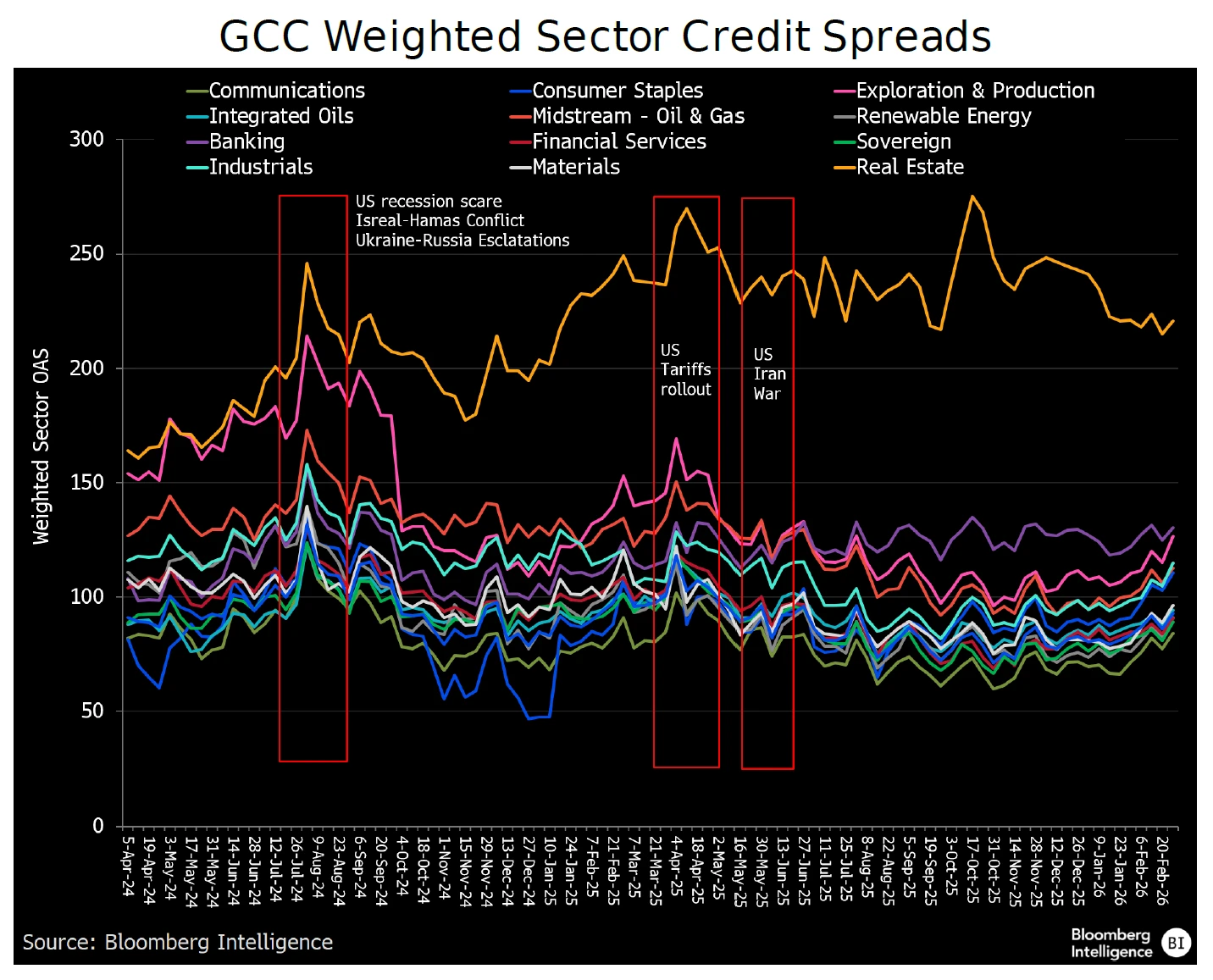
Gulf dollar credit pronounced spread reactions in recent times have broadly moved with global growth expectations and risk sentiment, with the US rates channel being a critical component as GCC sovereign curves move with Treasuries more than local macroeconomies. The deterioration in US labor data in August 2024 and the US tariff announcements in April 2025 had a sharper effect on GCC credit spreads than last June’s US-Iran war, as investors have are used to geopolitical flare-ups that fade quickly. Absent any targeting of energy and logistical disruptions, we expect the macro-systematic beta relations to continue to hold – with real estate, subordinated bank debt and oil services shown to be among the highest, while sovereigns and quasi names to possibly benefit from improved fiscal metrics on higher oil prices.
Lower rates on risk off will keep driving GCC sov+quasi returns
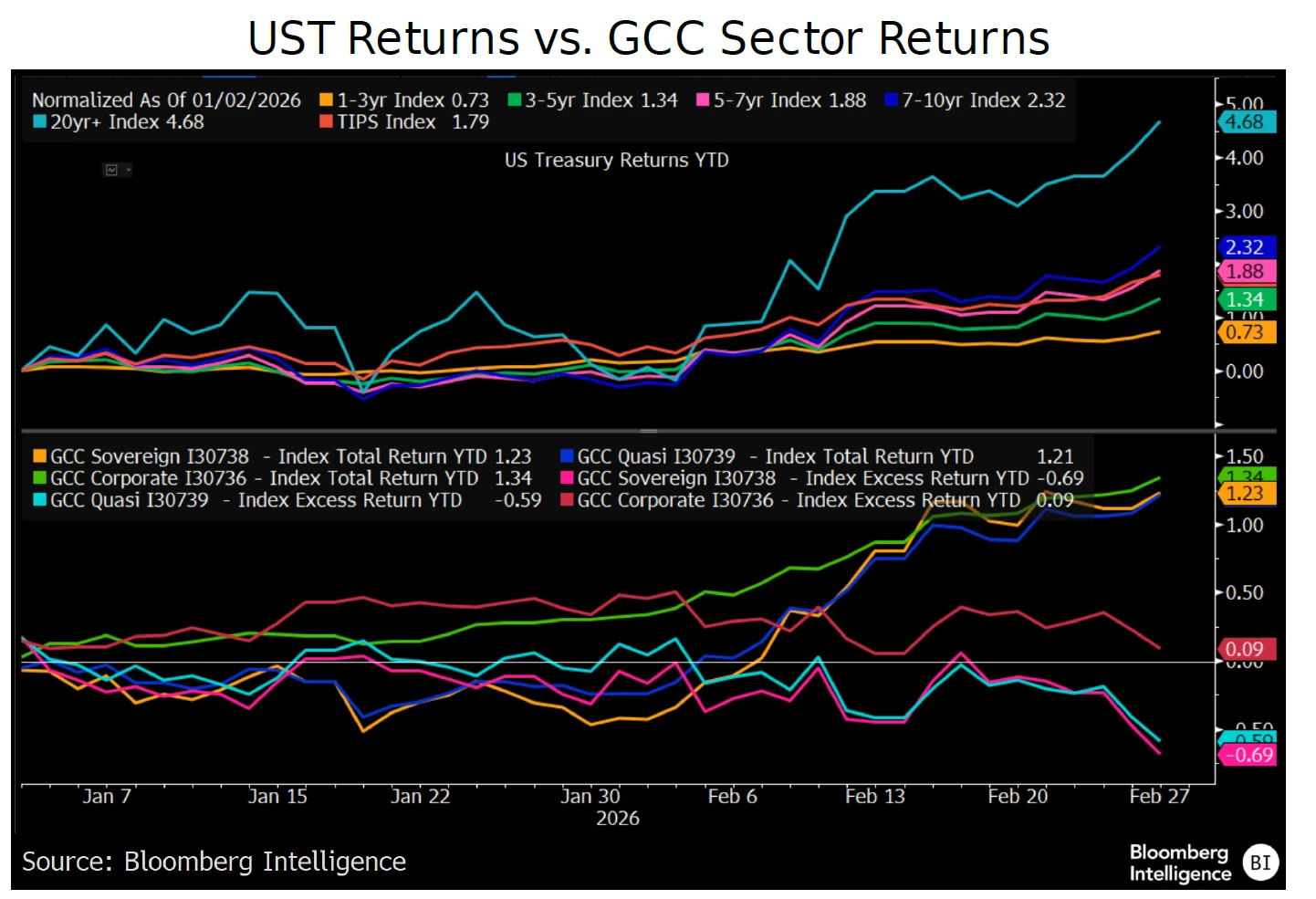
The GCC sovereign and quasi dollar credit indexes returns — with a combined $493.7 billion outstanding, covering 81% of the total GCC USD credit stack — has largely benefited from UST rallying year to date and the escalating regional conflict will only fuel the risk-off narrative, offering total return upside that will likely off set any spread widening risk aversion if vital energy infrastructure assets remain unharmed. The structurally larger duration profile of key sovereign and quasi names in Saudi Arabia, UAE and Qatar remains rates-driven, while still outperforming even as spreads grind wider. The GCC corporate index has been losing its year to date excess return momentum and will likely face downward total return pressure from the geopolitical shock.
The data included in these materials are for illustrative purposes only. The BLOOMBERG TERMINAL service and Bloomberg data products (the “Services”) are owned and distributed by Bloomberg Finance L.P. (“BFLP”) except (i) in Argentina, Australia and certain jurisdictions in the Pacific Islands, Bermuda, China, India, Japan, Korea and New Zealand, where Bloomberg L.P. and its subsidiaries (“BLP”) distribute these products, and (ii) in Singapore and the jurisdictions serviced by Bloomberg’s Singapore office, where a subsidiary of BFLP distributes these products. BLP provides BFLP and its subsidiaries with global marketing and operational support and service. Certain features, functions, products and services are available only to sophisticated investors and only where permitted. BFLP, BLP and their affiliates do not guarantee the accuracy of prices or other information in the Services. Nothing in the Services shall constitute or be construed as an offering of financial instruments by BFLP, BLP or their affiliates, or as investment advice or recommendations by BFLP, BLP or their affiliates of an investment strategy or whether or not to “buy”, “sell” or “hold” an investment. Information available via the Services should not be considered as information sufficient upon which to base an investment decision. The following are trademarks and service marks of BFLP, a Delaware limited partnership, or its subsidiaries: BLOOMBERG, BLOOMBERG ANYWHERE, BLOOMBERG MARKETS, BLOOMBERG NEWS, BLOOMBERG PROFESSIONAL, BLOOMBERG TERMINAL and BLOOMBERG.COM. Absence of any trademark or service mark from this list does not waive Bloomberg’s intellectual property rights in that name, mark or logo.
All rights reserved. © 2025 Bloomberg.