This analysis is by Bloomberg Intelligence Brokers and Exchanges Sharnie Wong. It appeared first on the Bloomberg Terminal.
Family offices have ballooned in Singapore over the past few years, largely led by smaller-sized funds, yet Hong Kong could catch up as it introduces new rules to make it more straightforward for single family offices to be exempt from tax, and Singapore tightens. The full removal of virus travel restrictions could give Hong Kong a further boost.
Family office surge in Singapore could slow
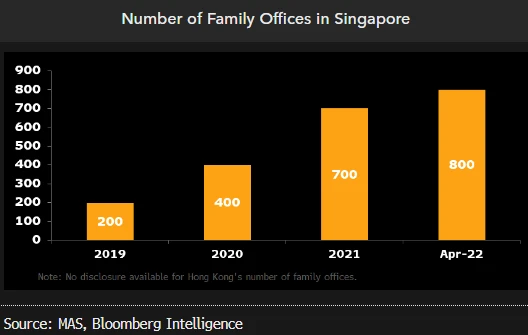
Singapore has attracted many family offices to set up over the past few years, including high-profile individuals like Ray Dalio, billionaire founder of hedge fund Bridgewater Associates, and James Dyson, the founder of vacuum cleaning company Dyson. However, the rapid surge in number of family offices, which doubled to reach 800 at end-April from 2020, was largely led by smaller-sized funds and could have prompted the Monetary Authority of Singapore to tighten tax concession rules. This could slow the number of new family offices, but raise the bar for the industry’s performance and professionalism.
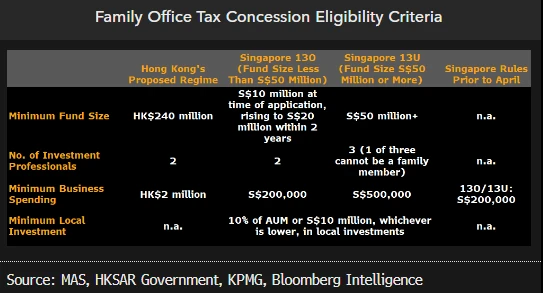
The MAS toughened tax concession eligibility criteria in April for new family offices by introducing minimum requirements for capital, local business expenditure, local investments and hiring of talent.
Hong Kong’s tax reform could level playing field
While Singapore is tightening tax concessions for family offices, the Hong Kong government proposed a new tax exemption regime to attract ultra high net worth individuals to set up single family offices in the city. Hong Kong’s new rules will provide tax certainty to the family-owned investment holding vehicles (FIHVs) managed by single family offices with capital of over HK$240 million to be exempt from profits tax and could take effect in the 2022/23 tax year if legislated. Hong Kong’s chief executive set a target in his October policy address to have 200 large family offices set up in the city by 2025.
The minimum business spending and the number of investment professionals required for family offices to be eligible for tax concessions is lower for larger-sized funds in Hong Kong than in Singapore.
Hong Kong could attract more family offices
Singapore and Hong Kong are Asia’s key financial hubs, yet Hong Kong is still affected by Covid-19 travel restrictions, and Singapore could have an edge with ultra high net worth individuals wary of Beijing’s influence over Hong Kong. Yet Hong Kong leads in terms of the size of the asset management industry, pool of cross border wealth, lower overall tax burden for both corporates and individuals, a larger market for IPOs and private equity, established financial infrastructure connected with mainland China’s capital markets and closer proximity to mainland China. The Greater Bay Area is among the wealthiest regions in the country.
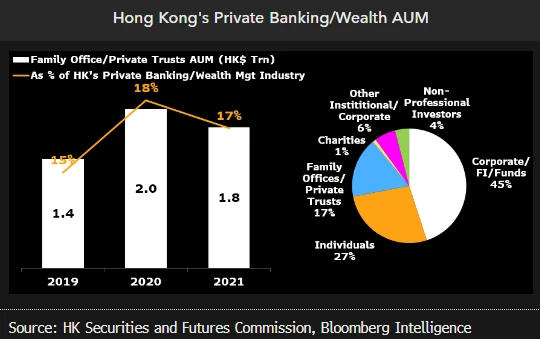
Hong Kong’s private banking industry sourced HK$1.8 trillion of assets under management from family offices and private trusts at end-2021, according to the regulator’s survey.
Hong Kong to regain ground if Covid curbs relax
Singapore’s faster reopening of its border after virus curbs, which began with certain travel corridors in September 2021, has helped the city attract wealthy individuals vs. Hong Kong. Yet the end to easing of mainland China and Hong Kong’s virus curbs could fuel a sharp rebound in mainland migrants as well as non-mainland expats and travelers to Hong Kong.
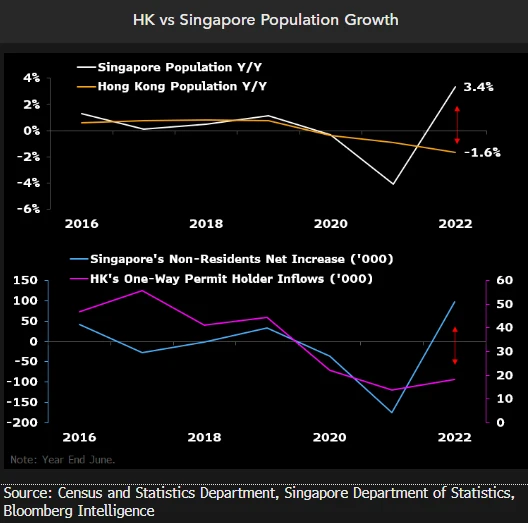
Overseas individuals flocked to Singapore, rising by a net of 97,059 non-residents in the year to end-June, accounting for over half of population growth of 3.4%. Conversely, new migrants from mainland China to Hong Kong under the one-way permit scheme, which cumulatively account for about 15% of Hong Kong’s population, plunged to 18,300 in the year to end-June, far below the annual average of about 45,000 between 2015-19.
Hong Kong’s temporary asset management slump
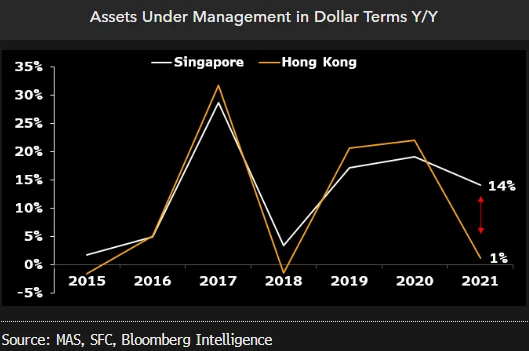
Hong Kong’s status as Asia’s asset management hub may have been hit by mainland China’s border restrictions and the city’s slower pace of reopening vs. Singapore, rather than political considerations, in our view. In fact, Hong Kong’s AUM growth outpaced Singapore in 2019 amid social unrest and in 2020 at the height of the pandemic, before stabilizing in 2021 as Singapore shifted to living with Covid-19, based on the regulator’s surveys of the industry.
The wealth tap from mainland China into Hong Kong has slowed to a trickle based on sales via cross-border programs like the Wealth Management Connect and the Mutual Recognition of Funds scheme. Yet inflows could rebound quickly once virus curbs are lifted and capital controls eased, more than offsetting outflows by those that fear Beijing’s tightening grip over the city.