Virginie Maisonneuve
Former Chief Investment Officer, Eastspring Investments
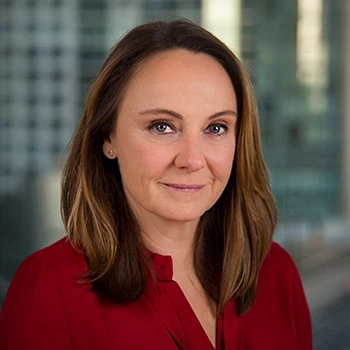
At the investment helm of Eastspring, Virginie Maisonneuve oversaw $195 billion in assets across 11 Asian countries. In this exclusive interview, she talks to us about the importance of balancing alpha generation with constant innovation. She also shares her investment principles, industry challenges, and her views on what the future holds for financial markets.
“When you combine machines with smart investors, the speed of learning and predictive power attainable is just unprecedented.”
Virginie Maisonneuve
Tell us about your role at Eastspring Investments and what your key business priorities are
I oversee $195 billion in assets at Eastspring Investments, and my priorities are to drive performance and innovation, and support our teams across 11 Asian markets. Alpha is essential in our business, but in this rapidly changing investment landscape, driving innovation is an imperative. Asset management is in the “dinosaur age” with regards to usage of technology versus other sectors; we need to move light-years from prehistoric times towards PM 2.0 to keep on being successful and offer our clients the outcome they expect. Today’s asset managers need to balance sound, high-integrity investment processes, strong teams and collaborative sustainable cultures whilst adapting to technology disruptions like AI, so they can outperform the industry.
What are some of the greatest challenges facing CIOs today?
One of the key challenges facing CIOs today is finding the right balance of innovation of solutions for customers both in terms of the manufacturing of alpha and distribution, and a culture promoting sustainability, diversity, talent retention, sound process and calculated risk taking. AI is a major, positive disrupter in our industry. I don’t think AI will replace investment managers, but for fundamental active equities AI can empower portfolio managers with new tools so they can be more efficient and focus on their strategies. Today’s portfolio manager needs to embrace change and integrate innovation at the right pace, amid a volatile and ever-changing market environment.
How do you form an investment view?
We value the diversity of views at Eastspring. As such, we don’t have a house view, but rather a range of views, each varying by asset class, that follows an investment process. Once a quarter, I host an “Eastspring Insights Forum” where investors share their views around key topics. It’s also a forum where people can debate and challenge their expectations. We also use this type of format in areas such as ESG, as well as in “hot houses” to bring colleagues from various departments together to co-create new tools or solutions.
What role will technology play in the future of the buy side?
Artificial intelligence will have a significant impact on the future of asset management. We are in an industry that has seen limited disruption by technology but this is going to change. The AI revolution, in my view, is akin to the introduction of the Bloomberg Terminal on the trading floor, which many years ago completely transformed the financial sector. When you combine machines with smart investors, the speed of learning and predictive power attainable is just unprecedented.
The second area of change is digital distribution. I believe that AI will play a key role in addressing financial inclusion and bringing financial products to a whole new set of consumers in remote areas and emerging regions. With AI, asset managers will be able to distribute products in a vastly different way, which will be game-changing.
Technology will also impact trading and possibly the role of benchmarks. The speed of trading and new data available could have an impact on the role of index funds, and more clients might be requesting custom benchmarks that meet their unique investment needs.
These are the push factors. The pull factors in the technology equation are regulation of the AI-enabled world, data integrity and compliance.
What investment principles do you live by?
The best investment managers have an innate sense of curiosity. They also have a unique combination of IQ and EQ, an investment instinct beyond the data and numbers, and an ability to think about risks. The world today is too fast and too big for the star portfolio managers of the past. Today, the best asset managers have clear investment processes. They embrace change but also have a risk posture and mindset, and embrace collaboration and diversity. In my view, there is both a science and art to investing.
What makes asset allocation unique in your region?
The Asia growth potential for asset management is just incredible. A key factor is millennials. Over 50% of the world’s millennials live in Asia, and this group has significant spending power. China and India alone have 450 million millennials, more than the workforce in the U.S. and Europe.
The rising middle class in Asia is another huge factor for growth. 46% of the global middle class is in Asia. In 10 to 20 years, this number will increase to 65%. Asia’s economic engine is driven by the region’s spending power, which is creating considerable demand for mutual funds and insurance products.
AI is another mega-trend that will serve Asia well and will bring speed and power to the region. The China AI and fintech story is one to watch. More and more, we will see a shift of asset allocation to Asia, one of the most exciting regions in the world. By 2027, we will see $13 trillion of mutual fund assets allocated to this region. With more money allocated to Asia, domestic demand will grow and fuel a more creative population, which in turn will reshape financial markets.
Additional Resource
Eastspring Investments and Bloomberg
Virginie is also one of the founding members of the Bloomberg Buy-Side Women’s Network — an initiative that brings together senior female buy-side leaders from across Asia.
The Journey to Tomorrow’s Buy-Side Operating Model
Today’s buy-side leaders know they need a clear, compelling vision to stay competitive. Attracting new assets, providing transparency and value, meeting growing regulatory demands, empowering people with efficient processes and tools, managing costs and maximizing performance are all essential.
Solutions for the Buy Side
Powered by an unparalleled combination of automation, innovation, access and service, Bloomberg’s comprehensive and integrated enterprise solutions help buy-side firms generate alpha, develop and service clients, remain compliant and grow profits in the face of change.