Cryptocurrency markets have evolved and have garnered increased institutional interest, especially over the last two years. What was initially interest from Private Banking, Family offices and select Hedge funds has now morphed into broader participation from larger hedge funds, ETF issuers and more traditional buyside and sellside customers.
Despite investment into digital assets from many of the largest firms, many barriers to institutional adoption of cryptocurrencies remain. Regulation remains the #1 concern for many, but it has been changing quickly and preparing for regulatory changes remains a challenge.
Regulatory push
On June 30, 2022, the Council of Europe reached an agreement on Markets in Crypto-Assets (MiCA) regulation, becoming the first international entity to bring crypto-assets, crypto-assets issuers and crypto-asset service providers under a regulatory framework.
MiCA will cover any type of market abuse related to any type of transaction or service, notably for market manipulation and insider dealing. It will also require stablecoins issuers to build up a sufficiently liquid reserve, with the aim of a more transparent and robust market in which customers are better protected.
In the US, regulation is both seen as a challenge and an opportunity. While potential new rules could redesign the market dynamics, participants also expect them to boost competition and market transparency and volumes.
MiCA’s provisional agreement is now subject to approval by the Council and the European Parliament before going through the formal adoption procedure. Pending unexpected hurdles, one can expect it to be ratified in late 2022, and come into force late 2023 or early 2024.
As well as significant for Europe, the MiCA is also expected to set a benchmark for other regulatory regimes for crypto globally.
How Tradfi Can Unpack the MiCA challenges & opportunities
BTCA – A proven methodology now available for Crypto
As part of its multi-asset expansion, Bloomberg Transaction Cost Analysis (BTCA) is now supporting crypto currencies, providing customers with benchmarking options and the range of BTCA’s trade surveillance and analytics capabilities ahead of new regulations in a growing market.
BTCA is a recognised Trade Cost Analysis Provider delivering insightful data for both best execution and compliance purpose. It’s exception-based workflow that provides fully automated surveillance of trading activity across asset classes.
Today, BTCA can apply its expertise in crypto currencies and support customers aiming for MiCA compliance and looking after Best Execution monitoring.
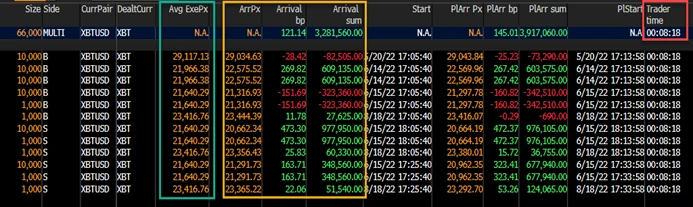
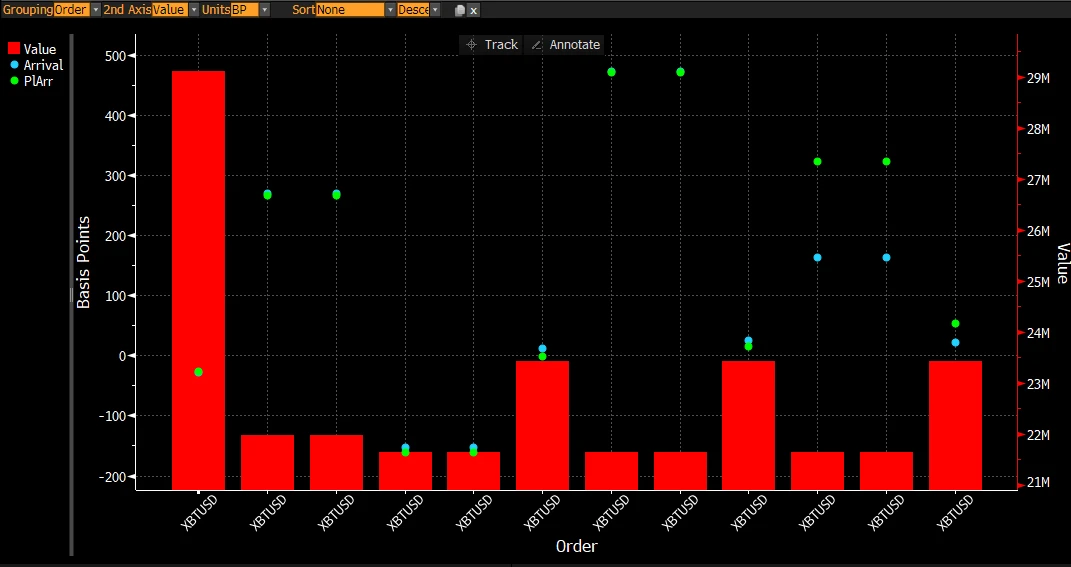
Below is a sample of XBTUSD trades, highlighting the deviation between Execution price and market levels at Order arrival and Placement arrival times, with an example of visualization in order to quickly spot outliers. Customers can also define tolerance thresholds and exceptions will be captured in a dedicated dashboard.
On the compliance side, BTCA has a suite of standard compliance rules that can be configured to monitor for a wide range of potential market abuse and unusual behavior scenarios. Each rule is preset to monitor all trade flows for specific trading patterns and can be enabled with default settings.
BTCA Prices – Benchmarking a fragmented market
As an initial step, BTCA is supporting Spot crypto currency pairs that are available on terminal, using BGN as pricing source.
BGN, Bloomberg’s preferred default source for generic FX data, is a streaming composite designed to show market-consensus.It is based on live quotes from multiple contributors. BGN pricing of crypto currencies is never-ending, being open 24 hours a day. By composition, BGN offers prices relevant to institutional customers and therefore integrates well in the BTCA framework.
The list of pairs currently supported can be accessed via DAS <GO> on the Terminal, under Source: Bloomberg / BGN. The current list as of September 2022 is below:
Bitcoin (USD, EUR, JPY)
Bitcoin Cash (USD, EUR, XBT)
Ethereum (USD, XBT, EUR, JPY)
Ethereum Classic (USD)
Litecoin (USD, EUR)
Dash (USD, XBT)
Monero (USD)
EOS Tokens (USD, EUR)
Ripple (USD, EUR)
Zcash (USD
BTCA provides Arrival Prices at order, placement and execution levels. Customers can access bid, Mid and Ask and can choose Near and Far Touch based on the direction of their own trade, for more granular benchmarking.