ARTICLE
Inflation Reduction Act’s incentives for EVs and clean energy in play

Bloomberg Intelligence
Electric-vehicle (EV) makers, including Tesla and Rivian, face increased risk from the 2024 presidential race, with IRA tax credits to promote the purchase of EVs, as well as emissions policies aimed at phasing in their use across the nation, likely on the line. If former President Donald Trump returns to office, solar companies like First Solar and Meyer Burger, and utilities including NextEra, may lose some of the supportive tax treatment that sector has received.
A Harris win means federal tax credits for consumer purchases of EVs (up to $7,500 for new vehicles, $4,000 for used) will probably stand, while under Trump they could be scrapped or replaced with a “Buy American” program that could benefit traditional automakers like Ford, General Motors and Stellantis. Consumer interest in EVs may be declining in the US: In an April Gallup poll, 48% of Americans said they wouldn’t buy an EV in the future, up from 41% a year earlier.
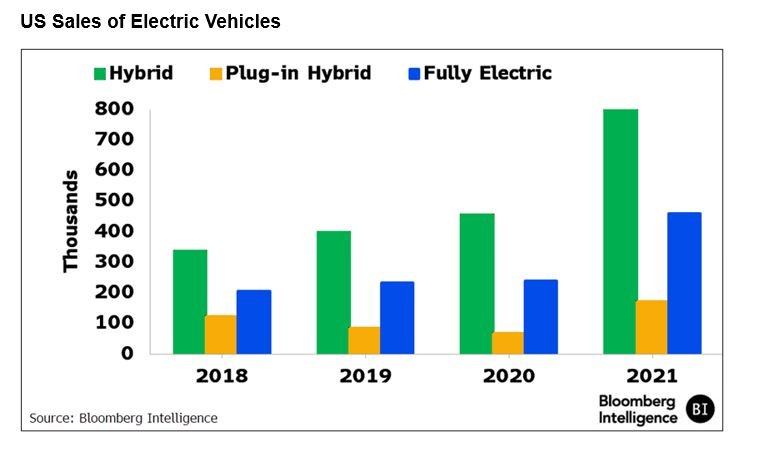
Enphase, Canadian Solar, First Solar, Meyer Burger, Qcells (Hanwha) and other solar equipment suppliers will be watching to see who wins the White House and control of Congress, with modification or a full repeal of the IRA a possibility.
US manufacturing spending surged following the August 2022 passage of the IRA, which provides generous subsidies for domestically produced solar modules and other components used to supply clean energy. In the case of First Solar, we calculate the company’s gross margin could drop to about 25% vs. about 45% when accounting for IRA incentives.
Should Harris win the presidency, we doubt such incentives would be at risk.
Electric vehicle rules and the environment
Though the Environmental Protection Agency slowed implementation of its final rule on emissions, it still requires two-thirds of new vehicles sold by 2032 to be electric in some sense, corresponding with the lifespan of the tax credits. Yet the credits — and broader EV policies — are vulnerable if Trump wins the White House, as we see only a 30% chance they’d survive. The IRA grants $7,500 in credits if EVs are assembled and batteries are built in North America, and if sourcing requirements for lithium and other minerals are met. With a rise in negative political rhetoric, new proposals look to curtail EVs that would qualify for the credits if certain components were sourced from “Foreign Entities of Concern,” including China.
Scaling back EV tax incentives also affects makers of EV battery parts or charging infrastructure like Sensata, TE Connectivity and Amphenol. Companies such as Eaton and GE that supply parts for electric grid operations could be hurt as well if Republicans reduce the IRA’s loans for grid improvements and funding and tax credits for charging stations.
The law set aside $5 billion in loans for the construction and repowering of generation and transmission facilities. If Harris wins, the IRA tax credits and further appropriations would almost certainly continue.
More traditional automakers Toyota, Ford and Stellantis could benefit if Trump scales back an EPA rule that phases in stricter vehicle emissions limits. The EPA in March finalized regulations to reduce allowable emissions applicable to model years 2027-32, but with a slower phase-in to the goal of 67% of new light-duty vehicle sales being EVs by model year 2032.
In a likely nod to gas-powered automakers, a wider range of vehicles — including some hybrids — will qualify. The Republican-led House in December passed the largely symbolic Choice in Automobile Retail Sales Act (CARS Act), which would have largely nullified the EPA rule. The Democrat-controlled Senate didn’t take up the bill. Changes in Congress’ composition could lead to a different outcome.
NextEra faces key election risk if Trump wins the presidency and embarks on rolling back the clean-energy tax provisions of the Inflation Reduction Act. With the IRA in place, we believe that NextEra subsidiary NEER has the potential to expand its 20% market share. The IRA’s transferability provision allows NextEra to monetize about $1 billion of tax credits in 2024 through sales to taxpayers, bolstering its cash flow from operations and lessening equity needs. This, along with increasing demand positions NextEra well to reach the top end of its four-year EPS guidance of a 6-8% CAGR.
Conclusion
A Harris presidency is almost certain to maintain Inflation Reduction Act tax incentives for electric-vehicle (EV) makers, including Tesla and Rivian, as well as emissions policies aimed at phasing in the use of EVs across the nation. Clean energy companies such as First Solar, and utilities including NextEra may lose supportive tax treatment if Trump is elected.