Mark Konyn
Chief Investment Officer, AIA
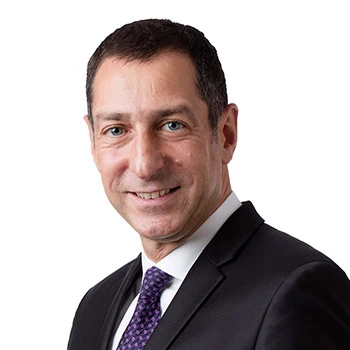
With a Ph.D in applied risk management, industry veteran Mark Konyn has plenty of academic brunt backing up his years of investment experience. In this interview, we talk to him about his role in steering AIA’s investment strategy, the uniquely Asia-centric focus of his company, and how life insurers can invest with the bigger picture — and greater good — in mind.
“Because of our size and scope, we see ourselves as a strategic partner in the development of the local financial system and the long-term growth of its capital markets.”
Mark Konyn
Tell us about your role at AIA and what your key priorities are
In essence, the buck stops with me for any investments that we make. It’s my team’s job across the region — that’s about 450 people spread across 12 locations — to ensure that our premiums are invested so that we are constantly matching liabilities with the most suitable assets. My priorities are to help support the growth of our insurance business, ensure our assets are deployed efficiently and reduce risk in our balance sheet. All forms of investing are constrained. For a life insurance company, it’s actually one of the most constrained environments and therefore extremely technical in the way the specifications are articulated.
What’s unique about AIA?
Some of the uniqueness of AIA is in our prevalence throughout the region. We’re a 100-year-old company, operating exclusively in Asia across multiple currencies, economies and capital markets. That means having the requisite skills on the ground to understand the local business conditions and respective capital markets really well. We are essentially local everywhere we operate.
But our mission is also a little different – we have a bigger purpose that goes beyond asset management. We are deeply committed to helping people live healthier, longer, better lives and we are very well placed to do that given the nature our business. Because of our size and scope, we see ourselves as a strategic partner in the development of the local financial system and the long-term growth of its capital markets. By aggregating local savings and channeling them productively into the local capital markets, we believe we’re helping to sustain the long-term growth of those economies.
How do you form an investment view?
Our investment view is formed at different levels, but essentially, what sets the tone for our strategy is the strategic nature of our liabilities. We have a macro view that starts centrally, then we process that into a tactical view that is formed with our local CIOs on the ground. They each have access to a common pool of research on both the credit side and equities side, which is organized on a regional level through powerful Bloomberg research repository tools.
We have one strong governance framework that operates on the highest standards, all on single systems that maintain data integrity, reporting, compliance and risk management, aggregated on a group level. Bloomberg’s technology helps us maintain these common systems through a data-driven approach. Despite the fact that our team sits in many markets, we operate as one investment function.
Finally, it is important to note that we invest in businesses that practice good governance and that understand the social and environmental impact of their operations. Reflecting this philosophy, in 2018 we became the first Hong Kong-headquartered business to become a signatory to the Principles for Responsible Investment as an Asset Owner.
What are the challenges to investing in APAC?
Capital markets need time to mature in any developing region. For example, you won’t typically see the same types of bond structures in Asia that you would see in more developed markets like Europe, so the challenge here is the scope of instruments available to you. So from a needs-based perspective, you really need to help develop the market and act not only as an investor, but as an active proponent of capital market development.
As a life insurer, we naturally need to invest long term, so it sometimes means encouraging governments to issue the right instruments, such as long-dated bonds. We were actually pioneers in helping China issue the century bond, for example, as well as participating in other long-dated bonds in places like Thailand. We are also constantly adjusting to individual market needs. In China, we know that their adoption of technology is extremely fast. This has a huge impact on how we are servicing our customers there and China’s investment universe as a whole.
What are the challenges facing a CIO today?
It’s important for a CIO to truly understand the mission of the firm and have a strong sense of purpose. If you don’t have that, you won’t be able to attract, inspire and retain the right talent. It’s also about bringing all of your expertise to bear. Everything we do at AIA is done in an Asian context and we are fortunate to have a deep pool of experience within the firm. Everyone brings to the table each of their different perspectives and it’s important, because Asia isn’t homogenous.
What role will technology play in the future of the buy side?
The role it currently plays for us is reducing operational risk, automating controls and allowing us to scale our business more efficiently. But going forward is where it gets exciting — we are starting to pilot machine learning in our investment process, so it’s possible that our use of technology will go beyond our current use within risk systems and play a role in our investment decision-making processes. The more you can automate, the more your team can focus on applying their experience. And in this modern environment, it’s just not possible that you can be a successful multi-national investor without the support of strong, scalable technology.
What is your favorite investment book?
John Kenneth Galbraith’s The Great Crash. It was a book written in the mid-50s about the financial crash of 1929 and it demonstrates that history often repeats itself despite the many advancements in the market. It had a great impact on how I see the markets and it’s also a great explanation of how things went wrong which informs my understanding of long-term investor behavior.
Additional Resource
AIA and Bloomberg
In 2017, AIA adopted Bloomberg’s full suite of buy-side investment solutions, encompassing risk analytics, compliance, research, data and multi-asset trading under one inter-operable workflow.
The Journey to Tomorrow’s Buy-Side Operating Model
Today’s buy-side leaders know they need a clear, compelling vision to stay competitive. Attracting new assets, providing transparency and value, meeting growing regulatory demands, empowering people with efficient processes and tools, managing costs and maximizing performance are all essential.
Solutions for the Buy Side
Powered by an unparalleled combination of automation, innovation, access and service, Bloomberg’s comprehensive and integrated enterprise solutions help buy-side firms generate alpha, develop and service clients, remain compliant and grow profits in the face of change.