John Pearce
Chief Investment Officer, UniSuper
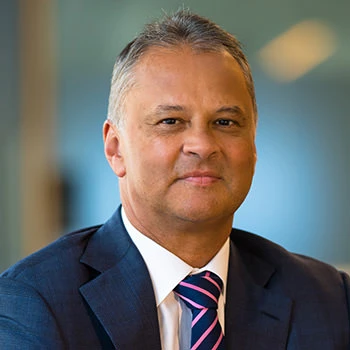
John Pearce joined UniSuper in 2009 and as its CIO, he has an important role in ensuring that the lines of communication remain open between his more than 50 specialist managers who manage about 75% of its $80bn in AUM. They see many good investment opportunities abroad, so continuing to diversify and invest in deeper offshore markets with more growth potential remains an important priority.
“Bringing funds in-house has also made us a better manager of managers, and of course the cost efficiencies have been huge.”
John Pearce
Tell us about your role at UniSuper and what your key priorities are
Some Chief Investment Officers aren’t directly involved in the investment management, especially those who are heavily reliant on consultants. At UniSuper, I’m heavily involved in the investment decision-making, particularly with respect to our defined benefit portfolio and overall asset allocation responsibilities. I’m in the fortunate position of having a very experienced team of professionals so I don’t spend any time micro-managing. My portfolio managers have a lot of autonomy and it’s my job to ensure that the lines of communication between our teams remain open. It’s about getting the balance right between providing adequate guidance and giving them the space to confidently make investment decisions. As a Chief Investment Officer, getting this right is certainly more an art than a science.
What’s unique about UniSuper?
Our domestic market is fairly narrow for an $80bn fund like us, which makes us a relatively big fish in a small pond. We don’t have depth is some key sectors such as technology or healthcare, which makes diversification in the domestic market somewhat problematic. Therefore, like many of the large Canadian pension funds, we have to look offshore, which is what we have been doing for many years. We are also in a fortunate position of receiving very strong inflows, which means that more of this will need to be allocated overseas.
We were one of the first superannuation funds to bring a large component of the investment function in-house, and the strategy has worked very well. This move ultimately gave us more control over our destiny and we are now able to tailor our portfolios to suit the return and risk profiles of our range of investment options. Bringing funds in-house has also made us a better manager of managers, and of course the cost efficiencies have been huge. Currently, about 75% of our funds are now managed by around 50 internal managers and as our operations are scalable, when fund inflows accelerate, we don’t necessarily need to hire additional managers.
How do you form an investment view?
We always start with the dominant macro themes and the most pervasive theme over the past decade, (and set to continue), has been ‘Financial Repression’, with interest rates tracking far below the rate of nominal GDP growth. This means that we either need to lower our return expectations, or we take on more risk to meet our current returns. That’s not unique to an Australian investor like UniSuper – many pension funds around the world need to adapt to this new reality. However, on a relative basis, it also presents an opportunity for a fund of our size and scope to leverage the full depth and breadth of our expertise. We actually see many good investment opportunities abroad, so continuing to diversify and invest in deeper offshore markets with more growth potential will be an important priority for our managers going forward.
Another theme we are looking deeply at is the technology revolution and the disruption being wreaked on traditional business models. Of course the challenge is to convert a thematic into an investment proposition and that’s where the intuition of the very best managers comes to the fore. In this regard we heavily leverage the expertise of our external managers.
What are the challenges to investing in APAC?
The biggest risk today tends to be geopolitical. There are no obvious financial solutions to this and Australia is trying to navigate itself through some of those tensions. While we don’t ascribe to any particular label we tend to acquire large stakes in ‘quality assets at a reasonable price’. We like companies with resilient business models and it’s the best way for us to manage this type of risk.
When diversifying and investing offshore, you also start to lose some execution and information advantage that you would enjoy back home. Diversification however, does not necessarily add risk to our portfolios – the volatility of your portfolio should actually reduce the more heavily diversified you are. Our hybrid model compensates for this as it allows us to bring in specialists who really understand their market or strategy.
We are uniquely structured to face some of these challenges. Unlike a number of other funds we don’t simply divide the world into emerging and developing markets. We look at individual regions, countries, and sectors. For example we have “specialist” mandates in Japan, India, Technology, and Healthcare. This allows us to dig much deeper into every investment opportunity. Our structure forces our investment managers to collaborate with one another, as they rely on each other to make their investment decisions.
What are the challenges facing a CIO today?
For me, it’s the ESG investment theme and the ability of investment managers to demonstrate their investment credentials. The investor demand is certainly there, but certain elements of ESG, especially the environment and social aspects, are very subjective and converting a theme like global warming into an investment thesis can be very difficult. It’s now becoming an important part of the investment process and that means evolving your process so you can find the right answers.
What role will technology play in the future of asset management?
We’ve been fortunate to have access to a lot of resources because of the size of our fund. Technology will continue to play a large part in investing, though I feel most of the big leaps for technology have already been had, and the advances going forward will be more incremental. We will continue to invest in technology where we need to, especially for our quant teams who tend to be more data-dependent than the fundamental teams.
What is your favorite investment book?
I’ll narrow it down to my favorite author and nominate Roger Lowenstein. His two books: Warren Buffett, The Making of an American Capitalist and When Genius Failed, are must reads. They show the opposite sides of the investment spectrum, and illustrate the triumph of common sense over intellectual arrogance.
Additional Resource
The Journey to Tomorrow’s Buy-Side Operating Model
Today’s buy-side leaders know they need a clear, compelling vision to stay competitive. Attracting new assets, providing transparency and value, meeting growing regulatory demands, empowering people with efficient processes and tools, managing costs and maximizing performance are all essential.
Solutions for Portfolio Managers
Bloomberg helps portfolio managers achieve their objectives by providing unmatched transparency into their portfolio’s performance, characteristics, risk and more. From one location, a series of powerful, integrated equity and fixed income tools deliver consistent insight, enabling you to create and execute differentiating investment strategies.