Through the looking glass: data management, risk, and regulatory compliance (Part 1)
This article was written by Bradley Foster, Global Head of Content (Enterprise) and Essan Soobratty, Product Manager – FRTB at Bloomberg.
The increasing popularity of exchange traded funds (ETFs) and other fund products has been written about extensively; and the importance of the role played by fund vehicles in international portfolios brings necessary questions relating to financial stability.
International bodies including International Monetary Fund (IMF), Financial Stability Board (FSB), and Basel Committee on Banking Supervision (BCBS) have presented their own research and engaged with the industry on a number of topics with implications for market stability. At the same time, central banks and other regulatory bodies have been more direct: both in their use of funds as instruments for policy transmission, and in their regulation of financial market participants via a number of supervisory measures.
Earlier this year the Federal Reserve announced extensive economic support measures in response to the market disruptions caused by the COVID pandemic, which included their support of market liquidity through the purchase of investment grade bond ETFs in conjunction with bond purchases directly. The Fed’s actions were not unprecedented: The Bank of Japan has used the purchase of equity ETFs as a tool for policy transmission since 2010.
In part 1 of this series looking at the treatment of funds under FRTB, we’ll review a high-level approach for the analysis of funds and then show how FRTB builds upon these existing workflows. In part 2 we’ll look in more detail at some of the challenges associated with the ‘look-through’ approach, and the next article in this series will look at alternative approaches for when ‘look-through’ may not possible.
Different ways of describing the risk
The use of funds either directly or via derivative contracts allows investors, asset managers and bank trading desks to obtain (or hedge) diverse exposures in ways that are operationally efficient, and cost effective.
While the positions and resulting risk exposures can to some extent be described, and then aggregated using available reference, classification and pricing data at the fund level, a truer picture of a fund’s risk characteristics is obtained only once the underlying positions in the fund are identified, and then analyzed as if those positions were held directly. This is known more commonly as fund look-through.
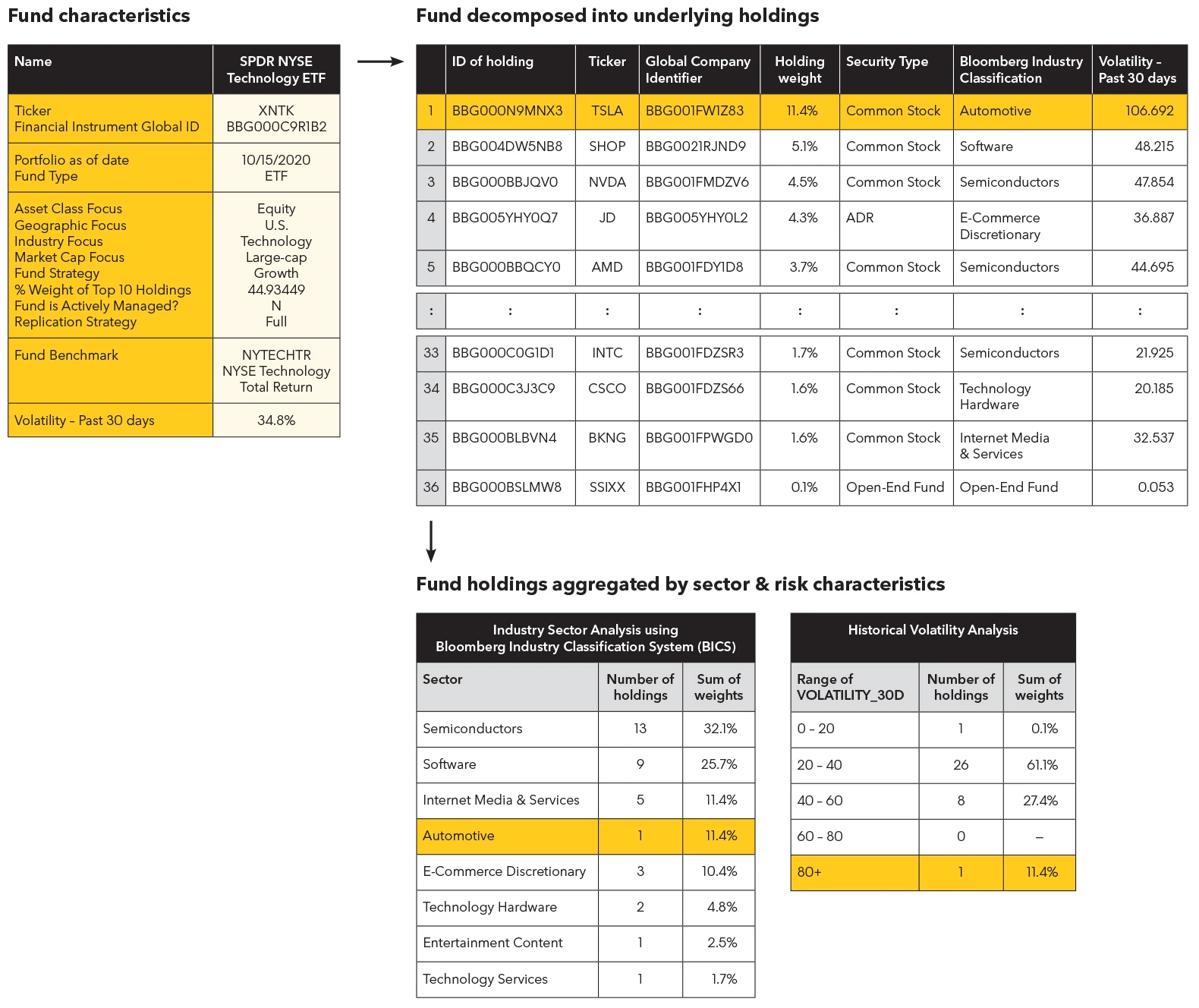
Holdings level analysis of this example ETF shows that by far the biggest holding is Tesla, which while heavily reliant on technology, is actually classified as a consumer stock by many classification schemes, including Bloomberg’s Industry Classification Scheme (BICS). In the example shown in Figure 1.1, the risk manager not only identifies Tesla as the largest holding but can also aggregate exposures from the underlying holdings according to characteristic that are most relevant. In this case, we use industry sectors and historical volatility ranges, but other characteristics for equity such as country of risk, market capitalization, or liquidity can be used. For bond funds, the possible risk characteristics extend to credit ratings, duration buckets, amount-outstanding, and other bond related criteria.
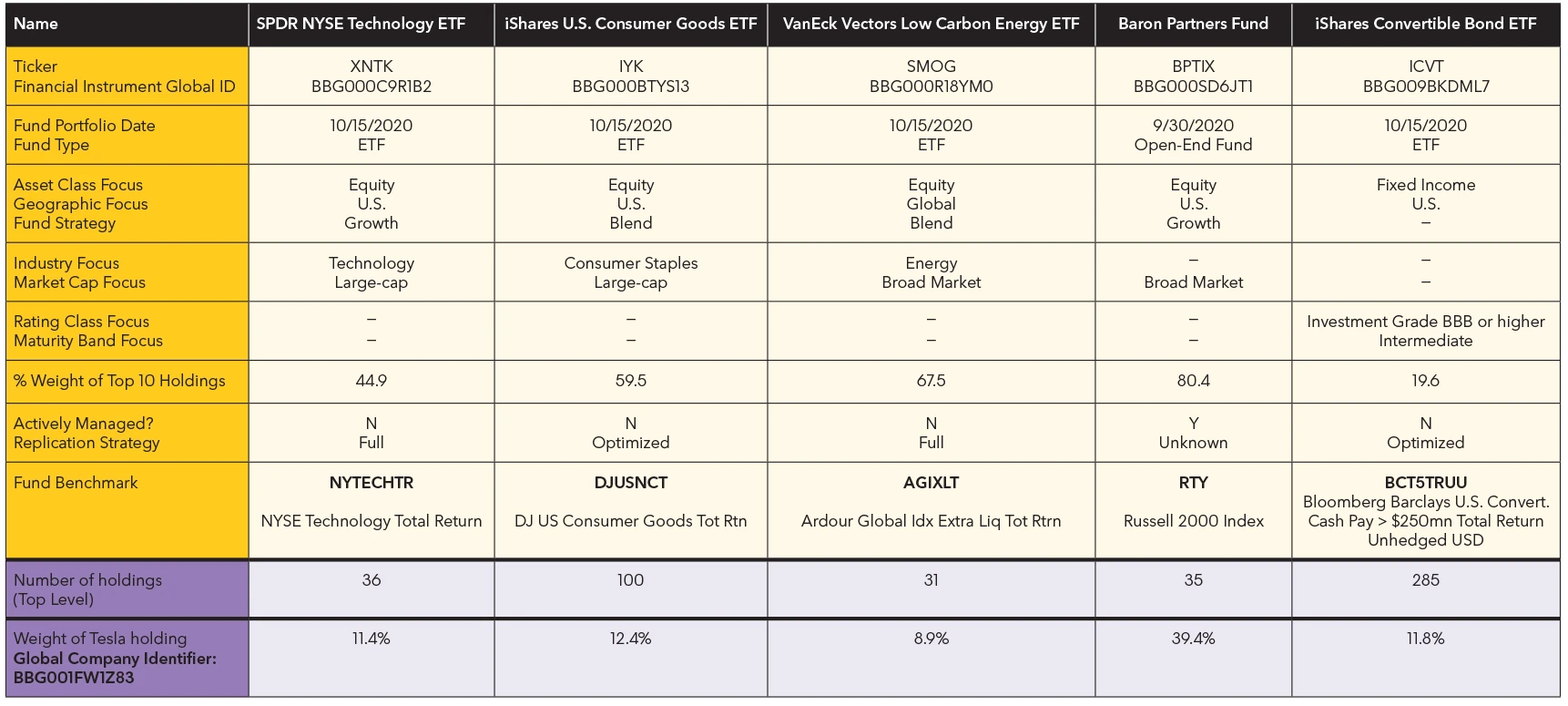
Decomposition of a single fund and the analysis of its underlying holdings provides a truer picture of the risk of an individual fund. When this approach is applied consistently to multiple funds or portfolios, it allows risk managers to discover and quantify concentrations of risk as shown in Figure 1.2. These risks, once identified, can be aggregated in a consistent manner across a desk or portfolio and then where desired, more broadly across the organization.
Obtaining fund holdings data
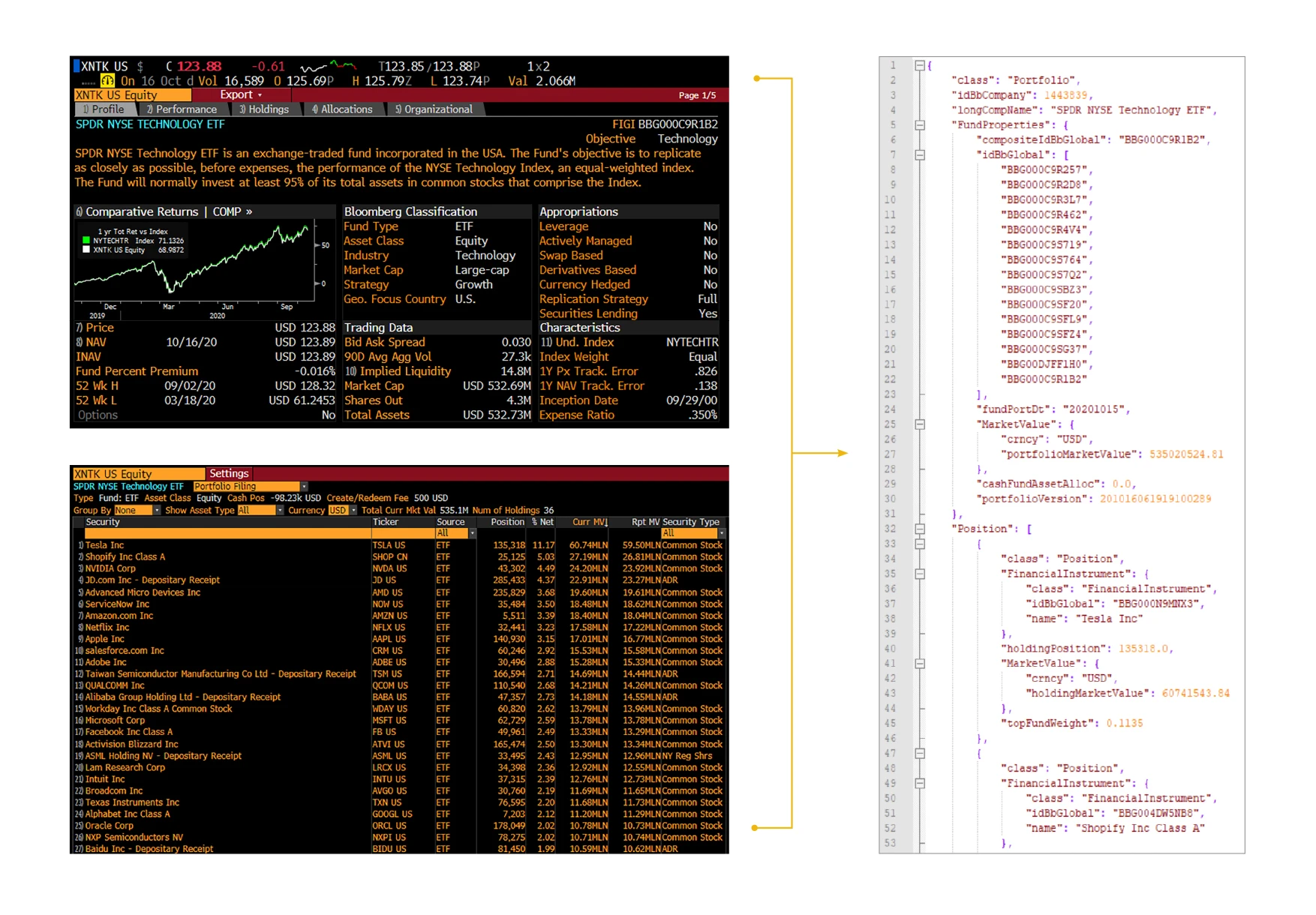
For fund vehicles such as ETFs, portfolio holdings data for a given fund is often available daily. Bloomberg provides access to this data in a number of formats including those that are machine-readable, and those designed with human interaction in mind. This dual availability allows for alignment in front office and downstream processes including valuation, risk and product control.
Common risk and portfolio management workflows integrate the acquisition and processing of this data along with other data, allowing for the automation of the entire process for fund decomposition, including:
- Obtaining the necessary reference, classification, and pricing information for each holding using industry-standard identifiers
- Computation and aggregation of exposures according to the characteristics and weightings for each holding
- Further aggregate/net across other exposures in the portfolio, or across the trading desk.
Risk management meets regulation
The benefits of understanding the characteristics of a fund at the investment vehicle level, and then at the deeper level of underlying holdings is not only intuitive and sensible from a risk management perspective but also lies at the heart of a number of regulatory requirements including Basel Committee’s Market Risk Capital Standards for international banks known as the Fundamental Review of the Trading Book (FRTB).
FRTB’s rules for the treatment of fund exposures span a number of areas and revolves around the regulatory concept of ‘look-through’ which the Basel Committee defines as:
“…an approach in which a bank determines the relevant capital requirements for a position that has underlyings (such as an index instrument, multi-underlying option, or an equity investment in a fund) as if the underlying positions were held directly by the bank”
With this definition of ‘look-through approach’ in mind, there are a number of implications for bank treatment of funds depending on the extent to which fund portfolio holdings data, and other information relating to the fund characteristics is available:
- Assignment of position in a fund to the trading book vs the banking book based on specific criteria.
- Standardized Approach rules governing the classification (bucketing) of funds and/or their holdings which has important implications for the determination of aggregate exposures and risk weights used in the determination of capital requirements.
- Extent to which desks with fund holdings are allowed to implement the often more desirable Internal Modelling Approach.
Extending the risk management workflow
Implementing FRTB requirements such as the Standardized Approach builds upon the risk management workflow described earlier: once a fund held by a trading desk has been decomposed into its constituent holdings, these relative positions can then be bucketed in accordance with their weighting in the fund depending on asset class, industry sector, and other characteristics relevant for the risk class in accordance with Basel rules.
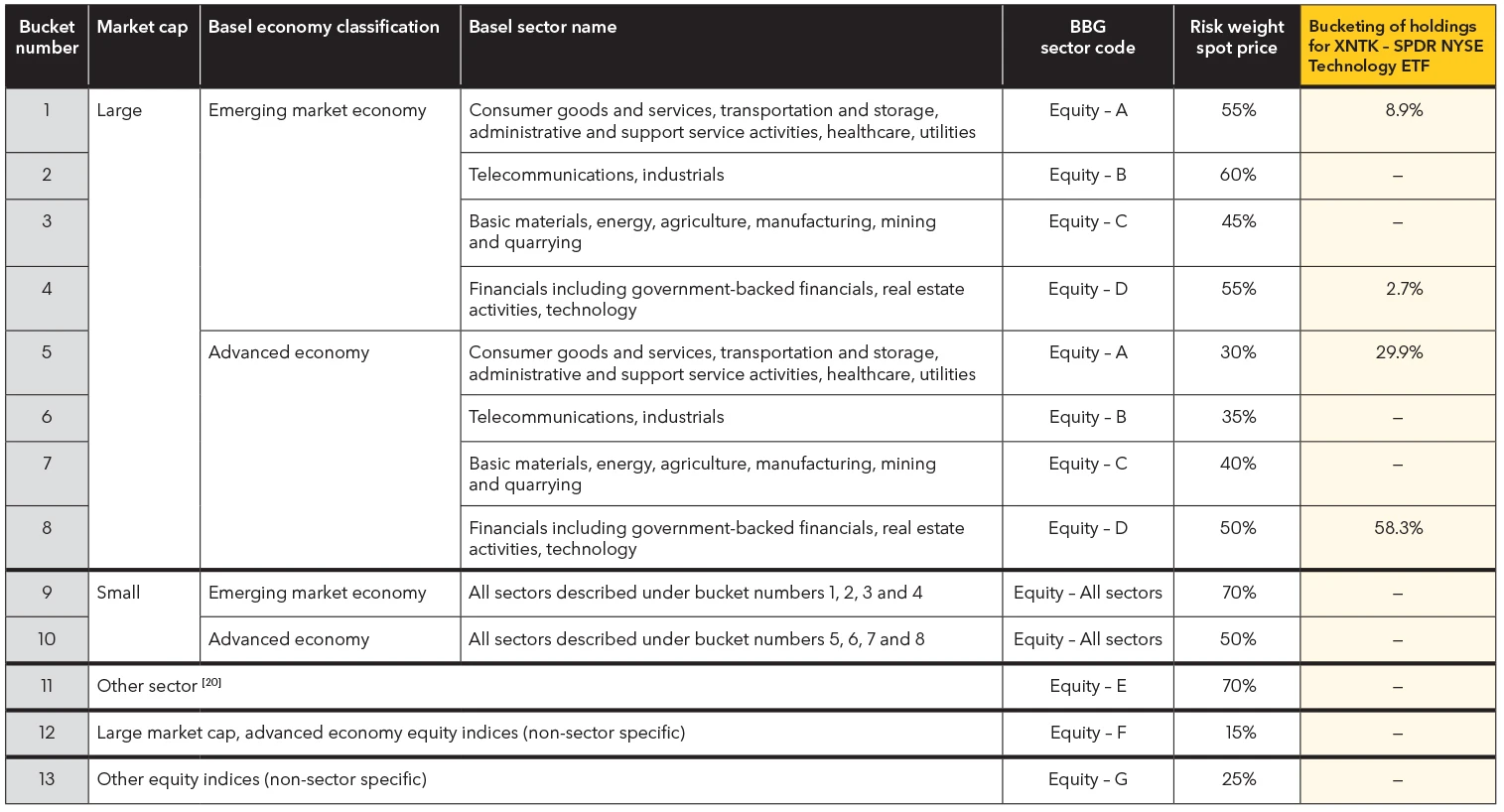
This ‘bucketing’ process is repeated for all funds and other exposures for the trading desk. In order to then compute the minimum capital requirements, risk-weighted sensitivities from each bucket are then aggregated (after netting where permitted) both within and across buckets, taking into account Basel-prescribed correlations.
In the event that a desk does not apply ‘look-through’, FRTB allows for other approaches, including bucketing the sensitivity arising from an exposure to a fund into the “other sector” bucket.
However, while that might seem a simpler approach, there are advantages that extend beyond the risk management benefits in decomposing a fund. These benefits include the ability to assign and net sensitives at holdings level across relevant regulatory buckets and to aggregate within and across buckets where correlations are less than one.
Applying the ‘look-through approach’ also avoids having to use the punitive 70% risk weight associated with the “other sector” bucket. In addition, look-through allows banks to gain correlation benefits where applicable in aggregating the weighted sensitivities. We will discuss some of the modeling nuances and challenges associated with look-through, as well as looking in more detail at the quantitative benefits that result, in the final article of this series.
In finalizing the FRTB framework, the Basel committee’s intentions are clear: implement an approach in assessing the risk of positions which have multi-underlying funds, which is not only intuitive, but also aligns with risk management best-practices already implemented at many firms. However, as straightforward as the Basel look-through approach might appear on the surface, the specific FRTB rules for look-through and other approaches contained in Basel’s framework can often prove challenging to implement in practice.
In the next part of this series, we will look at some of the specific challenges that banks may grapple with in implementing FRTB requirements for funds.