
Bloomberg Intelligence
This analysis is by Bloomberg Intelligence Chief Equity Strategist Gina Martin Adams. It appeared first on the Bloomberg Terminal.
Analysts are adjusting estimates lower, but not nearly enough to suggest they are anticipating the earnings impacts of “Liberation Day” trade measures. Even before President Donald Trump’s tariff announcements, surging layoffs and falling new orders already suggest a much weaker climate is emerging. Our model suggests that an average 20% tariff rate applied to S&P 500 overseas inputs alone may result in a modest earnings recession — afar cry from analysts’ forecasts for about an average growth year.
Analyst optimism is fading, but not likely liberated
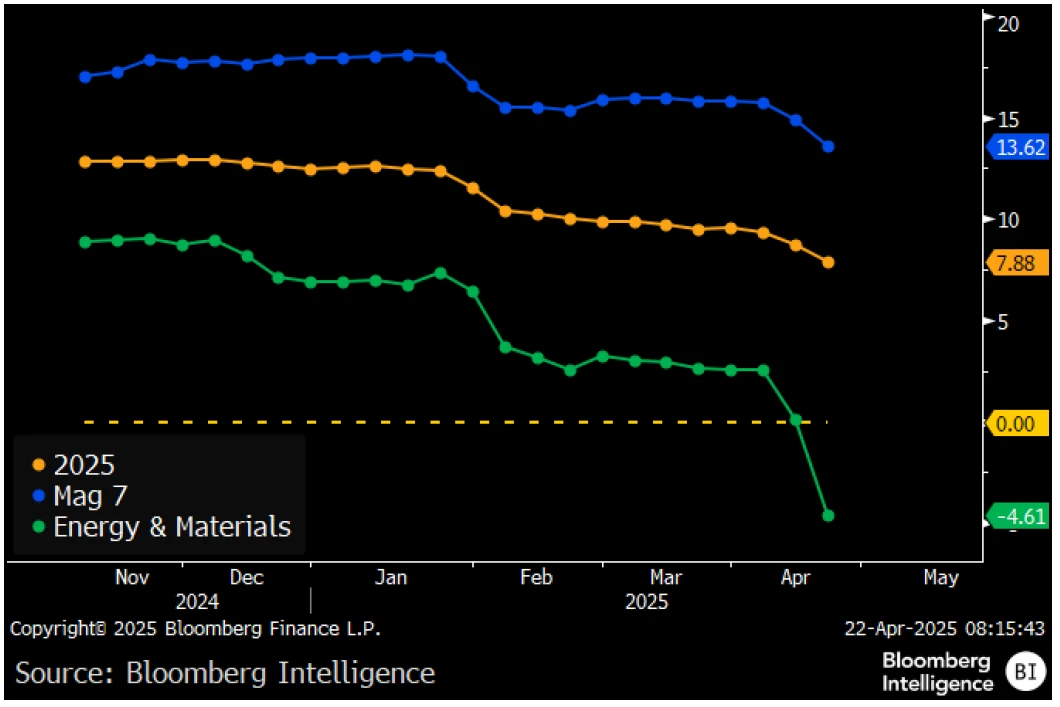
Though “Liberation Day” tariff announcements will likely result in materially slower earnings growth for S&P 500 companies this year, analyst forecasts for 2025 earnings growth have merely dropped at about the same pace as in the early stages of the 4Q earnings season. Currently, consensus is forecasting 7.9% earnings growth in 2025. While that’s down from nearly 10% just a month ago and over 12% at the start of this year, it’s still in line with the average pace of S&P 500 annualized net income growth of 7.7% since 2010. In the face of tariff uncertainty, average growth seems somewhat unrealistic.
All but the utilities sector have recorded downward adjustments, with the energy and materials segments among the hardest hit. The energy and real estate sectors are now expected to post earnings declines in 2025.
S&P 500 2025 earnings growth consensus forecast
Margin forecast likely in early stage of decline
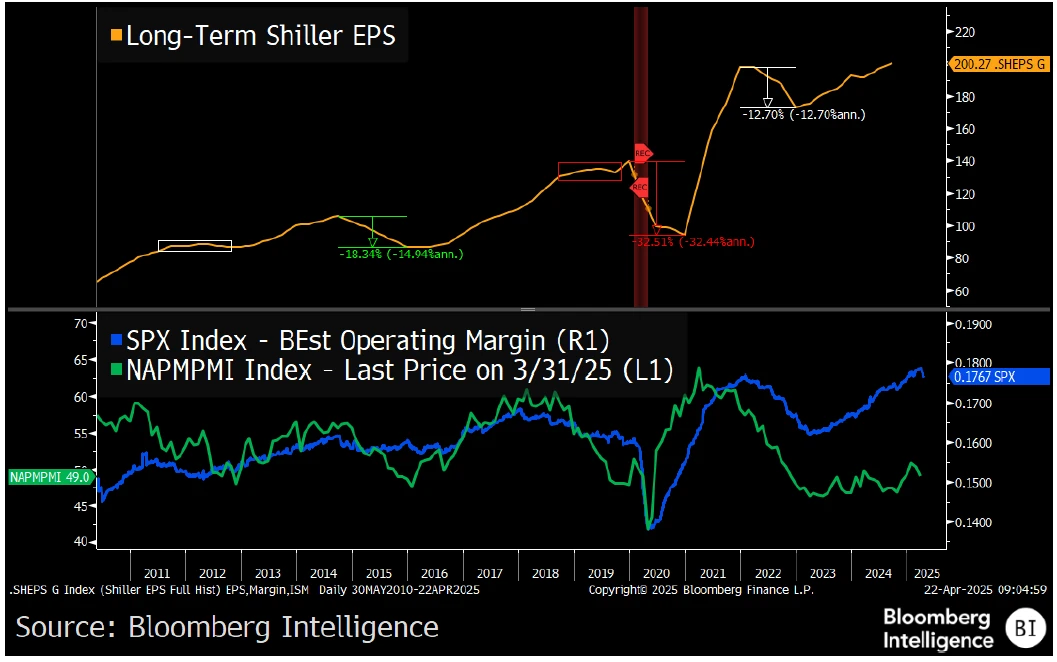
Operating margins typically cue periods of earnings weakness in the S&P 500 and now appear to be in the early stages of decline. Forward margin forecasts hit a new high by March, but have hooked a touch lower in recent weeks. In response to the modest tariffs and tightening Fed policy during the first Trump term, operating margin forecasts dropped about 70 bps. Given the bigger adjustments to trade terms announced so far this year, a larger decline is likely in 2025.
There have been five major corrections in the S&P 500, ranging from 14.1%-33.9%, and all were affiliated with an earnings slowdown or correction, with operating margin forecasts an indicator of fundamental weakness. The 2011 and 2018 equity market corrections of 19.4% and 19.8 occurred with merely a stall in fundamental momentum.
PMI, operating margin estimates are earnings cues
Modest beat to 1Q masking future quarters’ declines
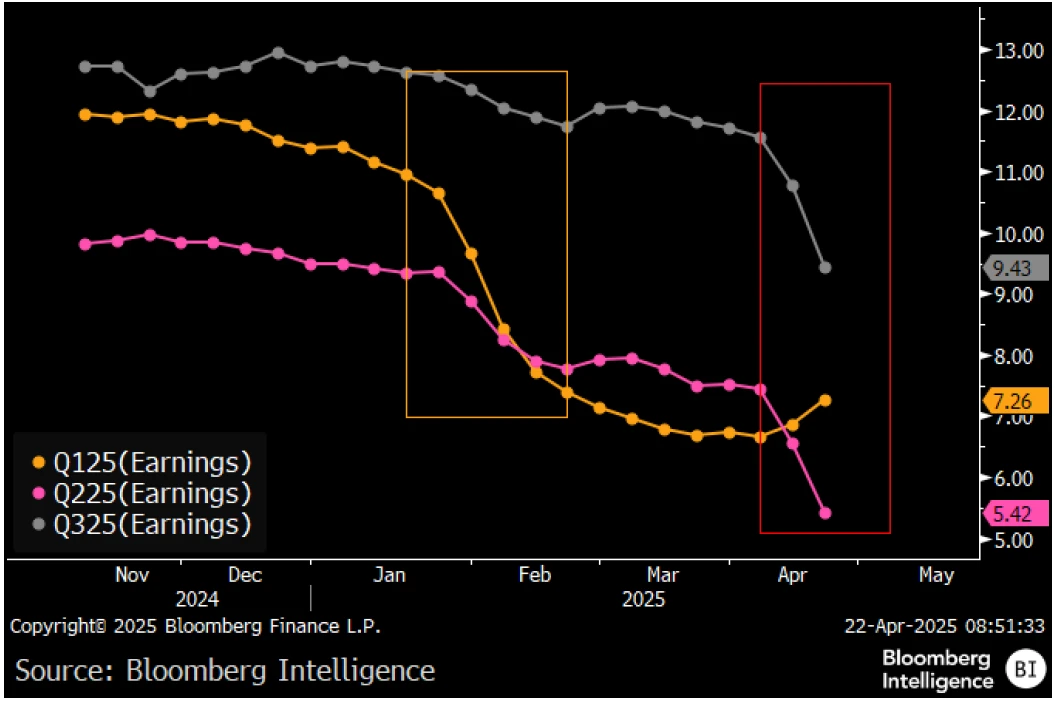
Part of the reason 2025 growth forecasts aren’t falling more is because 1Q reports so far have slightly beaten expectations. The outlook for future earnings growth is actually falling more rapidly than at the start of the last earnings season. Indeed, 2Q and 3Q earnings growth forecasts have dropped about 200 bps each over the last two weeks. Every sector recorded a decline in 2Q growth estimates, and now four S&P 500 sectors — discretionary, energy, materials and real estate — are expected to post year-over-year earnings declines in 2Q.
Revenue growth forecasts for each of the next two quarters have dropped 50 basis points over the last two weeks, with all sectors except for health care and materials posting declines.
S&P 500 2025 1Q-3Q earnings growth estimates
US tariffs could cause S&P 500 net income to fall 7.4% in ’25
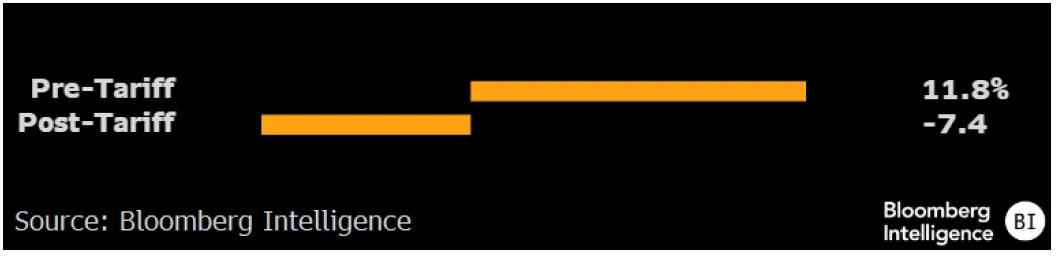
US tariffs could push the S&P 500 into an earnings recession in 2025 — leaving the index vulnerable to further downside given the froth still present in multiples. In 2024, the index posted a gross margin of 35.3% when excluding financials, real estate, utilities, energy and transports companies. Based on the 43.2% of COGS from overseas that we estimate and the 21.7% tariff rate estimated by Bloomberg Economics, gross margin could fall to nearer 29% once the levies are in place.
Current consensus is for $1.7 trillion in net income (11.8% growth) in 2025. Using the share net income comprises of gross profit assuming the 35.3% gross margin from last year (36%) and applying that to post-tariff gross profit based on consensus 2025 revenue forecasts implies just $1.4 trillion in net income (minus 7.4% growth year-over-year).
Pre- and post-tariff implied NI growth
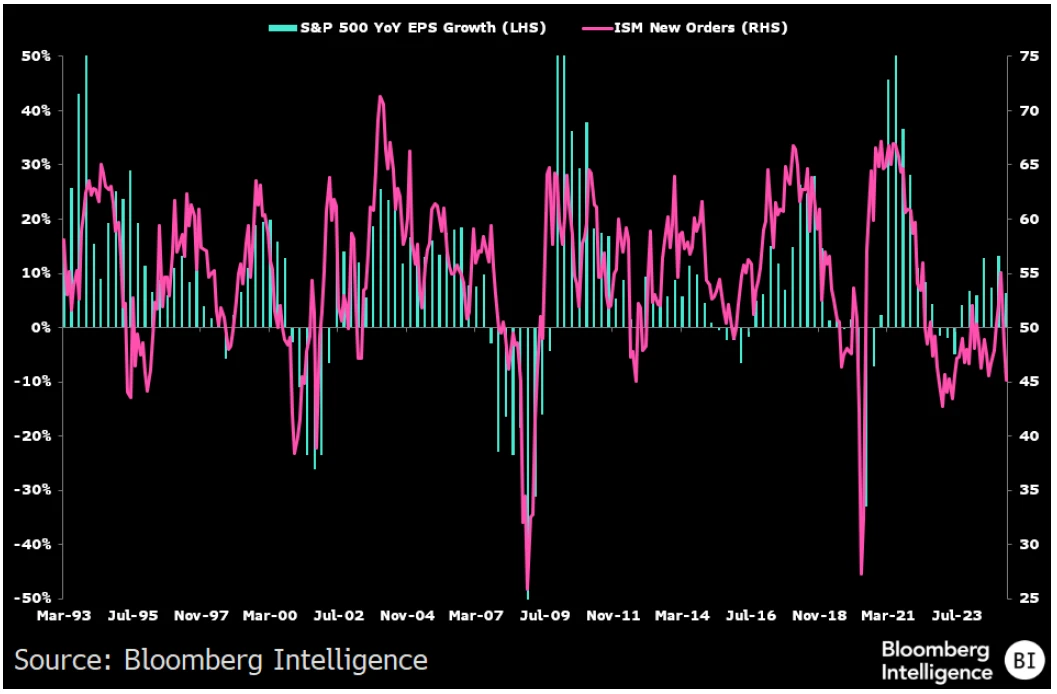
New orders signal dampening outlook for earnings
An economic slowdown is becoming evident and suggests the US earnings outlook is at risk. ISM new orders have been contracting for the last two months — the March value sits at 45.2, the lowest since May 2023. It had been in an uptrend until peaking in January. Dating back to 1960,there have only been 64 months (8.2% of months) when ISM new orders were less than the March2025 reading. Of those 64 months, 49 (76.6%) of them were during official US recessions.
When new orders contract (below 50), average year-over-year EPS growth for the S&P 500 is minus3.5%, a far cry from the consensus for 9.1% growth this year and our estimated implied market expectation for at least 15%. When new orders expand, earnings growth averaged a much stronger 15.6%.
ISM new orders vs S&P 500 EPS growth
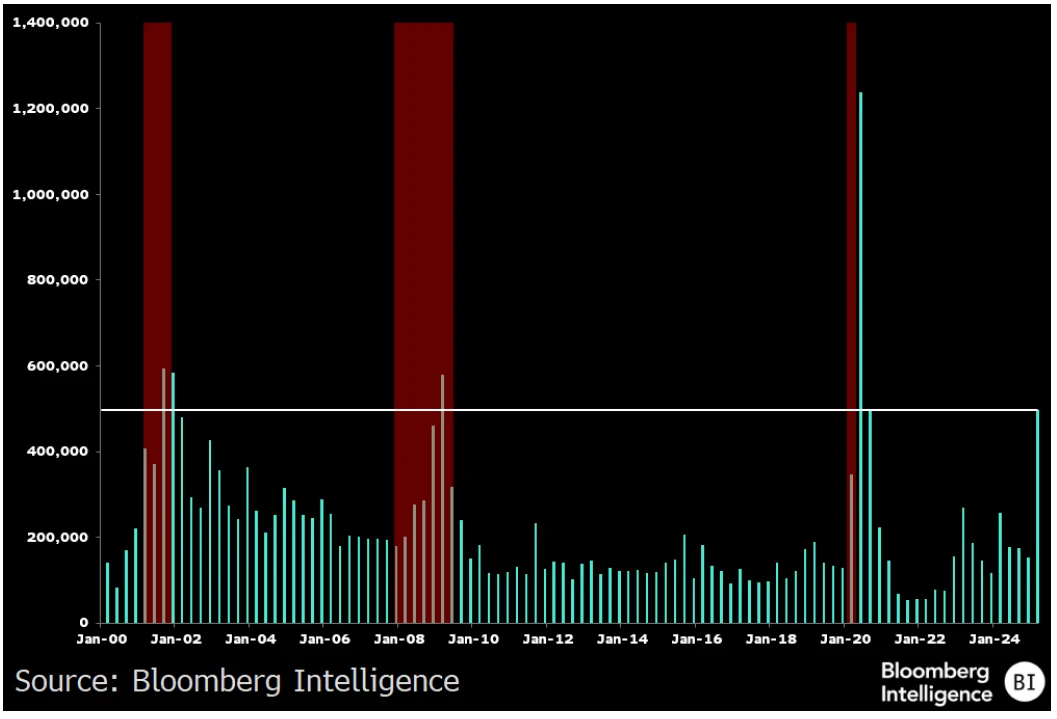
Layoffs paint a grim picture for consumer sectors
US layoffs, spurred by Department of Government Efficiency (DOGE) cost-cutting, are already triggering levels typically observed during recessionary periods. This will likely pressure the outlook for consumer-sector earnings. Challenger reported over 275,000 layoffs in March, up 60% from February’s total and up over 200% from March 2024. In total, nearly 500,000 layoffs were reported in 1Q, the most since 3Q20. In all quarters dating back to 2000, excluding those in or right after a recession (one quarter of leeway on both sides), average layoff s were 178,000. Last quarter was 2.8x higher than the average.
Average quarterly layoffs in or around recessions were roughly 400,000, or 20% lower than 1Q.
Quarterly layoffs reported by Challenger
The data included in these materials are for illustrative purposes only. The BLOOMBERG TERMINAL service and Bloomberg data products (the “Services”) are owned and distributed by Bloomberg Finance L.P. (“BFLP”) except (i) in Argentina, Australia and certain jurisdictions in the Pacific Islands, Bermuda, China, India, Japan, Korea and New Zealand, where Bloomberg L.P. and its subsidiaries (“BLP”) distribute these products, and (ii) in Singapore and the jurisdictions serviced by Bloomberg’s Singapore office, where a subsidiary of BFLP distributes these products. BLP provides BFLP and its subsidiaries with global marketing and operational support and service. Certain features, functions, products and services are available only to sophisticated investors and only where permitted. BFLP, BLP and their affiliates do not guarantee the accuracy of prices or other information in the Services. Nothing in the Services shall constitute or be construed as an offering of financial instruments by BFLP, BLP or their affiliates, or as investment advice or recommendations by BFLP, BLP or their affiliates of an investment strategy or whether or not to “buy”, “sell” or “hold” an investment. Information available via the Services should not be considered as information sufficient upon which to base an investment decision. The following are trademarks and service marks of BFLP, a Delaware limited partnership, or its subsidiaries: BLOOMBERG, BLOOMBERG ANYWHERE, BLOOMBERG MARKETS, BLOOMBERG NEWS, BLOOMBERG PROFESSIONAL, BLOOMBERG TERMINAL and BLOOMBERG.COM. Absence of any trademark or service mark from this list does not waive Bloomberg’s intellectual property rights in that name, mark or logo. All rights reserved. © 2025 Bloomberg.