Europe’s Energy Crunch
Where Can Europe Get the Gas to Fill Its Reserves This Summer?
Another cold weather snap in Europe is about to end, and gas stockpiles remain far above their normal levels. With energy supplies for this winter largely taken care of, the region is fast turning its attention to the next heating season.
Gas reserves will need to be replenished over the summer and autumn to levels that will ensure a safety buffer for next winter, should it turn out to be colder than the current one. With inventories likely to end the heating season far fuller than usual, much less gas will be needed to replenish them. But there will also be lower volumes from Russia, the backbone of previous refilling campaigns.
So, how is Europe going to fill that gap?
Higher-than-normal stockpiles are going to play a big part, according to Morgan Stanley.
Russian supply through pipelines this summer is likely to be about 18 billion cubic meters lower than last year, the bank said. That hole will be plugged by 29 billion cubic meters of higher stockpiles in key EU members by the end of March compared with last year, it said.
“The winter 2023-24 is rapidly de-risking,” Morgan Stanley said in a note.
Europe's Gas Buffer
Fuel stockpiles remain well above historic averages

As far as supply is concerned, liquefied natural gas is likely to remain a key source. Imports rose to record-high levels at one point during the winter, and analysts at BloombergNEF estimate they will remain strong, with major European nations’ purchases staying above historical levels through the summer.
Supplies of the super-chilled fuel have become crucial for the continent, with the US taking on a major role. And while pipeline shipments were slashed, ever more cargoes of Russian LNG were imported into Europe.
Europe Increased Russian LNG Imports
Shipments increased last year even as pipeline sales slumped

Novatek PJSC, whose Yamal LNG project in Arctic Russia supplied near-record volumes to Europe last year, sees continued interest from the region, according to Chief Executive Officer Leonid Mikhelson. But maintenance at the plant this year means production will be 5% lower than last year, he said.
Pipeline supplies from regions like Norway, North Africa and Azerbaijan also increased last year, but those capacities are not enough to reduce Europe’s reliance on LNG. Morgan Stanley sees piped shipments from these regions staying largely unchanged this year.
That brings the critical question of demand. Total consumption in the European Union and the UK fell by some 14% year-on-year in 2022, and by 15% compared to the average for 2017-2021, according to the Oxford Institute for Energy Studies.
Some analysts, including at think tank Bruegel, say that this year Europe might need even tighter consumption, especially if the weather disappoints and Russia cuts even the existing supply. Germany has also warned about complacency creeping in, and urged households and industries to keep reducing energy use.
Europe's Gas Demand Has Been Steadily Below Normal
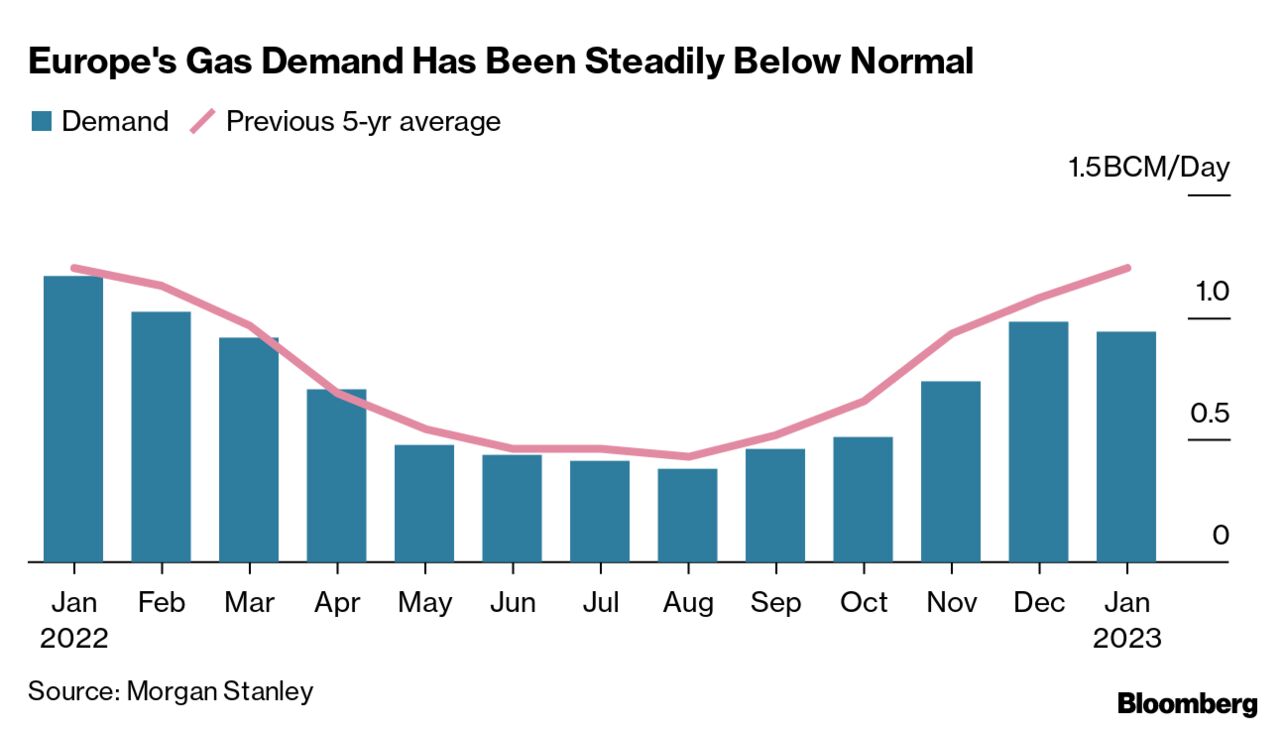
The gas market has turned around so sharply that it has moved from fears of shortage last year, to a potential glut later this year if current low demand and strong LNG imports continue. Morgan Stanley expects gas reserves will end the heating season at 59% full, double the levels of last year.
The bank even cut its forecast for gas prices in the third quarter to €47 a megawatt-hour — last seen in August 2021 — compared with the €64 it estimated a month ago.
But others don’t quite agree. SEB AB has warned that prices staying even at current levels for too long may spur a boost in consumption, and prices may rebound past €100 this year.
It’s a stark reminder that while the energy crisis has lost much of its sting, Europe isn’t completely in the clear as global supplies remain tight.
“What you will have going into 2023 of course is the return of a significant appetite from China to take up gas” after it ended its Covid-zero policies, Shell Plc Chief Executive Officer Wael Sawan said last week. “I would not declare an end to the energy crisis. I think we have a way to go.”
Previous Posts on Europe’s Energy Crunch Blog
Feb. 6: Europe Has Banned Russian Diesel. The Market Seems Little Concerned
More energy coverage
World's Biggest Carbon Capture Plant Gets Second Chance in Texas
In the Struggle for Big Oil’s Soul, the American Vision Wins Out