
Meet the Team: Data License Plus (DL+) Engineering
December 02, 2025
“Over the past decade, the number of Bloomberg employees has doubled,” wrote Michael Bloomberg in a recent Business Post op-ed. “Our Dublin office is now nearly our largest in the EU.” The Bloomberg founder attributes this growth to Ireland’s business-friendly environment and the country’s surplus of recent STEM graduates — the highest grad rate in the European Union. Bloomberg’s Engineering department benefits from this resource, and the company’s newly-opened office in Dublin is a dynamic hub for technology, where global projects come to life.
In particular, the Data License Plus (DL+) Engineering team builds and maintains tools that enable firms to streamline the acquisition, management, and distribution of Bloomberg entity, instrument, markets and pricing data from multiple delivery channels.
DL+ is part of Bloomberg’s Enterprise Data business, which delivers the industry’s most comprehensive, high-quality, and interconnected portfolio of multi-asset class data and analytics solutions to the enterprise. Through advanced, cloud-enabled technology combined with dedicated customer support, the team streamlines workflows, increases transparency, drives efficiency, and creates value for capital markets participants worldwide. Enterprise Data delivers the same trusted data that powers the Bloomberg Terminal, ensuring consistency across desktop and enterprise workflows.
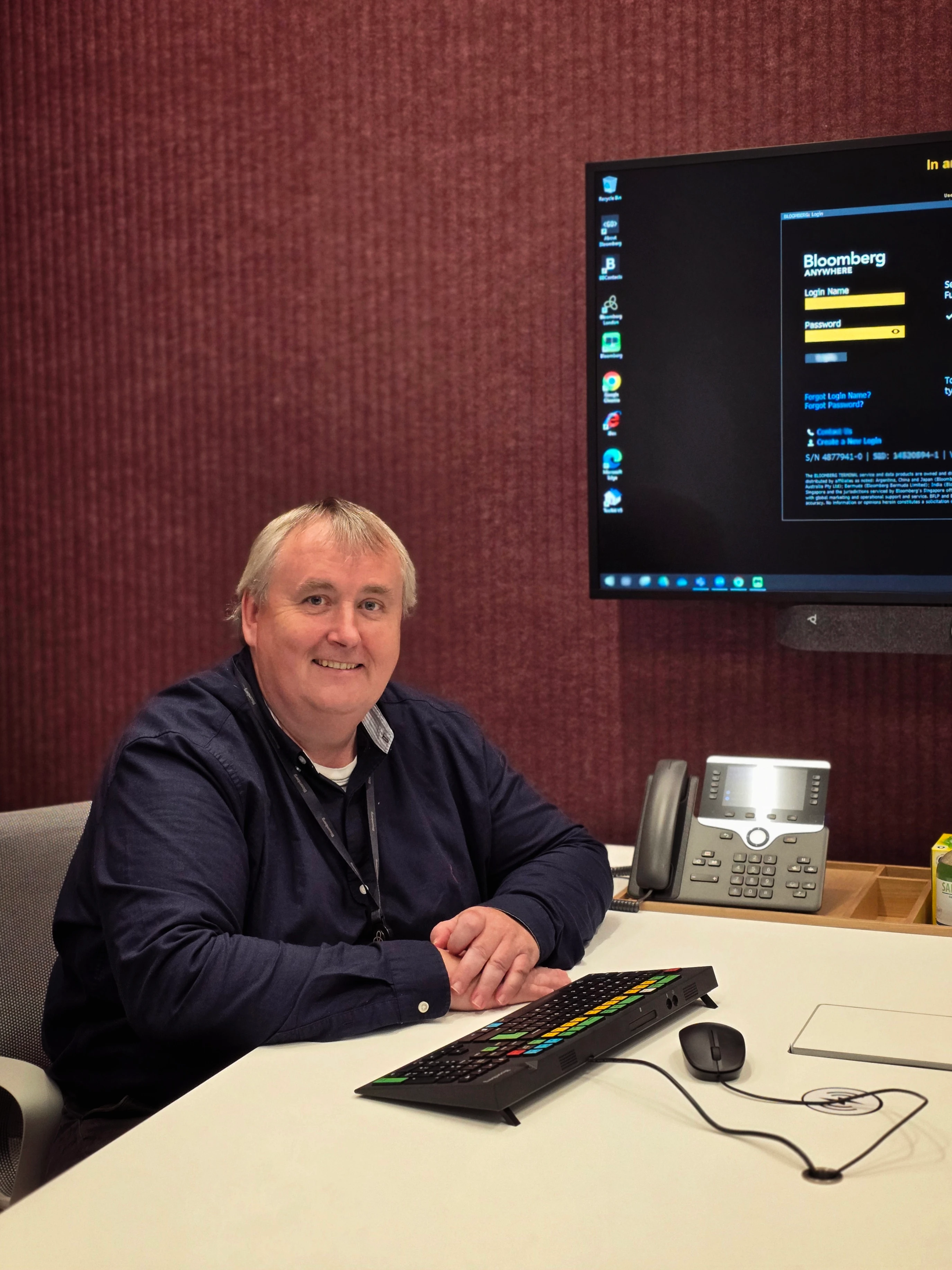
To learn more about the team’s work, let’s first check in with Engineering Manager Declan Costello. Declan runs the team out of Dublin, but his reports hail as far as London, New York, and Singapore.
Tell us about your team.
DL+ Engineering has three distinct groups. First, the Technology Infrastructure team runs the compute, storage, network, databases, and compute systems in our data centers, as well as the DevSecOps and SRE practices that support them. The Platform team provides job scheduling, file storage services, data manufacturing pipelines and persistent data services. And finally, the Applications and Content team owns our web application, API, cloud delivery, Unified Data Model (UDM) creation, and data fulfilment processes.
What are some of the unique technical challenges your team needs to tackle?
Our priorities are innovating to meet our customers’ growing appetite for high-quality data, rearchitecting our solution while in motion, managing data centers, security, and audit compliance, as well as integrating with the company’s broader engineering workflows, data centers, and practices.
Briefly tell us about your career path.
I started my career as a Smalltalk programmer at a fintech startup in 1996. In that role, I built retail banking applications and got to spend a lot of time with clients on engagement and implementation. I then moved to a custody and trade management solutions provider, where I took on engineering and product management roles. I joined Bloomberg in 2014 as an Engineering Manager.
What’s your strategy for choosing team members?
Our teams consist of a mix of long-tenured engineers and recent university graduates. It’s important to bring new people with fresh approaches to problems into the group, from a multitude of backgrounds. We have people from 21 different countries working with us.
What are some of the factors driving the rapid growth/expansion of your team?
Ireland is rich with fresh engineering talent, so it’s important for us to capitalize on the talent in the region to accelerate the work we do on our DL+ solution, a privately hosted, cloud-based solution that aggregates and organizes a customer’s Bloomberg data from multiple delivery channels, across their enterprise.
How do you foster culture on your team?
I try to encourage people to do their best at all times, be open to suggestions, adopt an active listening approach, allow experimentation, and adapt their approach to others’ abilities. Employees are encouraged to spend time with their colleagues one-on-one, and each is given clear ownership and control for their areas. We hold people accountable for their actions and support them in their decision-making processes.
What else would you like to share about your Bloomberg experience?
Coming into the larger Bloomberg Engineering organization from outside is such an overwhelming experience, but there is so much available to help get onboarded. For example, we have guilds, training, and internal developer conferences. These are all ways that new employees can find folks willing to help.
We are working in a rapidly changing landscape of AI and competitive pressures, along with an ever-changing geopolitical landscape. Tomorrow’s world is going to be a challenge, but at Bloomberg, I believe we answer these uncertainties with organizational stability, a focus on challenging computer science problems, a can-do culture, and a collaborative work ethic.
“Ireland is rich with fresh engineering talent, so it’s important for us to capitalize on the talent in the region to accelerate the work we do on our DL+ solution.”
– Declan Costello
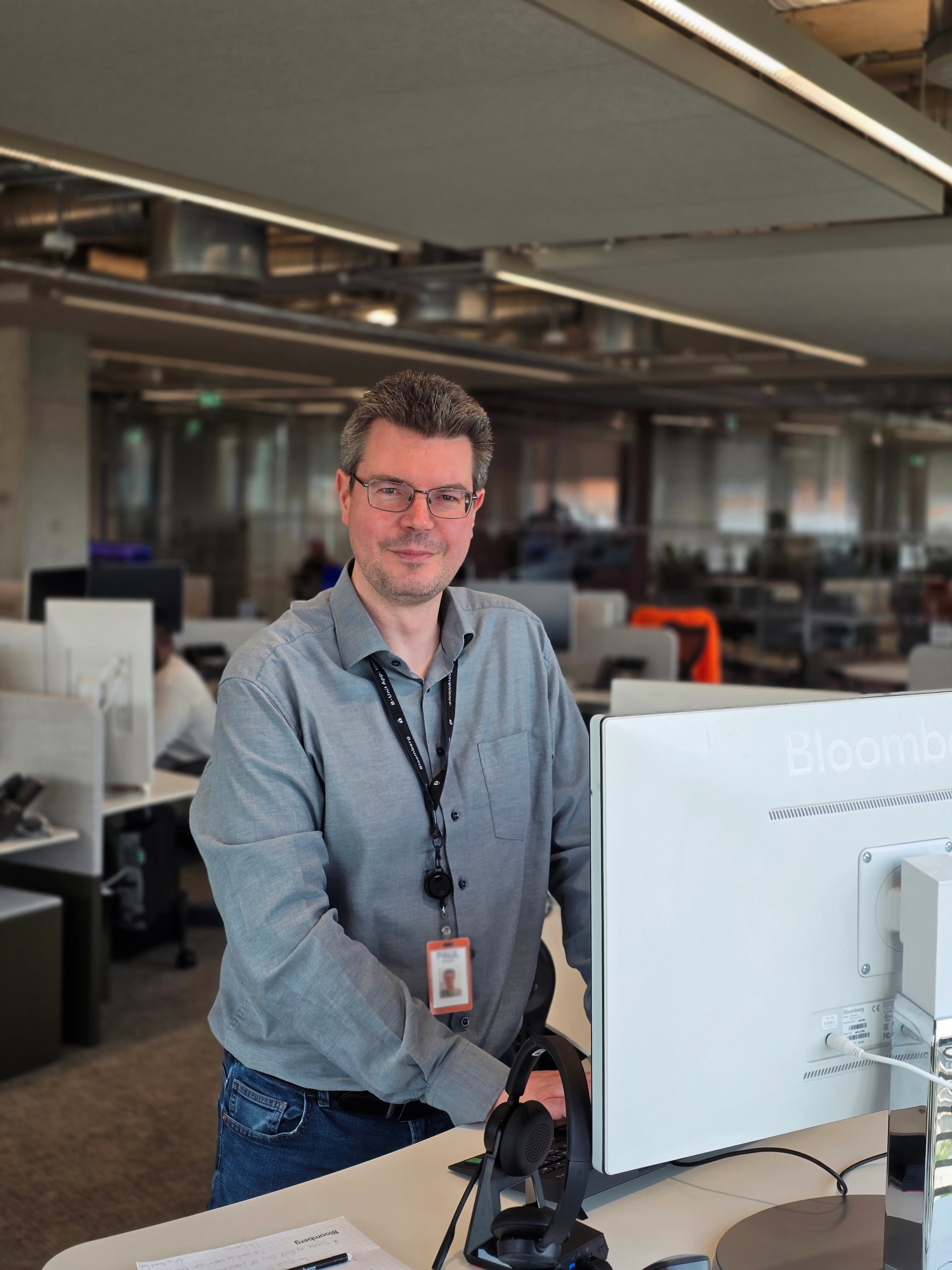
Paul Priest manages the Applications and Content group within DL+ Engineering. He’s settled in County Wicklow with his family, where he’s dabbling in archery.
Tell us about your team.
Applications and Content comprises four teams: The Web Applications team is responsible for the full-stack for the UI, as well as DL+’s integration with Metering. The Client Fulfillment team is responsible for tools for customer tenancy establishment, and supporting the general area of security resolution and setup. Content Onboarding is responsible for the tools and configuration for mapping Data License Bulk and Per Security data into our Unified Data Model (UDM). Finally, Cloud Delivery provides DL+’s support for delivery of modelled UDM data and notifications to all major cloud providers, as well as Parquet files via SFTP.
Tell us about your career path.
I started my career as a graduate developer from the first London training class in 2003. Working in a team known variously as Equities, or Realtime Applications, I was responsible for products such as Monitors/Worksheets, Alerts Manager (ALRT), Custom Index Library (CIX), Price and Volume Dashboard (VWAP), Trade Ideas (TMSG), market depth, price history, equity pricing, and more. I spent my early years rewriting, consolidating, and reenvisioning products using the latest technology stack. I later became a team lead and manager, including serving on the London Leadership Committee for a while.
I originally moved to Dublin on a short-term contract in 2012. I performed a variety of duties in establishing the SaaS for a couple of years, including the build-out of our data center architecture and initial customer services, working directly with senior leadership and various Bloomberg network and design teams. I then transitioned to become the lead of the Web Applications team for around 10 years.
Tell us about what you’re working on now and what your biggest challenge is. What inspires you most about it?
As a whole, we are largely focused on scaling up the DL+ business to support hundreds of client firms.
We are starting to look at the plan for migration or spanning of our data centers to Bloomberg’s U.S.-based ones to allow for more options for growth. My main project is a multi-year and multi-pronged approach to ensure that we are also able to fundamentally scale to account for the volume of data and complex permutations of data sources, and to streamline the configuration and data maintenance processes.
Finally, one of the biggest challenges we have currently is to fill the large number of open positions that we have.
How do you keep things interesting after so many years at the same company?
Taking on new products, understanding the original intent or customer needs, and overhauling or significantly extending them and then watching usage grow (or not!) is rewarding, as is building innovative features that satisfy a niche and lead to user stickiness.
How do you foster a collaborative, inclusive environment at work?
We allow everyone to contribute what they’re best at, and give them the opportunity to take on responsibilities that are a good fit. On the flip side, we expect everyone to play well with others.
What are your best tips for inspiring direct reports?
I aim to lead by example with respect to work ethic, technical ability and domain knowledge. I try to delegate effectively, giving opportunities to others to grow without micromanaging. Finally, we look out for each individual and their needs like career growth, quality feedback, or recognizing if they are struggling technically, feeling unchallenged, or needing rest.
“We allow everyone to contribute what they’re best at, and give them the opportunity to take on responsibilities that are a good fit.”
– Paul Priest

Vanja Zubcevic is a database administrator for the Technology Infrastructure team.
What are you working on now? What inspires you most about it?
Our team is in charge of the whole infrastructure stack behind the DL+ application. Alongside a skilled group of system administrators, network engineers, and fellow database administrators, my role involves ensuring infrastructure stability, enhancing performance, and managing daily operational challenges. We also handle disaster recovery, capacity planning, maintenance, and general support for all our systems. One of our constant challenges is maintaining continuous uptime in a live production environment, which requires prompt detection and resolution of any issues that might crop up.
What I find most inspiring about my role is the troubleshooting aspect. It allows for continuous learning and application of new technologies, and also supports our developers by ensuring their database needs are met.
How do you keep things interesting after so many years at the same company?
Although my role might appear routine, each day brings its own set of unique puzzles to solve and occasional unexpected problems. Working with a great team helps me stay engaged and enthusiastic. My manager always gives me opportunities to work on new things and explore any new interests.
How do you foster a collaborative, inclusive environment at work?
Teamwork is very important to me, as well as making everyone feel included. Being the only woman in my immediate team, I know how important it is for everyone to feel like they belong. That’s why I’m always ready to help out and encourage others to do the same. We often need to combine knowledge about different parts of the system to solve problems, and I make sure to listen to other people’s ideas. It’s not just about getting things done; it’s about doing them together and making sure everyone feels like they’re part of the team.
What’s it like working on a team that’s spread across multiple geographies?
While most of our engineering team is in Dublin, we also have colleagues in London, New York and Singapore. One of the significant advantages of covering multiple time zones is being able to quickly respond to issues around the clock. We organize team meetings at times that suit everyone and will often chat on Instant Bloomberg (IB) throughout the day. It’s important to communicate and not leave co-workers isolated. While the pandemic changed the way we work with other people, with more remote meetings than before, it is still necessary to check in on people and work hard at coordinating and collaborating.
“Teamwork is very important to me, as well as making everyone feel included. Being the only woman in my immediate team, I know how important it is for everyone to feel like they belong. That’s why I’m always ready to help out and encourage others to do the same.”
– Vanja Zubcevic

Conall Caverly is a full stack software engineer on the Manufacturing and Storage Services (MASS) team. He’s been working with Bloomberg for four years.
Tell us about what you’re working on now and what your biggest challenge is. What inspires you most about it?
I am currently working on upgrading our data store. This upgrade includes API changes and a data format change, which means that it is a significant migration project, including terabytes of data. Due to the size of some of our indices, migrating them can take a long time.
I’ve been working on speeding up this process and using our job management system to run an end-to-end migration. I have to incorporate error handling, reports, data validation, and verification. From our clients’ perspective, there should be no disruption while we’re migrating the system, and there will be no change in user experience once we have completed the migration. It’s my job to ensure the whole thing is seamless.
What inspires me about the project is how much I am learning about the underlying technology and how we are using it across many of our services. Before the project, I had not been involved much with this system, but I am now one of its chief maintainers. I enjoy projects such as this that provide opportunities to use new technologies and tackle new challenges.
How did you find out about Bloomberg? What made Bloomberg stand out for you?
I found out about Bloomberg through the internship program at my university. I applied for and completed my internship in 2020 before returning to university for another year. What stood out for me was the number of operations the company runs in countries all over the world. This gave me the opportunity to move to London a year after joining the team in Dublin. I still work with the MASS team remotely from Bloomberg’s London Office.
What do you wish you knew about software engineering careers before you joined Bloomberg?
It was something a lot of people had told me about but I was still surprised with how much I didn’t know and how much I learned once I started working.
I would encourage new Engineering hires to get involved with some of the many guilds at Bloomberg. They’re a great way to start learning about some of the important underlying systems and best practices at Bloomberg, as well as getting to know some great people. The guilds have been a great help to our team getting more integrated into the broader Bloomberg organization.
Tell us about the mentorship you’re receiving at Bloomberg.
Both during my internship on the MASS team and since I rejoined the firm, I have received excellent mentorship from all members of the team. All interns on the MASS team are given a mentor to help them settle in, someone they can direct their questions to, who can introduce them to the work we do and acquaint them with colleagues at Bloomberg.
We try to take on an intern every year, and I have previously had the opportunity of mentoring one of our interns. It is a very rewarding and valuable experience and is a great way to form strong relationships with a team member.
What’s it like working on a team that’s spread across multiple geographies?
Our manager ensures everything runs smoothly with short standups each morning and longer weekly team meetings. When people are having in-person meetings, there is always a Zoom call that can be joined or someone around to give a catch-up after. Demos are always encouraged at various stages of a project to anyone who is interested.
“What inspires me about the project is how much I am learning about the underlying technology and how we are using it across many of our services. Before the project, I had not been involved much with this system, but I am now one of its chief maintainers.”
– Conall Caverly
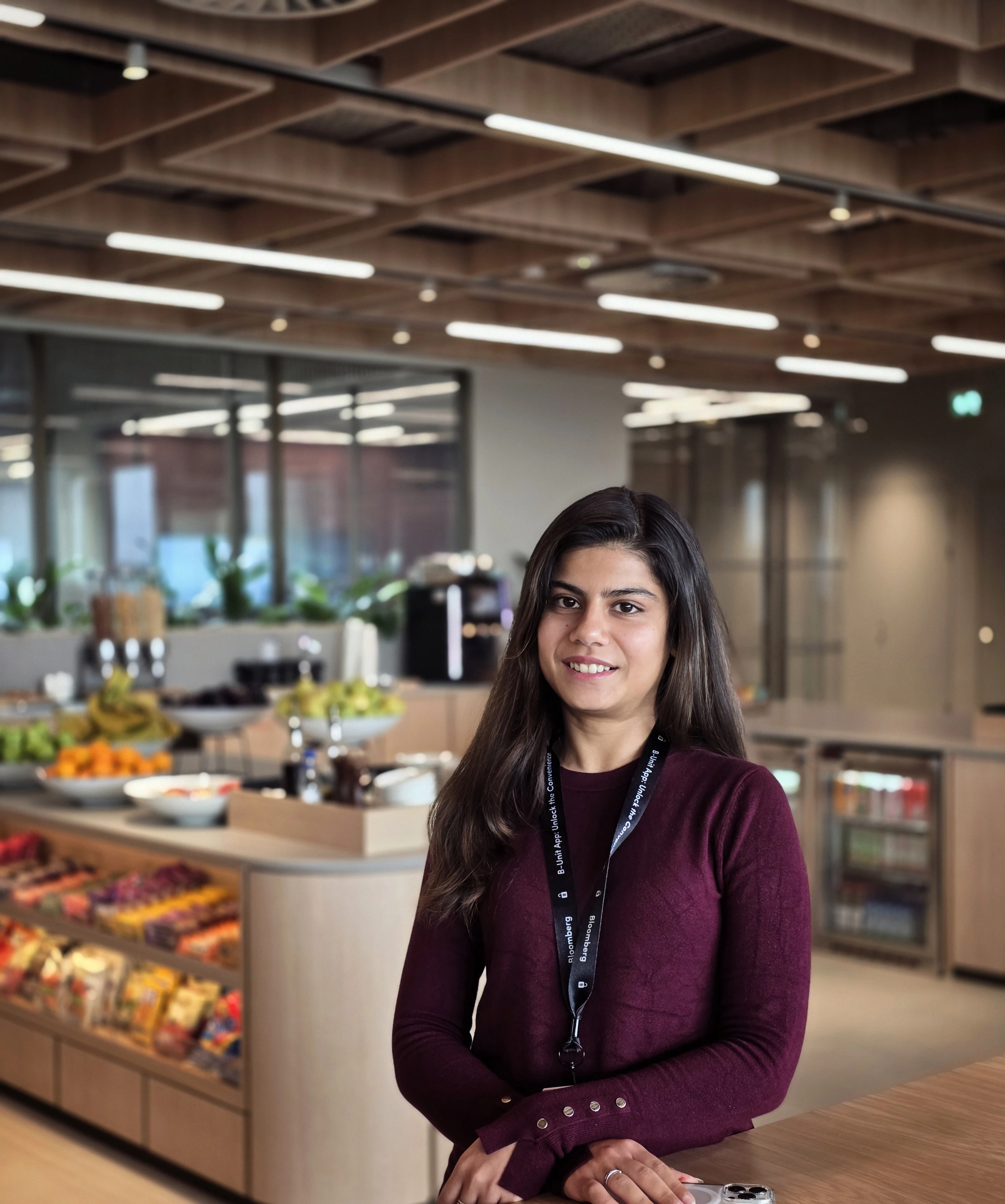
Vanshika Agarwal is a back-end software engineer on the Index team in DL+ Engineering.
Tell us about what you’re working on now and what your biggest challenge is. What inspires you most about it?
My current project involves optimizing the read/writes of large Parquet files into customized reports and improving runtime. The biggest challenge is the need to merge different types of datasets into one comparable to SQL-like queries involving joins, all while keeping the memory and hardware consumption in check. Solving such challenges on a daily basis is what drives me the most.
How did you find out about Bloomberg? What made Bloomberg stand out for you?
I first learned about Bloomberg at a career fair in college and university recruitment events. Bloomberg’s reputation as a leader in both finance and technology frequently came up in discussions about innovative companies making a significant impact.
Bloomberg stood out for me due to its unique blend of finance and technology, creating a stimulating environment where cutting-edge tech solutions have an impact on global financial markets. The company’s emphasis on real-time data, the scale of its operations, and its commitment to fostering a culture of innovation were particularly compelling.
I decided to go for Bloomberg because they offer challenging projects, and I get to be part of a collaborative, forward-thinking crew. Bloomberg’s strong emphasis on professional growth, mentorship, and continuous learning lines up perfectly with where I want my career to go as a software engineer.
What do you wish you knew about software engineering careers before you joined Bloomberg?
Before joining Bloomberg, I wish I’d known how wide-ranging software engineering careers can be within such a large, dynamic company. Bloomberg isn’t just about finance; there are so many opportunities to work on cutting-edge technologies, from real-time data processing and advanced analytics to big data technologies and machine learning. Understanding the importance of both technical and soft skills would have better prepared me to navigate and leverage the vast variety of resources and career paths available here.
What’s your best advice for inspiring new college grads who have recently joined Bloomberg?
For new college grads joining Bloomberg, my best advice is to embrace continuous learning and be proactive in seeking opportunities. Bloomberg is a place where innovation thrives, so stay curious and don’t hesitate to explore different areas within the company.
“Bloomberg stood out for me due to its unique blend of finance and technology, creating a stimulating environment where cutting-edge tech solutions have an impact on global financial markets.”
– Vanshika Agarwal
Check out some open roles across our DL+ Engineering group and Dublin office: