
How Bloomberg is driving gender equality and helping investors
December 15, 2016
This article was written by Paolo Gaudiano and Ellen Hunt from Forbes and is licensed by Bloomberg.

Screenshot of the GEI on Bloomberg’s Terminal
It is clear from reading the headlines and checking the research that, in spite of significant efforts, progress toward gender equality in corporate America has been very slow. What can be done to move the needle? Bloomberg is betting that viewing the issue through a data-driven lens has the potential to drive change, increase shareholder value and improve the economic well-being of women and communities around the globe. It is for this reason that, earlier this year, Bloomberg launched its Financial Services Gender-Equality Index (GEI), a reference index that measures gender equality in the financial services industry.
We had the pleasure of interviewing Angela Sun, Bloomberg’s Head of Strategy and Corporate Development – and principal architect of the GEI – on the day that Bloomberg released its survey for the 2017 GEI. Join us as we learn more about the motivation behind the index and why Ms. Sun is bullish about the GEI’s significance on Wall Street and beyond.
Parts of this interview have been edited for clarity.
Paolo Gaudiano And Ellen Hunt: What led you to create the GEI?
Angela Sun: I sit on the Board of Trustees of Women’s World Banking (WWB), the largest global network of microfinance institutions and banks that focuses on women’s inclusion in financial services and the economic empowerment of women. The President and CEO of WWB is Mary Ellen Iskenderian, and one of her funders is Citigroup. During one of their conversations, they observed that there is a dearth of hard data around gender equality. They thought that in the same way that people really focus on the Dow Jones Sustainability Index, which has gained traction over the past 15 years, there ought to be an index that benchmarks where companies stand on gender issues. The person at Citigroup said “don’t you have a Board member who works for Bloomberg? This would be a perfect area for them.” When we looked at this it made perfect sense for us. Bloomberg is founded on principles of transparency and providing access to data and analytical tools. We are experts at gathering data, standardizing it, normalizing it and then adding analytics on top.
We saw that our clients – investors – were increasingly looking at Environmental, Social and Governance (ESG) data to evaluate a company’s value, reputation and performance. The whole sector around socially responsible investing really started in the early 70s: Pax World created the first Socially Responsible Investing (SRI) fund and when you look at investor demand over the past 40 years, demand for it has only grown. Standard setting, starting with the United Nations’ Global Compact and then the UN’s Principles for Responsible Investment (PRI) established in 2006, has fueled this growth. Today there are 1,500 members in PRI with roughly $62T in combined assets.
The bottom line is, where investors are paying attention, companies are paying attention. And Bloomberg needed to be a part of that. So we launched the GEI earlier this year.
Gaudiano And Hunt: How does the GEI differ from other indices that focus on Socially Responsible Investing?
Sun: Many of the existing indices come from an ideological standpoint. The innovation here is the index itself, and its data-driven approach.
The GEI collects data for four areas. First is gender statistics. We are looking to track how companies demonstrate their commitment to Diversity & Inclusion in the workplace by promoting female hires into management.
Second, we look at company policies. Which policy goals are set to maintain and improve a diverse working environment and to promote women professionally, including gender-neutral family support?
Third, we want to see if companies publicly support women in various ways, including sponsoring external education programs, supporting gender equal legislation and supporting organizations that advocate for gender equality.
And last, we probe about product offerings. This is a new category that demonstrates full commitment beyond a company’s own employees. We are looking to see how committed a company is to women’s empowerment, which includes creating financial resources and opportunities for women clients. These are the initiatives that promote economic growth throughout communities and families.
Gaudiano And Hunt: Can you explain how you selected the companies and how you calculated their rank?
Sun: For the 2016 GEI, we sent out the survey to 100 firms that met our eligibility criteria: they had to be in the financial services sector, including asset management, banking and insurance. They must be publicly traded on a U.S. exchange, with a market cap of at least $15 billion.
In terms of deriving a GEI ranking, we give points for answering the questions. Extra points are awarded for best-in-class answers. The index uses a modified market cap-weighted model by multiplying the company’s current market cap with its Bloomberg GEI score. The membership weights will be rebalanced quarterly.
The 2016 index included 26 inaugural members.
Gaudiano And Hunt: And how did the companies in your 2016 Index fare, compared to other companies across the financial services sector, or even across all industries?
Sun: When we look at the stats for financial services firms in general, the percentage of women on boards stands at 12%. For GEI members it’s 26%. Further, in viewing the percentage of women in the workforce we see that GEI members have already achieved parity. That is, they stand at 50% representation, while women represent 36% of non-GEI company workforces. Another salient point is the number of women who are getting stuck in middle management. Here the rate is more acute than companies in general in the S&P 500. This despite the evidence that having more women in leadership roles has a positive impact on performance metrics and share price.
In fact studies on the 22 female CEOs in the S&P 500 show that they have out-performed male led companies over the last 1, 2 and 5 years. You can see the analysis in the September 22, 2016 Bloomberg Brief: “How Much Is a Female CEO Worth to Investors?” Another finding is that when these women took over as CEO, gender diversity on the Board increased by 7%.
Gaudiano And Hunt: You mentioned that you are expanding the universe of eligible financial service firms for the GEI. How has your thinking evolved on this?
Sun: From the outset, we decided to take a global lens on gender equality. First of all, this is Bloomberg and we are a global company. And second, we wanted to be able to capture regional differences. The hypothesis was that we’d find that the Europeans would be more progressive in their gender practices than the US and Asia. For example, Scandinavians are more progressive and generous with parental leave. What surprised us was that while they are progressive, the US and North America far out-indexed them in fertility and in education benefits. We also noted regional differences in the focus on issues to support women. For example, in Scandinavia they are focused on “returnship;” in Asia it’s elder care; and in the US it’s parental leave and fertility. By keeping the GEI focused on financial services only, we are able to make these kinds of pure peer-to-peer comparisons and get insights into the interplay between legislation and corporate policies.
In terms of building the index, we initially contacted the largest banks because we believed that once they participated then everyone else would take note. With our first year behind us, we are now opening the eligibility for the index to the top 400 or so global firms. The thinking behind this, is that real financial innovation is occurring in developing countries. Getting more women into formal banking services is happening at a regional level, and we wanted to make sure that we caught that shift.
Gaudiano And Hunt: What is driving demand for this type of data, specifically this focus on gender diversity?
Sun: Let me give you some data points on demand. I was in Copenhagen a few weeks ago for a meeting with the Scandinavian banks and the banking association there. I made a presentation to the Danish Diversity Council and I showed the group a chart on investor SRI demand. An interesting note here is that while there were people from HR, the key participants were treasurers, investor relations people and country managers. Why? Because when shareholders care, Boards have to listen.
While it has been anecdotal that women and Millennials are the largest investor groups that asset managers are courting today, the following data makes their interest in SRI and diversity clear. When you look at the breakdown in terms of the percent of ownership or interest in SRI, females outweigh males. One of the key issues is wage inequality. For example, the National Women’s Law Council found that women attorneys earn $450,000 less than men over the course of their careers. And a study found that at the current rate, women would achieve wage equality in the year 2139. That’s more than a hundred years from now. That seems pretty unacceptable. So women are expressing a very strong interest in wanting to align their investments with their values. And when you look at demand by demographics, specifically by age, you see 20% of Millennials own SRI funds and another 57% have expressed interest in ownership. This represents a commanding share of wallet that asset managers cannot ignore.
And last, another investor group, high-net-worth individuals – those with $10-plus million – tripled their SRI investments in just one year since 2015, moving from a 9% allocation to 27%! By introducing the GEI when we did, we will be able to help investors determine how and why gender diversity impacts performance.
Gaudiano And Hunt: Do you see signs that society as a whole is starting to embrace gender equality?
Sun: Yes. For one thing we can look at politics: overseas we see women leaders in Germany, Scotland, the U.K., and here Clinton is running for President and we already have Yellen and more.
An example more directly relevant to our sector is a recent New York Times review of the movie Equity, which has Anna Gunn in the lead role. She plays a woman who struggles to get to the top in Wall Street. There has not been a movie with a woman in this type of leading role since Working Girl in the late 80s. Usually women on Wall Street are shown in secretarial or more compromised roles, never as a lead or as a protagonist.
One of the comments in the New York Times piece is that there has never been a female CEO of a major Wall Street firm. This is supported in our numbers. The members of our GEI, on average, are more progressive in terms of their record on gender equality. But even among the GEI group, which has an average workforce of 50% women, there are still no women at the top – although Ana Botin stands out as the only Chairman of the Board at Banco Santander.
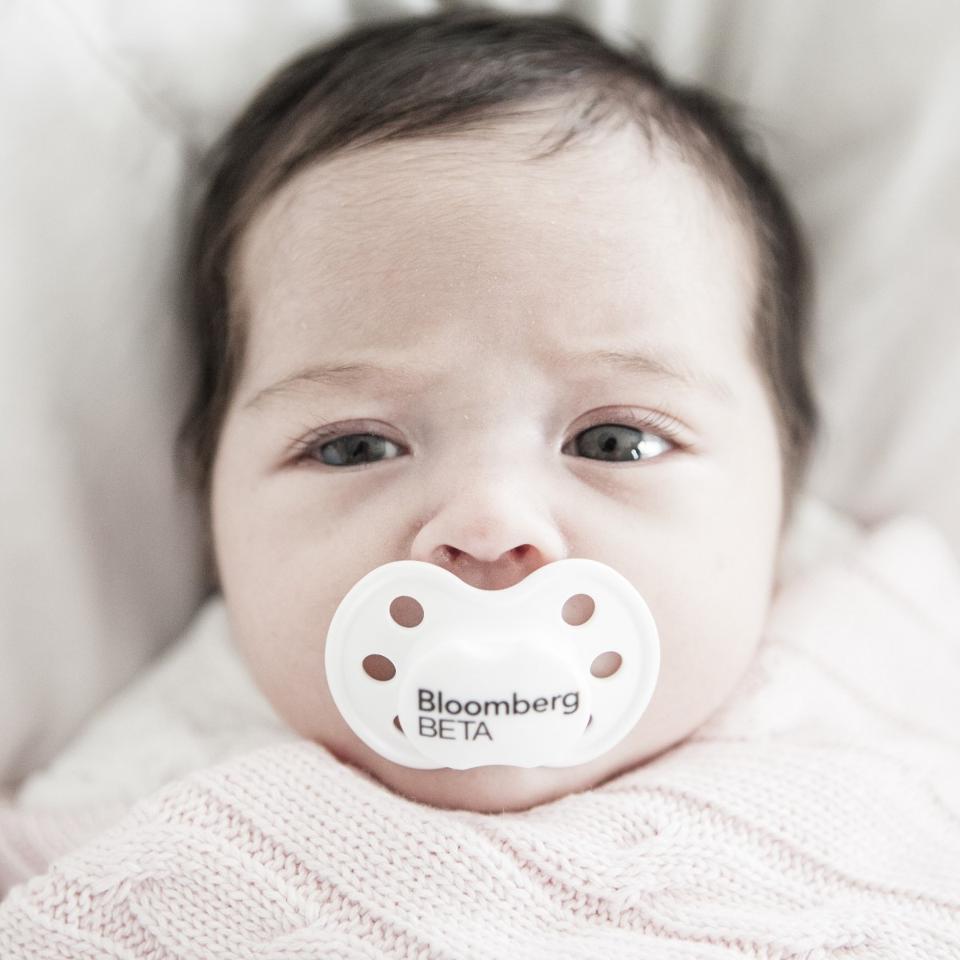
Angela Sun’s daughter, Avery, at the time when the GEI was launched
Gaudiano And Hunt: And what about you personally? How has your work on GEI intersected with your personal life?
Sun: When we launched the index, there were more than 200 people in attendance. Both Mike Bloomberg and Peter Grauer, Bloomberg’s Chairman, participated: Mike opened, Peter closed. I introduced them, and led the conversation.
I made it personal because I embody some of the topics we were discussing, and it was a room with equal parts investors, corporate clients, Diversity & Inclusion and HR representatives, and people from the ESG field. We were deliberate about not just having Diversity Officers.
In a twist of irony, I was there taking a break from maternity leave to talk about gender equality . That was a twist but it’s very real, and it put into sharp relief why these issues matter. It matters where your company puts its commitment, whether it’s borne out in statistics or policies showing a commitment to a diverse workplace.
As a new mom to a baby girl, Avery, who was only three months old at the time, it’s become more meaningful to me today than it was when I pitched the index a year ago. She was a Bloomberg champion from Day One! Anyone with a newborn knows there are angel and devil days when it comes to a child. And I took this glamorous picture a week or so before the launch. As it turns out, I did not have the baby nurse for that one week when GEI was launched. I felt confident, but on that week the nurse had to go home for a death in her family. I was gearing up to launch the index, I had never put Avery in her baby seat, and she had her mouth wide open crying. So I took a selfie and sent it to my husband, and I said “GET HOME RIGHT NOW.” That’s gender equality. It’s emblematic of what working parents have to contend with.
_____________________________________________
In creating the GEI, Bloomberg set out to create a platform that expands the diversity conversation beyond HR, to engage all parts of a business. The focus on data and performance across four key areas is a welcome evolution from the more ideological approach seen in other indices, and it reflects Ms. Sun’s observation that “when shareholders care, Boards have to listen.” And that, we would agree, is the real point of leverage for moving the needle.
This article was written by Paolo Gaudiano and Ellen Hunt from Forbes and is licensed by Bloomberg.