
Singapore’s GDP Growth to Hold Near 3% Through 2030, Supported by AI, Finance and Infrastructure: Bloomberg Intelligence
April 20, 2026
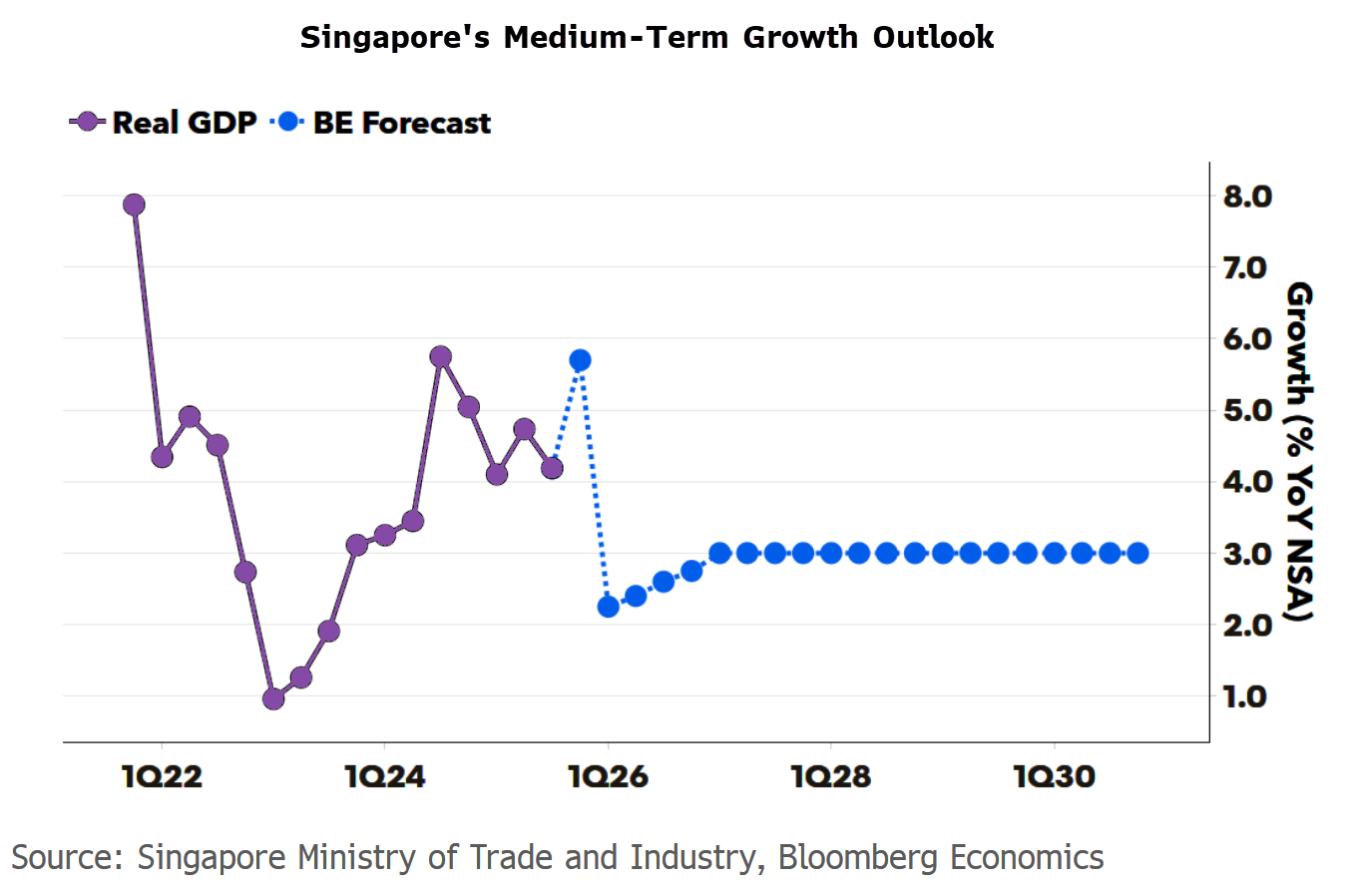
SINGAPORE, April 21, 2026 – New research from Bloomberg Intelligence (BI) finds that Singapore is likely poised for steady growth on the backdrop of a more fragmented global economic landscape, leveraging its multi-hub strategy and early adoption of artificial intelligence backed by a strong regulatory framework. Despite headwinds from rising protectionism and US-China tensions reshaping global trade and investment flows, BI’s Singapore Briefing 2026 projects that Singapore’s GDP is forecast to grow about 3% annually through 2027-2030, outpacing other developed Asia-Pacific economies.
The report indicates that Singapore’s GDP growth will ease to 2.5% in 2026 after an outsized 5% expansion in 2025 driven by AI-led investment and front-loading of spending ahead of US tariffs. In the long term, growth is expected to settle at 2-3% in most years, rising to 4% when international conditions are relatively good.
Over the medium term, US tariffs and broader geopolitical shifts are likely to redirect global trade flows rather than diminish them, positioning Singapore to continue benefiting from its strategic location at the gateway to the Strait of Malacca. Singapore could also benefit from the fact that most of its GDP (68%) is services-oriented, with a much smaller share of output (under 17%) directly exposed to tariffs through the manufacturing sector. At the same time, longstanding public-sector investments in infrastructure, technology and human capital are expected to support sustained growth.
“Singapore’s economic model rests on its ability to punch above its weight as a financial center and magnet for multinational investment,” said Sarah Jane Mahmud, Senior Asean Banks Analyst, Bloomberg Intelligence, and lead author of the report. “The city-state is channeling the disruption of a more fragmented world into opportunity: positioning itself as a stable wealth-management destination and semiconductor supply-chain anchor for Southeast Asia.”
To some extent, instability in the global economy and geopolitical conflict may benefit Singapore’s economy, which can use its reputation for careful regulation, strong currency and an AAA sovereign credit rating to continue to draw significant wealth-management business. According to BI, assets under management across Singapore banks DBS, OCBC and UOB grew 13% in 2025, above the annual rate of 7.6% during 2019 – 2024.
Moreover, a BI survey of private bankers in the city-state found more than half expect AUM in Asia’s private-banking industry to grow 6-10% annually through 2030, with net new money increasing at a similar pace, sustained by cross-border flows. About a third of respondents predicted compound annual growth of 11% or more. Singapore’s household wealth could climb around 47% to S$4.8 trillion over the next five years, gaining over 115% between 2015 and 2025.
Other key findings from the report include:
- Reforms to Stimulate Equity Markets: A package of reforms, including fiscal stimulus, tax perks, changes to listing rules, and market-structure reforms, can help revive Singapore’s equity market, stimulating listings and trading after a recent slowdown.
- AI Investment Poised to Bear Fruit: Singapore’s wide-ranging investments in artificial intelligence appear likely to make it a regional center for AI adoption. Most of the impact is expected to be felt in advanced manufacturing, including semiconductors and biomedical products.
- Singapore Emerges as Semiconductor and Biomedical Hub: Singapore is emerging as a critical supply base for automotive-power semiconductors, complementing Japan and Taiwan and helping to fortify the supply chains of major European chipmakers. Singapore’s biomedical manufacturing output reached S$36 billion in 2025, up from S$27 billion in 2015, with multinationals continuing to invest in complex, high-value output such as biologics and bioconjugates.
- Singapore Defends Lead in Digital-Asset Race: Singapore has a likely edge over Hong Kong and other Asian rivals in digital-asset infrastructure and product diversity. The city-state’s wide range of activities, including crypto derivatives and margin trading, draws institutions, while political stability helps attract fund flows. Tightening restrictions on overseas-focused firms help contain systemic risk.
- Infrastructure and Logistics Underpin Long-Term Competitiveness: Singapore’s visitor arrivals are set to climb about 2% annually, rising nearly 38% to around 24 million over 2024-2040, underpinning Singapore Airlines’ passenger-traffic growth and Changi Airport’s planned expansion to 140 million passengers of annual capacity by the mid-2030s with the completion of Terminal 5.
The full Singapore Briefing 2026 Deep Dive is available to Bloomberg Terminal subscribers who can access the report via {BI DEEP <GO>}.
Contact
Alaina Hay
Bloomberg Intelligence
ahay38@bloomberg.net
About Bloomberg Intelligence
Bloomberg Intelligence (BI) research delivers an independent perspective providing interactive data and investment research on over 2,000 companies, 135 industries and all global markets. Our team of over 400 research professionals help our clients make decisions with confidence in the rapidly moving investment landscape. BI analysis is backed by live, transparent data from Bloomberg and more than 600 third-party data contributors that clients can use to refine and support their ideas. Bloomberg Intelligence is available exclusively on the Bloomberg Terminal and the Bloomberg Professional App. Visit us at https://www.bloomberg.com/professional/product/bloomberg-intelligence/ or request a demo.
About Bloomberg
Bloomberg, the global business and financial information and news leader, gives influential decision makers a critical edge by connecting them to a dynamic network of information, people and ideas. The company’s strength – delivering data, news and analytics through innovative technology, quickly and accurately – is at the core of the Bloomberg Terminal. Bloomberg’s enterprise solutions build on the company’s core strength: leveraging technology to allow customers to access, integrate, distribute and manage data and information across organizations more efficiently and effectively. For more information, visit Bloomberg.com/company or request a demo.