
Frictions Weigh on Public Markets, Capital Goes Private, Finds Bloomberg Intelligence
April 22, 2026
NEW YORK, April 22, 2026 – US companies are increasingly choosing not to go public amid rising disclosure burdens, litigation risks and broader frictions, pushing capital formation toward private markets that are largely inaccessible to most investors, according to a new report by Bloomberg Intelligence (BI) released today.
According to BI’s Future of IPOs 2026 Outlook, capital formation in the US has undergone a substantial realignment over recent decades, with public equity markets now home to roughly 4,000 listed companies, less than half the number at its peak in 1996. At the same time, the number of private companies valued at over $1 billion grew from 280 in 2017 to 1,582 in 2025, a 465% increase. The move from public to private markets has significant implications for access, transparency, governance and the distribution of economic gains as companies stay private for longer, raise more capital outside public scrutiny and concentrate value creation in markets that most retail investors can’t access.
“Capital formation underpins the entire financial ecosystem, and its challenges affect virtually every stakeholder, from companies securing investment capital to hire, build and invest, to the job seekers looking for employment,” said Larry Tabb, Global Head of Market Structure Research at Bloomberg Intelligence and author of the report. “Our analysis focuses on how to potentially rejuvenate the public side to free up private equity capital for future long-term investment.”
BI interviewed more than 150 high-level executives from 68 institutions across venture capital, private equity, traditional asset management, hedge funds, exchanges, brokers, banks and infrastructure sectors. These discussions examined the structural challenges and potential changes associated with an improved capital formation ecosystem that better supports economic growth and efficient capital allocation.
BI finds that there is no single explanation for the shift away from public capital formation. Headline factors include the disclosure burden, the pressure to meet short-term market expectations, regulatory complexity, increased litigation risk, the growing availability of private capital and the governance advantages of concentrated ownership. Other issues creating this cumulative friction include concentrated intermediaries, pricing opacity, procedural delays and weakened small-cap support infrastructure.
BI’s analysis reveals the most significant impediments to stronger public markets are liability, the IPO process, regulatory burdens, market structure issues, improvements to the investment process and the ability to enhance non-IPO capital formation tools.
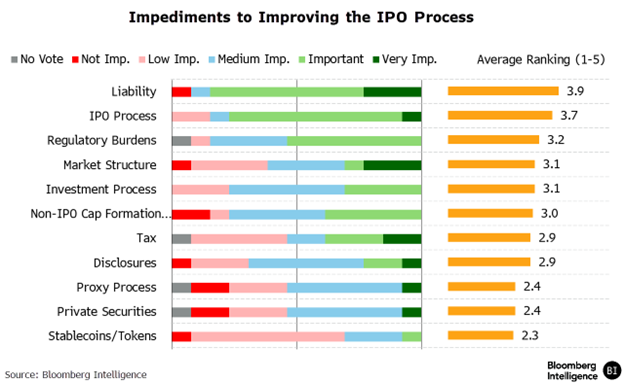
The focus of BI’s report revolves around market drivers and the interconnected roles of regulatory distortion, technological advances, structural evolution and corporate preferences, and what could be done to revitalize public listings.
The full Future of IPOs 2026 Outlook Deep Dive is available to Bloomberg Terminal subscribers who can access the report via {BI DEEP <GO>}.
Contact
Alaina Hay
Bloomberg Intelligence
ahay38@bloomberg.net
About Bloomberg Intelligence
Bloomberg Intelligence (BI) research delivers an independent perspective providing interactive data and investment research on over 2,000 companies, 135 industries and all global markets. Our team of over 400 research professionals help our clients make decisions with confidence in the rapidly moving investment landscape. BI analysis is backed by live, transparent data from Bloomberg and more than 600 third-party data contributors that clients can use to refine and support their ideas. Bloomberg Intelligence is available exclusively on the Bloomberg Terminal and the Bloomberg Professional App. Visit us at https://www.bloomberg.com/professional/product/bloomberg-intelligence/ or request a demo.
About Bloomberg
Bloomberg, the global business and financial information and news leader, gives influential decision makers a critical edge by connecting them to a dynamic network of information, people and ideas. The company’s strength – delivering data, news and analytics through innovative technology, quickly and accurately – is at the core of the Bloomberg Terminal. Bloomberg’s enterprise solutions build on the company’s core strength: leveraging technology to allow customers to access, integrate, distribute and manage data and information across organizations more efficiently and effectively. For more information, visit Bloomberg.com/company or request a demo.