
Bloomberg Professional Services
APAC Policy Series: Dialogue with SFC CEO Julia Leung
May 10th, 2023
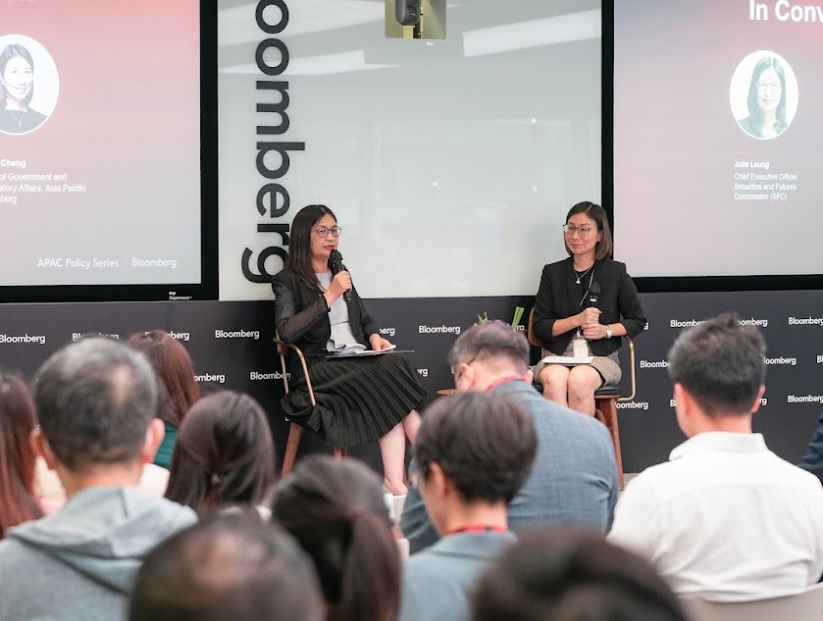
Julia Leung, CEO of SFC (left), in a conversation with Bloomberg’s Vicky Cheng (right)
Hong Kong – Bloomberg hosted its fourth APAC Policy Series event where Julia Leung, CEO of Hong Kong’s Securities and Futures Commission (SFC), spoke exclusively to Bloomberg clients for the first time since stepping into her new role. In this wide-ranging conversation, she discussed her immediate priorities and areas of key focus at the SFC, including fostering resilience and market integrity, enhancing Hong Kong’s competitiveness and embracing sustainability and innovation.
In her more than 25 years of public service, Julia has extensive experience in financial regulation, market development and international cooperation. Before joining the SFC in 2015, she was Under Secretary for Financial Services and the Treasury and also served at the Hong Kong Monetary Authority (HKMA) for 14 years. During her eight years as Executive Director at HKMA, she helped strengthen financial cooperation with Mainland and international regulators.
Four months into her new role as CEO of the SFC, Julia shared her thoughts in a dialogue with Vicky Cheng, Head of Government and Regulatory Affairs, Asia-Pacific, Bloomberg.
Fostering resilience and market integrity
Julia shared that the SFC remains vigilant in market surveillance and the monitoring of licensed corporations to ensure they have sufficient capital and liquidity buffers as well as sound risk management practices. The SFC has recently introduced the Investor Identification Regime in March 2023, which allows it to monitor investor behaviour and strengthens its ability to monitor concentration of positions. It has also looked very closely into the risk management measures of intermediaries and occasionally conducts stress-test exercises. She pointed out the regulator will soon conclude its risk management measures for futures contracts and will extend efforts to enhance the industry’s risk management.
Another priority is to maintain the quality and integrity of Hong Kong’s financial markets. Julia stressed that investor protection is the SFC’s core mandate. This requires the effective and targeted use of regulatory tools in order to mitigate the risk of market misconduct. She emphasised that the SFC maintains a steadfast “zero tolerance” approach to combatting crime and misconduct in the securities and futures markets.
Enhancing Hong Kong’s competitiveness
She noted that the SFC’s priorities are both relevant and critical to promoting high quality markets and attracting international investments. These in turn, will strengthen Hong Kong’s position as a premier international financial centre and an essential financial gateway to Mainland China.
A key part of the SFC’s strategy is to expand and enhance the many mutual market access schemes between Mainland China and Hong Kong by providing diverse products, services and currencies to regional and global investors. The expansion of Stock Connect, further relaxation of the Mutual Recognition of Funds scheme and the move towards Wealth Management Connect 2.0 are currently on the SFC’s agenda. She observed from her recent trips to Beijing that the SFC’s Mainland counterparts were keen to see more cross-border flows from international markets and that they are highly supportive of Hong Kong. She also expects the city’s role in connecting China and the rest of the world to be further expanded.
She added that, given the current geopolitical environment, it was crucial for Hong Kong to diversify its source of listings and capital (e.g. from the Middle East, Southeast Asia). To enhance Hong Kong’s position as a premier financial centre, the SFC will remain principle-based, predictable and rooted in the Securities and Futures Ordinance. She did, however, emphasise that the SFC must move with the times and identify new growth opportunities. For example, its listing regime was updated to facilitate the listing of biotech companies and, more recently, specialist technology companies. New economy companies have already become Hong Kong’s largest sector, accounting for 40% of total market capitalisation.
Embracing sustainability and innovation
When asked about her views on digital assets, Julia highlighted both the virtual asset trading platform (VATP) regime and sustainable finance are key emerging trends which transcend borders and require a global and coordinated response. She sees the VATP initiative as an important linchpin in the Web3 ecology and reiterated the SFC’s support for the underlying distributed ledger technology and responsible innovation. While she believes this new technology will benefit the financial industry tremendously in terms of efficiency, robustness and user experience, she warned of associated risks and highlighted the need to manage these risks properly.
On the global stage, the SFC has been taking the lead in key international work at both the International Organization of Securities Commissions (IOSCO) and the Financial Stability Board. For example, the SFC participates in the crypto and digital assets and decentralised finance workstreams under IOSCO’s Board-level Fintech Task Force. To mitigate regulatory arbitrage, the SFC is working with global counterparts to set a baseline of standards to regulate centralised virtual asset exchanges for adoption in major markets.
The SFC is also actively involved in sustainable finance efforts on local, regional and global levels. Julia said Hong Kong can play an important role in driving investments towards more sustainable decision-making, providing investors with consistent, comparable and decision-useful corporate information, to help combat greenwashing. In particular, she felt that HKEX’s April 2023 consultation on climate-related corporate reporting requirements was a major step towards aligning Hong Kong with the standards to be published by the International Sustainability Standards Board (ISSB) by June of this year. With 80% of the Hong Kong-listed companies from Mainland China, she emphasised these new standards should allow for scalability and flexibility without losing sight of ambition.
Julia also took the opportunity to announce the SFC’s own goal to achieve carbon neutrality before 2050 and its interim target to reduce its total emissions by 50% by 2030.
To watch the replay of the conversation, please visit the event registration page here. For more information about Bloomberg’s products and services, please visit https://www.bloomberg.com/professional/.