
Bloomberg Professional Services
Bloomberg co-hosts APAC Benchmark Regulation and Migration Forum with ISDA
May 30, 2019
Forum speakers report healthy progress in preparing markets for benchmarking alternatives to LIBOR, but time is running out
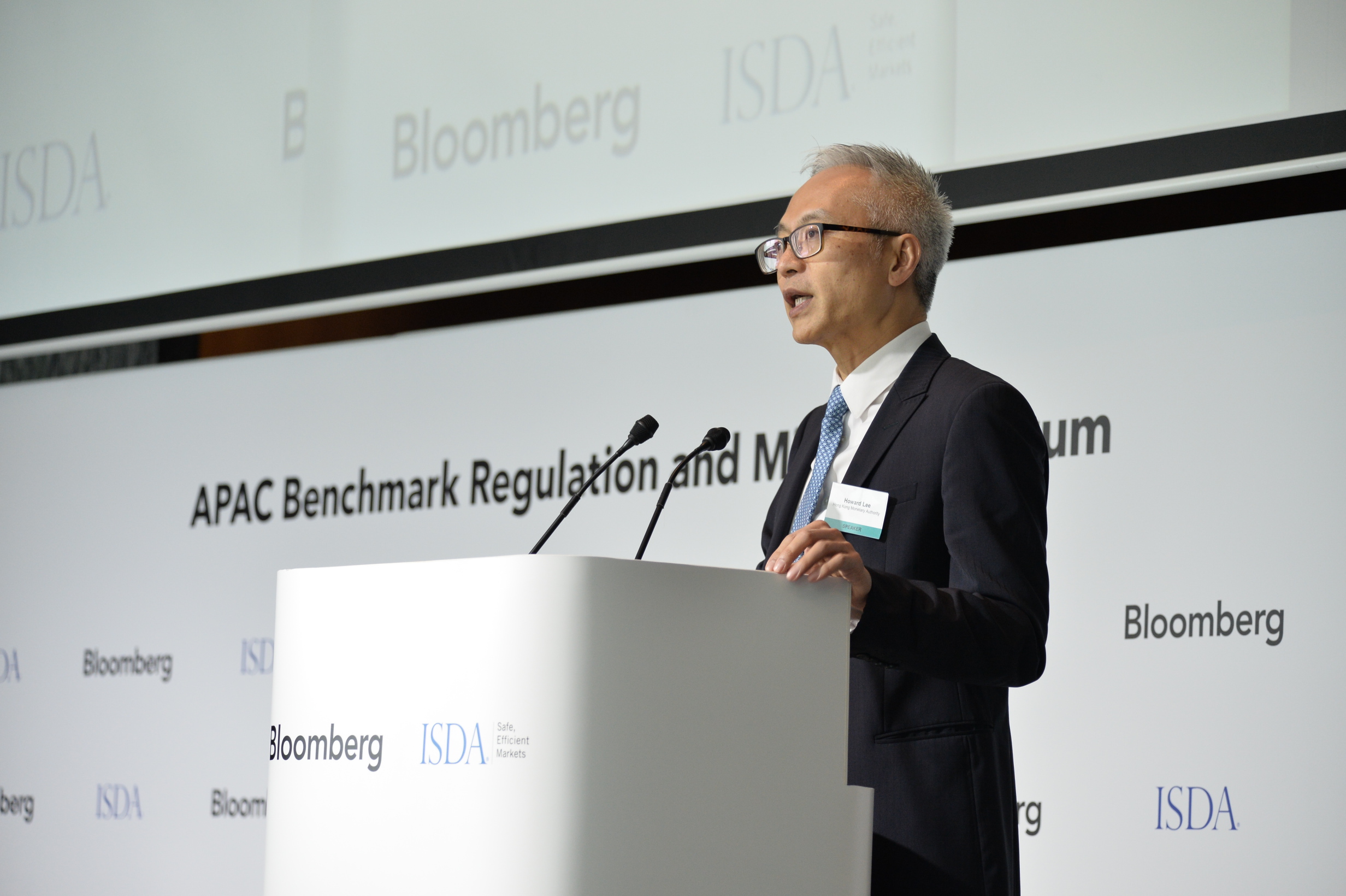
Howard Lee, Deputy Chief Executive of the Hong Kong Monetary Authority, delivering his keynote speech at the APAC Benchmark Regulation and Migration Forum
Bloomberg this week co-hosted its second annual APAC Benchmark Regulation and Migration Forum with the International Swaps and Derivatives Association (‘ISDA’) in Hong Kong to address how the world’s financial markets are preparing for its move away from benchmarking against LIBOR. The transition to alternative benchmarks is scheduled to take place in late 2021 and it is significant for Asia because of the outsized influence of the USD on Asian Rate markets.
Senior speakers from ISDA, the Hong Kong Monetary Authority as well as the Reserve Bank of Australia joined the forum with industry experts from banks and corporates to discuss what lay ahead during the transition period. Several panel discussions tackled infrastructure, migration and modelling issues as well as concerns over fallback provisions, liquidity during the transition and term structures.
“It is important that different market participants understand what the transition will mean for their business operations and how they should prepare for these changes,” said Howard Lee, Deputy Chief Executive of the Hong Kong Monetary Authority in his keynote speech. “This is something too important for any market participant to ignore and given the tremendous amount of preparatory work required to ensure a smooth transition, no one in the market can afford to play a waiting game.”
Read: The SOFR impact in Asia: Getting to know a new benchmark
Central bankers and regulatory bodies around the world, including in Asia Pacific, are urging the industry participants to prepare for this transition as it will require fundamental changes to market infrastructure requirements. Stakeholders in Asia have taken note of SOFR (Secured Overnight Financing Rate) introduced by the US Federal Reserve in 2018, but other central banks have begun to look to other alternative reference rates (ARR), such as London’s Sterling Overnight Interbank Average Rate (SONIA) and the EU’s ESTER (currently EONIA).
“With an estimated $370 trillion in notional exposure to the IBORs, this is an issue that affects all users of derivatives, in all sectors, in all jurisdictions,” said Scott O’Malia, ISDA Chief Executive, in his speech. “However, time is not on our side but the good news is that progress has been made. Ultimately, though, it comes down to everyone getting familiar with the new rates and starting to trade them. Given the uncertainty over LIBOR post-2021, our advice is not to leave this to the last minute.”
He added, “Ensure your firm has the systems and infrastructure in place to use these rates.”
Regulators and industry bodies present at the forum actively encouraged readiness as well as collaboration amongst stakeholders. Many countries and regional markets are starting transition plans early due to the substantial technology and infrastructure changes that are needed.
“There is no doubt that this transition is complex – but strong leadership and coordination, along with a rapid implementation of relevant technology will result in a much smoother transition,” said Taran Khera, Head of Asia-Pacific at Bloomberg. “Together with ISDA, we have been ensuring that the investment community in APAC understands the importance of this migration by hosting events such as these. Bloomberg already offers advanced technology to help manage risk and assess liquidity and we will continue to work with the industry to develop tools with a focus on enhancing capabilities for risk assessments.”
For more insights on what this means for your business please contact your Bloomberg representative or click here.